The Uniform (夜校女生, Chuang Ching-Shen, 2024)

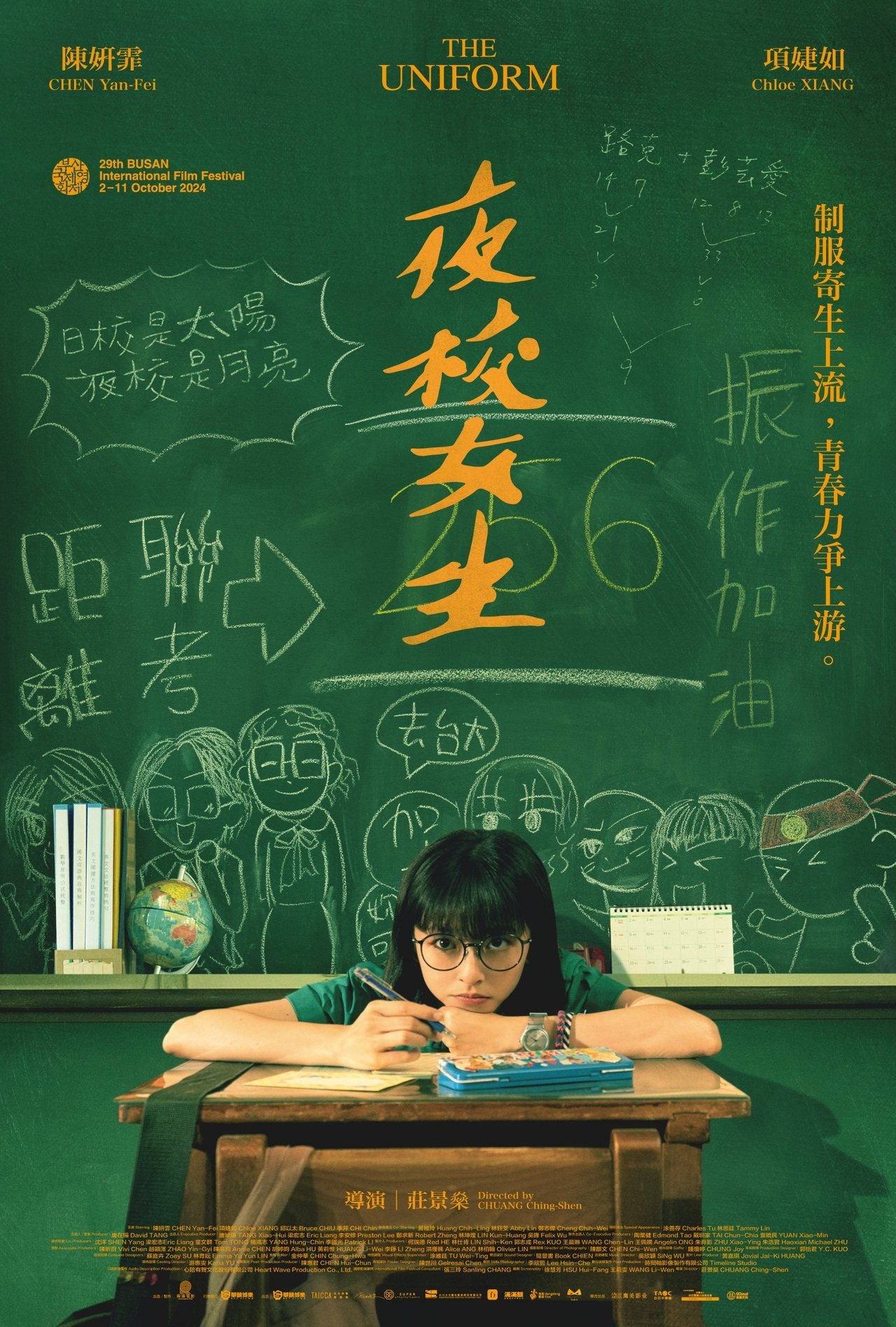
The problem for Ai (Buffy Chen Yan-fei) is that a minor difference in her uniform causes her to be treated differently. Set in the late ‘90s, Chuang Ching-Shen’s The Uniform (夜校女生, yèxiào nǚshēng) uses the school to examine the stratified nature of the contemporary Taiwanese society and the elitism that governs it. Having failed the main exam, Ai has won a place at a prestigious girls academy but been relegated to the “night school”. To maximise its efficiency, the school operates on a shift system with day pupils attending classes until 4.30pm and the night students taking over until 9. Though there isn’t supposed to be any difference between the two, the night students are treated as a kind of overflow intake and looked down on by the day pupils while some complain that they’re unfairly using up resources which should be theirs by right. 

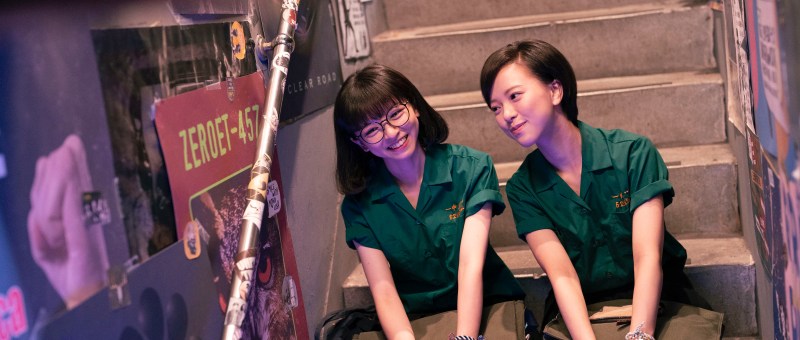
Despite the differences between them, Ai strikes up an unexpected friendship with a day student with whom she shares a desk, Min (Chloe Xiang Jie-ru). Shy and somewhat timid, Ai is taken by Min’s free spiritedness and often skips out on her classes to do fun things with her like going to a club to see Mayday before they were famous. Min, obviously, never misses out on her education and though she later reveals her own sense of insecurity in not feeling that she fits in at the school nor really deserves to be there, does not really understand Ai’s situation nor her own feelings of frustration and futility. Ai, meanwhile, is attracted by the upper-middle class atmosphere of the day pupils and increasingly embarrassed by her own more humble home life.

Ai’s father died in an accident and her mother runs a cram school out of their home. Ai’s mother (Chi Chin) is always trying to save money and picking up mismatched furniture for free, much to Ai’s annoyance, while Ai also does a series of part-time jobs including working at a ping pong club at the weekend though her mother doesn’t really want her doing sports because they’re unladylike and not all that useful for landing a place at a top university. The reason she sent her to the academy was to give her a leg up into what she sees as a conventionally successful life by getting a degree and finding a man with a professional job to marry. Ai’s resentment is partly provoked by this sense of being railroaded towards a future she might not want while at the same time facing tremendous pressure and afraid that in the end she won’t be able to measure up to her mother’s expectations. 

It’s at the ping pong club that she first meets Luke (Chiu Yi-tai), a handsome student from the elite boys’ school, and begins to strike up a relationship with him before Min tells her she likes him too. This ordinary teenage love triangle is coloured be class conflict in which Ai doubts she has the right to go after Luke because he is from a wealthy family, lying to him to cover up the fact that she and Min skip school by swapping their shirts which are embroidered in different colours for day and night students by claiming to be a pupil in the elite advanced class while hiding from him that she’s actually a night pupil. After beginning to suspect that Luke might actually like Ai, Min too begins to look down on her as if she thought that Ai were forgetting her place and has no right to date him because, unlike her, she is not his social equal. 

As for Luke himself, he’s actually rather bland and in part because his own life seems so easy because of his family’s wealth though he too later lets slip that he feels embarrassed by his parent’s apparently secret divorce and has only just begun to let go of the idea of them getting back together. For much of the film, it seems like he’s merely in the way of the relationship between the two girls which more successfully overcomes the barrier of class. After vicariously enjoying living Min’s lifestyle, Ai eventually comes to realisation that she and Luke are “not the same” and come from different worlds. He doesn’t really care about that, and seems to have become aware of his privilege abandoning a plan to get into university by competing in the maths olympiad and take the exam instead in the interests of “equality,” which is a well-meaning gesture but not really the bold act of egalitarianism he thinks it is even if also emphases his commitment to Ai in his willingness to break down class barriers that might otherwise work to his advantage.

As a means of denying her reality, Ai escapes through writing letters to Nicole Kidman with the help of a young man who speaks English and works in her aunt’s video store but is eventually jolted into adulthood by a more literal earthquake that reminds her how precious each of her relationships is and fragile the world around her. Through her various friendships, Ai comes to understand that almost everyone she knows also suffers with feelings of inferiority or a lack of confidence, weighed down by the pressure to achieve social success which might not be what they want anyway, but that they can overcome them together through understanding and mutual support that crosses class boundaries. Charmingly nostalgic, the film has a sense of hope for the future that it is indeed possible to achieve success on your own terms while prioritising your friendships and taking care of those around you.


The Uniform screens in Chicago 12th April as part of the 19th edition of Asian Pop-Up Cinema.

Trailer (English subtitles)

18×2 Beyond Youthful Days (青春18×2 君へと続く道, Michihito Fujii, 2024)

Screenshot

Apparently inspired by a real life viral blog, the latest from the prolific Michihito Fujii, 18×2 Beyond Youthful Days (青春18×2 君へと続く道, Seishun 18×2 Kimi e to Tsudzuku Michi) is in many ways in dialogue with Shunji Iwai’s Lover Letter which itself makes an appearance in the film in a allusion to a love that as the hero says never quite even began. Even so, the he, as the heroine had, undertakes a journey not so much to find himself as to recover the young man he once was before romantic heartbreak and professional strife left him emotionally numb and filled with despair.

Jimmy (Greg Hsu Kuang-han) says he’s on a journey with no destination, and perhaps, he is though it’s clear there is an end point in sight only one he’s reluctant to go to. It’s never quite clear to what extent the film intends its big reveal to be quite so obvious, though it seems clear enough that this is a tale of lost love and a circular journey towards a new beginning. After being kicked off the board at the games company he started, Jimmy catches sight of an old postcard soaked in the perfume of a girl he once new perhaps ironically called the flow of time. It does indeed call him back to the past, sending him on a trip to Japan where he too encounters various people who help him to reaffirm himself during a solo trip towards the nexus of his emotional pain.

Back in Tainan 18 years previously, he developed a crush on a young Japanese woman, Ami (Kaya Kiyohara), who rocked up at the karaoke bar he was working at the summer before uni and asked for a job having lost her wallet. Ami is four years older than him and perhaps sees his clumsy attempts at courtship as childish even as he earnestly brushes up his Japanese to be able to converse with her but otherwise treats him warmly if keeping him at arms length. In his own recollections, Jimmy was a clueless teenager who never really picked up on the pregnant hints Ami was leaving him in her sometimes cryptic comments and confusing behaviour but nevertheless went into a massive sulk on hearing she planned to return to Japan wasting precious time with her and almost ruining the memories of their tentative relationship by allowing it to end on a sour note.

The 36-year-old Jimmy is only a little wiser, a lonely, melancholy man who appeared to have little aside from the work that been taken away from him. This apparent mid-point of his life, a double 18 split in the middle, affords him the opportunity for self-reflection as many of those he meets along his way remind him. What he’s doing in a way is travelling on the flow of time, heading back into the past in order to travel through it and out the other side as he later says leaving this moment of youth behind to move into a more settled adulthood and an end to his frustrated inertia. 

As in Love Letter, he ends up deep in frosty snow country reflecting the emotional coolness of his adult self in contrast with the tropical temperatures of Tainan and sunniness of his memories of the summer with Ami. What he discovers is also a kind of love letter as yet undelivered but waiting for him at the destination he was afraid to approach as a kind of closure that will allow him to begin moving forward while carrying his memories with him rather than remaining trapped inside them. Reflecting that the people we meet along the way each leave something of themselves behind in our hearts, Jimmy is finally able to recognise himself and discover a way forward in reaccepting the memories of his summer that never quite blossomed into love as warm and comforting rather than the chilly sadness of the pure white vistas of snow country on Ami’s postcard. Travel doesn’t as much broaden his horizons as remove them, leaving him with an endless, meandering journey open to the possibilities of life and a spirit of adventure born of a lost but not forgotten love.


18×2 Beyond Youthful Days screened as part of this year’s Nippon Connection

Trailer (English subtitles)

The Silent Forest (無聲, Ko Chen-Nien, 2020)


There can be no justice in silence, but when those in a position to help refuse to listen what can be done? Inspired by true events, Ko Chen-Nien’s The Silent Forest (無聲, Wúshēng) takes aim at cycles of abuse and systems of oppression in society at large through a thorough investigation of the culture of silence at a school for deaf children in which endemic bullying spreads like a virus emanating from a single trauma inflicted by a negligent authority. Yet this kind of violence cannot be fought with violence and there must be empathy too for the bully or the chain will never end as Ko’s ambivalent conclusion makes clear. 

The film opens with a boy on the run, finally chasing down an old man and tackling him to the ground pummelling him until the police turn up and separate them. The policemen are frustrated. This is apparently the first time they’ve ever come into contact with a deaf person and have no idea how to communicate with him. Chang Cheng (Troy Liu Tzu-Chuan) tries to protest their injustice, but they continue to treat him as aggressor rather than victim even as he explains in writing that the old man had stolen his wallet (the old man claims he “found” it and was planning to hand it in). Finally a teacher from his new school, Mr. Wang (Liu Kuan-ting), turns up and interprets but it quickly becomes clear that he too is in a sense complicit, reporting that Cheng is sorry for what he did and grateful to the officers. In his view at least, the boy has his wallet back and there’s no harm done so why make a fuss? Just let it go and everyone goes home.

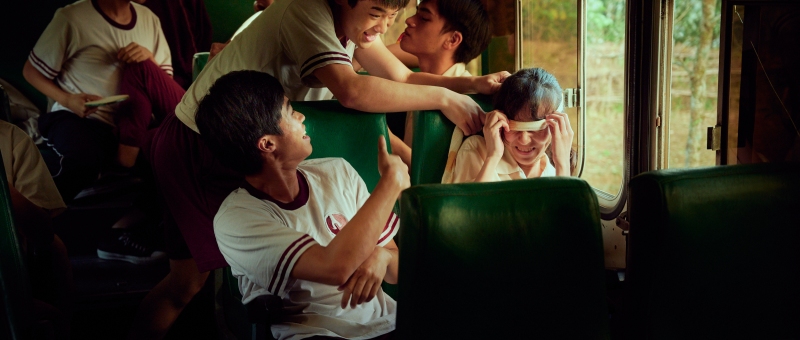
It’s this conflict between “silence” and justice that continues to prey upon Cheng’s mind after he starts at the school and becomes aware of the widespread culture of bullying witnessing a girl he likes being sexually abused by a gang of boys at the back of the school bus while the teacher sitting at the front does nothing. He tries to convince the girl, Beibei (Buffy Chen Yan-Fei), to tell one of the other teachers but she refuses, not wanting to “betray” her “friends”, insisting they were “just playing around”. Her reluctance however mainly stems from an intense fear of being sent away, that she might have to leave the school which is the only place she feels accepted. Both she and Cheng feel intensely othered in the hearing world, wary of being blamed for things that weren’t their fault as if their very existence were bothersome or “abnormal”. Even if it means putting up with extreme degradation, she would prefer it to the loneliness she felt before she found the school.

Yet the sense of social isolation is only one of the various oppressions to be found at the institution which ironically cultivates a culture of silence as regards the ongoing abuse as a means of preserving its reputation and therefore the “greater good” in providing the “safe space” from the social stigma the children face in the hearing world. Beibei points out that she was screaming, yet nobody could hear her. At first she tried to tell a teacher, but the teacher blamed it on her and implicitly on her disability insisting that the boys were “good kids” who were “just playing around” and didn’t understand she didn’t like it because she failed to communicate that she was uncomfortable. If they knew she was suffering they’d have stopped, the teacher insists before coldly walking away. Mr. Wang feels quite differently and wants to help but discovers that the culture of silence extends much deeper than he thought and the problem most likely cannot be solved through a few simple countermeasures but requires whole-scale systemic reform.

In fact, very little is done by the authorities leaving Chang Cheng with a hero complex believing that he has to be strong to beat the bad guys and save Beibei, but his righteous desire still leads him back towards complicity in order to protect her. The arch antagonist, Xiao Guang (Kim Hyun-Bin), bullies as a defence mechanism insisting that no one would dare bully him, manipulating others to do his bidding through the same mentality that one can either be a bully or a victim. Yet Xiao Guang is also a victim himself, a wounded damaged boy let down by a culture ruled by shame and unable to defend himself by any other means though apparently uniquely vulnerable to one particular aggressor. Only by addressing the root of his trauma can the cycle be brought to an end, but the concurrent cycles which he set in motion will in turn require their own resolution. A painful allegory, The Silent Forest boldly makes the case for speaking out but also admits that it doesn’t matter how loud you shout if no one is listening and without the desire for empathy and communication in all its forms the cycles will grow and repeat until the end of time.


The Silent Forest streams in Illinois until March 21 as part of the 12th season of Asian Pop-Up Cinema.

Original trailer (English subtitles)