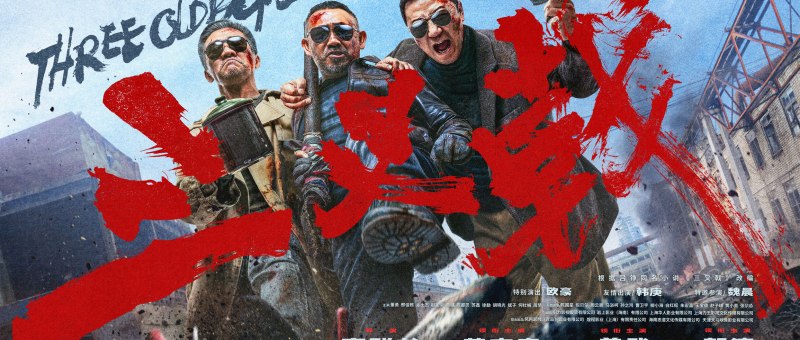
Three Old Boys (三叉戟, Gao Qunshu, 2024)

In a surprising development of Chinese propaganda cinema, the once untouchable subject of police corruption has become a prominent feature albeit often in tales of righteous cops who stand up for real justice against the few bad apples who’ve allowed themselves to be corrupted by contemporary capitalism. Then again, its subject matter might explain why TV police procedural veteran Gao Qunshu’s Three Old Boys (三叉戟, sānchājǐ) has been languishing on the shelf since at least 2020 if it were not also for the inevitable effects of the pandemic. 

In any case, Gao’s film has a distinctly retro vibe with use of classic Chinese pop and very ‘70s soundtrack while its maverick cop heroes all dress in the fashions of 40 years previously. All born in the late 1960s, they are products of an even more authoritarian era and began their careers in the late 1980s. Like any other old cop movie, they bemoan the restrictions of the contemporary society and suggest modern notions of appropriate police behaviour prevent them from doing their jobs which has its degree of awkwardness on the one hand implying the modern police force is now not so hardline but also that it should be because that’s what gets the job done. 

As they contemplate retirement, the trio are offered positions as part of a new squad set up to tackle economic crimes and specifically international money laundering, the chief problem with being that the criminals had the effrontery to move the money out of China which is stealing from honest, hardworking, Chinese citizens aside from having already ripped them off with fraudulent investment schemes and good old-fashioned blackmail operations. Of course, as it turns out, the case has a connection to something that happened 20 years earlier and police officer Cui’s (Huang Zhizhong) desire for revenge on the gangster king pin, Huang Youfa (Jin Shijie), who caused the death of his younger brother murdered by gangster Donzgi who was then shot dead by fellow officer Big G (Jiang Wu). 

The convoluted narrative is heralded by a homeless man who takes the police chief hostage and mutters something about a sword of justice that sounds like something right out of a wuxia serial before being updated to the present day. The sword does actually make a reappearance and is wielded by Big G against a young whippersnapper out for revenge and to take care of what he sees as corruption in the earlier generation. When the trio are first put on the case, they are given a young rookie to help them because he’ll be able to do the tech stuff which the old guys probably can’t because their idea of policing was largely rooted in their fists and a capacity for intimidation. But this doesn’t really work with the youth of today who are for some reason fond of reminding them they aren’t their fathers so they don’t have to do what they say. This is particularly true of young thug Blondie who is caught between Ghost, the old gangster king, and Qing an upstart who is actually working for Huang but in pursuit of his own particular goals. 

Huang has his claws well and truly embedded in the modern society and has it seems manoeuvred favourable people into the police force ensuring that Cui and his team are neutered before they get the chance to do anything. Then again, Big G seems to have a very co-dependent relationship with Ghost who tells Blondie off for getting into a fight with him because cops are off limits. Nevertheless, the point is to dismantle Huang’s networks of influence to restore the integrity of the police force so they can enforce the law which exists for the protection of the people. It’s all rather confusing, but generally lightened by the intense action sequences designed by Yoo Sang-Seob which are also suitably retro but make good use of sword play along with a motorcycle chase. Perhaps ironically inspired by Hollywood hero cop dramas, the film ends with a regime change and a new photo being taken of the guys in their more modern uniforms receiving a commendation with the clear indication that something has been put to rest and the rebellion suggested by Qing’s attempt to steal power from the old quelled while the old boys seemingly decide that justice requires they put off their retirement just a little longer.


International trailer (English subtitles)
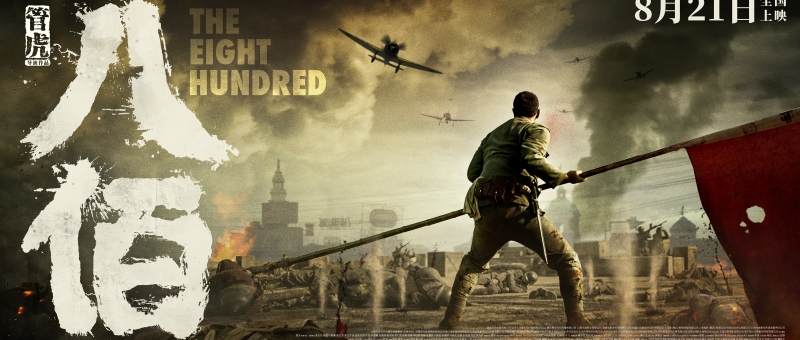
The Eight Hundred (八佰, Guan Hu, 2020)

“Enjoy Shanghai. Enjoy Your Life” reads a neon-lit sign in the art deco paradise of Shanghai in the 1930s. Across the river, however, a war is raging. Guan Hu’s The Eight Hundred (八佰, Bābǎi), the first Chinese film to be shot in IMAX and boasting an unprecedented budget of US$80 million, was the last in a series of movies to be ignominiously pulled from a festival slot, the opening night of the Shanghai International Film Festival no less, for “technical reasons”. In this case, most have interpreted the nebulous term as a squeamishness on the part of the censors’ board to the fact that the film celebrates the heroism not of the PLA but of Chiang Kai-shek’s Nationalist Revolutionary Army who put up the last stand during the fall of Shanghai, securing a warehouse on the opposite side of the river from the British Concession knowing that there was no hope of stopping the Japanese, but hoping that their defiance would inspire foreign powers over to the Chinese side. 

The action opens in October 1937 shortly after the outbreak of the second Sino-Japanese War. Shanghai is falling and the Japanese will soon be on their way towards Chiang’s capital, Nanking. Nevertheless, the Japanese have resolutely avoided encroachment into the foreign concessions for fear of inflaming international relations in ways which might be inexpedient for their current goals. As a diplomat later puts it, war is always a matter of politics. Ordered to hold the line, the last remnants of the NRA are expected to die as an act of political theatre. There is no practical benefit to their sacrifice save the vindication that they went down fighting, their moral righteousness a tool to garner sympathy firstly with the international community who might be persuaded to intervene at an upcoming conference in Brussels (which is finally postponed because of a corruption scandal engulfing the Belgian PM). 

In Guan’s retelling, however, it is a much more domestic audience which becomes the ultimate target. A contrast is repeatedly drawn between behind the lines China, a wasteland of fire and rubble, and the glittering lights of the foreign concession with its billboards for Hollywood movies, famous actresses surveying the scene while the sound of opera both domestic and Western wafts over the river and business carries on as normal in the large casino run by an eccentric short-haired madam dressed in a Western suit. Cynical journalists chase the story from the comparative safety of a balcony above the bridge, chiding the Chinese reporter, Fang (Xin Baiqing), who has also been working as an interpreter for the Japanese, that he acts as if this war is nothing at all to do with him. The heroism of the 800 is the key to unlocking the latent patriotism of those living in the dream of the foreign concession where war happens only across the water, in another world no more real to them than a movie. They stand by the water and they watch, increasingly grateful to the soldiers for their protection until they too remember that they are also Chinese and this war is also their war. Women extend their hands towards those retreating across the bridge while the Peking opera turns its drums to the rhythms of war and the casino madam gives up first a flag and then a large stash of morphine hidden in her safe for probably obvious reasons. 

The flag might be one of several explanations for the censors’ squeamishness in that it is obviously now the flag of Taiwan and reminds us that these men are members of Chiang Kai-shek’s NRA, more often characterised in ideological terms as traitors rather than heroes. They are not however saints in the propaganda movie mould and it is even perhaps suggested that they are not much better than the Japanese, ruthlessly executing their own men as deserters and using prisoners of war as target practice for untrained, nervous recruits (the Japanese meanwhile publicly dismember their prisoners with the intention of intimidating Chinese forces). The youngest of the soldiers is only 13, a farmer’s son pulled off his land with his older brother who was tricked into the war machine by the desire to see the shining city of Shanghai and perhaps travel to England. Some of them try to run, torn between the desire for escape and a responsibility to their fellow men, each eventually fully committed to their forlorn hope determined to hold the warehouse if only to prove that they held the line for as long as it could be held. 

That same diplomat encourages commander Colonel Xie (Du Chun) that what he does here will be remembered, and that his men are the “real Chinese people” in another statement that probably rankled with the censors. Repeated references to legendary general Guan Yu paradoxically link back to the contemporary context as the narrator of a shadow play echoes that the Han restoration rests with the young while an angry soldier rants about planting a flag on Mount Fuji as revenge for everything they’ve suffered, making the case for the resurgent China beholden to no one something echoed by the moving scenes juxtaposing the ruined warehouse with the ultramodern city which now surrounds it. Yet Guan opens with a peaceful image of pastoral serenity which stands in stark contrast to the chaos of war as his numbed camera slowly pans between one scene of carnage and the next. Men blow themselves up, cry out for their mothers, send letters home, and call out their names as they die to prove that they existed while a beautiful white horse runs wild in the vistas of desolation. Unashamedly patriotic despite its slightly subversive context, The Eight Hundred presents war as the meaningless chaos that it is, but also lionises the men who fought it in the mythic quality of their heroism as they alone stood their ground and finally convinced others to do the same.


The Eight Hundred is in UK Cinemas from 16th September courtesy of Cine Asia.

UK trailer (English subtitles)

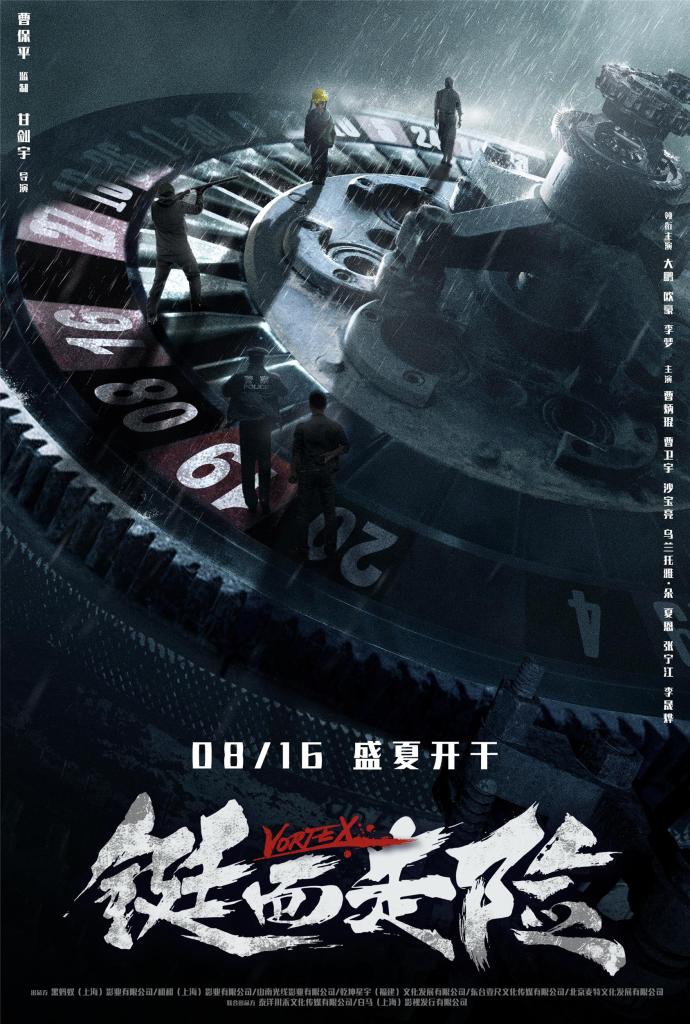
Vortex (铤而走险, Jacky Gan Jianyu, 2019)

“Only with money are you treated like a person” according to cynical gangster Xia Tao, another embattled soul turning to the dark side to try and survive after multiple betrayals in a cruel and unforgiving society. Anchored by a standout performance from comedian Da Peng in a rare dramatic role, Vortex (铤而走险, Tǐng’érzǒuxiǎn) sees one feckless young man falling into a web of criminality after succumbing to the temptation of an easy fix to all his problems. As he and others will discover, however, actions have consequences and there are no victimless crimes. 

Liu Xiaojun (Da Peng) is an embittered young(ish) man left orphaned and resentful after his policeman father died on the job. Nominally a mechanic with his own repair shop he also has a self-destructive gambling problem that’s left him deep in debt to local mobsters. He tries to hit up an old friend, Brother Wan (Cao Bingkun), recently released from prison, but he offers him a job rather than money, explaining that it’s only crime adjacent not actually illegal. All he has to do is drive unregistered cars back to the depot where Wan can resell them, and he’ll get 10,000 a pop. Xiaojun isn’t really into crime so he’s reluctant to take Wan up on his offer, trying his policeman uncle (Cao Weiyu) for yet another loan instead, but when he blows that too in reckless gambling he realises he has no other choice. The plan goes badly wrong, however, when the car Xiaojun is supposed to pick up turns out to be occupied and he finds himself in a fight with the Xia brothers. He manages to get it back to the depot but there’s another problem. The car was carrying cargo, a little girl, Qiqi (Audrey Duo / Doo Ulantoya), hidden in the boot apparently at the centre of a kidnapping plot. 

Xiaojun wants to call the police, but Wan is against it. He urges him to dump Qiqi somewhere and hope the authorities find and return her to her parents, but Xiaojun finds himself keeping the little girl. When Qiqi’s frantic mother calls the cellphone that was left in the car he realises she’s worth around two million and it’s too good an opportunity to pass up. After all, it’s a win/win. Xiaojun isn’t going to hurt Qiqi like the kidnappers might so he’s keeping her safe and he gets to pocket the money in return. 

So begins his series of moral justifications for the vortex of crime that began with his decision to drive the car for Wan which was itself caused by his gambling problem and addiction to quick fix solutions. Later, we can see that his self-destructive streak is a kind of despair, an act of self-harm taken in revenge against the unfairness of losing his father who apparently did everything right but paid a heavy price in attempting to serve justice. Xiaojun unfairly blames his uncle for failing to save his dad in choosing to do his job as a policeman and fiercely resists his well-meaning, paternal attempts to save him from his life of crime adjacent activity, but later perhaps comes to understand after unwisely becoming involved in the kidnapping plot, bonding with the innocent Qiqi, and then bitterly regretting his foolishness in placing her in danger to chase the money. 

Yet money, as Xia Tao (Sha Baoliang) says, is only thing that counts and you’re nothing without it. Xia Tao too turned to crime following parental betrayal, no longer seeing the point in playing by the rules if all it gets you is a lifetime of righteous suffering. Wan’s bar hostess friend, Zhao Qian (Li Meng), seems to be mixed up in the plot too though as her role becomes clear we realise that she has also succumbed to a quick fix solution out of desperation, trying to save a man she loves but later describes as “only a friend” by resorting to desperate measures to ensure he gets a life saving operation. Even little Qiqi seems to feel betrayed by mum and dad, answering Xiaojun’s question about who she thinks loves her more with a sad “neither”, while asking not to be returned to her mother because she’s been stopping her seeing her father and she misses him.  

As we later find out, there might be quite a good reason for that which Qiqi is too young to understand, but still she wants to try and find him and seems cheerful enough with Xiaojun while he says he’ll help her. Until then, Xiaojun becomes an awkward paternal presence, touched by Qiqi’s earnestness and lost in a moral quagmire trying to work out where the best place to send her might be while still hoping to get his hands on the cash. Redeeming himself by, in a sense, paying the ransom by deciding to prioritise saving Qiqi from the Xia brothers, Xiaojun begins to extricate himself from the vortex of crime, rediscovering a more positive paternal presence of his own in forgiving uncle Wang and his own father in coming to an understanding of their choices through being forced to make his own. A minor condemnation of the modern China’s wealth obsession and growing social inequality, Vortex finds its villains less villainous than one might expect, succumbing to the slippery slope of criminality in desperation and a sense of abandonment in a society which seems content to leave them behind.


Vortex is represented by Fortissimo Films.

International Trailer (English subtitles)