I WeirDO (怪胎, Liao Ming-Yi, 2020) [Fantasia 2020]

Being in love can be a little like a sickness, but what happens when the spell wears off? A meditation on fatal attraction syndrome and the duplicitous delusions of “normality’, Liao Ming-Yi’s charming romance I WeirDo (怪胎, Guàitāi) arrives at the most opportune moment in which we’re all “weirdos” now, stuck at home obsessively washing our hands and dutifully remaining “alert” as we disinfect everything we see. Liao’s PPE-clad heroes find love in shared anxiety, but happiness is the enemy of fear and the things that brought you together may in the end drive you apart.

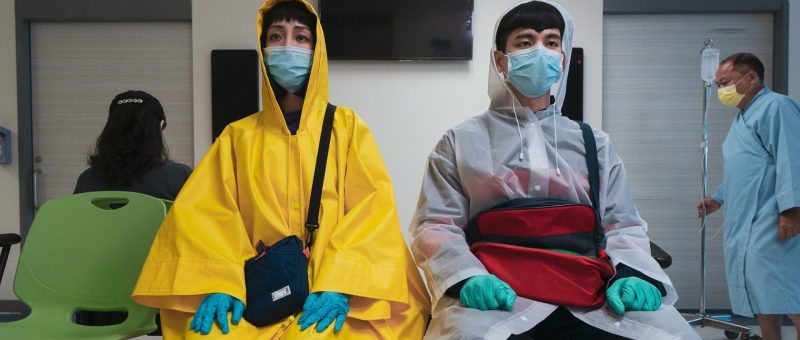
Chen Po-ching (Austin Lin Bo-hong) is somehow able to afford a spacious two-level home working as a full-time literary translator despite the fact it takes him ages because he’s unable to type. A sufferer of severe OCD, he lives by strict routine and is deathly afraid of germs. For most of his life he simply remains at home, but on the 15th of every month he dons full body PPE and braves the outside to pay his bills, do his shopping, and visit a doctor he hopes can help him beat the condition but only gives him mysterious medication which doesn’t seem to make much difference. His life changes one particular 15th when he spots a woman dressed much like himself who is also headed to the supermarket where she shoplifts a bar of chocolate and buys up the remaining stocks of his favourite disinfectant. Chen Ching (Nikki Hsieh Hsin-Ying), as she later gives her name, approaches him to make sure he’s not going to dob her in about the chocolate which she doesn’t even like, it’s just a compulsion. She suffers from OCD too along with a skin allergy that means she’s not supposed to spend a lot of time outdoors. 

Love eventually blossoms. Ching opens up Po-ching’s world, conspiratorially involving him in her shoplifting and inviting him to visit her at work as a life model for a drawing class where she’s asked to pose like a fallen angel with broken wings. They go on weird “dates” taking germ challenges like eating at tiny eateries with questionable hygiene standards and picking up rubbish before Po-ching realises that going “out” so much is placing a strain on Ching’s health so he proposes she move in with him. Luckily she’s an ace typist so she can help with his work as well as the intensive cleaning regime he already has in place. What they’ve made is a blissful world of two, isolated from the confusing pollution of regular society. But paradise can also be a cage, and it’s natural enough to long for freedom. Before long a problematic pigeon and a loitering lizard have them each pondering life in the outside.  

Opening in a boxy, claustrophobic square, Liao eventually swaps narrators and switches to a comparatively open widescreen as horizons quite literally expand, a development which introduces, ironically, a new but distinctly unhelpful anxiety into a relationship both apparently hoped would be unchanging. The couple’s OCD struggles become a stand-in for the giddy obsession of new love as they cocoon themselves happily within their romantic bubble only for the magic to inevitably begin wearing off. Despite all they have in common, the pair have an ideological mismatch. She actively craves their difference, believing OCD is a gift that allows them to lead unique lives, but he secretly yearns for “normality”, to be cured and become a “normal” person living a “normal” life. She’s for staying in, he’s for going out. “Why do we have to be the weirdos?” Ching asks Po-ching seconds after revealing suicidal tendencies. He tells her he’s never given it too much thought. His OCD simply is, it can’t be changed, so he just accepted it. But change, which is of course what they most fear, eventually comes, paradoxically because when you’re “happy” and you feel accepted perhaps you don’t need so much obsessive control over your life. 

Liao undercuts the darker side of a life ruled by intense anxiety through whimsical production design adding a touch of fairytale glamour to the sad romance of the two similarly named protagonists falling in love in an uncertain world. Shot entirely on iPhone, the cinematography is unexpectedly rich and innovative, handsome even in its immediacy and like the protagonists embracing its limitations with wit and charm. Perfectly tailored for the post-corona world, I WeirDo wants to ask us if love can survive our fear of change or if our intense need for control over our lives robs us of the ability to live, if being “normal” is worth the price of love, and if there’s really anything wrong with being a “weirdo” especially if you find someone to be a weirdo with. Po-ching and Ching are still figuring it out, but aren’t we all even in these admittedly strange times? 


I WeirDO streamed as part of this year’s online edition of Fantasia International Film Festival.

Original trailer (English subtitles)

The Laundryman (青田街一號, Lee Chung, 2015)

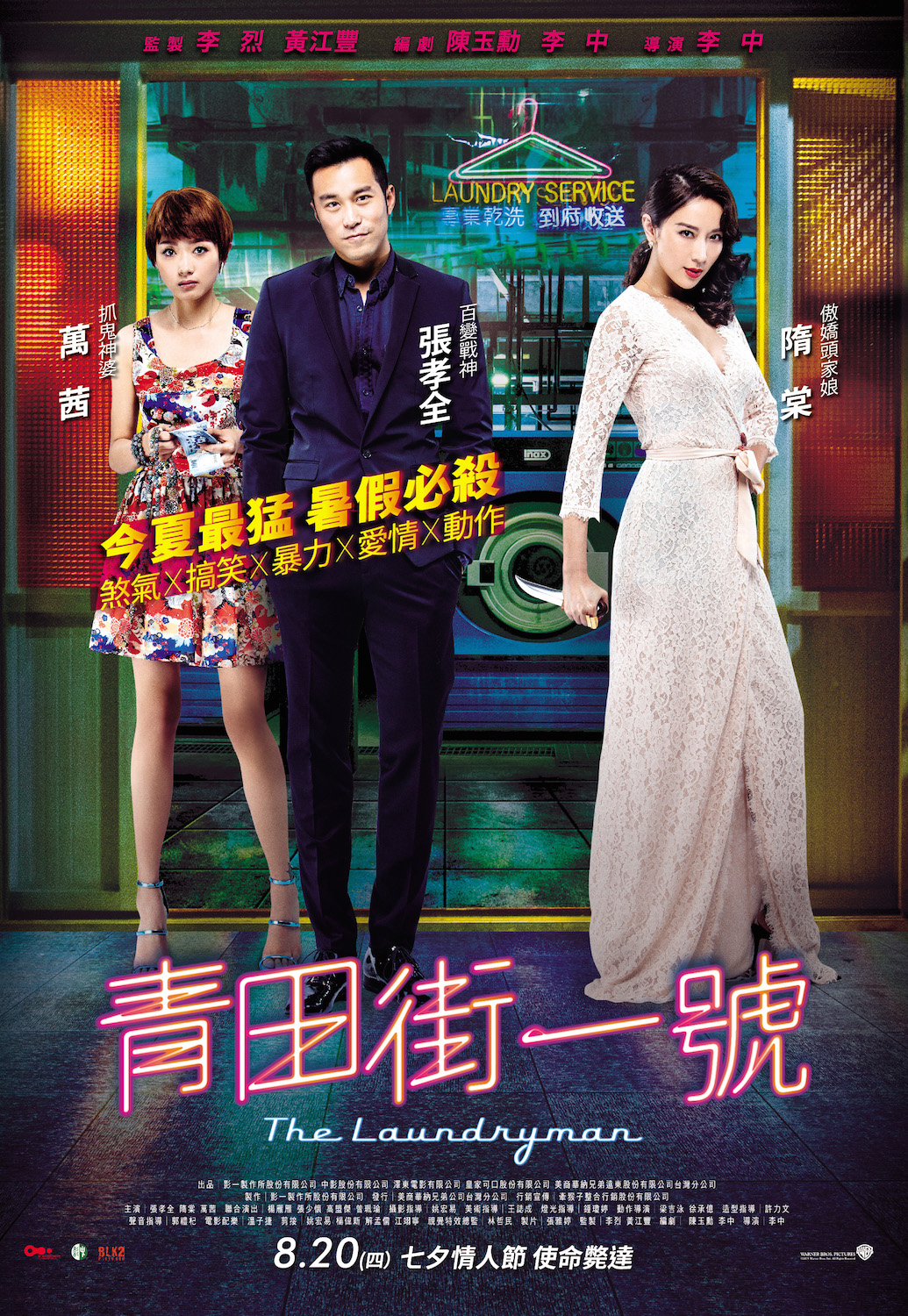
青田街一號_主海報A_直式_有贊助_OLCould you, should you, attempt to wash away life’s “stains” by erasing them? The hero of Lee Chung’s The Laundryman (青田街一號, Qīngtián J Yīhào) is engaged with just that in his clandestine occupation in which he works as a kind of “cleaner”, smoothing the wrinkles out of life’s little problems for the monied and unscrupulous. Yet he finds himself “haunted” by his crimes, accused by those he so casually dispatched without asking why, and eventually forced into a reexamination of his life and work.

Known only by the cryptic codename “No. 1, Chingtian Street” (Joseph Chang Hsiao-chuan), our hitman is one of many working for the mysterious A-gu (Sonia Sui Tang) at her family laundry which she runs as a cover for her stable of assassins, claiming that they merely clean the stains from people’s lives rather than their clothes. A-gu’s methods are complex and exacting. Picking up concerned citizens in the street, she guides them towards her services before Chingtian or one of his colleagues inserts themselves into their target’s daily routine, knocks them off in a quiet sort of way, then brings the body “home” to be “laundered”.

The snag is that Chingtian has recently become plagued by the spirits of those he’s killed. Three of them, to be exact (and an extra one he didn’t off but has started following him anyway). Traditional therapy proving no help, A-gu sends Chingtian off to see Lin (Regina Wan Qian), a pretty psychic, despite affirming that all of this is some weird thing going on with Chingtian’s head rather than genuine paranormal activity. Lin, spotting his ghostly followers right away, explains to Chingtian that they most likely have unfinished business – i.e. finding out who wanted them dead and why. There is, however, a little more to it than that as a further trail of death begins to linger behind Chingtian that leads back to a dark and repressed memory of his youth.

Despite its whimsical tone, Lee’s drama leans heavily into the darkness in asking why it is someone might decide to pay to have someone else killed. The answers aren’t the ones you’re expecting. No business disputes or political machinations, only frustrated loves and loneliness. A nerdy young loner falls for the larger lady from next-door and is horrified to realise that her boyfriend beats her to the point at which she has begun to consider suicide as a means of escape. He wants to save her, and after all the world might be “better off” without the violent boyfriend, so he gives in to A-gu’s alluring offer to have the guy offed (for a small fee). Meanwhile, another mark decided on his course of action out of an excess of love, or to put it more pointedly, its dark side as he became increasingly convinced he could not live up to its expectation and determined to free himself of the burden, damning himself further into a downward spiral of self-destructive humiliation.

A-gu’s life philosophies lean to towards the callous with all her talk of “cleaning” and affirmations that “useless people should be destroyed”, but as Lin points out it’s quite something else to bump off a lovely older couple – some might even call it heartless. Heartless is what Chingtian has been raised to be, so his recently reawakened humanity is quite a problem. Caught between A-gu who alternates between something like possessive mother and femme fatale (which is just as strange a dynamic as it sounds), the pixyish Lin, and later the dogged policewoman Yang (Yeo Yann Yann) who’s picked up on a trail set down for her to find but followed it further than intended, Chingtian is forced to confront himself and his past, in a sense putting his psyche on a spin cycle to reverse a lifetime’s worth of brainwashing and remember who it is he really is.

Strangely warm and fuzzy, Lee’s whimsical world of colour is a perfect mix of film noir fatalism and fairytale promise as Chingtian walks a precarious path towards reintegration of his personality while trying a fair few others on for size. The childlike silliness of an anti-ghost musical number mingles with the hard edged kung fu of a violent procedural but Lee never loses his sense of cartoonish fun even as Chingtian begins to find his answers and with them a clue to inner darknesses personal and otherwise.


Currently available to stream in the UK (and possibly other territories) via Amazon Prime Video.

International trailer (English subtitles)

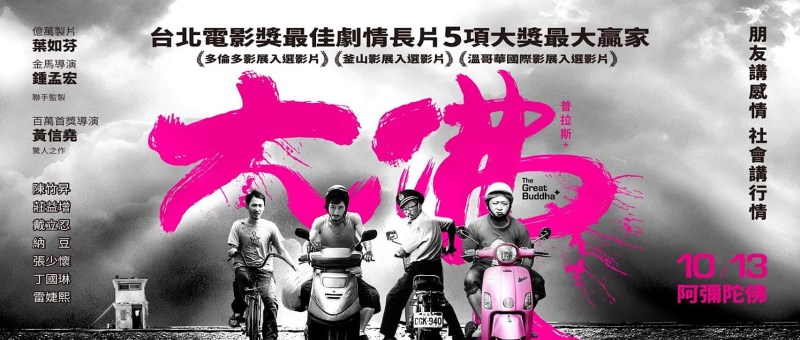
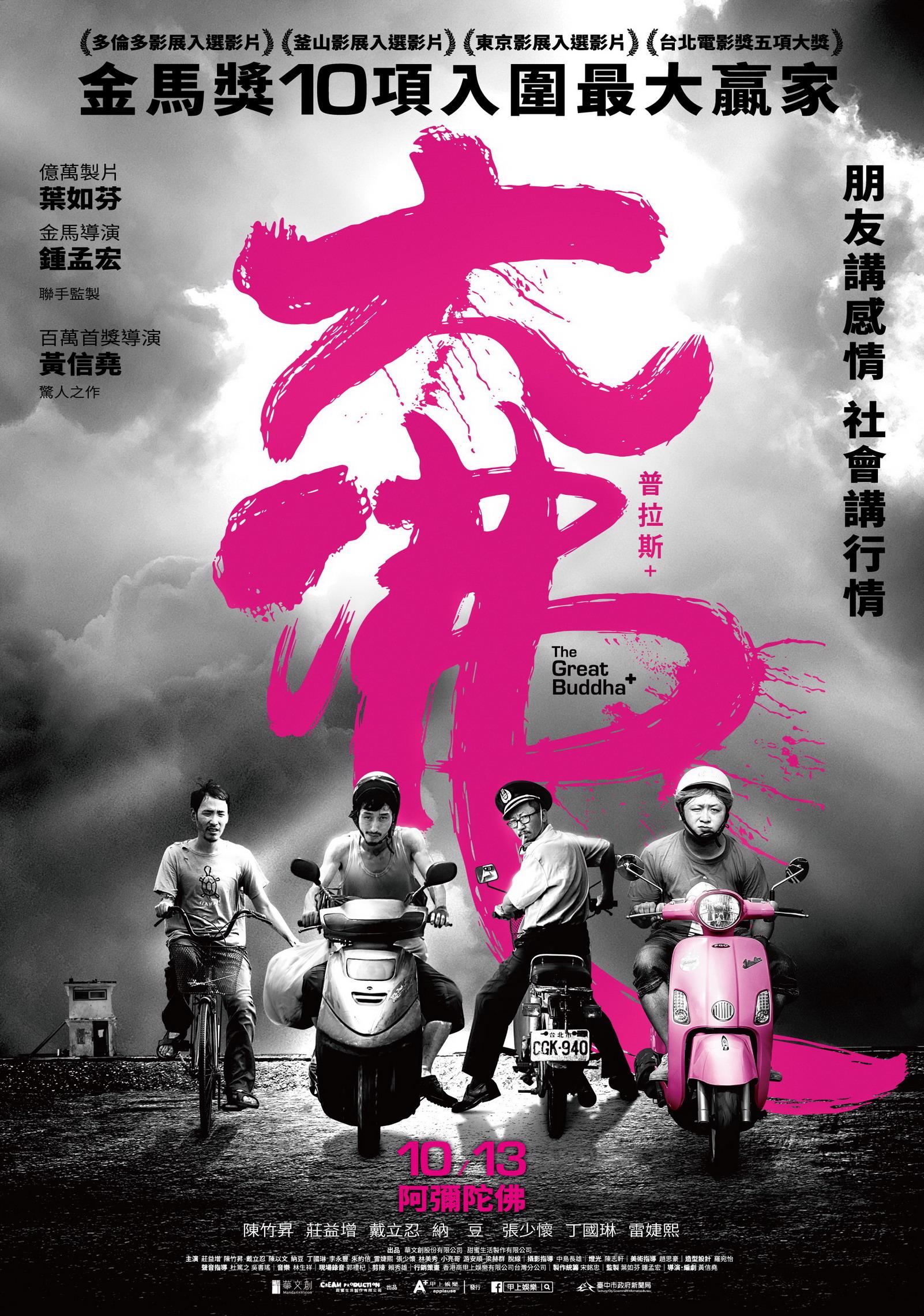
The Great Buddha+ (大佛普拉斯, Huang Hsin-yao, 2017)

Great Buddha + posterFor some, the good life always seems a little out of reach, as if they showed up late to the great buffet of life and now all that’s left is a few soggy pastries and the salad someone’s aunt brings every year that no one really likes. Still, even if you know this is all there is, it doesn’t have to be so bad so long as you have good friends and something to do every day. The “heroes” of documentarian Huang Hsin-yao’s fiction feature debut The Great Buddha+ (大佛普拉斯, Dà fó pǔ lā sī) are exactly this sort – men in late middle age who’ve never quite grown up but have eased into a perpetual boyhood safe in the knowledge that there’s nowhere left for them to grow up to.

“Pickle” (Cres Chuang) is something of a holy fool. His major preoccupation in life is his elderly mother whose increasing medical bills he is continually worrying about paying. He’s taken to banging a drum in a local marching band with a big line in funerals for extra money at which he is terrible but seeing as there’s no one else his job is probably safe for the minute. His “occupation” is nightwatchman at a factory owned by “Kevin” (Leon Dai) – a renowned sculptor working on a giant Buddha statue. Nothing ever happens at the factory at night so no one is very bothered what Pickle does there, which is mostly being “entertained” by his “best friend” Belly Button (Bamboo Chen). Belly Button doesn’t really have a job but earns money through collecting recyclables and selling them on. Looking for a new source of vicarious fun, Belly Button talks Pickle into stealing the SD card from the dash cam on Kevin’s fancy car so they can enjoy riding along with him in their very own private sim. This turns out to be more fun than expected because Kevin is also a womaniser with a thing for car sex even if the cam only captures the audio of his exploits. Nevertheless, the guys inevitably end up seeing something they shouldn’t.

Huang shoots in black and white but switches to vibrant colour for the dash cam footage, somehow implying that nothing is quite so real to guys like Pickle and Belly Button as a fantasy vision of someone else’s glamorous life. After all, if it’s not online it didn’t really happen. Trapped in the gutter of small town life, both men have either failed to move on from or wilfully regressed into a perpetual adolescence in which they waste their days idly on pointless pursuits – leafing through ancient porn mags, gossiping, and eating half frozen curries from half-filled Tupperware boxes. A mild mannered man, Pickle is so innocent that he never quite understands Belly Button’s lewd jokes while Belly Button, who is picked on and belittled by everyone else in town, takes delight in being able to boss him around.

Together the pair of them can only marvel at a man like Kevin with his wealth and talent which allows him to gain the thing they want the most – female company. Kevin, however, is not quite as marvellous as they might assume him to be even if they remain in awe of his caddish treatment of women while perhaps feeling sorry for those unfortunate enough to fall in love with him. In tight with the local bigwigs, Kevin is simply one link in a long chain of bureaucratic corruption in which business is done in the bathhouse surrounded by floozies. Kevin never explicitly lets on whether he knows that Pickle and Belly Button have stumbled on his secret, but their lives begin to change all the same. Their easy nights in the security cabin have gone for good and they feel themselves under threat in a chilling reminder of how easily a little guy can disappear or fall victim to an accident after asking too many questions about a vain and powerful man with money.

Meanwhile, Pickle is left worrying what’ll happen to his mum if he falls out with Kevin. Even if he wanted to speak out about a great injustice, he’d be putting his mother in the firing line. Then again, after a brief visit to Belly Button’s home in which he cocoons himself inside a mini UFO filled with the prizes he’s won from UFO grabber games (he says it’s like “therapy”), Pickle is forced to wonder how well he even knew him – his only friend. As Huang puts it in his melancholy voice over, we might have put men on the moon, but we’ll never be able to explore the universe of other peoples’ hearts.

Huang’s deadpan commentary is among the film’s strongest assets with its New Wave associations and determination to wring wry humour out of the increasingly hopeless world inhabited by Pickle, Belly Button, and their similarly disenfranchised friends. Filled with meta humour and a deep sadness masked by resignation to the futility of life, The Great Buddha+ is a beautifully lensed lament for the little guy just trying to survive in a land of hollow Buddhas and venial charlatans.


Screened as part of the 2018 London East Asia Film Festival.

Original trailer (English subtitles)
The Village of No Return (健忘村, Chen Yu-hsun, 2017)

健忘村_畫報風篇_RED_OK_VWouldn’t it be wonderful to just forget all the terrible/embarrassing things that have ever happened to you and live in a paradise of blissful ignorance? To put it bluntly, this is an experiment with historical precedent and one which has never yet worked out for the best. Absurd Taiwanese comedy Village of No Return (健忘村, Jiànwàng Cūn) is both a raucous life in the village comedy and subtle satire on the roots of tyranny, cults of personality, fake news and the evils of the art of forgetting that ultimately turns into a defence of the benevolent dictator.

Somewhere around 1914, the early years of the Chinese Republic, an ambitious warlord (Eric Tsang) has his sights set on capturing Desire Village which, he has been assured by a fortune teller, contains numerous treasures and will make him a king. Unfortunately, his village mole is the unscrupulous Big Pie (Ban Zan) who treks home with carrier pigeons he’s supposed to send back with the message “wait”, “come”, or “don’t come” only Big Pie can’t read. None of that really matters in the end because Big Pie is shortly to die in mysterious circumstances just as a mysterious monk, Fortune Tien (Wang Qianyuan), rocks up with a strange “Worry Ridder” device he claims can permanently ease anxieties.

The main drama revolves around melancholy village girl, Autumn (Shu Qi), who was married off to the ugly and abusive Big Pie against her will. Still pining for the son of the village leader, Dean (Tony Yang), who went off to become an official but has become displaced during the Revolution, Autumn has spent her life literally shackled to the stove and has begun to dwell on death as an antidote to the hopelessness of realising Dean is probably not coming back. Autumn is, however, the last to hold out against the lure of the Worry Ridder, reluctant to give up the memory of Dean no matter how painful it may continue to be.

Fortune Tien is nothing if not persuasive. Little by little he sells the virtues of his machine and quickly has the villagers eating out of his hand. Before long he’s erased the memories of life before he came and installed himself as village chief, presiding over a collection of beatific zombies content to do the literal spade work while Fortune Tien reigns supreme with an easy answer for everything. The parallels are obvious, even if Tien’s case is more extreme. History is rewritten, anyone who remembers differently has a faulty memory or is, perhaps, mad. Only Tien can be relied upon to arbitrate the truth of his false revolution.

The Worry Ridder itself is a fabulously designed piece of anachronistic technology, displaying memories like silent movies with scratchy sound and operated by a modern user interface complete with kitschy animation. Its evils can only be undone with the long lost “Soul Restorer” and its overuse seems to lead to an advanced senility. Though it does indeed erase memories and offer a kind of drugged up serenity, the machine cannot undo the underlying emotions and so those lingering feelings of love or attraction, misplaced or otherwise, remain even without the reasons for their existence. Love is the force which saves the day as Autumn, temporarily saved from her hellish life as the wife of Big Pie after becoming the “First Flower” of Tien’s dictatorial regime, continues to dream of her former love leading her to question Tien’s all powerful grip on the accepted truth.   

Meanwhile outside the village other threats are looming. Prior to their own revolution, the villagers had been excited to learn of the coming railways, mistakenly believing that randomly building an unconnected station (which is like a farm for trains!) would make them rich. The nefarious gangster quickly gets forgotten but he seems evil enough seeing as he’s flying kites made out the skins of his murder victims, though his biggest allies – the Cloud Clan, are led by a portly postmistress (Lin Mei-hsiu) to whom he presents an “iron horse” (i.e. a bicycle) which proves a surprisingly difficult challenge for her to master. The Cloud Clan’s main weapon is their sweet sound, beatboxing a background melody for the surprisingly beautiful voice of the postmistress often heard just before she whips out her giant machete and dispatches her foes with ruthless efficiency. An absurd satire on the ease with which tyranny makes use of human failings, Village of no Return ultimately wonders if blissful mindlessness is really all that bad if all your needs are met and you can count yourself “safe” and “happy”. A good question at the best of times, but one that seems oddly urgent.


Currently streaming on Amazon Prime Video in UK & US.

International trailer (Mandarin with English subtitles)