
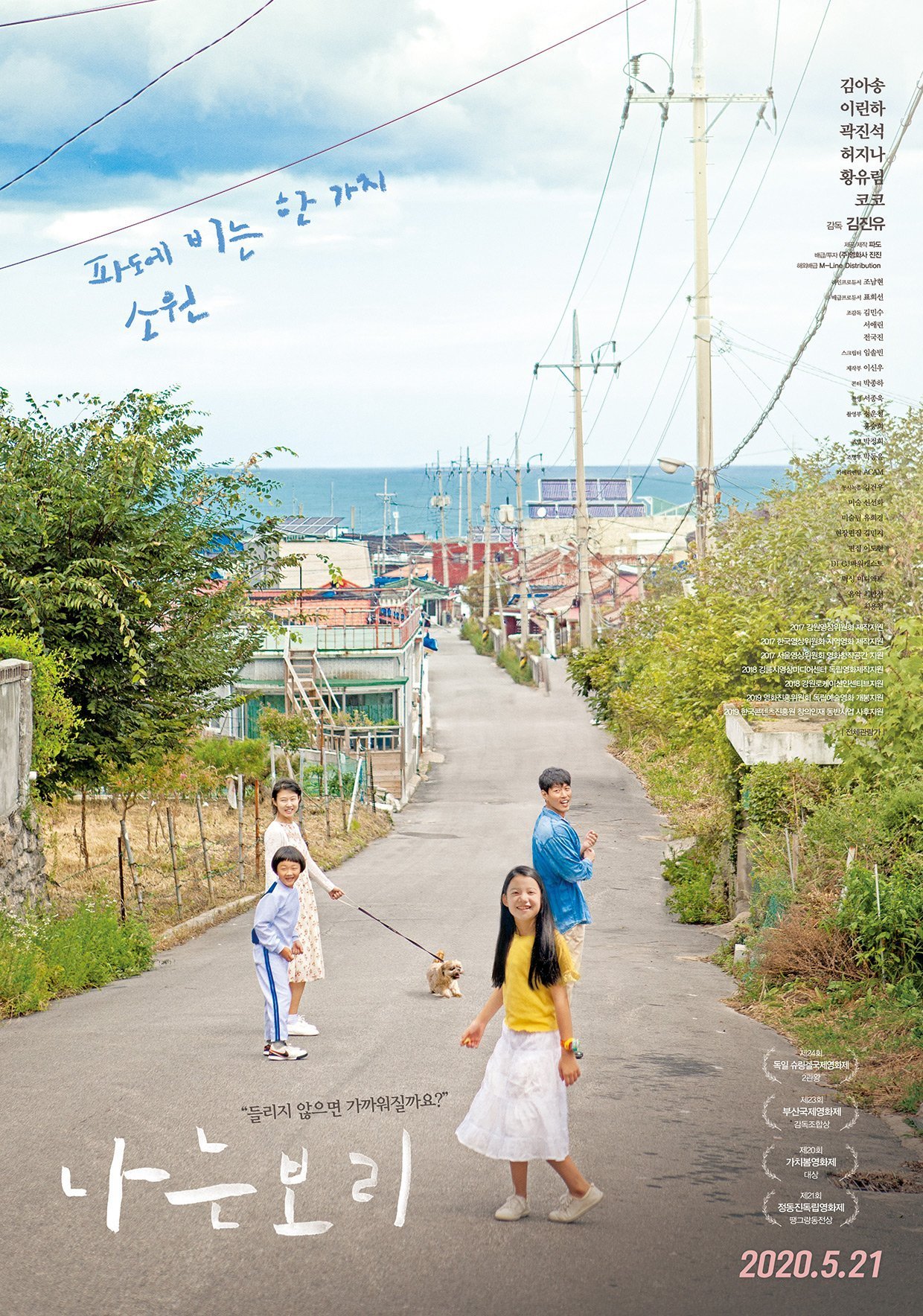
Perhaps it’s not unusual for a soon-to-be teenage girl to feel out of place at home, but for young Bori the sense of alienation is all the greater because she is the only hearing member of her family. Set in a charmingly tranquil seaside town during a serene summer holiday, Bori (나는보리, Na-neun-bo-ri) touches on themes of identity and belonging, disability and discrimination, communication and connection, but is at heart a beautifully drawn coming-of-age tale in which the heroine learns to feel at home in herself and her family while fully accepting that difference need not be a barrier.
Though her home life appears to be blissfully happy, Bori (Kim Ah-song) can’t help feeling a little pushed out in being necessarily othered as she acts as a speaking interpreter for her family members. She mildly resents her younger brother Jeongwoo (Lee Lyn-ha), who like her parents is deaf, because he’s allowed to mess around just being a kid while she has to take on a more mature responsibility, telephoning for take away food, buying train tickets at the station, talking to bank tellers, giving taxi drivers directions etc. Though she obviously understands sign language, she does not always use it, often falling back on note writing to get across exactly what she wanted to say, and sometimes feels excluded from the happy bubble of her parents and brother as they continue to communicate in ways which still elude her.
For these reasons, she’s taken to stopping off at the local shrine on her way to school to pray that she somehow loses her hearing. Bori’s best friend, Eun-jeong (Hwang Yoo-rim), is confused why she would actively like to deafen herself but nevertheless supportive, lending her her earphones to listen to white noise at unhealthy decibel levels but it’s not until the first day of summer holiday when she copies an elderly diver on TV and tries to implode her eardrums by jumping in the sea that she almost gets her wish, waking up in hospital and telling everyone that she too is now deaf. To Bori, all she’s done is make herself the same as everyone else in her family so she can’t understand why people seem upset. After all there’s nothing wrong with being deaf, so why is everyone acting as if she’s met with some kind of tragedy?
Then again, being “deaf” doesn’t seem to make the difference she thought it would. Her father (Kwak Jin-seok) cheerfully tells her it makes no difference at all to him whether she’s deaf or not, she’s just his lovely little girl while her mother (Hur Ji-na) who was understandably upset at the hospital quickly adapts. Jeongwoo meanwhile begins to confide in her a little more, temporarily becoming the big brother as he explains to her how difficult it can be for him as a deaf child in a hearing school. “I’m difficult for him too” Jeongwoo generously concludes telling his sister that he mostly doodles or sleeps in class because he finds it difficult to lipread and the teacher doesn’t seem to have made much of an effort to be inclusive. Bori realises that the reason her brother’s so football crazy isn’t just that he enjoys the sport, but that it’s the only time the other kids interact with him. He doesn’t really have any “friends” and even though he’s the best player for his age he’s only a substitute on the team because the coach is wary of his disability even though it can’t be said to make much difference on the pitch.
Eun-jeong, while suspecting Bori might be faking, treats her pretty much the same making an effort to communicate in whatever manner works, though the girls were used to talking through notes in class anyway. Some of the other kids at school, however, are far less understanding, unaware she can of course hear their barbed comments, and while out shopping with her mother she becomes more aware of the direct discrimination she faces as two rude cashiers in a boutique talk openly of their disdain for the “mute” in their store, whacking an extra 5000 won on the price thinking she won’t notice. Bori is outraged, but can’t say anything without blowing her cover.
The worst occurs however when her aunt takes her and her brother for a checkup at the local hospital where the doctor suggests possible surgery and a cochlear implant for Jeongwoo. Bori hears him say that after the operation Jeongwoo would be unable to play sports or go swimming because of the dizziness meaning he’d have to give up football, his only outlet. Conflicted over whether to warn him, she is also a little offended that everyone seems to consider deafness as a problem to be fixed, not even bothering to enquire if that’s actually something that Jeongwoo might want. She repeatedly asks him, but is conflicted when he tells her that he would or at least he doesn’t necessarily want a “cure” for his deafness but would desperately love to be able to talk to his friends. Nevertheless, she’s annoyed with her aunt for railroading them towards “normality” without properly discussing it with them.
Talking with her father he tells her of the discrimination he faced as a child, that the reason he can’t write is because he was badly bullied and prevented from attending school. He’s glad things are better for Jeongwoo, though they are obviously not perfect. What Bori realises is that her difference doesn’t matter and neither does anyone else’s, the people who love her would still love her no matter what and the ones that wouldn’t aren’t worth worrying about, while she also resolves to stand up to discrimination and injustice on behalf of those who might not be able to. A charmingly wholesome coming-of-age drama set in a sunny seaside town, Bori is a gentle plea for a more inclusive world fulled by empathy and openness.
Bori streams in the UK on 12th November as the closing gala of this year’s London Korean Film Festival.
International trailer (English subtitles)
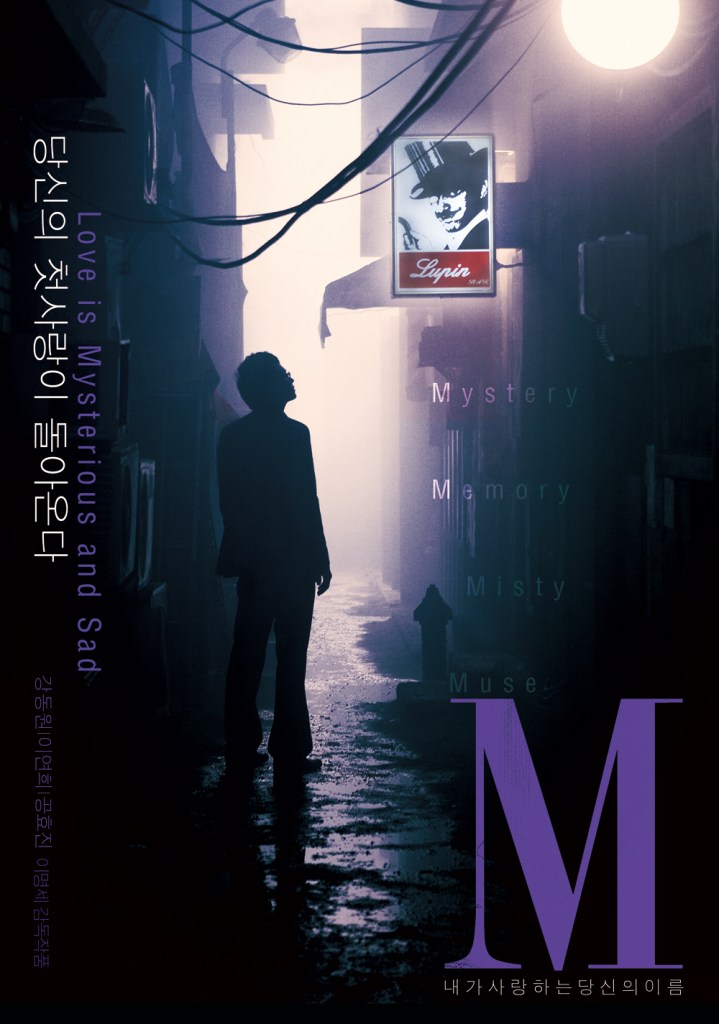 “More specific, less poetic” the distressed author hero of Lee Myung-se’s M (엠) repeatedly types after a difficult conversation with his editor. Almost a meta comment on Lee’s process, it’s just as well that it’s advice he didn’t take – M is a noir poem, a metaphor for an artist’s torture, and a living ghost story in which a man shifts between worlds of memory, haunted and hunted by unidentifiable pain. Reality, dream, and madness mingle and merge as a single kernel of confusion causes widespread panic in a desperate writer’s already strained mind.
 Windows on Worlds