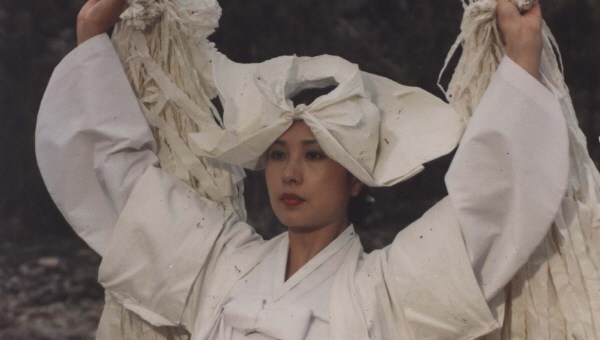
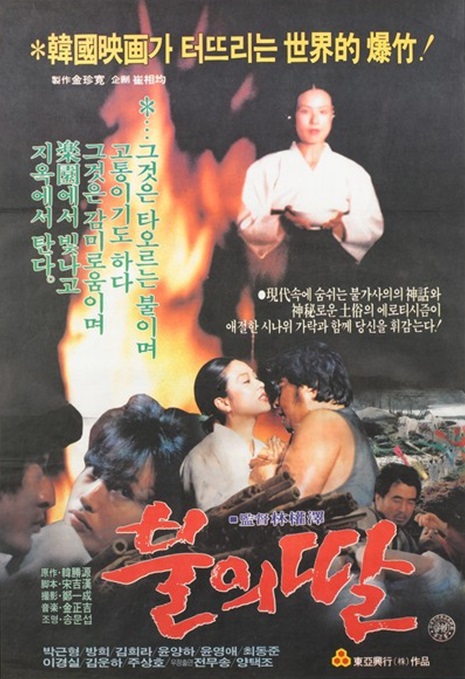
Daughter of Fire (불의 딸, Im Kwon-taek, 1983)

“Doctor, is it possible in our modern society for someone to suffer from that kind of illness?” the conflicted hero of Im Kwon-taek’s Daughter of Fire (불의 딸, Bul-ui ttal) asks his psychologist, plagued by nightmares of the mother who abandoned him at 11 and suffering what seems to him to be the call to shamanism, only what place could such a backward and superstitious practice have in “our modern society?”. In many ways, it’s exactly that question which Im seems to find so essential, implying in a sense that even in the politically repressive but increasingly prosperous Korea of the late ‘70s that they have perhaps lost something of their essential Koreanness in their abandonment of their ancestral beliefs in favour of modern “sophistication”.

Listening to his troubles, the disinterested psychiatrist reassures Hae-joon that it’s just a “minor neurosis” caused by “frustration” which can easily be cured. On his way home, however, Hae-joon is accosted by an older woman dressed in shaman’s clothing who addresses him as a son, reminding him that he has the blood of shamans running in his veins and try as he might he’ll never be able to escape it. Her intervention perhaps links back to an earlier encounter with the pastor at his wife’s church who explained to him that his wife is at the end of her tether, embarrassed by his lack of faith believing that it reflects badly on her as a religious woman hoping to lead others towards the lord if she cannot at least count her husband among the saved. So great is her distress that she has apparently even considered divorce. This is perhaps one reason Hae-joon is so keen to exorcise his shamanistic desires, though it’s also clear that his presence in his home is intensely resented, his wife later only warmly greeting him by hoping that he’ll be able to let go of his “dark and diabolical life” for something brighter and more cheerful, ie her religion though the grey uniformity and intense oppression of her practice only make her words seem more ironic. 

The pressing problem in his family is that his daughter is also sickly, seemingly with whatever it is which afflicts Hae-joon. She has begun sleepwalking and later suffers with fits and seizures which to a certain way of thinking imply the onset of her shamanistic consciousness. Hae-joon’s Christian family, in a touch of extreme irony, are convinced that an exorcism in the form of a laying on of hands will cure her, yet they like many others view the ritualised religious practice of the shaman as a backward relic of the superstitious past. The ironic juxtaposition is rammed home when Hae-joon is sent to cover a supposed miracle for his newspaper that his wife and her friends from church regard as the second act of Moses, standing ramrod straight and singing hymns while a noisy festival of shamanic song and dance occurs further along the beach apparently a rite to appease both the sea god and the vengeful spirit of an old woman accidentally left behind when her community migrated to another island to escape an onslaught of tigers. Stuck in the middle, Hae-joon exasperatedly explains to his photographer that this parting of the seas isn’t any kind of miracle at all, merely a natural result of low tide revealing that which would normally be hidden. 

Yet despite his unsatisfactory visit with the psychologist, Hae-joon becomes increasingly convinced that only by finding his mother can he come to understand what it is that afflicts him. Speaking to the various men who knew her from the step-father he later ran away from to escape his abuse after his mother disappeared, to a blacksmith who cared for him as an infant, and the men she knew after, Hae-joon begins to understand something of her elemental rage. Driven “mad” by the murder of her lover by the Japanese under the occupation, she wandered the land looking for fire to exorcise her suffering only later to lose that too when the oppressive Park Chung-hee regime outlawed shamanism entirely in his push towards modernity. Consumed by the fires of the times in which she lived, there was no place in which she could be at peace and nor will there be for Hae-joon or for his daughter until they embrace the legacy of shamanism within. 

“Shamanism will not disappear and die” Hae-joon later adds, now able to see that there is or at least could be a place for it in “our modern society” or perhaps that it’s the modern society which must change in order to accommodate it. Despite his long association with depictions of Buddhism, it is the shaman which Im considered the foundation of Korean culture, something he evidently thinks in danger to the perils of a false “modernity”, Hae-joon eventually professing his concerns that without it Korea will forever be oppressed by foreign influence. Only by accepting the shaman within himself can he hope to find freedom in an oppressive society. 


Daughter of Fire streams in the UK until 11th November as part of this year’s London Korean Film Festival.
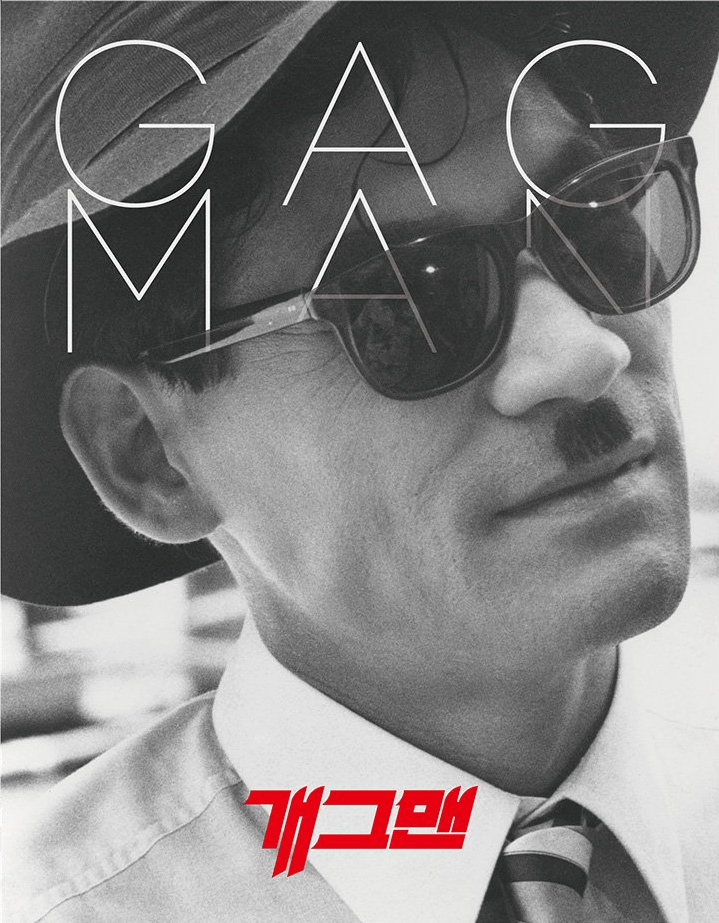
Gagman (개그맨, Lee Myung-se, 1988)

gagman cover

Is everything we see a waking dream or does it just appear that way? This question posed (or perhaps dreamed) by the protagonist of Lee Myung-se’s debut becomes a kind of key for unlocking much of what has gone before as Lee freewheels between fantasy and reality as his cast of movie obsessed dreamers attempt to inhabit their very own stretch of celluloid within the “real” world. Released in 1988, Gagman (개그맨) catches Korea in a moment of transition. Newly free of a lengthy dictatorship and back on the world stage after hosting the 1988 Olympics, the country was eager to promote itself as a modern liberal democracy. Hence, the arts were the first to feel the new freedom with young directors given the chance to create boundary pushing films and show just how far Korea could go. Lee was just one of these directors but Gagman is no political treatise (at least, not directly) preferring to experiment with form as a farcical exercise in meta comedy.

Cinema obsessed comedian Lee Jong-sae (Ahn Sung-ki) wants nothing more than to make the next great Korean movie which every one of the 40 million Koreans will fall in love with. Consequently he’s blagged his way onto the film set of a top director to whom he’s already sent his “prize-winning” script. Eventually thrown out, Jong-sae does not lose heart but promises the lead role in his movie to his equally film obsessed barber Moon Do-suk (Bae Chang-ho) whom he sends out on “research” missions walking into banks and asking about security. A fortuitous meeting with a feisty young woman in a cinema, Oh Sun-young (Hwang Cine), provides a another impetus for Jong-sae’s filmmaking dreams and so when he unexpectedly gets his hands on a gun after an encounter with a deserting soldier things just got real in a very unexpected way.

Lee signals his intent early on with a static camera shot focusing on the barber, Do-suk, as he waxes on about Kirk Douglas in the Vikings whilst simultaneously remarking on the fall in quality of his beloved dog meat. Do-suk feels that when it comes right down to it, Korean mutts are the best – not these scrawny poodles that cheap restaurant owners are substituting for the real thing. His comment might easily go for himself and Jong-sae, two scrappy working class Korean guys trying to make it in a walled off industry, but interestingly enough bar a mention of Sorrow Even Up in Heaven, Lee’s references are to European and American cinema rather than that of his homeland.

The most obvious of these lies in the central gag – that the gagman has a “funny” face. Ahn Sung-ki is saddled with a Charlie Chaplin moustache throughout the film (with the added bonus that it of course looks like a Hitler moustache to European/American viewers) and plays Jong-sae as someone who’s constantly doing a Chaplin impression with his strange walks and silent cinema plaintive looks. Ahn even begins layering his performance so that we get Charlie Chaplin impersonating Brando in the Godfather to recite the melancholy monologue which seems to open Jong-sae’s unfilmable script. For Jong-sae his existence is cinema, the life he lives is unreal or surreal always with an added dose of narrative in the ongoing story of his rise to greatness as the most famous Korean filmmaker of them all.

Fantasist as he is, Jong-sae has a way of pulling other people into his unrealisable dreams including the barber Do-suk and a young woman who unexpectedly starts canoodling with him in a cinema in an attempt to avoid some other creepy guys. Oh Sun-young is almost a mirror image of Jong-sae in her pragmatic realism though she too is looking at the stars and willing to engage in fantasy to get there. It is she who first suggests that the “research” they’ve been doing might have a more practical application and she is also the one to maintain a calm approach to their eventual need for escape but, even if she always has one foot in reality, Sun-young cannot escape the gravitational pull of Jong-sae’s strange dreamverse. Do-suk, by contrast, is a willing convert – just as obsessed with cinema and comics as Jong-sae, his desperation to be a part of the movies and unwavering faith in his friend lead him to give up everything in service of art even going so far as to get painful eye surgery to increase his box office potential (apparently a meta dig at a Korean celebrity who did something similar).

In keeping with the Chaplin theme Lee’s humorous universe is defined by slapstick and absurdity, his dialogue needlessly theatrical and mannered with a melodramatic seriousness. Nevertheless Lee makes the most of his canvas as the film goes on behind Jong-sae while he enters one of his reveries as in one particularly amusing scene in which he attempts to declare his love to Sun-young without noticing that she’s long wandered off and been replaced by Do-suk. Despite the cartoonish, comedic tone the atmosphere is a melancholy one reflecting the final destination of Jong-sae’s film project but also of his continuing inability to integrate the two distinct universes into one concrete whole which could be termed “reality”. In this Lee returns to that first question but this time he asks us as cinema lovers which world it is we live in, and which it is that is the more “real”.


Gagman is available on region free blu-ray courtesy of the Korean Film Archive but you can also watch the whole thing legally and for free via their YouTube channel!

The Bacchus Lady (죽여주는 여자, E J-Yong, 2016)

bacchus-ladyRather than a Maenad in a divine frenzy driven by drunkenness, lust, and hedonistic fury, a “Bacchus Lady” is a humorous nickname used for the older women who solicit men in Korean parks by euphemistically offering to sell them a bottle of Bacchus energy drink. E J-yong reteams with veteran Korean actress Youn Yuh-jung to tell the tragic story of Youn So-young, hooker with a heart of gold and now a member of the older generation permitted to slip through the cracks in the absence of familial connections.

Youn So-young (Youn Yuh-jung) is going to have to close the shop for a few days, she has gonorrhoea thanks to a no good customer who (presumably) paid her extra for no protection. As if that weren’t bad news enough, So-young becomes a witness to a public domestic dispute as the doctor’s Filipina former lover and mother to his unacknowledged son tracks him down to his clinic. During the heated argument conducted in English the jilted lover stabs her no good former beau with a pair of scissors and is hauled off by security, instructing her young son, Min-ho, waiting downstairs, to make a run for it.

Not knowing quite why, So-young chases after the boy and ends up taking him home. With the help of her transgender landlady (An A-zu) and younger neighbour with a prosthetic leg (Yoon Kye-sang), So-young cares for the boy before trying to figure out what’s going on with his mother. So-young returns to work after her initial problems are cleared up which brings her into contact with three former clients who each have a very unusual favour to ask of her…

First and foremost, The Bacchus Lady (죽여주는 여자, Jug-yeo-ju-neun Yeo-ja) wants to ask a lot of questions about the status of the elderly in contemporary Korea. Korea has one of the highest rates of older people living in poverty among the developed nations with many forced to keep working to support themselves even as their health fails. Though many older people have extended family networks, the nature of modern society leaves them isolated as their children may have moved away or even to foreign countries and are not able, or simply not interested, in providing later life care for their relatives. Some, like So-young, are on their own. With no familial connections to rely on and only her neighbours to count as friends, she has few options and opportunities for women of her age are thin on the ground.

Speaking to a client who turned out to be a documentary filmmaker, So-young reveals that she chose prostitution out of pride – she couldn’t bring herself to take a street cleaning job and thinks this is better. In fact, her story is more complex and exposes a deep seem of historical social problems as So-young first became a prostitute at the American air base.

There are odd parallels to be found everywhere – So-young was seduced an abandoned by an American soldier just as Min-ho’s mother has been abandoned by her Korean doctor who returned home and married well, leaving her far behind. In fact, Min-ho has a picture of his happy family which is almost identical to one So-young has stashed away in a drawer (only she’s torn out the painful half of hers). Now the Koreans are making the same mistakes as the previously mentioned occupying forces, sowing their wild oats abroad and forgetting all about their foreign adventures when they come home to settle down.

Parents reject their children, and children reject their parents. When one of So-young’s former customers suffers a stroke, his son’s family come back from the States to visit him but the daughter-in-law coldly announces that they won’t visit again for another year (knowing full well he may not have that long). The grandchildren barely speak Korean and aren’t interested in hanging round the sickbed of a man they don’t quite know, grandfather or not. The son says nothing. The daughter-in-law even tries to stop So-young visiting her husband’s father assuming she’s some kind of granny gold digger (got to protect that inheritance after all). No wonder the poor man becomes the first of many asking So-young to help him to die. Loss of youth, loss of health, loss of relationships – the loneliness and the boredom alone are too much to bear, let alone pecuniary worries.

So-young is an impulsive sort of woman. When asked why she does some of the things she does, So-young replies that she doesn’t know, she must be mad. Yet there’s a kindness and a naivety belying her otherwise straightforward personality. Even if she can feel something is probably a bad idea but it might help, she feels compelled to do it anyway, eventually with disastrous consequences. So-young is a nice woman who’s been unlucky and society continues to make her pay for that. Always left feeling as if she needs to atone for an unforgivable sin, So-young lives an oddly ascetic life, taking few pleasures and giving away most of her rewards. Her story may be an extreme one, but hers is the fate of many older women who find themselves abandoned without pensions, savings, or family to help them survive.

An interesting look at life on the fringes of an affluent city, The Bacchus Lady is sad tale though one filled with compassion and good humour. E avoids outward melodrama or unwelcome sentimentality, approaching So-young’s ultimate destination with the necessary pathos. The gentle accordion based score lends the film a whimsical air which is only undercut by the abrupt tonal shift and suddenness of the coda finale, but E’s aim is a serious one. So-young is her own woman, but she also stands for a disadvantaged stratum of society who have been consistently denied the ability to fend for themselves and are suddenly expected to do so in their old age when they most need society’s help. Sympathy for Lady Bacchus? Society would do well to take note.


Reviewed at the 2016 BFI London Film Festival

Original trailer (English subtitles):