
Egoist (エゴイスト, Daishi Matsunaga, 2022)

If love is unselfish, is it really love at all? Based on a semi-autobiographical novel by Makoto Takayama, Daishi Matsunaga’s deeply moving romantic drama Egoist (エゴイスト) asks if all love is in the end transactional and if to deny its “selfishness” is akin to denying love itself because it would mean denying a basic human need for connection and reciprocity. In the end, perhaps selfish is what we should be with love because we are always running out of time and if we aren’t careful it will slip away from us unnoticed.

An “extreme realist”, fashion editor Kosuke (Ryohei Suzuki) is already full of regrets and many of them linking back to the early death of his mother from illness when he was only 14. It’s clear that his financial wealth helps to fill an emotional void but also that he’s lonely and longs for a sense of family that’s long been absent from his life. He rarely visits the conservative hometown where he was bullied for being different, and seems to have a strained relationship with his widowed father (Akira Emoto) who doesn’t know that Kosuke is gay and continues to ask him about getting married and settling down. Early on in his courtship with Ryuta (Hio Miyazawa), a personal trainer he met through a friend, Kosuke remarks that he’s never met a lover’s mother before hinting at the landmarks of a relationship such as marriage that LGBTQ+ people often miss out on in a conservative culture in which such things cannot always be discussed openly.

Later, Ryuta’s mother Taeko (Sawako Agawa) tells Kosuke that knew from that first meeting that they were more than just friends and was happy that her son had someone he loved who loved him regardless if they were a man or a woman. But just when the relationship had seemed to be blossoming, Ryuta had abruptly tried to break up with Kosuke explaining that he had been involved in sex work since his early teens in order to support his mother who was unable to work due to illness. Now that he’s experienced real romantic love he finds sex work “painful” but has no other means of supporting himself and so gives up love for economic necessity. “I’ll buy you,” Kosuke unironically counters adding a note of literal transactionality to their relationship which is already fraught with disparity in the respective differences in their ages along with Kosuke’s wealth and Ryuta’s poverty. 

Kosuke later describes his gesture as “pure”, something he’d previously called Ryuta while also remarking that he found him too “polite” in bed and would rather he be a little more “selfish”. In a way it’s altruistic, he isn’t really trying to trap Ryuta into a compensated relationship only to help him while simultaneously ensuring that he stays in his life. His wealth fills a void, but it’s by giving pieces of it away that he feels that void decreasing. Kosuke first gives Ryuta gifts for his mother, knowing that it’s easier for him to accept them because doing so is unselfish when the gift is for someone else. Even so as he later acknowledges sometimes the gift is more for himself than the recipient, a means not of manipulation but of healing. Kosuke claims not to know what love is and largely mediates it through money along with additional acts of care, but as Taeko later tells him it doesn’t really matter if he doesn’t know because they felt his love anyway. 

Matsunaga frequently cuts backs to visual motifs such as door numbers, envelopes, and dropped coins to hint at the transactionality of love but eventually reflects that love is an act of exchange in which the desire to be loved is an essential component. Kosuke eventually asks his father how it was for him when his mother was dying and he recalls a conversation in which she said she wanted to leave him because she couldn’t bear to see him suffering for her, a request which could in itself be read as “selfish” even in its “selflessness” with his reply implying that it’s alright to be selfish in love because in way it might be its ultimate expression. Filming with handheld realism, Matsunaga captures the rhythms of contemporary gay life along with the easy giddiness of burgeoning romance and the poignancy of profound loss tempered only by a fleeting feeling of warmth and the jealous memory of a “selfish” love. 


Egoist screens in Frankfurt 9th June as part of this year’s Nippon Connection.

International trailer (English subtitles)

Waterboys (ウォーターボーイズ, Shinobu Yaguchi, 2001)

Japan has really taken the underdog triumphs genre of sports comedy to its heart but there can be few better examples than Shinobu Yaguchi’s 2001 teenage boys x synchronised swimming drama Waterboys (ウォーターボーイズ). Where the conventional sports movie may rely on the idea of individual triumph(s), Waterboys, like many similarly themed Japanese movies, has group unity at its core as our group of disparate and previously downtrodden high school boys must find their common rhythm in order to truly be themselves. Setting high school antics to one side and attempting to subvert the normal formula as much as possible, Yaguchi presents a celebration of acceptance and assimilation as difference is never elided but allowed to add to a growing harmony as the boys discover all new sides of themselves in their quest for water borne success.
Dreamy high school boy Suzuki (Satoshi Tsumabuki) is currently the only member of his high school’s swimming team, and unfortunately he’s not a particularly good swimmer. His interest is piqued when he spots a synchronised swim meet, but he forgets all about it until a new teacher arrives and pledges to revive the school’s fortunes in the pool. Seeing as their new teacher is a pretty young woman with an interest in swimming, the team suddenly becomes much more popular but when she reveals her synchronised swimmer past numbers dwindle once again. Unfortunately, the hot new teacher suddenly has to leave the school so the boys are left to fend for themselves in their new and possibly embarrassing career in a generally feminine sport.

Being teenage boys who only started this whole thing because of the pretty teacher, most of the other guys are are looking for a way out but they also don’t like to be called quitters and so they become determined to make a success of themselves. Suzuki, who secretly wanted to become a synchronised swimmer anyway, is the most committed but also, perhaps, the least confident in his choice of sport as he embarks on a tentative romance with a girl from another school – herself an enthusiast of the more masculine karate. Terrified that she will find out and laugh at him, Suzuki goes to great lengths to avoid telling her what it he really does in his club activities, possibly putting the growing romance at risk in the process.

This mild challenge to masculinity is the main joke of the film but Yaguchi neatly subverts as the guys become cool again thanks to mastering a difficult skill and creating an impressive spectacle through hard work and group mentality. The boys gain an unlikely mentor in the form of a dolphin trainer at Sea World who they hope will be able to train them in the same way he trains his marine creatures but quickly sets them off on some Karate Kid style practical training which involves a lot of menial tasks around the park before dumping them at the local arcade to play dance dance revolution until they learn the art of synchronicity through the power of idol pop. Waterboys is, essentially, a hymn to the harmonious society as the boys eventually find their common rhythm and the power that comes from many acting as one.

Unusually, this does not requite a loss of individuality or for any erasure of essential personality traits but rather a greater need for acceptance as difference merely adds to the strength of the whole. Though there are a fair few gay jokes in what is essentially a movie about high school boys in skimpy trunks, the joke is not homosexuality but reactions to it as Yaguchi adopts a “get over it” attitude and so when one of the boys does confess his love for another it’s treated with no particular reaction other than lack of surprise. Similarly the cross dressing mama-san from the local gay club (a surprising turn from Akira Emoto) becomes one of their greatest supporters and may provide comic relief but is never a figure of fun. In order to succeed the boys will need to be in tune with each other, but that in tune sounds better when it allows for harmony rather than insisting on dull monotony.

Visually inventive and often hilarious, Waterboys lacks the heart of Yaguchi’s similarly plotted Swing Girls but nevertheless succeeds in its tale of inexperienced young guys working hard and achieving the impossible, growing up and discovering new things about themselves as they do. Waterboys may be lighthearted, crowd pleasing fun, but its good natured message that great things are possible when determined people work hard at them together, and that group harmony does not necessarily require social conformity, only add to its warm and gentle tone.


Korean trailer (Korean captions/subtitles only)

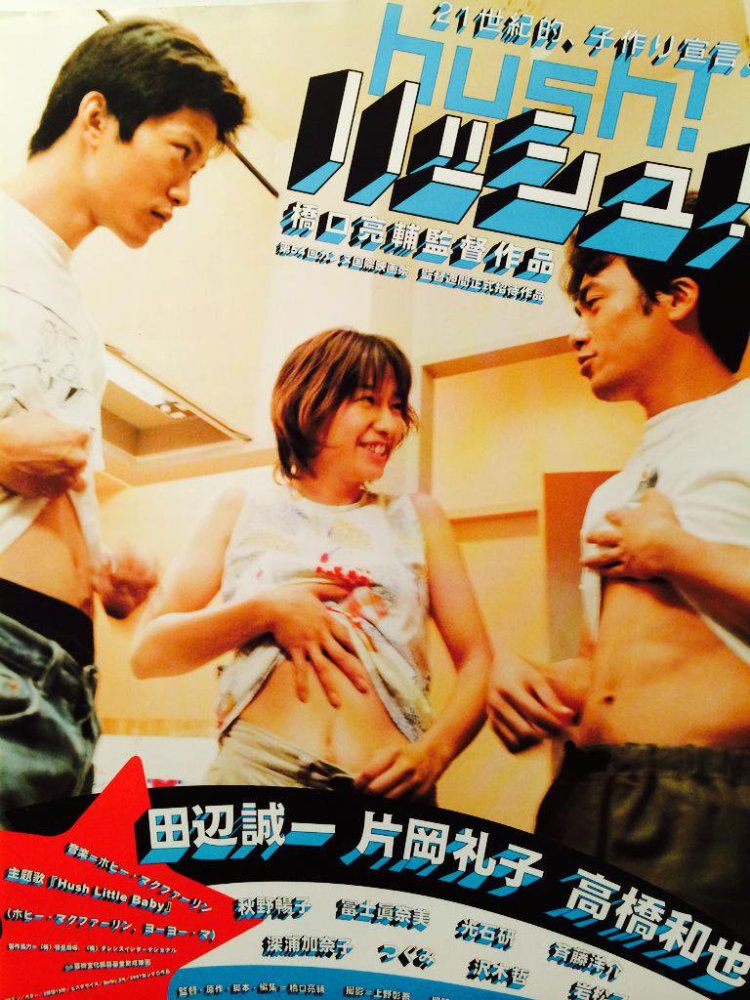
Hush! (ハッシュ!, Ryosuke Hashiguchi, 2001)

hushThe family drama is a mainstay of Japanese cinema, true, but, it’s a far wider genre than might be assumed. The rays fracture out from Ozu through to The Family Game and Crazy Family which sought to ask a few questions about where the idea of “family” was headed in a society of rapidly increasing materialism. Ryosuke Hashiguchi comes at the idea from a different angle in 2001’s Hush! (ハッシュ!) as he once again takes the perspective of the gay community and asks if the “traditional family” is about to change – what could, or should, survive if the old, rigid ideas can be remade into something lasting created out of love and acceptance rather than obligation?

As the film begins, Naoya (Kazuya Takahashi) wakes up to find his one night stand already fully dressed and heading out the door, awkwardly, without even stopping to say goodbye. Eventually he hooks up with the kindly Katsuhiro (Seiichi Tanabe) and the two quickly become fairly serious but then a damaged woman, Asako (Reiko Kataoka), enters their lives hoping to use Katsuhiro as a sperm donor, forcing the men to reassess a number of important desires and beliefs, putting strain on their still fledgling relationship. If that weren’t enough drama, a girl at Katsuhiro’s place of work has also developed a crush on him and is prepared to take her unreturned love to some extremely dark places.

The first level of mini stresses Naoya and Katsuhiro have to contend with is their conflicting (if complementary) personalities and attitudes to their sexuality. Naoya is an easy going type with a job at a pet grooming salon. He’s a fully out gay man and a frequenter of city’s gay scene. Katsuhiro, by contrast, is much more mild mannered and innately kind. He works at a scientific research station and is more or less closeted – that is, he doesn’t particularly go out of his way to hide his sexuality from his work mates and family but he doesn’t volunteer the information either. This attitude seems to bother Naoya at various points but being the easy going type he’s apt to let it go most of the time.

However, when Katsuhiro reveals Asako’s offer, Naoya is actively against it. His idea of gay life suggests that relationships are generally short, he prefers the relative freedom of his life as an essentially “single” man rather a husband shackled to a family. Katsuhiro on the other hand perhaps would have liked children, or to be a father figure to someone else’s. Though Naoya has previously expressed boredom and disillusionment with his life spent in clubs and gay bars, he’s still resistant to the idea of settling down, or at least to the belief that a single relationship really can stay the course.

All three of the central characters have, in a sense, been let down by the “traditional” family. Naoya’s father left when he was small, leaving him with a single mother which is something that wasn’t so common when he was a child resulting in a fair amount of social stigma from other people in the community. These days his brassy mother knows about his sexuality and seems OK with it (aside from getting the random idea that Naoya will be wanting a pair of breasts at some point). Katsuhiro’s father was an alcoholic who died when he was just a small boy, his relationship with his brother and his family seems good but he’s afraid to reveal his sexuality to them for fear of disapproval. His brother had an arranged marriage, which doesn’t seem to have worked out so well at least from the sister-in-law’s perspective. Asako has also had a troubled life looking for affection in all the wrong places, feeling that if she had not been neglected as a child perhaps she’d have been a steadier adult. Naoya was running away from the idea of family ties, but Katsuhiro and Asako are actively seeking to repair the ones which never grew into the kind of roots one needs to anchor onself in a society entirely built around familial bonds.

After receiving some surprising medical news, Asako perversely decides that her own salvation lies in becoming a mother. She’s had enough of casual relationships and decided to go a different route so when she spots the kind look Katshiro gives a small child at a restaurant, she decides he must be the one to father her baby. Asako knew that Naoya and Katsuhiro were a couple, but that works out pretty well for her plan so she approaches him and makes her left field offer right off the bat. It will take some figuring out but this literal third way is a neat solution to a series of problems and, being completely new, is safe from the pettiness and misery often found within the traditional family unit. Contrasted with the bitterness displayed by Katsuhiro’s sister-in-law, the unusual arrangement of these three would be parents and their unborn child(ren) is one filled with love, forgiveness and mutual support rather than cold obligation or a simple fulfilment of societal expectations.

Once again Hashiguchi proves himself adept at creating a series of complex, flawed human beings who are nevertheless relatable and often endearing. Hashiguchi’s films tend to run long but he also ensures that even his supporting characters are well enough drawn to maintain interest in the many subplots from Naoya’s abrasive gay bar buddy to Katsuhiro’s unhinged stalker. An interesting sideways look at the state of the modern family, Hush! seems to advocate that just shutting up and going with the flow is not the answer but there are quieter solutions to be found if everyone is willing to listen to the silence.


Original trailer (no subtitles)