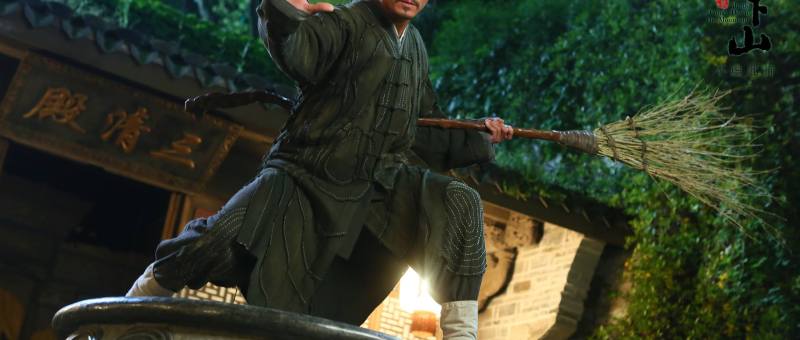
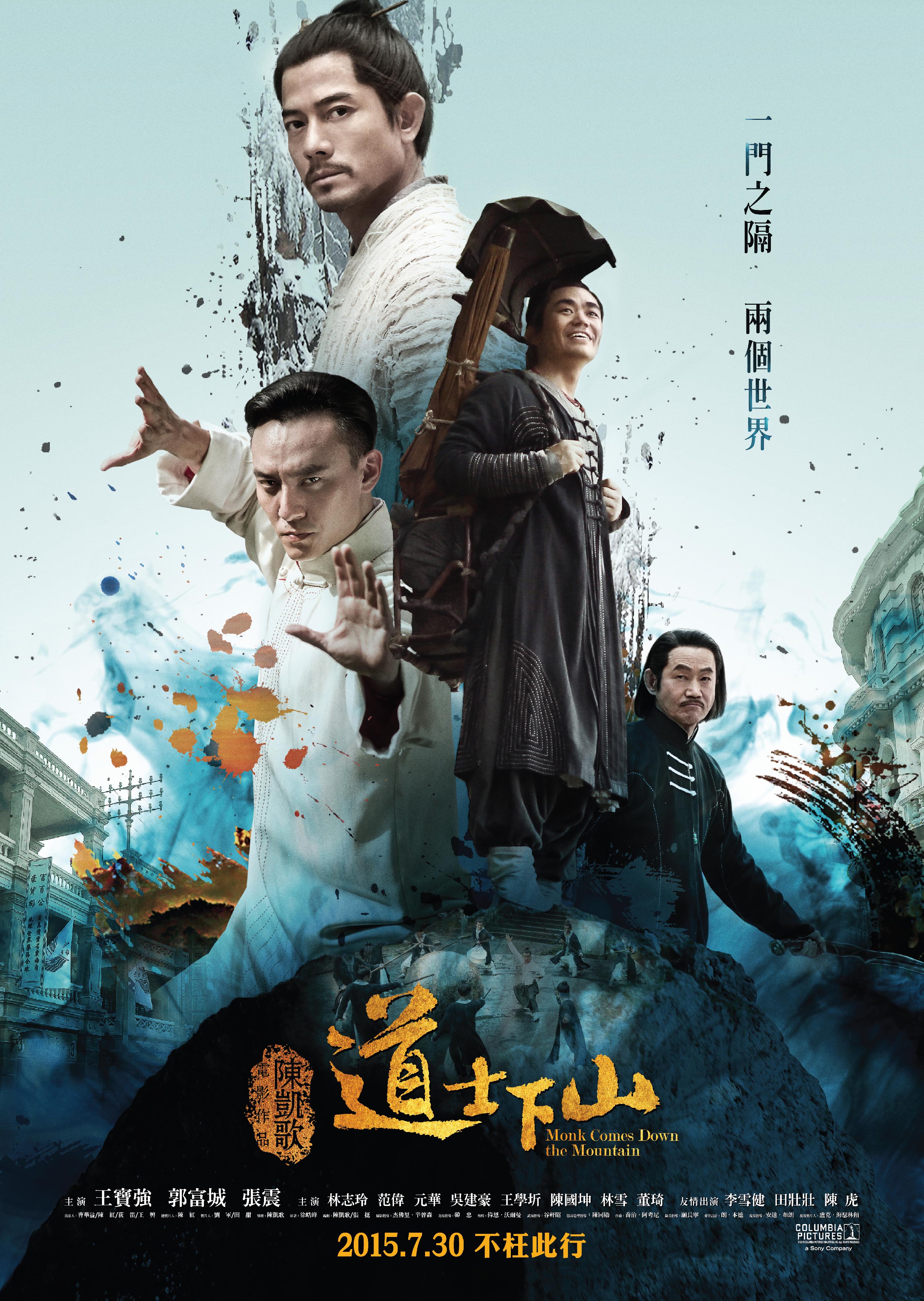
A wandering monk is forced to consider a series of dualities presented by his traditional upbringing and burgeoning modernity in Chen Kaige’s ‘30s wuxia Monk Comes Down the Mountain (道士下山, dàoshì xiàshān), inspired by the work of novelist Xu Haofeng. Essentially a picaresque, Chen sets orphan He Anxia (Wang Baoqiang) adrift in the secular world where he learns to see good and bad and perhaps the murky overlap between the two while simultaneously telling a rather subversive tale of frustrated same sex love and corrupt authorities.
When the temple at which he was abandoned as a baby falls into financial difficulty, He Anxia enters a kung fu fighting competition he believes will put him first in line for food only in cryptic monk fashion the “prize” turns out to be exile as the winner is obviously the most capable of looking after themselves alone in the world. He Anxia is however something of an innocent and despite the monk’s warning to stay true to himself soon falls into difficultly yet ends up discovering a new father figure in monk turned pharmacist Tsui while trying to steal his fish. For all of Tsui’s goodness, however, there is discord in his house as his pretty young wife Yuzhen (Lin Chi-ling) prefers his dandyish brother, Daorong (Vanness Wu), who has abandoned the filial piety of the past to chase modern consumerist pleasures in selling the shop he inherited for a fancy ring. When the situation escalates, Anxia finds himself taking drastic action only to wonder if he did the right thing.
Head of a local temple Rusong (Wang Xueqi) encourages him to think beyond dualities, wondering if he did the right thing for the wrong reasons or the wrong for right. This temple is famous for helping women have male children through praying to goddess of mercy Guan Yin, yet under Rusong’s predecessor they adopted a much less spiritual solution to the problem in simply providing a place where other men could father their sons. Rusong again asks him if the men who took part were sinners or saints while laying bare the paradoxes of the monastic life in the contemporary society. A petitioner goes so far as to ask Anxia if he might be her saviour, pointing out that if she cannot provide a male heir even though the problem may lie with her husband she may be cast out of her family, thereby disgraced not to mention financially ruined. Having lived all his life in the temple surrounded by men, gender inequality is not something Anxia had been very aware of. He tells her that though he had no family he was able to find one only to lose it, little understanding why she might not be able to do the same.
On the other hand, he appears to show surprising perspicacity in the touching moments in which he must say goodbye to his second father figure, reclusive kung fu master Xiyu (Aaron Kwok), in realising the depth of his feelings for army buddy Boss Zha (Chang Chen) who then becomes his final master. Ironically, the obviously homoerotic relationship between Xiyu and Boss Zha was perhaps less controversial in 2015 than it might be in the present day but its inclusion is nevertheless surprising if also poignant as Xiyu tells Boss Zha that he should resume his stage career, marry and have children, while he will live a quiet and lonely life perfecting his kung fu though he will always keep him in his heart. Fiercely loyal to his mentors, Anxia accepts this relationship totally and appears to fully understand its import to Boss Zha to whom he subsequently transfers his allegiance as they band together to face off against big bad Peng.
Playing into the good fathers and bad motif, Peng’s problem is his sense of paternal rejection in being passed over by his biological father in favour of Xiyu whose skills are stronger. After having ousted his rival, Peng fears the same thing will happen to his own son who is not only lacking in aptitude for martial arts but also appears to have a drug problem. To win they resort to cheating in picking up a pistol signalling both their own lack of jianghu honour and the nature of the changing times in which the very nature of kung fu has perhaps become obsolete. Meanwhile, Anxin and Zha are targeted by the police commissioner, Chao, who happens to be a former triad and also points his gun at them if less successfully while in cahoots with the amoral Peng and son.
Only through each of these subsequent encounters does Anxia begin to realise why he was cast down from mountain, understanding that he had to witness the good and bad of the secular world in order to understand his Buddhist teachings and finally find his place. With sumptuous production values perfectly recreating the 1930s setting, Chen’s quietly subversive 20th century wuxia takes aim at the ills of the contemporary society in its tales of corrupt authorities and amoral greed, but eventually finds solace in simple human goodness and genuine relationships as Anxin continues on his long strange journey to find his way home.
International trailer (English subtitles)
 Windows on Worlds