The Whole Family Works (はたらく一家, Mikio Naruse, 1939)

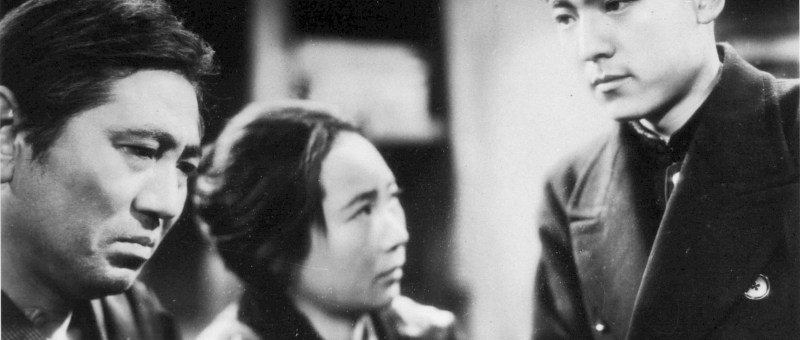
A young man becomes fed up with the constraints placed on his life and asks for the opportunity to improve his circumstances, but knows that to do so will leave his family at a disadvantage, at least in the short term. Is his request selfish, or are his parents selfish for exploiting the labour of their children and thereby impeding their progress in the world? As in many of Naruse’s films, the great enemy is poverty, but as the wise teacher Mr Washio says, the solution would be easy if Ishimura had a drinking problem or Kiichi were lazy but the situation is too complicated for such a simple adjudication.

Ishimura (Musei Tokugawa) has a job, but his wages are low and he has nine children to support along with elderly parents who are also still working. Fourth son Eisaku (Takeshi Hirata) tells his mother (Noriko Honma) that he doesn’t want to go to the factory and would like to carry on to middle school with his friends, but she tells him he’s being selfish and childish and that all his brothers began working after primary school. Perhaps because the burden disproportionally falls on her, it’s the mother who is most acutely obsessed with money and the most controlling of her children. Ishimura is more of a soft touch and genuinely sorry that he can’t really agree to oldest son Kiichi’s (Akira Ubukata) request to take five years off to study because the family can’t survive without his wages.

But Kiichi’s problem is that he’s trapped in a dead-end job. There’s no possibility of advancement and his wages won’t ever change. He could work there 50 years and never be able to support a family of his own. His idea is that he wants to become an electrician which he believes will be a steady occupation that will pay enough to allow him to take care of his parents when they’re old and also get married. He thinks if he doesn’t do something now, he’ll be trapped in this life forever and never escape his parents’ yoke. Nevertheless, he worries about whether his desire is “filial” or not and feels a tremendous amount of guilt and frustration that sends him to drink.

Ishimura also knows that if he agrees to Kiichi’s request, he’ll have to say yes to the others too. All the boys have dreams of their own with young Noboru (Seikichi Minami) even hoping to become a lawyer, while Genji (Kaoru Ito) and his younger brother Kokichi (Seiichiro Bando) are intent on joining the armed forces which is perhaps a nod to the rising militarism of the age. Scenes of imagined warfare leave a less aspirational vision of the military, though there hints of it throughout the boys’ lives through magazines and children’s literature such as the book Mr Washio gives to Eisaku. The household becomes a kind of microcosm of a totalitarian regime that controls the boys’ lives and futures, causing them to form a conspiratorial faction talking over their mutual dissatisfaction in the coffeehouse opposite run by Genji’s old school friend Mitsuko (Sumie Tsubaki) who has a crush on Kiichi. Eisaku has been patiently saving his allowance, but his mother finds out and so he blows the whole lot taking his brothers out for dinner rather than allow her to “borrow” any more of his money to which she feels herself entitled.

It’s the entitlement that’s the point. The parents expect the children to work without giving them any choice and thereby deny them the opportunity of working towards their own futures. Kiichi sees the big picture and wants to improve his circumstances, but does so because he wants to work for his family. He doesn’t intend to abandon them and chase his own success, he just wants to be able to provide for himself and at least have enough to eat. Mr Washio says he won’t tell him what to do, but also that there’s no rush, which seems like an intrusion from the censor’s board to reinforce the importance of filial piety over individualistic desire but also doesn’t deny that Kiichi has a point and as a grown man a right to freedom and independence. Nevertheless, there’s a subversive tension in the confrontation scene as the family sits in silence as the clock ticks away on the wall and the rain beats down outside. The brothers roll around in exuberance upstairs, while their defeated parents can only look up in resignation to their broken authority as the children’s revolution begins to take hold.


The Whole Family Works screened at Metrograph as part of Mikio Naruse: The World Betrays Us – Part II.
Passing Fancy (出来ごころ, Yasujiro Ozu, 1933)

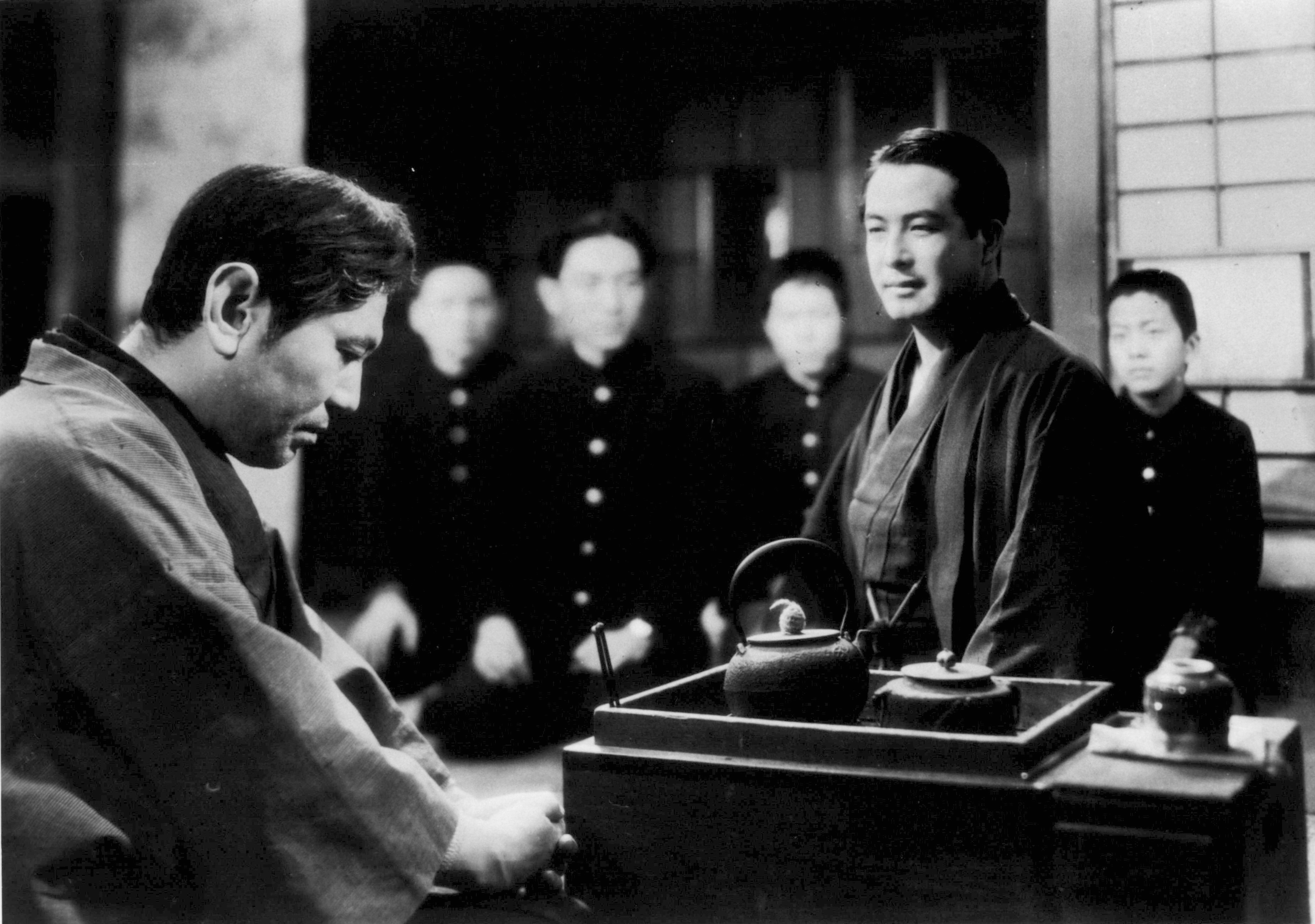
“We have to help one another” a sympathetic soul insists towards the conclusion of Yasujiro Ozu’s Passing Fancy (出来ごころ, Dekigoroko). Ozu’s depression-era silents are not as devoid of hope as it might at first seem, but it is a much more positive statement and perhaps surprisingly the central messages lie more in the necessity or otherwise of repaying kindness and the kinds of forms that action may finally take. It is also, however, the first in a loose trilogy of films revolving around a single father named “Kihachi” and the only one in which he is not (at least potentially) exiled from the family he has been trying to protect. 

This Kihachi (Takeshi Sakamoto) has one young son, Tomio (Tokkan Kozo, AKA Tomio Aoki), and casual job working in a brewery though he is hardly a model employee and is often late due to oversleeping after a night of heavy drinking. A roguish womaniser, he is also a kinder soul than he seems which is why he stops to talk to a pretty young woman, Harue (Nobuko Fushimi), wandering around in distress late in the evening. His first approach is slightly crass, responding to her question about lodging for the night by explaining that he has a kid and no wife but then he takes her to a local cafe he frequents and persuades the owner, Otome (Choko Iida), to take her in. Otome takes a liking to her, and decides to offer her a job as a waitress. 

Kihachi develops a hopeless crush, comically dolling himself up in his fanciest kimono and getting an advance from work to buy a pretty comb, an unmistakably romantic gift, to present himself to Harue. Of course, she’s grateful but sees him as a nice older gentleman rather than a potential husband. In fact and somewhat surprisingly she develops a crush of her own on the brooding Jiro (Den Obinata) despite the fact he is constantly rude to her and more or less implies she’s an untrustworthy woman out to take advantage of “vulnerable” men like himself. There is something quite touching and unusual in the brotherly friendship between the two men that occasionally comes off as something more in Jiro’s deep antipathy to Harue, which is to say she isn’t going to come between them but the situation is indeed complicated. 

Harue is, in that sense, a distraction that takes Kihachi’s eyes off his proper role as responsible father. He and Tomio have a close, interdependent relationship and it’s clear that it’s often little Tomio, older than his years, who finds himself managing Dad. Kihachi is immensely proud of his son, fond of saying he’d be top of his class if only he had better manners. Like any father what he most wants for him is that he escape their life of poverty which is why he’s so glad that the boy does well at school. But little Tomio finds himself bullied precisely because of Kihachi’s lack of standing. The other boys mock his illiteracy, unable to believe a man could reach adulthood without being able to read. When his son is taken ill, Kihachi laments circumstances even more. “It’s horrible not having an education”, he tells Jiro, “I got my son sick and I can’t even pay the doctor’s bill”.

The depression may be less visible than in Ozu’s other ‘30s films, but its evidence is everywhere. Harue ends up on the streets after losing her job at a silk mill and having no family to fall back on. At the naniwabushi performance which opens the show, a series of spectators hopefully open a lost wallet but find it empty. Kihachi notices the discarded purse is slightly bigger than his own and makes a swap as a hopeful investment for the future. Just before the performance ends, several of the guests seem to be plagued by fleas. Kihachi is forever asking for advances for frivolous reasons but assumes he’ll be able to manage hand to mouth only to enter a moment of crisis when hit by the unexpected expenses of his son’s illness for which he feels responsible in attributing it to an excess of luxury after giving a him a pocket money bonus which he unwisely blew in one go on sweets (like father, like son after all). 

Yet what shines through is compassion and camaraderie. A friendly barber loans Jiro the money for a doctor, which is one reason he intends to leave for Hokkaido even after realising his feelings for Harue. As with the other Kihachis, this Kihachi rediscovers a sense of fatherly duty in feeling as if this debt must be his, that he should be the one to go to Hokkaido to repay it even if that means leaving his son behind. The barber tells him not to bother, the sentiment is enough for him and he doesn’t mind missing the money knowing it saved a boy’s life. “We have to help one another”, kindness doesn’t necessarily have to be repaid directly but can be paid forward in becoming a way of life. The Kihachis of A Story of Floating Weeds and An Inn in Tokyo are exiled from their families and serve their sons only by abandoning them, but this Kihachi turns back, his sense of “responsibility” perhaps a “passing fancy” but one that’s taught him the true meaning of fatherhood and what it is to live in a society.


365 Nights (三百六十五夜, Kon Ichikawa, 1948)

For his second film at Shintoho, Kon Ichikawa had wanted to adapt a story by Ryunosuke Akutagawa that later inspired Rashomon, but was handed a standard melodrama to direct first. Ichikawa apparently did not think much of the novel the film was to be based on nor the script by Kennosuke Tateoka which he subsequently brushed up with the help of his new wife Natto Wada, and it’s not difficult to see why he might have felt he had an uphill battle. Melodrama is after all a genre that is founded on coincidence, though 365 Nights (三百六十五夜, Sambyaku-rokujugo ya) quickly strains credulity with the sheer number of unlikely events and surprise reappearances along with its rather strange take on the contemporary post-war society which is undoubtedly influenced by the demands of the Occupation censorship regime. 

Indeed, the setting itself seems reminiscent of 1930s cinema following the dashing hero Koroku, played by the equally dashing Ken Uehara, an architect who has walked away from his privileged upbringing as the son of a successful construction magnate. His problem is that he’s being aggressively courted by the haughty Ranko (Hideko Takamine), also the daughter of a successful but shady businessman, who to modern eyes is basically stalking him. Grinning with an evil glint in her eye, she tells her minion Tsugawa (Yuji Hori) that she’ll have seduced Koroku within 365 days which by melodrama standards seems to give her quite a lot of leeway.

Clueing us up to her villainy, Ranko is always seen wearing incredibly stylish Western outfits but otherwise behaves in a transgressively masculine fashion ordering her male employees about while set on the sexual conquest of Koroku who despises her for everything she is. It’s difficult not to see an inherent criticism of the new post-war woman and an anxiety regarding the power that comes with wealth being wielded by someone who is not a man. The contrast between Ranko and traditional femininity is rammed home by the fact that Teruko (Hisako Yamane), the daughter of the landlady in the house where Koroku finds new lodging after moving home to escape Ranko, is always dressed in kimono and otherwise naive and innocent. 

This positions Ranko, and her minion Tsugawa who is also in love with her, as the villains who are rebelling against the kind of earnestness expressed by Koroku and Teruko. From more humble origins, Tsugawa is deeply resentful of Kokoku’s class privilege and feels that he looks down on him which is one reason he seeks revenge by destroying his life along with his sexual jealously that Ranko pays him no attention yet is fixated on Kokoku perhaps precisely because he is entirely uninterested in her though it remains mystery why you’d want to be married to someone who strongly dislikes you. 

Yet for all his own earnestness, Koroku is almost betrayed by the capitalist father of whom he also seems to disapprove when he asks him to consent to an arranged marriage with Ranko to save his business. Meanwhile, it also transpires that Teruko’s father has been absent from her life because he two has a criminal past further tainting the legacy each of them bear. Ichikawa stages each evolution of their relationship at the same, noirish street corner that seems to exist as a kind of border between the illicit underworld that seeps out from Tsugawa’s bar into the post-war society, and the geniality represented by Teruko’s otherwise nice, middle-class home. 

It’s the this transgressive quality, of being caught between these two worlds, that starts to eat away at Koroku leaving him a broken and shabby man little better than a tramp. In a break with melodrama norms, though he is aware that he has led Teruko into Tsugawa’s trap he comes to believe that she has betrayed him while she clings fiercely to her love and in the end attempts to sacrifice it basically giving Koroku to Ranko whom she believes can better care for him in his now corrupted state. Though events become grim with a wedding that is staged like a funeral and takes place at a death bed, there is also the sense that something must come right that seems a little incongruous and perhaps a concession to the censors board as may be the coda implying that Ranko, despite having undergone a kind of redemption, will also have to pay for all her dodgy dealings. Though clearly hampered by the material, Ichikawa crafts some stunning images such as the final scene at Tsugawa’s bar along with a surprisingly energetic action sequence during which Koroku fights off burglars at Teruko’s home and wins her heart with his manliness. In any case despite the hints at redemption the implication remains that this is a world dark at its core in which not even the earnest can escape its creeping corruption. 


Our Neighbor, Miss Yae (隣の八重ちゃん, Yasujiro Shimazu, 1934)

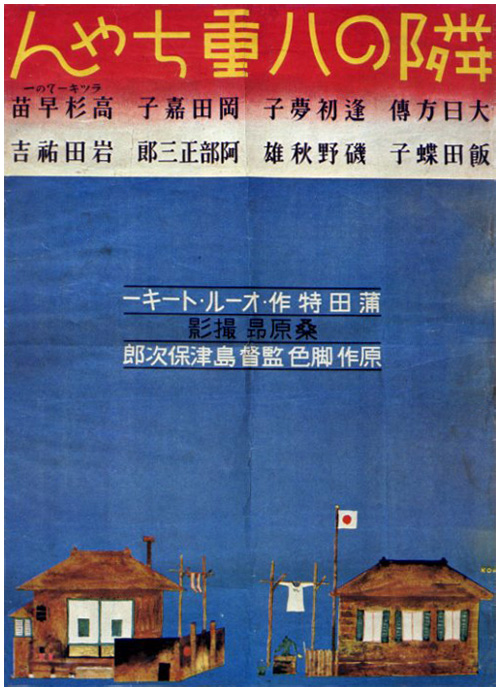
Our Neighbour Miss Yae poster

Retrospectively, Japan in the 1930s looks like a time of misery and darkness, permanently overshadowed by oppressive government and coming tragedy. However, life went on much as it had before with all its customary joys and sorrows. The films of Yasujiro Shimazu are indeed among the least politicised of the era (which might make them, in an odd way, among the most politicised) and Our Neighbour, Miss Yae (隣の八重ちゃん, Tonari no Yae-chan) is no exception in its presentation of the everyday easiness between two very close families and the burgeoning romance between the younger daughter and older son of each.

Notably, the film opens with a scene of intense suburbia as the brothers, middle-schooler Seiji (Akio Isono) and university student Keitaro (Den Obinata), play catch in the yard training for Seiji’s big game at which he has a shot at playing at the legendary Koshien stadium. As young men are want to do, they break next-door’s window but luckily Mrs. Hattori (Choko Iida) across the way is a nice woman who hardly minds, especially as this is such a regular occurrence that the families almost have an account with the local glazers.

The Hattoris and the Arais are so close that it’s no problem at all for Keitaro to jump the fence and hang out with Mrs. Hattori, who even offers to feed him, when he arrives home early to find himself locked out while his mother (Ayako Katsuragi) has gone shopping. Despite his ease in the Hattoris’ home, he is flustered when the girl next-door, Yae (Yumeko Aizome), gets back from a school with a friend in tow. Even more so when he overhears the two girls’ typically teenage conversation in which they briefly touch on Yae’s possible feelings for him while somewhat provocatively discussing breast size – something Keitaro awkwardly chastises Yae for when she returns to the living room in more comfortable clothing.

Shimazu dramatises Keitaro’s embarrassment through his ongoing clumsiness – first of all spilling tea on his floor cushion and attempting to hide it by folding the cushion in half and placing it oddly between thighs and calves, and then by tipping pickles everywhere while awkwardly trying to share them with Yae (much to the amusement of her perspicacious friend who has missed absolutely nothing in this series of awkward exchanges). Yae eventually tries to take the cushion back as it’s a good one only meant for “guests” (which she evidently does not regard Keitaro to be) only to discover his mishap with the tea which is something they can all have a good laugh over. Through all of this Keitaro and Yae seem almost like a young couple already, gently bickering but with real affection. It’s all very innocent but also flirtatious to the extent that the offer to darn a pair of socks almost seems like an elaborate metaphor but then really what could say true love better than a willingness to deal with someone’s stinky footwear?

Seiji is forced to recall his brother’s cute and innocent piece of flirtatious banter when commiserating with Yae’s melancholy older sister, Kyoko (Yoshiko Okada), who returns home unexpectedly after having apparently walked out on an unhappy marriage. An act unthinkable to her mother, Kyoko resolves to have a divorce on account of her husband’s improper relations with the maid and generally frivolous character. Keitaro jokingly said that if he had a wife he’d make her put his socks on for him everyday and she’d have to do it. Keitaro might have been joking, but there’s something in what he said and in Kyoko’s insistence that she doesn’t want to be so “submissive”, preferring to be alone rather than spend another second with a man for whom she has no respect.

Kyoko is, after a fashion, the film’s antagonist in that she begins to come between Yae and Keitaro, destabilising the easy relationship between the families by introducing unexpected tension into the otherwise happy Hattori home. Longing to return to a more innocent girlhood but mindful that she can no longer be as “pure” as Yae, Kyoko is torn between two different kinds of being. She takes on the male role, using her status and position in an attempt at seduction. Becoming a third wheel on Yae’s attempt to ask Keitaro out to the pictures, Kyoko buys the whole gang dinner at an expensive restaurant at which she gets roaringly drunk and falls asleep on Keitaro’s shoulder in the cab on the way home. Noticing Keitaro’s discomfort and irritated on a personal level, Yae asks her to move only for Kyoko to state, ironically, that as she’s paid for the evening she’s sure he can put up with it.

In any case, Kyoko becomes an unanswered question. She remains trapped, wanting her independence but unable to access it. She refuses to return to her husband, but finds scant support from her family who remain preoccupied with potential scandal and the difficult future prospects for a divorced woman. Despite Mrs. Arai’s reassurance that perhaps those things no longer matter so much to younger people, which both women seem to view as a positive development, Mrs. Hattori fails to see the effect her disapproval is having on her daughter’s mental state until it is too late. 

Shimazu doesn’t seem to have much of answer for what to do about women like Kyoko save to leave the question dangling. He does not send her back to her (possibly abusive) husband or find a way for her to move past her difficult circumstances but allows her to become another lost woman whose sense of possibility has been gradually eroded by an oppressive society. Nevertheless, counter to her melancholy we have the girlish innocence of Yae who seems to be on a path of natural, easy connection with the straightforward Keitaro. Even so, her brief idyll is then ruptured by political interventions which might take her far away from her putative love. This potential disaster is eventually partially reversed, mimicking the familiar pattern that one family must be broken in order for another to be formed though in a somewhat perverse fashion that sees Yae become a temporary member of the Arai household but as something more like a sister.

This final intervention of the political is the only hint of external darkness. Shimazu’s vision of ordinary contemporary life is a cosmopolitan one filled with Hollywood glamour which references Fredric March and takes the gang to watch a fairly disturbing Betty Boop cartoon on the big screen while the boys dream of baseball glory and the parents look on mystified but happy. Yet despite the generalised happiness of the serene suburban world they inhabit, there is a mild note of disquiet presented by a deliberate lack of resolution which sends Yae, no longer a neighbour, skipping off happily into the future full of childish innocence while others make their way in a much less certain world.


Lumberjack and Lady (與太者と小町娘, Hiromasa Nomura, 1935)

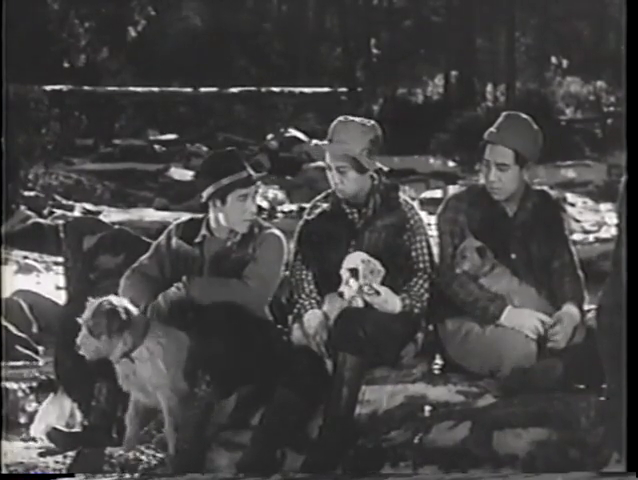
vlcsnap-2019-03-01-23h23m29s757Remembered mostly for his 1938 melodrama Aizen Katsura starring Kinuyo Tanaka and Ken Uehara, Hiromasa Nomura was a prominent studio director at Shochiku in the pre-war period before decamping to Shintoho in 1948 and then to Daiei in the mid-50s before shifting back to Shintoho and then to TV for the final part of his career. Much of his earlier work is presumed lost, but a late silent effort from 1935 Lumberjack and Lady (與太者と小町娘, Yotamono to Komachi Musume, AKA The Layabout and the Town Belle – part of the “yotamono” (layabout) series) seems to showcase a talent for slapstick comedy while perhaps engaging with the concerns of the time in its three heroes’ quest to defend their mountain against an evil upstart from the opposing peak.

The trouble begins when our three “stooges” get themselves stuck on a logging cart and accidentally end up on the other mountain where a rival logging group run by the fabulously moustachioed Torazou (Isamu Yamaguchi) are not exactly happy to see them. Just when things look grim for our heroes, Torazou himself shows up and saves the day, handing them a letter to take back to their boss, Kaheiji (Sojin Kamiyama). The letter, however, contains ill tidings – Torazou wants the hand of Kaheiji’s pretty daughter Kayo (Yoshiko Tsubouchi) and makes plain that he’s not about to take no for an answer.

The early part of the film revolves around the comical exploits of our three bumpkins who are always accompanied by their three adorable dogs. The guys are all, predictably, in love with Kayo but in a dreamy, innocent sort of way – there is no conflict between them over their shared love of the boss’ daughter, only a sort of pure hearted camaraderie and a desire to make sure the best is done for her which means putting paid to the evil Torazou once and for all.

In a mildly interesting twist, it’s clear that the Kaheiji gang are the poor but honest crowd. Our guys dress in torn and battered clothing, remaining unable to pay off their tabs with the wily old lady who runs the local store even after old Kaheiji has given them some money to go out on the town. Torazou’s boys, however, seem to be doing much better. Torazou himself is portly man in early middle age who is always accompanied by his bizarrely tiny henchman who is always ready to repeat whatever it was his boss just said only with additional menace. It’s clear we don’t want Kayo to fall into his clutches lest her innocence be polluted by his grubby little hands. A mustache twirling villain, Torazou is perhaps as close as you might be able to get in 1935 to a personification of the evils of the age as an exploitative capitalist fat cat who thinks he can do as he pleases because he has the most minions and the most friends in handy places. Not much of strategist, he thinks nothing of trying to force himself on the grieving Kayo as she bends over a grave, somehow convinced that this will be a surefire way to win her love and pave the way to a happy marriage.

The action takes an unexpected direction in the second act after a key player mysteriously falls off a cliff in true silent movie fashion. Realising they need to find a “suitable” husband for Kayo (i.e. someone not like them but of a higher social class), the guys run into “Mr. Yamazaki” (Den Obinata) from Tokyo who, unbeknownst to them, is Kaheiji’s chosen successor and a potential fiancé. Kenji brings some Tokyo class out to the mountains along with a little youthful hotheadedness in which he cannot help but refuse to back down in the face of Torazou’s continuous shenanigans – an act which accidentally puts Kayo in danger while he fixates on proving himself the bigger the man.

A light and fluffy escapade, albeit one which perhaps subtly reinforces some of the ideas many maybe seeking escape from, Lady and Lumberjack is largely built around the slapstick adventures of our three idiot heroes which are enlivened by the fresh mountain air and beautiful location shooting. Drawing inspiration from popular Hollywood silent comedies, Nomura perhaps fails to tie his series of set pieces together in a suitably coherent fashion but fully embraces the film’s sense of silly fun (mostly had at the expense of the decidedly dim, if essentially good, lumberjacks) while ensuring a victory for the honest little guy against the forces of selfishness and corruption.


A Woman Crying in Spring (泣き濡れた春の女よ, Hiroshi Shimizu, 1933)

woman crying in spring still 1The later legacy of Hiroshi Shimizu has largely been one of melancholy humanism shot through the unjaded eyes of children who have found themselves for one reason or another excluded from mainstream society. His first talkie, 1933’s A Woman Crying in Spring (泣き濡れた春の女よ, Nakinureta Haru no Onna yo, AKA The Lady Who Wept in Spring) is among his more pessimistic efforts, adopting the trappings of the classic melodrama but repurposing them as a coming of age tale for a woman who is already a mother herself set against the backdrop of the precarious contemporary economy among migrant workers and self-trafficking women. Though the overall tone is one of defeat and resignation in which the only possible salvation lies in learning to accept one’s fate, Shimizu does at least allow his heroines the possibility of a brighter future having actively decided on its course.

The film begins with a collection on men being counted onto a ship, onto which they are eventually followed by a collection of women. The men are going north to Hokkaido to work in the newly opened mines, while the women are following them to work in the newly opened bars. This is not a western, but it is a frontier town being made anew by the ongoing economic flux of ‘30s Japan.

The foreman reads out some rules for migrant workers arriving at the mines which boil down to – no women, no sake, no gambling, and the foreman’s word is law. The first two of these will turn out to have been good advice which was not followed, but it is the foreman himself who kicks off the drama by taking two of the miners, Kenji (Den Obinata) and Chuko (Shigeru Ogura), to the local bar run by one of the boat’s female passengers, Ohama (Yoshiko Okada). Ohama has a small daughter, Omitsu (Mitsuko Ichimura), whom she often neglects while she operates her slightly taboo business. Meanwhile, bar girl Ofuji (Akiko Chihaya) has taken a liking to the handsome and sensitive Kenji who tried to comfort her while she was crying on the boat. Ohama, however, has also taken a liking to him which has created an awkward situation among the women at the bar, though Kenji himself is a solitary sort and perhaps not really thinking of taking up with either woman.

The dilemmas are romantic, largely, but their implications wider. The first “issue” stems from the running of the mine itself which is shown to be inefficient and unsafe. The owners care only for money and not for the men who are all poor migrants unable to secure other, safer work in more palatable industries. The same is largely true of the women at the bar who have “fallen” into this line of work through poverty and lack of other options. Ofuji, possibly new to this world of casual prostitution, weeps on the boat despite having come to terms with her decision while a letter from home letting her know that her mother is seriously ill continues to weigh on her mind. She is touched by Kenji’s kindness and perhaps sees in him a possible escape from the increasingly oppressive nature of her life as a lowly bar girl.

Ohama, however, thinks something similar though her conflict is a slightly different one. Already a mother, Ohama is a middle-aged woman and the bar’s owner, which is to say she is in part the oppressor of these other women and in the business of marketing them to the local miners. Demonstrating his continuing sympathy for lonely children, Shimizu lets Ohama’s daughter Omitsu take centrestage through her mother’s continuing emotional distance. Ohama continually shuts Omitsu out of her bedroom (which is, technically, a place of work) as somewhere which is “unfit for children”, but ignores the inconvenient fact that this world is completely unfit for raising a child. Cast out, Omitsu wanders alone around the physically dangerous mine while she is surrounded by rough men who are often drunk and violent – all dangers her mother refuses to see in being entirely self-involved and overly conscious of the illicit nature of her business.

Ofuji and Ohama both see Kenji as a way out of their dead end lives, but Ohama is gradually made to realise that her opportunity for escape through romance has already passed. Like the later A Mother’s Love, Shimizu seems to suggest that a woman must cease to be a woman when she becomes a mother and that Ohama’s salvation is not a man but in accepting her role as Omitsu’s guardian and protector. Thus, chided by Kenji who has befriended the lonely little girl and noticed how keenly she feels her mother’s coldness towards her, Ohama begins to abandon her romantic fantasies and accept herself as a middle-aged woman with a child. Though this evidently means that she has both the right and the duty to continue on “alone” as a single woman raising a daughter, it is also a mild endorsement of the notion that single women with children must dedicate themselves entirely to childrearing and have lost all rights or hopes for future romantic fulfilment through the slightly taboo idea of “second” marriage.

The Japanese title is noticeably ambiguous and could as easily be a general statement on the unhappy state of 1930s women told through the melancholy tale of two trapped in the Hokkaido snows long after “spring” has supposedly sprung. Ohama, accepting her fate, sacrifices herself for Ofuji, enabling Ofuji’s flight in the knowledge that for her the ship has already sailed. His first talkie, Shimizu makes interesting use of sound in his frequent musical motifs but makes sure to leave space for the mournful sound of the boats departing as a woman watches sadly from an open window while the snow continues to fall silently before her.


The Rainbow Man (虹男, Kiyohiko Ushihara, 1949)

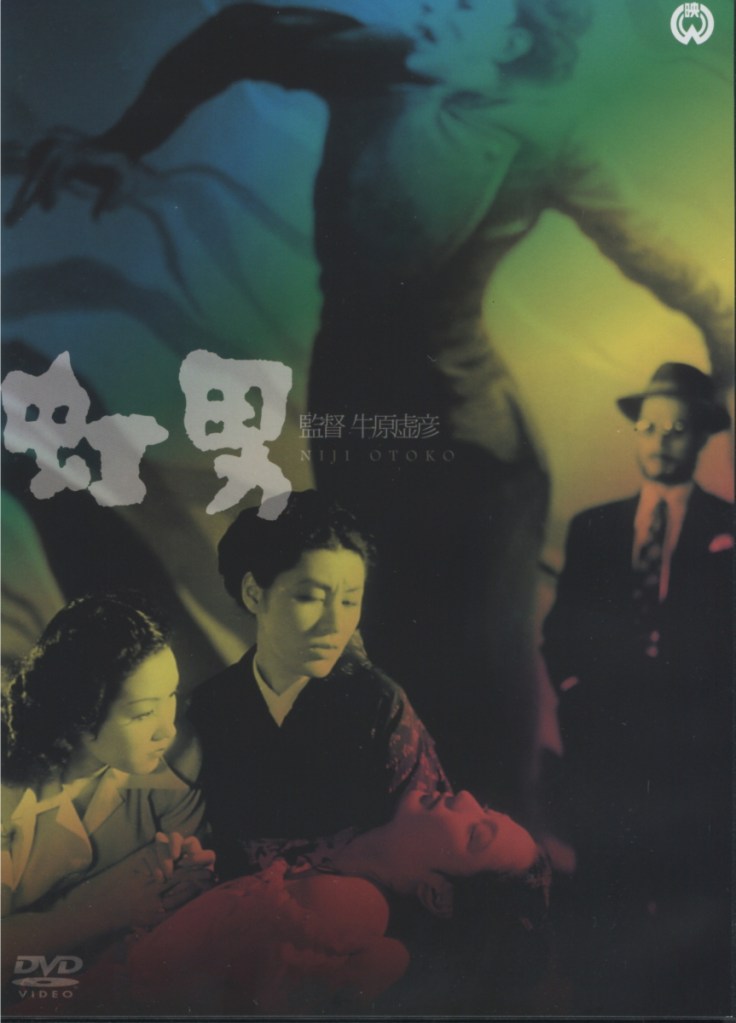
The Rainbow Man“The Rainbow Man” sounds like quite a cheerful fellow, doesn’t he? How could you not be excited about a visit from such a bright and colourful chap especially as he generally turns up after the rain has ended? Daiei have once again found something happy and made it sinister in this 1949 genre effort which is sometimes called Japan’s first science fiction film though there isn’t really any sci-fi content here so much as a strange murder mystery with a weird drug at its centre.

The story begins with lady reporter Mimi beating her rival Akashi to an important scoop but soon after she runs into an old school friend who seems about to become a major story herself. Yurie has been taken in for questioning regarding a mysterious incident in which a rural cottage burnt down with the body of a murdered man hidden inside it. Heading into town with her maid, Yurie was taken ill near the crime scene and the maid left to go get help meaning Yurie can’t account for the hour or so that she was alone there and being so ill her memories aren’t clear either.

The case at hand concerns the extremely strange Maya family which is led by the mad scientist father who insists on studying artificial rainbows despite an ancient curse on his family which makes this a very bad idea. He is joined by his equally mad artist son Katsuto who creates disturbing, psychedelic paintings, younger son Toyohiko who has recently returned after a five year absence, and his second wife who likes Yurie and cats but not much else. The murdered man, Hachiro, was also connected to the family and was the first to fall victim to the curse of the Rainbow Man!

Unlike some of Daiei’s other genre pictures from this period, Rainbow Man (虹男, Niji Otoko) is a little more straightforward and doesn’t feature any particularly complex special effects. That said, the most notable feature of the film is the rainbow effect itself – right before the murders occur, the victims start shouting about the Rainbow Man whilst hallucinating bright rainbow-like colours. At this point, the screen erupts with psychedelic colours in strong contrast to the regular black and white footage of the rest of the movie. As surprising as this effect is now, it must have been truly shocking to the audience of 1949 who were understandably much less used to colour movies let alone the use of colour in films otherwise monochrome.

Though The Rainbow Man is tagged as sci-fi or horror, it’s really much more of a regular murder mystery with a scientific bent. In the end, it all comes down to the effects of the perfectly natural real world drug mescaline which though unusual is not a scientific fiction. The only instance of strangeness is in the bizarre rainbow man curse in which the Maya family is not supposed to be asking questions about rainbows, which is fairly odd thing to be cursed with, but then they are a very odd family in all aspects. There is, however, a strong mad scientist vibe which, mixed with the creepy old Western style house and persistent stormy weather, makes for an excitingly gothic atmosphere.

The special effects were once again designed by Eiji Tsuburaya and, even if this isn’t such a FX heavy film as some of Daiei’s other movies from the period, are always quite exciting. Director Kiyohiko Ushihara does a nice job of keeping the tension up and provides several interesting set pieces filled with unusual compositions which also make good use of gothic lighting.

The Rainbow Man is also quite interesting as an example of female led genre cinema as lady journalist Mimi takes the central investigator spot and is presented as a talented reporter who always seems to outsmart her male counterpart from a rival newspaper, Akashi. The police too, who are also depicted as competent and open minded, take Mimi seriously by valuing her investigative skills and her desire to protect her presumably innocent friend from harm. The Rainbow Man might not be the sci-fi/horror film it is often supposed to be, but it does provide an intriguing murder mystery with gothic overtones and light layer of genre inflected strangeness.


Can’t find any clips of the movie but here’s a recording of the main theme plus some stills:

https://www.youtube.com/watch?v=VxPYAg9U9tI