Room 666

a wim wenders collection v2 Room 666-4preston sturges

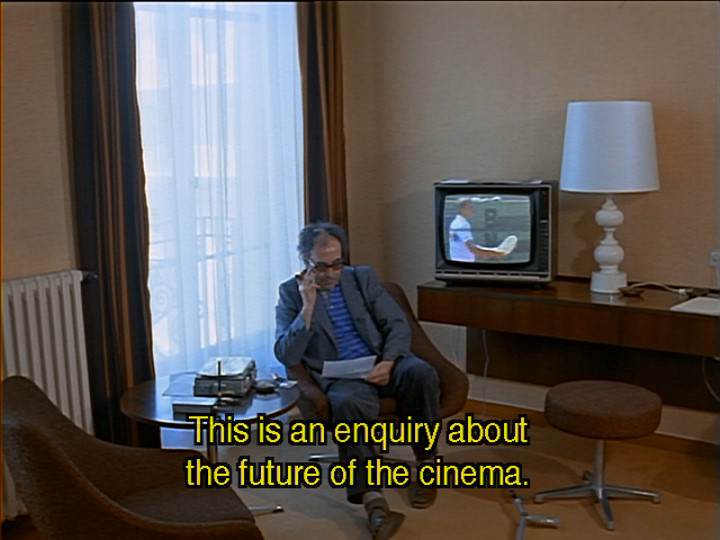
If you’re Wim Wenders and you’re bored at the 1982 Cannes Film Festival, you could amuse yourself by getting a bunch of your director friends to answer a series of pre-set questions about the future of cinema whilst sitting alone (aside from the ever present TV) in front of a static rolling camera in a fairly anonymous hotel room. Luckily, you have a lot of director friends making all sorts of films from all over the world who apparently won’t get that weirded out by sitting alone in an empty room pontificating about the death of cinema as an art form.

This is 1982, the year I was born (though I was born in the winter and Cannes is in the spring so I’m probably on my way somewhere but haven’t quite arrived yet), and this ‘future of cinema’ they’re envisioning is the present in which we now live. It’s depressing how many of the arguments the class of 1982 come up with are the exact same arguments we’re having now – that cinema as an art form has migrated to television and the cinematic output has been reduced to a vague amalgam of the the things Hollywood (in particular) wants it to be. More than one American director, when questioned about his own cinematic habits, admits he rarely watches films himself – he prefers television. In a telling and prophetic fashion, he videotapes films off the TV but then never bothers to watch them. Another recounts the story of friend who’s terrified of this ‘brave new world’ where you’ll be able to buy things through a video camera or, heaven forbid, order a meal from a computer screen! Some are more positive like Werner Herzog who believes the cinema has its own aesthetic which will save it or Antonioni who looks forward to a new age of HD video which is only now coming to pass.

However, aside from the futuristic visions of thirty years ago, it’s almost even more interesting to note how each director chooses to behave inside this strange “diary room”, left all alone except for the silently glaring camera. Jean-Luc Godard is first up – sitting directly facing the camera, smoking in a relaxed fashion and lamenting that his position isn’t the best for seeing the tennis on the TV just beside him. He gets the longest unbroken lecture in which he talks at length about various quite unrelated things until he gets bored and leaves in true Godard fashion – we wouldn’t have him any other way but it’s difficult to tell how seriously he’s taking this. Some directors sit nervously on the edge of the seat, thinking hard about their answers where as others bluster through as though they were at a Hollywood pool party a la Spielberg who laments the weak dollar and the rising cost of filmmaking which he fears will lead to a decline in artistry (which seems kind of ironic). Werner Herzog wins all the prizes for his entrance in which he makes a point of removing his shoes as ‘these aren’t the sort of questions that should be answered with your shoes on’ and being the only director to realise he can turn off the TV behind him! Antonioni gets up and roams around the room as if giving a lecture whereas Rainer Werner Fassbinder (in a late career appearance – he would sadly pass away of a drugs overdose only a few weeks later) gives his answer concisely and leaves almost straight away.

So there we have it, cinema apparently died sometime prior to 1982 and has been subsisting in some kind of bloated zombie state ever since. Art forms are always dying, books died a century ago and yet new ones keep being born which we take to our hearts and minds, nurturing them even though we keep being told there is no hope. The theatre is dead, pop music is dead, classical music and opera? fossilised, perhaps? The presence of the TV set in background is the most ironic use of a TV screen in any movie, just as the directors talk about the threat of television the viewer is constantly distracted by whatever happens to be playing (which includes some kind of Battle of the Planets type thing and Planet of the Apes!) and good old Werner is the only one who thinks to turn it off so we can focus all of our attention on what he has to say. Perhaps the most pressing segment is the one where the director isn’t even present as he’s the subject of an extradition order by the Turkish government but has been able to tape record his contribution prompting Director Wim Wenders to step in front of the camera to explain. This segment highlights how the cinematic art form is still held as a threat and that the true artistic spirit it can exhibit is often suppressed or oppressed by bodies governmental or otherwise. Sadly, this is a problem that has not gone away, nor is it likely to (and unfortunately applies to all art forms equally not just cinema which necessitates higher visibility). Where is the cinema in 2014 then, still trapped like Shrodinger’s cat inside an opaque box where we can’t be certain if it lives or dies? Maybe, it’s making noises every now and then though perhaps it doesn’t sound quite like it used to. The real question though is who wants to save it, and why? Are there people willing to stand up and fight for their art and what exactly is the ‘cinema’ that they want to save?

Watched on Mubi 12th June 2014 (its expiry date). Also available from Anchor Bay in the UK or legal streaming from The Paris Review (among other places).


Secret Screenings: The Imposter 14th August 2012 (Spoiler Free)

This was my first visit to Secret Screenings – a sister strand to Secret Cinema that aims to show as yet unseen films for one night only with the Secret Cinema touch only on a smaller scale. This is, in fact, only the second of such events, the first having been Searching For Sugarman complete with a performance by Rodriguez himself. My first contact with this event was a rather ominous email taking the form of a court summons and asking me to confirm my attendance at the above day time (i.e buy a ticket).

Dutifully doing so I began to wonder what the film might be. Secret Screenings kept up the crime & punishment theme, posting lots prison related links and videos like Johnny Cash at San Quentin etc so I started to think about prison films. However, things started to skew a little and there seemed to be more about truth vs fiction and identification so I started to think about recent films along those lines.

There was only one thing it could be – I was convinced Secret Screenings were going to show us Bart Layton’s The Imposter. The first thing I noticed when I arrived at Conway Court Hall was the Spanish telephone box, being a bit dim though I didn’t really connect it with the film until later. There wasn’t a queue as such when I arrived but I could immediately see the police presence and after a while one of the officers asked us to line up behind the desk. While we were lined up other officers walked up and down the line checking tickets etc and keeping order. There were also more Secret Screenings signs around here including the lyrics to a song.

While I was near the front of the queue a boy, dressed in suspiciously thick clothing for the hot day, came and sat inside the phone box and I immediately knew my guess had been correct as I recognised it from the promotional material for the film. On finally getting inside we had to hand over our questionnaires to the policeman who filed them according to whether we’d selected truth or fiction. The girl in front of me refused to choose and after some arguing he gave in and created a separate pile. The questionnaires didn’t appear to have any further use and nothing more was made of them on the evening.

The ‘court house’ wasn’t open yet so I wandered around and spotted several ‘Missing’ adverts on the walls – more evidence. When the court did eventually open, we had to pass through a metal detector (which wasn’t switched on or connected to anything but was watched over by a policeman who made sure we went one by one). Once inside we were directed to one side for truth and another for fiction. I sat down on the truth side but this didn’t really make any difference in the end and if you came later you obviously just had to sit wherever there was space.

The film was then introduced by someone dressed as a British style barrister complete with wig who warned us we were to sit in judgement on a very complicated case but not to make up our minds until we’d heard the cross-examination of witnesses after the film had finished.

As you might expect if you’ve read anything at all about the film it is an extraordinarily complicated and distressing case. I came to sympathise with everyone and no-one by turns but even though I was aware of being manipulated I did come to sympathise more with the protagonist than anyone else. After all I’m assuming someone checked the injuries he claimed to have sustained as part his ‘story’ and that therefore he must have received these injuries at some point himself. One of the family members does describe him as walking with a limp from the beginning but I suppose he could have been putting it on all along.

After the film finished we were treated to a Q&A with the director and ‘star’ of the film private investigator Charlie Parker which took the form of a cross-examination by the barrister from the introduction. A lot of questions were asked about the level of scripting in the film and use of actors (none, bar brief reconstruction scenes) and whether anyone had been payed to appear in the film (expenses only). Apparently Frederic Bourdin now disowns the film because he thinks it makes him look bad and harangues the director about it on twitter. Charlie Parker talked how he came to be involved in the case – a current affairs program brought him on board to do some investigative work on a piece they were running about the Barclay family. By chance Parker was standing right next to a picture of the boy who disappeared whilst looking at Bourdin and could see what no-one else could see – it wasn’t him (not least because the shape of his ears was all wrong). Parker then became determined to expose Bourdin as an imposter believing him to be some kind of spy (!). Later Parker formulated his own opinion about what must have happened to the real Nicholas Barclay and is continuing to investigate the case although it has been closed by the police department and FBI.

I would urge everyone to see this fascinating documentary for themselves and make up their own mind. It is obviously very upsetting in terms of its subject matter, the boy who went missing at thirteen is of course still still unaccounted for. It’s a very interesting look at deception and why someone was able to get away with something so absurd in this particular case. There are no easy answers and the film certainly raises lots of questions about human nature and the way that it is often exploited.

A Man Vanishes


Imamura’s A Man Vanishes starts out as a documentary surrounding the disappearance of a plastics salesman but eventually becomes a discourse on truth, reality and cinema. We begin in documentary fashion by paying a visit to the police station and having the details of the missing man related to us. We then hear from the man’s fiancée who it seems is very keen to find him, and his family who are worried but also hurt and disappointed. It transpires that Oshima, the absent centre of the film, had many secrets those closest to him did not know. He had previously been suspended from his place of work for embezzlement, though the money had been repaid and the matter settled. He was also a drinker and according to his friends had been expressing doubts about his planned marriage, either because he did not want to marry or because he disapproved of his future sister-in-law’s supposedly ‘immoral’ lifestyle. There is also a rumour he’d been having an affair with a waitress which resulted in a pregnancy.

All this information uncovered and still no real clue as to Oshima’s whereabouts, Imamura takes the bold step of deciding to put the fiancée on television. After this things start to change, the fiancee seems to have lost her zeal to find her intended and, as it turns out, has developed feelings for the interviewer on the documentary (who is actually an actor). Shortly after this they visit a kind of spirit medium who claims the future sister-in-law has poisoned Oshima and disposed of the body because she too was in love with him and did not wish to share.

This ultimately leads to a showdown in a tea house in which the fiancée confronts her sister with the evidence so far and seems unwilling to believe her denials. Except at the climactic moment Imamura orders the set to come down around them and we see they’re just in a pretend tea house room in the middle of a soundstage. This ‘reality’ was fabricated, and other filmmakers will come here to make their fictional truths or untruthful realities. We thought we were watching fact, but it was a construction.

The final scene of the film then follows this up further, Imamura announces what we’re watching is a reconstruction, a fiction, as a man swears he saw Oshima going up the stairs with the sister, which she flatly denies. Another witness then shows up and reaffirms his testimony about having seen Oshima and the sister, and the debate continues with some of the participants becoming quite irate. Can we believe anything we’re seeing here, what or how much of this is truth? What is truth anyway, what is reality?

Was there a man who vanished, are these the people in the his life? If they are, are they themselves or have they begun to play versions of themselves more suited to film? Imamura later said this film might more rightly have been called ‘When a Woman Becomes an Actress’, and it is true that you can see a definite change in the fiancée after her television appearance. Or can you, is it just the way Imamura presents it or has the change really taken places since the woman became a ‘character’ watched by the TV audience? Just as we’ve been unable to reconstruct a accurate picture of Oshima through the descriptions of those who knew him, our vision of the major players, the fiancée and her sister is also clouded by Imamura’s presence.

Imamura’s assertions that objective documentary making is pointless and that greater truth can be displayed through fictional film making are carried right the way through the film. What you largely have are ideas which are then reconstructed by the film maker in the editing suite. It’s a document of real people and real lives but only from one perspective. Fictional film making, in Imamura’s view, is better able to articulate human truths than this patching together of material which cannot be a fully accurate representation.

A Man Vanishes is one of Imamura’s most intriguing films but nevertheless has been unavailable with English subtitles for a long time. Thankfully Masters of Cinema will be releasing a new version on DVD in a couple of months the viewing of which will, hopefully, help to clear things up a little (but then again, maybe not).

Kazuhiro Soda at the Japan Foundation

Today the Japan Foundation played host to an evening with Japanese documentary maker Kazuhiro Soda, author of Campaign and Mental.  Soda gave an informal, interactive talk about his documentary film work beginning with his leaving Japan for New York on a whim and enrolling in film school and then serendipitously seeing an advertisement for a filmmaker who knew Japanese and English which led him into making documentary films for NHK. He came to making his first feature length film on hearing that a friend from university had recently decided to run for public office, this was surprising as his friend has always been quite eccentric – having failed to enter university five times, he never attended classes (despite living on campus) and subsequently was held back three times, he met his wife on the internet and they decided to honeymoon in North Korea(!) – and not only was he standing for office he was doing so with the backing of the staunchly conservative JLPD (the party of  Prime Minister Koizumi, in power at the time). Soda described his alienation from the TV documentary production methods he’d been used to – scripting/narration, shot lists, titles, music etc and his decision to make an observational film, to go in with no research, no preconceptions just to observe with camera and construct the film in the editing room. He then showed a clip from his second film, Mental,  which centered around a very open and moving story from a women who’d suffered some truly terrible things and discussed the ethical difficulties of documentary film making. Although many of the patients at the clinic declined to participate in the film, luckily there were enough who accepted and Soda was very clear about obtaining permission before shooting, taking into account the very sensitive nature of the information. In other cases though it  was possible that permission be sought afterwards where necessary, but permission is always sought and the subjects well being always a very important factor in the filmmaking process. The audience was then treated to a very special preview of Soda’s latest film, Peace, which is screening at the Sheffield documentary festival this weekend. Having intended to make a film about his wife’s grandmother which proved too sensitive and had to be abandoned, Soda was watching his father-in-law feed some stray cats when he noticed a male cat prowling around the circle of others and not being allowed in. The father-in-law explained that this was ‘thief cat’ who would look for an opportunity to steal the food for the others and was thus not very popular, the father-in-law had taken to putting a separate dish of food away from the other cats to stop this happening and thief cat eagerly, if somewhat suspiciously, lapped this up. It struck Soda that this would be a perfect scenario for a film commission he’d recently been offered which needed to reflect the them of peace and acceptance which he’d been unsure whether to accept. Luckily he’d had the camera rolling and decided to include the moment in his next film. The clip shown certainly looked very interesting and we can only hope the film will find an audience after its Sheffield screening.