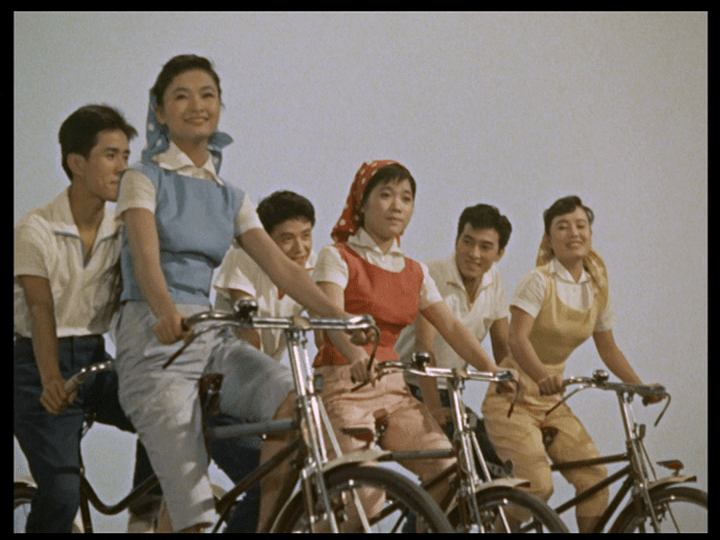
 Romantic Daughters (ロマンス娘, Romance Musume) is the second big screen outing for the singing star combo known as “sannin musume”. A year on from So Young, So Bright, Hibari Misora, Chiemi Eri, and Izumi Yukimura reunite on screen once again playing three ordinary teenagers with a love of singing and being cheerful through adversity. This time the main thrust of the narrative is the girls’ friendship with a wealthy boy and his grumpy grandpa who takes a liking to them.
Michiru, Rumiko, and Eriko are three ordinary teenage girls in contemporary ‘50s Japan. Very close friends, they even have part time jobs working together at a local department store. One day Michiru decides to return some change a customer forgot to take with him directly to his home and the three girls are rewarded for their extremely high commitment to customer service by getting their pictures in the paper! This brings them to the attention of their friend Kubota’s grandfather who is very impressed with their honesty. He invites them round to his mansion where they enjoy a mini Western style feast and play a few songs on the piano. Shortly after, a man in a bow tie turns up and says he’s managed to find grandpa’s long lost daughter only she has unfortunately passed away leaving a little girl, Yukiko, with no one to look after her. Grandpa isn’t quite convinced by this story, but begins spending time with the sad little girl to try and see if she really could be his granddaughter.
Just like So Young, So Bright, Romantic Daughters is not an integrated musical but an ironic comedy with frequent musical interludes. There are plenty of excuses found for the girls to suddenly start singing, whether it’s that they’re involved in a local festival, entertaining an old man, or trying to cheer up a sullen little girl. Also like the first film, the girls (and Kubota) attend a theatrical performance but this time they do actually see “themselves” – that is Michiru, Rumiko, and Eriko head off to see Izumi, Hibari, and Chiemi. They even sit underneath a large poster of their real life counterparts in the lobby completely confusing one of their admirers who can’t believe his luck! Once again they each get a production number with Izumi getting the “sexy” routine this time which is a little bit On the Town. Chiemi gets an elegant set piece with a ball gown and a fairytale palace behind her, but Hibari’s number is just kind of nuts as she cross dresses to play a male samurai who ends up “saving” Michiru from the attentions of Chiemi who is also playing a guy complete with bald cap and top knot.
Kubota seems most interested in Rumiko and the other two girls have some kind of relationship with two other guys who work at an amusement park but are completely forgotten about for most of the film until they’re needed to fill the other two rear seats for the finale which is a trio number featuring the three girls riding bicycles with the guys on the back. At one point the girls and Kubota decide to take the little girl to the amusement park to try and cheer her up, which they eventually do by venturing into a haunted house (actually quite scary) where Chiemi decides to break protocol by using some of the judo moves she was seen practicing earlier on a couple of the ghosts and ghouls to be found in the psychedelic horror show.
Once again what’s on offer is cute and fluffy fun with some silly comedy and impressively choreographed production numbers thrown in. Like the first film there are also a number of recurring subplots of single mothers, long lost fathers, and this time also the problem of the little girl who may or may not be the granddaughter but by the time they start to reach a conclusion it may be too late to undo all the bonding that’s begin to occur in any case. Cinematic soul food, Romantic Daughters makes full use of its vibrant Eastman colours for a Hollywood inspired elegant musical feast that is undoubtedly a lot of empty calories but nevertheless extremely satisfying.
Can’t find any clips from the film but here is the English language US pop track sung by Izumi Yukimura in the movie in its release version:
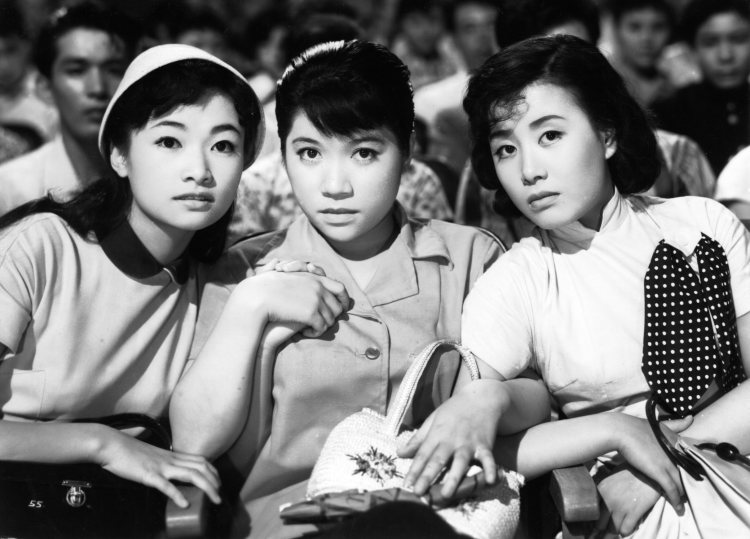 Pop stars invading the cinematic realm either for reasons of commerce, vanity, or just simple ambition is hardly a new phenomenon and even continues today with the biggest singers of the era getting to play their own track over the closing credits of the latest tentpole feature. This is even more popular in Japan where idol culture dominates the entertainment world and boy bands boys are often top of the list for any going blockbuster (wisely or otherwise). Cycling back to 1955 when the phenomenon was at its heyday all over the world, So Young, So Bright (ジャンケン娘, Janken Musume) is the first of four so called “three girl” (Sannin Musume) musicals which united the three biggest female singers of the post-war era: Hibari Misora, Chiemi Eri, and Izumi Yukimura for a music infused comedy caper.
 Windows on Worlds