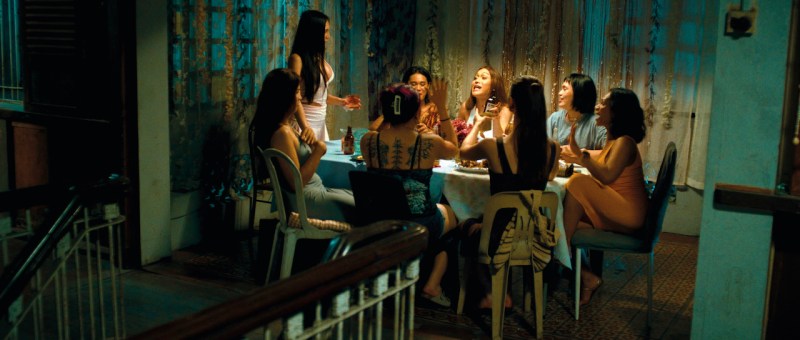
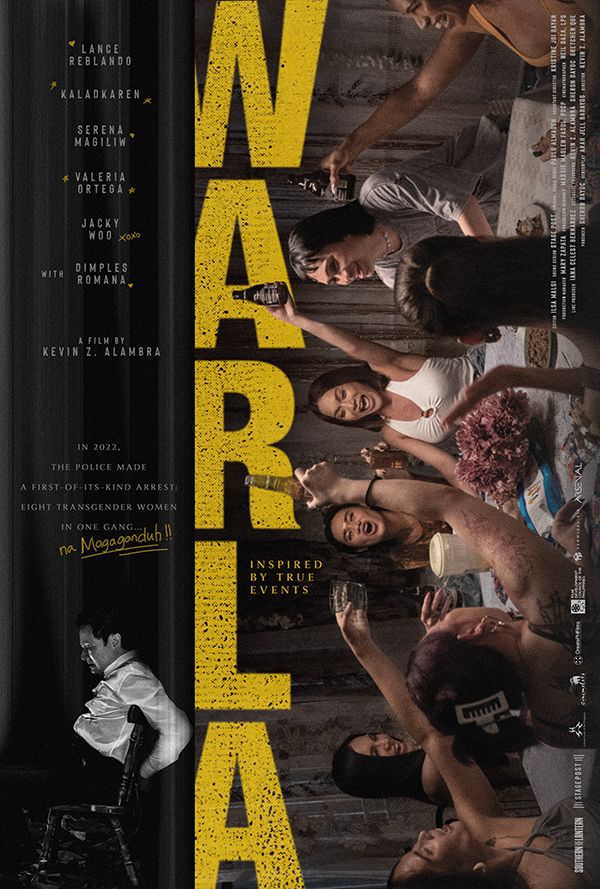
A group of transwomen attempts to turn the tables by kidnapping wealthy foreign businessmen and blackmailing them to fund their surgery, but a newcomer to the group forces them to confront their hypocrisy in turning the violence inflicted on them back on the patriarchal society. Inspired by a real life case, Warla explores the marginalisation of transpeople in a country so imbued with Catholicism and toxic masculinity as the Philippines where all they really have to rely on is each other.
The violence of that society is evident from the very first frames as a body begins to drift into view. Mother Leila has been murdered in a brutal fashion for the crime of existing. Kit-Kat (Lance Reblando), rejected by her conservative father and brother, is cast adrift with no other means of affirming herself. When her father kicks her out, she’s taken in a family of transwomen led by Joice (KaladKaren), but what she didn’t know is that their business model is meeting foreign businessmen on dating apps, kidnapping them, beating them up, and blackmailing them by threatening to tell their wives, families, and employers. In doing so, they’re turning the prejudice they face back on those who rejected them, but as Kit-Kat points out, it’s as if they’ve joined the system rather than beating it. She doesn’t want anything to do with the violence, with ends up partially going along with because it she wants to remain part of the group and has nowhere else to turn.
As Joice points out, having nowhere else to turn is why they’re doing this. There is no social support for them in the Philippines and they struggle to even get casual jobs in fast food restaurants just by virtue of being transpeople. Barbie Ann (Serena Magiliw) has a son from her previous marriage which ended when she decided to embrace her trans identity, but her former wife, Kate (Francesca Dela Cruz), has met someone else and wants to move in with him. Roger (Jel Tarun) is evidently a much more conservative man and is already beginning to distance Kate from Barbie by banning her from the house. When she tries to talk to him on the street, he tells her that she’s filling her son’s head with a lot of nonsense about how people like her are okay which will lead to him getting bullied. He thinks that, as he’s accepted the child and will now be providing for him, he should have a greater say over what he’s taught to think. Barbie’s existence is dangerous precisely because of what she was teaching son, challenging the social order by undercutting the patriarchy.
Ning (Valeria Kurihara), meanwhile, struggles to maintain a relationship because she wants to wait until she’s had her surgery to become intimate. Experiencing extreme dysphoria, she doesn’t want her partner to see the part of herself that she hates, but he gets fed up and leaves her for a cis woman. He tells her that their relationship was always doomed because his father wouldn’t accept her. With his new girlfriend, he can post pictures on social media and doesn’t feel the need to sneak around. Getting the money together to go to Thailand for her surgery becomes an obsession in part so that she can get Lance back, but also so that she will finally feel whole. Barbie also wants the surgery to avoid the kind of violence she inflicts on their victims. Kit-Kat says she isn’t interested in surgery which places her at odds with other members of the group such as Barbie who suggests it’s alright for her because she presents as more obviously feminine and so isn’t subject to the same levels of violence and rejection.
Though they may feel that they’re only playing these men at their own game, they bite off more than they can chew with a short-fused Japanese businessman who talks like a yakuza and flies off the handle with wait staff. Most of the other men gave in quite quickly because of the shame they feel and the fear they have of their transgressions being exposed, but Isamu (Jacky Woo) was like them in that he had nothing left to lose and soon realised he’d been set up. In the end, Joice is forced to make the ultimate maternal gesture to try and save her girls, while Kit-Kat must reckon with where this dark path has taken her. Though she knew that her mother loved her but was unable to stand up to her father’s patriarchal violence, she eventually finds solace in the fact that she can still hold her hand and call her by her true name even if the rest of the world refuses to recognise her.
Warla screened as part of this year’s BFI Flare.
Trailer (English subtitles)
 Windows on Worlds