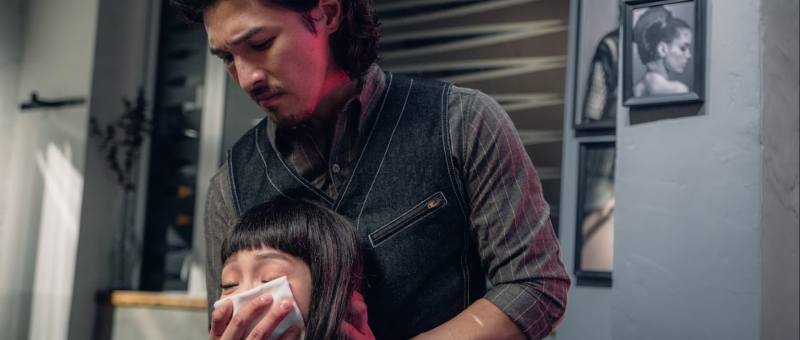

Tales from the Occult: Body and Soul (失衡凶間之罪與殺, Frank Hui, Daniel Chan Yee-Heng, Doris Wong Chin Yan, 2022)

The second in a series of horror-themed anthologies, Tales From the Occult: Body and Soul (失衡凶間之罪與殺) takes fairytales as its theme but truth be told none of the episodes has very much in common with the most well known version of their respective stories. What they do have in common is a rather grisly view of the nighttime city perhaps inspired by classic Cat III shockers though mediated through a strong sense of irony. “I like it a bit dark” one of the heroes exclaims and it’s certainly a sentiment shared by each of the three directors. 

The first instalment, Frank Hui’s Rapunzel finds former idol star Maggie (Michelle Wai) trying to prop up her flagging career while constantly written off as a has been best known for a cheesy pose in a dated shampoo commercial. Her manager sends her to an obnoxious rich kid’s birthday party where the women are so young they weren’t even born when she was a star and relentlessly mock the weird “aunty” and her “retro” movies. One of the guys sets fire to her hair which is even more of a problem for her because she’s supposed to have an important meeting with a producer in the morning and he’s not going to hire her with a less than perfect appearance. Maggie’s desperation eventually draws her into the orbit of a hair fetishist serial killer from whom she must try to escape while attempting to rescue her hair and save her career. A secondary strain of social community places the killer’s creepy all night salon in a building that’s about to be torn down for urban renewal leading him to be bullied by gangsters to move out but not wanting to for obvious reasons. Maggie meanwhile eventually makes a surprising decision in order to fix herself which is in its own way cannibalistic at least of the female image when it comes to the idea of perfect hair. 

You couldn’t say that Daniel Chan’s Cheshire Cat really has that much to do with the classic Alice in Wonderland character either, though Chan does throw in something like a Mad Hatter’s tea party and leave his heroine trapped in a cage suspended above the air. Nora (Cecilia Choi Si-Wan) works in a cat rescue centre and is particularly upset by the idea of people hurting her feline friends, especially as her own cat Bobo was recently murdered. After agreeing to rescue a kitten trapped under a van she unwittingly passes into a grim haunted house adventure with a death metal vibe. In a series of atmospheric shots, Chan frames Hong Kong in an angry red tint capturing the increasing resentment of Nora as she continues to take out her rage on those who would harm poor defenceless creatures. 

Doris Wong’s The Tooth Fairy perhaps ironically subverts its title while toying with the interplay of sadomasochistic fetishes. Dental nurse Sammi (Karena Lam Ka-Yan) is being relentlessly harassed at work by sleazy dentist Steve (Tommy Chu Pak-Hong) who won’t take no for an answer. On her way to the bank, she comes across a fight between two young men in which one bites off the other’s ear, and invites the biter to her clinic to get his swollen cheek looked at. Steve, however, does not take kindly to this after seeing he and Sammi flirt with each other, extracting a healthy tooth without anaesthetic as if teaching him a lesson, but clearly deriving sexual pleasure from his pain just like the sadistic killer on the news. In any case events soon escalate following some cake-related triggering and not just for its capacity to ruin your teeth. The killer may claim they’re setting people free from their earthly suffering but is clearly in part at least killing for the thrill. 

In any case, danger seems to lurk behind every corner with potential serial killers apparently all around us as the heroes find out during their various quests. Their stories may not have much in common with their inspiration but each have a strangely ironic quality curiously mimicking B-movie cinema in terms of colour palette and production design, Frank Hui eventually opting for a neon-coloured nightmare lair while Nora and the gang chase through a haunted Hong Kong and Sammi does her best to extricate herself from the unwanted attentions of her sleazy boss who is perhaps the real monster in the shadows. 


Trailer (English subtitles)

Trivisa (樹大招風, Frank Hui & Jevons Au & Vicky Wong, 2016)

Trivisa posterIt’s worth just taking a moment to appreciate the fact that a film named for the three Buddhist poisons – delusion, desire, and fury, is intended as a criticism of Hong Kong as an SAR that revels in the glory and subsequent downfall of three famous criminals who discover that crime does not pay right on the eve of the handover. Mentored by Johnnie To, Trivisa (樹大招風) is directed by three young hopefuls discovered through his Fresh Wave program each of whom directs one of the film’s three story strands which revolve around a trio of famous Hong Kong criminals.

Back in the ‘80s, as Mrs. Thatcher delivers her pledges on the Hong Kong handover, King of Thieves Kwai Ching-hung (Gordon Lam) gets stopped by a random police patrol, kills the officers, and then has to fake his identity to escape. 15 years later he’s a petty mobile phone trafficker dreaming of pulling off a big score. Meanwhile, Yip Kwok Foon (Richie Jen), once known for his AK47 brandishing robberies is a “legitimate businessman” smuggling black market electronics into Hong Kong and bribing Mainland officials to do it, while Cheuk Tze Keung (Jordan Chan) is a flamboyant gangster revelling in underworld glory and dreaming of eternal fame.

Rather than weave the three stories into one coherent whole or run them as entirely separate episodes, the three strands run across and through each other only to briefly reunite in the ironic conclusion. The most famous of the three real life criminals, Kwai Ching-hung’s arc is perhaps the most familiar though rather than fighting an existential battle against his bad self, Kwai’s quest is to regain his title as Hong Kong’s most audacious thief. To do this, he’s reunited with an old friend and comrade in arms who’s retired from the life and married a Thai woman with whom he has an adorable little daughter. Unbeknownst to him, Kwai has not come for old times’ sake but is taking advantage of the fact that the family live directly opposite his latest score. Employing two Mainland mercenaries, Kwai has his eyes on the prize but his friend is wilier than he remembered, is quickly suspicious of Kwai’s friendship with his daughter, and has his suspicions confirmed when he finds his kid’s backpack full of guns.

Yip’s story, by contrast, is one of diminished expectations and ongoing financial woes. An early scene at a restaurant finds Yip in the company of Mainland officials to whom he must scrape and bow, placating them with various bribes and engaging in the strange trade of precious vases which seems to pass as currency among corrupt civil servants. Corporate shenanigans and business disputes, however, are no substitute for good old fashioned firefights and Yip’s frustration with his new career is sure to lead to some kind of explosion at some point in time.

Cheuk becomes the lynchpin of the three as he takes an advantage of a rumour that the three “Kings of Thieves” are getting together to plan a giant heist to track down the other two and see if he can make it work for real. The most successful and happiest in his life, Cheuk has made his fortune out of ostentatious crime – kidnapping the sons of the extremely wealthy for hearty ransoms. He is, however, bored and dreams of making a giant splash which will ensure his name remains in the history books for evermore – i.e., blowing up the Queen.

Facing the approaching handover, each is aware the world will change, unsure as to how they’re in the process of trying to secure their futures either way. Kwai wants one last heist, Yip has already begun courting Chinese business, and Cheuk just wants to be the face in all the papers across the entire Chinese world. Kwai’s sin is “desire” – he wants one last hit as a criminal mastermind and he’s willing to take advantage of his friend (and even his friend’s young daughter) to get it, Yip’s sin is “fury” as dealing with constant humiliation leaves him longing for his AK 47, and Cheuk’s failing is “delusion” in his all encompassing need to be the big dog around town, all flashy suits and toothy grins. On the eve of the handover they all meet a reckoning – betrayal, a stupid and pointless death, or merely ridiculous downfall.

The heyday of crime has, it seems, ended but that’s definitely a bad thing, laying bare a change in dynamics between nations and a decline in the kind of independence which allows the flourishing of a criminal enterprise. Bearing To’s hallmark in its tripartite structure, ironic comments on fate and connection, and eventual decent into random gun battle, Trivisa is a ramshackle exploration of a watershed moment in which even hardened criminals must learn to live in a brave new world or risk being consumed by it.


Screened at Creative Visions: Hong Kong Cinema 1997 – 2017

Original trailer (English subtitles)