Wild Search (伴我闖天涯, Ringo Lam Ling-Tun, 1989)

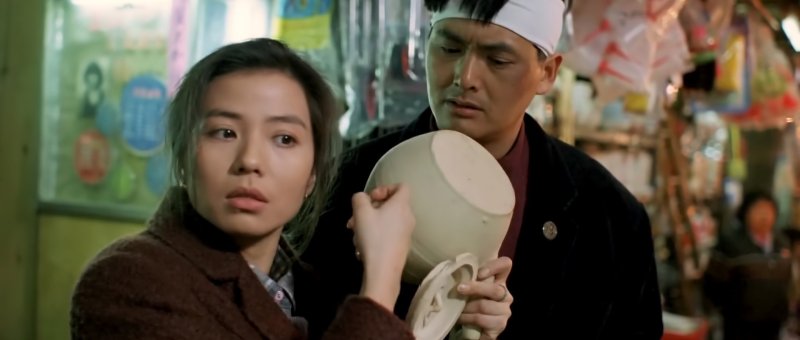
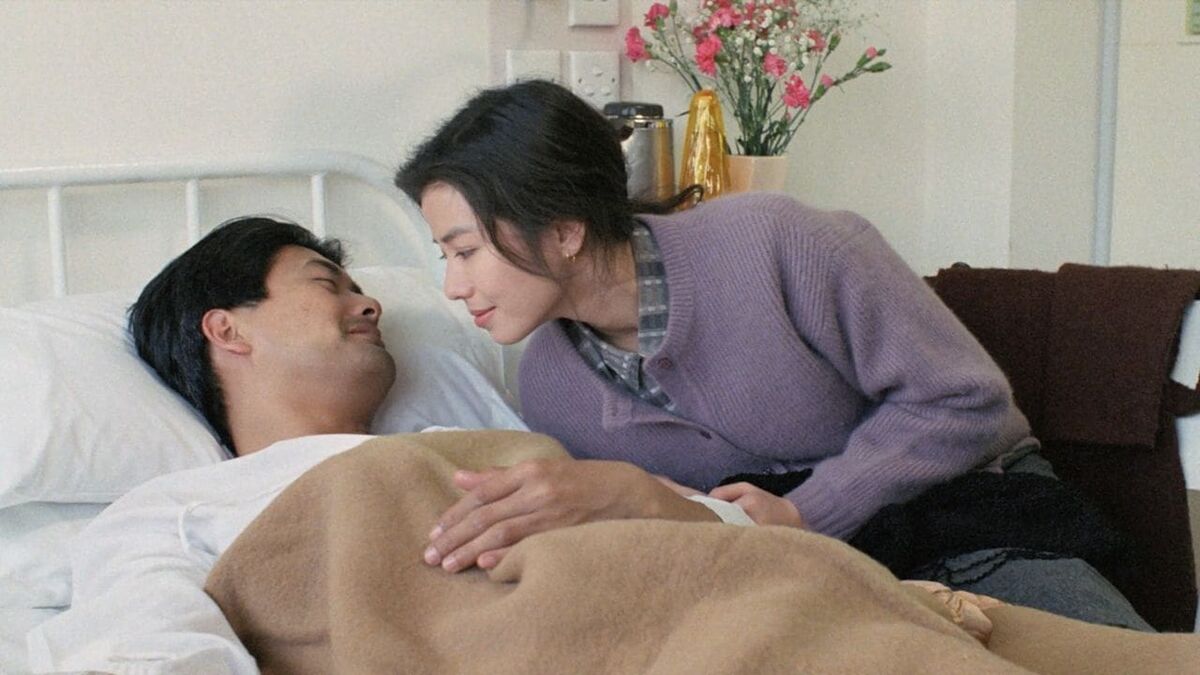
Loosely inspired by Peter Weir’s Witness, Ringo Lam’s Wild Search (伴我闖天涯) sees Chow Yun-fat’s melancholy cop falling for Cherie Chung’s isolated village girl while chasing down arms dealers in a changing Hong Kong. Just as Mew-Mew enters the more traditional world of the inland Chinese community, Hong Kong also seems to be facing incursions from the outside while becoming richer and more sophisticated as a burgeoning financial centre.

This clash of cultures can perhaps be seen in the relationship between Elaine (Elaine Jin), an antiques dealer from the inland Chinese village, and Hung (Paul Chun), a Chinese-Vietnamese gangster with friends in high places. Suckered into using her antique shop as a front to smuggle guns in from Vietnam and sell them on to Japanese yakuza, when is Elaine killed by one of her own men during a police raid Hung denies all knowledge of her and refuses to accept paternity of her now orphaned daughter Ka-Ka. He says that he has plenty of mistresses and suggests to Mew-Mew that he is essentially untouchable thanks to his connections. 

Hung appears to be the source of corruption both the inland Chinese community and Hong Kong as a whole. Elaine’s father has disowned her because of her relationship with Hung and having a child out of wedlock. Despite her orphanhood, the grandfather (Ku Feng) rejects Ka-Ka, refusing to speak to her or waving a knife in her face and screaming that he’ll sell her if she doesn’t stop crying. Mew-Mew first bonds with her because she’s the only witness in his arms dealing case, but also adopts a quasi-paternal position over her largely because no one else is willing to do so. He also draws closer to Elaine’s sister Cher (Cherie Chung Chor-hung) who is caring for Ka-ka, even if the implication is that she is the pure-hearted innocent uncorrupted by contemporary capitalism unlike her sister who went to the city.

But there are incursions and corruptions even within the Inland Chinese community as Cher is pressured by her ex-husband who spent a long time in China where he had another woman and a family he kept secret from Cher. Now he’s insistent on moving back into the family home despite being officially divorced, and becomes increasingly paranoid about Cher’s relationship with Mew-Mew. There might then be a minor irony in the fact that Leung had a wife and son in China, while Mew-Mew is also a widower who lost his wife and son and was originally wary of embarking on another romance. 

Nevertheless, there is a kind of healing that takes place through these interconnected relationships that eventually squeezes the Vietnamese gangsters out. Though he resented Ka-ka as a symbol of all the ways his daughter had wronged him, the grandfather eventually comes to love and accept his grandaughter. Leung, meanwhile, ends up going completely crazy when he begins to realise that Cher has chosen Mew-Mew but eventually concedes defeat on witnessing Mew-Mew’s selflessness when he rescues him from the marauding gangsters even though he’d just been trying to kill him with a meat cleaver a few moments ago. Hung, by contrast, is laid low when his men start turning against him in the hope of better treatment.

Somehow, this world that had seemed broken beyond repair in the opening scenes in which the Christmas lights and neon signs are juxtaposed with scenes of women escaping violent men and bloodied corpses in the street, has been made whole again and not least through the repeated refrains of Teresa Teng’s The Moon Represents My Heart along with shots of the moon above Hong Kong that echo the innocence of the romance that arises between Mew-Mew and Cher. To that extent, the action scenes may play second fiddle to the drama but are also themselves visceral and kinetic from the high-speed car chases to the final showdown in which the gangsters make it all the way to the village as Mew-Mew’s romantic and professional lives collide in a bloody fight to the death with the twin forces of their corruption. While the gangsters might be willing to unleash terror in public places little caring for the lives of ordinary people, Mew-Mew and friends will seemingly counter that with compassion and solidarity while protecting all that they hold dear.


Trailer (Traditional Chinese / English subtitles)
Trivisa (樹大招風, Frank Hui & Jevons Au & Vicky Wong, 2016)

Trivisa posterIt’s worth just taking a moment to appreciate the fact that a film named for the three Buddhist poisons – delusion, desire, and fury, is intended as a criticism of Hong Kong as an SAR that revels in the glory and subsequent downfall of three famous criminals who discover that crime does not pay right on the eve of the handover. Mentored by Johnnie To, Trivisa (樹大招風) is directed by three young hopefuls discovered through his Fresh Wave program each of whom directs one of the film’s three story strands which revolve around a trio of famous Hong Kong criminals.

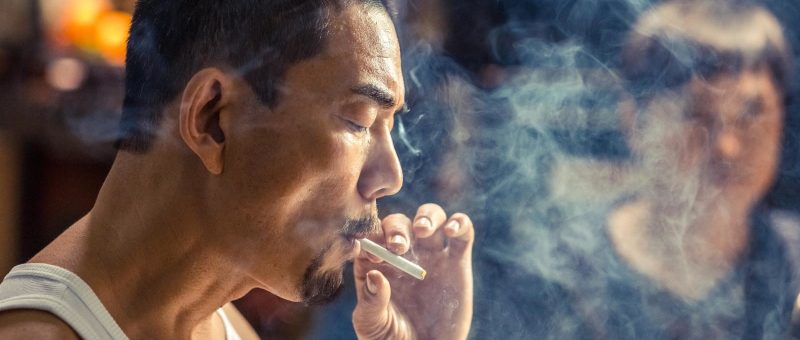
Back in the ‘80s, as Mrs. Thatcher delivers her pledges on the Hong Kong handover, King of Thieves Kwai Ching-hung (Gordon Lam) gets stopped by a random police patrol, kills the officers, and then has to fake his identity to escape. 15 years later he’s a petty mobile phone trafficker dreaming of pulling off a big score. Meanwhile, Yip Kwok Foon (Richie Jen), once known for his AK47 brandishing robberies is a “legitimate businessman” smuggling black market electronics into Hong Kong and bribing Mainland officials to do it, while Cheuk Tze Keung (Jordan Chan) is a flamboyant gangster revelling in underworld glory and dreaming of eternal fame.

Rather than weave the three stories into one coherent whole or run them as entirely separate episodes, the three strands run across and through each other only to briefly reunite in the ironic conclusion. The most famous of the three real life criminals, Kwai Ching-hung’s arc is perhaps the most familiar though rather than fighting an existential battle against his bad self, Kwai’s quest is to regain his title as Hong Kong’s most audacious thief. To do this, he’s reunited with an old friend and comrade in arms who’s retired from the life and married a Thai woman with whom he has an adorable little daughter. Unbeknownst to him, Kwai has not come for old times’ sake but is taking advantage of the fact that the family live directly opposite his latest score. Employing two Mainland mercenaries, Kwai has his eyes on the prize but his friend is wilier than he remembered, is quickly suspicious of Kwai’s friendship with his daughter, and has his suspicions confirmed when he finds his kid’s backpack full of guns.

Yip’s story, by contrast, is one of diminished expectations and ongoing financial woes. An early scene at a restaurant finds Yip in the company of Mainland officials to whom he must scrape and bow, placating them with various bribes and engaging in the strange trade of precious vases which seems to pass as currency among corrupt civil servants. Corporate shenanigans and business disputes, however, are no substitute for good old fashioned firefights and Yip’s frustration with his new career is sure to lead to some kind of explosion at some point in time.

Cheuk becomes the lynchpin of the three as he takes an advantage of a rumour that the three “Kings of Thieves” are getting together to plan a giant heist to track down the other two and see if he can make it work for real. The most successful and happiest in his life, Cheuk has made his fortune out of ostentatious crime – kidnapping the sons of the extremely wealthy for hearty ransoms. He is, however, bored and dreams of making a giant splash which will ensure his name remains in the history books for evermore – i.e., blowing up the Queen.

Facing the approaching handover, each is aware the world will change, unsure as to how they’re in the process of trying to secure their futures either way. Kwai wants one last heist, Yip has already begun courting Chinese business, and Cheuk just wants to be the face in all the papers across the entire Chinese world. Kwai’s sin is “desire” – he wants one last hit as a criminal mastermind and he’s willing to take advantage of his friend (and even his friend’s young daughter) to get it, Yip’s sin is “fury” as dealing with constant humiliation leaves him longing for his AK 47, and Cheuk’s failing is “delusion” in his all encompassing need to be the big dog around town, all flashy suits and toothy grins. On the eve of the handover they all meet a reckoning – betrayal, a stupid and pointless death, or merely ridiculous downfall.

The heyday of crime has, it seems, ended but that’s definitely a bad thing, laying bare a change in dynamics between nations and a decline in the kind of independence which allows the flourishing of a criminal enterprise. Bearing To’s hallmark in its tripartite structure, ironic comments on fate and connection, and eventual decent into random gun battle, Trivisa is a ramshackle exploration of a watershed moment in which even hardened criminals must learn to live in a brave new world or risk being consumed by it.


Screened at Creative Visions: Hong Kong Cinema 1997 – 2017

Original trailer (English subtitles)