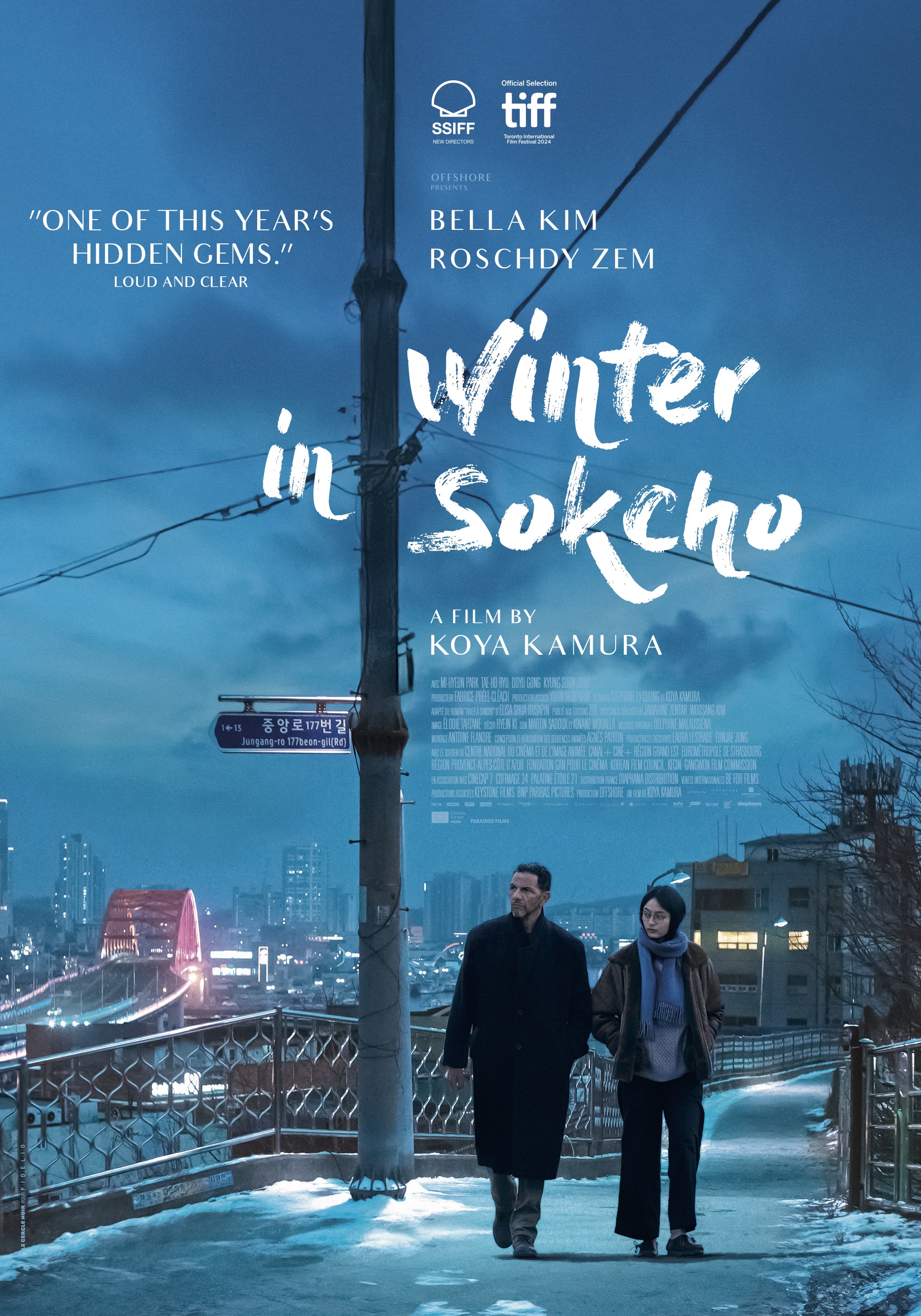
Winter in Sokcho (Hiver à Sokcho, Koya Kamura, 2024)

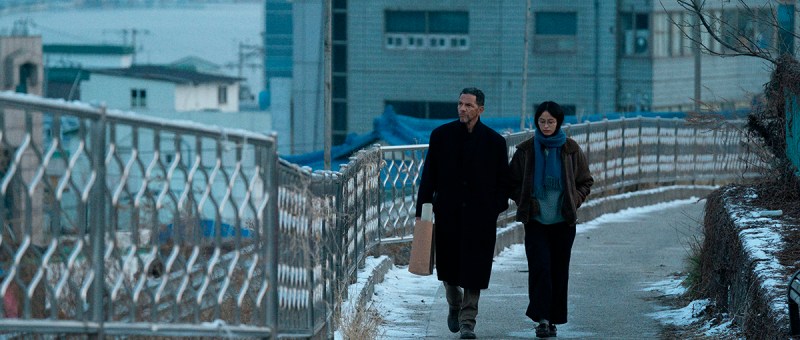
A young woman is awakened from a kind of spiritual hibernation by the unlikely arrival of an incredibly brusque French artist in Koya Kamura’s adaptation of the Elisa Shua Dusapin novel, Winter in Sokcho. Like many, Soo-ha (Bella Kim) is waiting for spring, though it’s less this place that has her feeling trapped than an inability to find her place within it, or indeed anywhere, as she struggles with her own identity and the unanswered questions about the father she never knew.

In any case, it seems clear that Soo-ha as begun to resent herself on some level and is unhappy in her long-term relationship with a high school boyfriend, Joon-ho (Gong Do-yu), an aspiring model. It’s not clear why shy returned to Sokcho after studying French and Korean literature in Seoul, but she otherwise lives her life in peaceful monotony working at a small boarding house where the owner, Mr Park (Ryu Tae-ho), has recently lost his wife and is therefore in need to practical and emotional support. One night a week she spends with her mother (Park Mi-hyeon), a fishmonger specialising in fugu, though there’s a frostiness and frustration to their relationship in which neither seems quite satisfied with the other’s life choices. 

Soo-ha repeatedly asks her mother why she never attempted to look for her father, a Frenchman who worked in the fishing industry, though her mother doesn’t really want to talk about, it leaving Soo-ha with unresolved doubts and questions about her past. Her interest in French literature may be a way of trying to explore this side of herself in the absence of a guide, though the attempts at connection a frustratingly one-sided. When a Frenchman suddenly turns up at the boarding house, Mr Park encourages her to use her skills “the one time they’re useful”, though she herself is reluctant, giving Yan (Roschdy Zem) the smallest room in the adjacent annexe like a thought paused for later.

Yan asks her to show him her Sokcho, but as he later says, he’s just a tourist and like the father she never met is just passing through. There may be something a little exploitative in his working visit for though he’s come to draw inspiration from this place, he is willing to give almost nothing to it. He refuses to eat the food that Soo-ha cooks at the boarding house and instead badgers her to take him to restaurants while finding little to like there either. As his incredibly outdated, paper driving licence isn’t valid in Korea, he talks her into taking him to the DMZ which seems to echo the liminal space that exists between them. Soo-ha talks about how sad it is that people still yearn to be reunited with their relatives all these years later, though Yan is indifferent and later mentions a son that it seems he may rarely see. But as he tells her, she may be looking in the wrong place if it’s a deeper connection that she’s seeking or searching for something that will unlock the secrets of herself.

There are reasons for her to feel displaced even in Sokcho given that her unusual height makes her stand out as the nickname “beanpole,” makes plain. Her mother nags her for never eating properly or enjoying her food which may be another expression of her listlessness, but also reminds her not to eat too much and get fat. Joon-ho tells her get plastic surgery, as do a few other people, and though it’s even more insensitive and troubling given that Soo-ha’s father was French. It’s as if they’re telling her to erase these parts of herself, as if she were not “fully” Korean and should become so by adjusting her jawline and the shape of her eyes. Soo-ha’s internal questioning is expressed in brief animated sequences in the style of Yan’s ink paintings as she tries to conjure the image of herself.

There’s a woman at the guest house who’s there recovering from extensive plastic surgery that will give her a whole new face. She sits in the dining area, simultaneously anonymous and instantly identifiable by her bandaged face. Her story is never revealed, so it’s impossible to say whether her decision was motivated by a desire for conformity and conventional beauty or to become more herself and have her outside reflect the person she feels herself to be. Sokcho is also undergoing a process of renewal, as high-rise office blocks spring up everywhere and the traditional quality of the streets disappears as if this urbanisation were creeping up on Soo-ha and taking from her even the anchor of this place which no longer quite exists. 

Joon-ho assumes they will move back to Seoul together when his career takes off because “who doesn’t want to get out of Sokcho?” But Soo-ha may be beginning to feel that perhaps this place might suit her after all. A few cosmetic upgrades could breathe new life into the old-fashioned boarding house and brighten an otherwise gloomy existence. While showing Yan around town she describes a local legend, or perhaps concocts one for the occasion, about a bird who wanted to fly above the clouds but couldn’t. She, meanwhile, may have begun to soar amid the arrival of spring, finally ready to break out of her self-imposed winter in having discovered a way to become more herself rather than what others perceive her be.


Trailer (English subtitles)

Flowing Stories (河上變村, Jessey Tsang Tsui-shan, 2014)

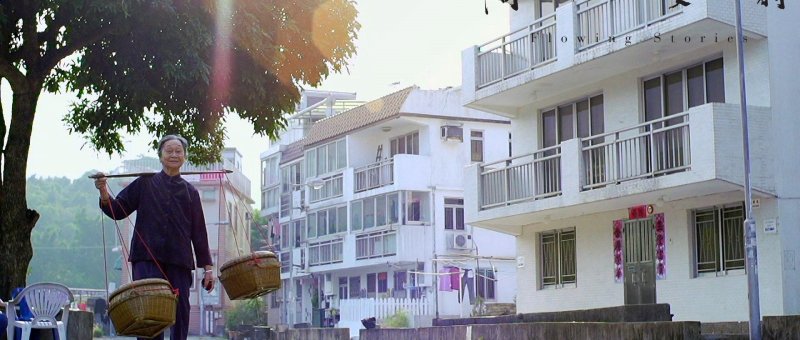
Shooting in her own home village, documentarian Jessey Tsang Tsui-shan spins a meandering tale of diaspora and dislocation in her 2014 documentary Flowing Stories (河上變村). Beginning in the small village of Ho Chung in which almost all of the residents have gone abroad to find work, the film charts the paths of migration along with the hardships discovered both at home and away while centring the village festival held every 10 years as a point of reunion as sons and daughters return in celebration of an idealised village life the modern world has denied them. 

Tsang begins her tale with Granny Lau, an elderly lady who lived next-door to her when she was a child whose relatives often brought her souvenirs from Europe. As Granny Lau explains, her life was always hard. She married Grandpa Lau at 19 in an arranged marriage but he left to find work abroad soon after, returning only a handful of times in 20 years during which they had several children Granny Lau had to raise alone. She describes her familial relationships as without affection, her husband a virtual stranger to her while she also had to work in the fields leaving her disconnected from her sons and daughters. Later, many of them traveled to Calais to work in the restaurant Grandpa Lau had set up with the intention of reuniting his family in France. 

The children who went also talk of hardship, being unable to speak the language and mixing only with other migrants from Hong Kong many from the same the village. Fourth daughter Mei Yong remarks that only the thought of the village festival kept her going when she came to Calais at 17 leaving all her friends behind and having nothing much to do other than work in the restaurant. Her sister-in-law says something similar, that when she arrived she was immediately put to washing dishes and only reprieved when the children were born but that wasn’t much better because the only source of entertainment available to them was to have dinner together. The second of the sisters Mei Lan moved to London with her husband and still doesn’t know the language, having regular mahjong parties with with her neighbours who are also from Hong Kong and many of them nearby villages. 

Most of the others say they don’t think they’ll ever move back, as Grandpa Lau eventually did, because they’ve spent more than half their lives abroad and have had sons and daughters who have grown up and made lives in other countries. But for Mei Lan it’s different because she has no children. She and her husband regret the decision to go abroad, suggesting they did so because their parents encouraged it thinking it would be easier for them to find work but really there were opportunities to be had in Hong Kong and they might have been happier living in a place where they spoke the language. 

But life is hard in every place, and equally for those who leave and those who are left behind. Some reflect on the changing nature of Ho Chung with its new settlement across the river dominated by detached houses which has, a daughter who moved to Edinburgh suggests, disrupted the sense of community. Where people once rarely closed their doors and neighbours wandered through each others homes helping each other out where needed, now everyone is scattered in disparate settlements. Then again, Granny Lau seems to think that sense of community is largely a myth explaining that in her day you had to do everything yourself, no one was going to feed your cow or plough your field if you couldn’t do yourself.

In her own way strangely cheerful in her stoicism, Granny Lau is a tough woman who asks why she would cry for a husband who was over 80 years old when he died, insisting that she had “nothing to be nostalgic about” and counting herself lucky as long as she has two meals a day. Now only around 900 people remain in the village, while it is said that the Shaolin Temple may be looking to build a new complex in the area as the natural vistas are disrupted once again by diggers further eroding the traditional qualities the village festival celebrates. The stories of migration flow in and out of Ho Chung taking pieces of the of the village with them as they go but equally leaving behind a melancholy sense of loss for a disappearing way of life.


Flowing Stories screened as part of this year’s Hong Kong Film Festival UK.

Original trailer (Traditional Chinese / English subtitles)

Our Day Will Come + Q&A at the ICA

Our Day Will Come is the sort of polarising film that will upset a lot of people. It’s essentially an absurd road movie in which two red headed men take revenge for all the confusion and disappointments in their lives by exploiting racial prejudice and trying to con their way out of Northern France. This is in itself quite funny as neither of the men actually have very red hair, the boy’s is a fake looking reddish brown (very dark), and the older man’s a greying pepperish colour. Nevertheless they seem to believe they’ve found a common bond and a persecuted minority to claim them as their own, even going so far as developing the desire to go to Ireland so they can be among their people. However, after things come to a crisis point for Patrick (Vincent Cassel), the older man and possibly the worst guidance counselor ever (if he ever really was one), events take a definite turn for the worse.

The humour here is really very dark, a lot of people probably won’t quite get it or its absurd tone. For those who do though this is likely to be a very enjoyable film with a lot of interesting things going on. It’s a film that perhaps doesn’t have a direct message, is it a film about persecution? about violence and alienation? about French society, or more specifically Northern French society? All these elements are in the movie but as for which of any of them the films means to express in point, it can’t be said. The absurdity is perhaps the point itself. Cassel and Barthelemy both turn in astonishing performances as the conflicted leads with good support from the unfortunate people they encounter during their pointless quest, notably the sullen little girl in the red jacket. Romain Gavras has made a very strong feature debut and is definitely a voice to look out for in the future. It’s certainly a film that many will find offensive or fail to engage with but also one that will find its own audience.

Vincent Cassel and Romain Gavras  kindly came to the stage after the film to answer some questions, of which there were undoubtedly a few. They first explained how the film got made, that Cassel had known the younger Gavras and the film’s producer for many years and after seeing Gavras’ last music video had come to the conclusion that Gavras was now ready to direct a feature and so decided to produce and possibly star in it. Gavras and the creative team then set about writing the script which went through many iterations, it did not originally feature red hair as a plot element but Gavras liked the idea of these two men who didn’t really have red hair banding together as red heads and convincing themselves they’d been unfairly persecuted for this reason. The completely pointless quest to find and liberate their people then became the driving force of the film. However Gavras was quick to say he himself doesn’t really know the point of the film or if it has one. Apparently they did test dye Barthelemy’s hair bright red but it looked too odd and Cassel added that after that he would have himself refused a full red dye. Someone asked if Cassel actively sought out these more extreme parts or was it just that it’s what he’s offered to which he answered he’d tried playing nice guys but it wasn’t very interesting and anyway he doesn’t find the nice guy archetype very true true to life. The same person then asked how he’d been influenced by his father Jean-Pierre Cassel which he found he couldn’t possibly answer other than in ways he couldn’t tell, but pointed out also that he’d ended up making very different films from his father. The same question was put to Romain which he answered in a similar way but added he hadn’t really had any choice about becoming a director and that all his siblings had entered the same field. The Q&A session then ended with a slightly odd (and a bit redundant) question about the Irish tourism board which was answered with a fairly flat ‘yes they approved’ style answer but all in all a very interesting conversation about this film that defies explanation.

Les Diaboliques

This article will discuss the plot of Les Diaboliques in full and therefore contain major plot spoilers


Now that Les Diaboliques has been been released on Blu Ray, twice, once by Criterion (Region A) and once by Arrow (Region Free, UK) it seems like an appropriate time to revisit one of cinema’s most enduring thrillers. It might be thought that the film would seem dated or that the constant imitations and ought right theft of the central plot twist in every prime time mystery show of the last fifty years would leave a modern audience unimpressed, feeling they’ve seen all of this before. However, on seeing the recently restored print at the BFI a few months ago, it was most reassuring (and completely wonderful) to hear several disbelieving gasps as Nicole and Michel congratulate themselves on the successful completion of their plot, followed by amused discussion of the young boy’s curious reacquisition of his slingshot at the very end. Les Diaboliques remains a perfectly plotted crime thriller, complete with some of the most disturbing imagery ever captured on celluloid.

So then, the plot. As the film opens, we meet Christina (Vera Clouzot) – The Wife, and Nicole (Simone Signoret) – The Mistress, who is wearing dark glasses after, it seems,  receiving a black eye from the film’s apparent villain, Michel (Paul Meurisse) – The Husband. Oddly, Christina seems very concerned about Nicole’s injury and seeks to comfort her, and this strange camaraderie between wife and mistress is remarked upon by two of the other teachers of the boarding school at which the central trio live and work. Later on we see the women discussing a plan to get rid of Michel, who has obviously been causing both of them not a little pain. The plan goes off without too much trouble, but then, the body disappears and Michel’s presence begins to make itself felt in unexpected ways….

of course this is only the beginning of the plot we think we see throughout the film (and you might want to look away now if you ignored the spoiler warning and blatant mention in the first paragraph) as it transpires that Michel really is the villain of this piece and along with Nicole has concocted a diabolical plot involving his wife’s fragile heart, her religious mentality, and his own faked death. The scene where he rises out of the bath tub, with those strange (and painful looking) dead man contact lenses is one of the most iconic in cinema history – truly chilling. However, Michel and Nicole have not counted on the perspicacity of the retired policeman Fichet who is there to rob them of their final triumph. Not content with this masterful plot twist, Clouzot seeks to tease us again, although we see Christina die, we are presented with the mystery of the small boy and his slingshot, which he says was just returned to him by the headmistress, who we know to be dead. This is the same small boy who was accused of lying about seeing the ‘deceased’ Michel earlier in the film, whom we now know to have been telling the truth. So, is Christine really dead? is her ghostly presence inhabiting the school? or did Fichet manage to save her life after all? or is the boy lying this time? We’ll never know, Clouzot just wanted to leave us with that one last note of uncertainty to completely mess with our heads once and for all.

It is Christina, whose apparent death we finally witness, that we’ve sympathised with all the way through. We can see right from the beginning that she’s terrorised by her cruel husband Michel – carrying on with another woman right in front of her, forcing her to eat rotten fish, forcing her off screen where it’s implied he will beat and rape her. We are right behind her desire to kill Michel, we can see that this is the only way out of an unbearable situation for her, and we are eager to release from that torment. She can’t divorce him as she’s a strict Catholic, and he likely wouldn’t consent to a divorce because he’s dependent on her money. She owns the school but he controls it. We also sympathise with Nicole who it seems is under some sort thrall to Michel although he also beats her and she isn’t tied to him in any way, perhaps we buy into her desire to eliminate Michel in revenge for the humiliation she has suffered. Nicole is the driving force behind the initial plan convincing Christina to go through with it, forcing her hand when she wavers. However, it is Nicole who ‘appears’ to crumble as things start to go wrong, for a brief period Christina becomes the dominant woman and Nicole ‘panics’ as the relationship between the two women becomes fraught and they both goad each other to go the police. Though of course Nicole’s actions here are completely calculated to place further stress on Christina, she obviously is fully aware of what’s really going on. In fact the character of Nicole is one of the most intriguing aspects of the film, she must be the most diabolical of all the characters – appearing to comfort and console Christina whilst leading her to her death so that she can have the loathsome Michel and all of Christina’s money. Why she thinks Michel will be any more well disposed to her than he’s been to Christina is anyone’s guess, but then perhaps she really is in that much thrall to him.

Indeed the relationship between the two women both one of the most central aspects of the film and one of the most ambiguous. In the novel which served as the source material for the screenplay (Celle Qui N’Etait Plus by Boileau & Narcejac who also wrote the inspiration for Hitchcock’s Vertigo) the plot twist is reversed. A man and his mistress plot to kill his wife, but haunted by the crime he eventually kills himself and it turns out that the two women are lovers and have plotted together to get rid of the husband, and in the novel they get away with it. Clouzot, probably rightly, assuming such a scandalous affair would never get through the censors, and probably wouldn’t be accepted by the audience even if it did altered the original plot to a slightly more conventional situation. However, throughout the film, the two women appear very close, they’re very tactile and are often posed like a couple, see the way Nicole holds Christina’s arms when persuading her to call Michel in Niort and at several other points in the film. They are seen to share a bed on more than one occasion and at least once they get back to the school there’s no logistical reason for them to do so. The scene where Nicole decides to leave also resembles a typical thwarted lovers parting scene, Nicole’s ‘Do You Hate Me?’ is particularly potent. Is Christina telling her to go because she’s going to confess, or because she doesn’t trust her anymore? Were the two women lovers, is this another motive for the murder of Michel? and of course, this is looking even worse for the already pretty awful looking Nicole, was she sleeping with both of them? Did she like Christina at all, did she have some remorse for what was about to happen? Who can say, but she does seem fairly ecstatic afterwards.

Clouzot’s typically bleak world view is very much in evidence here. Christina aside (and even she’s a murderess, albeit an unwilling one) no one comes out of this film looking particularly good. Does the policeman really let Christina die as punishment for her part in the hypothetical crime? Perhaps he has a plan in place to save her afterwards and whip her out as a sensational witness at the trial but even so it’s quite an ordeal he leaves her to suffer. You also have to wonder why no one is investigating standards at this school, did none of the children complain about the rotten fish, how much are their parents paying for this sort of thing? but I digress. Clouzot succeeds in piling up the tension until it becomes almost unbearable by the end, this has to be one of the most successful suspense films ever made. Even if the twist appears obvious to the modern viewer the final scenes still succeed in being genuinely thrilling!

As for the Blu Rays, as far as picture quality goes Criterion is the winner as the Arrow is slightly cropped and although both releases look occasionally soft the higher bit rate on the Criterion really pays off. As for extras both offer very interesting supplements, I would probably advocate the Arrow as the video introduction from Ginette Vincendeau is indispensable (and much longer than expected!) and the full length commentary by Susan Heywood more informative than the selected scene commentary provided by Criterion. Though the introduction provided by Criterion is also very good and the short piece by Kim Newman is very interesting as well. Fans of the film who have the ability to play A coded discs would benefit from double dipping on both editions, but as always your choice is pretty much decided for you by your region of residence and both have their merits. Les Diaboliques remains a prime example of the thriller genre and a must see for anyone interested in psychological horror.

Secret Cinema, 23rd April 2011 (matinee)

For the longest time I’ve been reading about and following secret cinema, but due to a slight problem with cowardice, coupled with the logistical one of not knowing where one will be expected to go I hadn’t yet been able to attend one of their performances. I think I first became really aware of them when they did Wings of Desire, which is one of my favourite films, and then later there was a news segment on their screening of Blade Runner (another of my favourites) two events I’d really have loved to attend! The conceit behind Secret Cinema is that generally speaking, you won’t know the name of the film, or even it’s location when you book the tickets. The location will be transmitted to you at a suitable time before your visit, and the identity of the film when the projection starts. However, there are of course various hints given out by the organisers, including a suggested (but optional) dress code which assist in trying to work out what sort of film is likely to be shown. Unusually on this occasion, the location was known ahead of time which is most useful for people of a nervous disposition, such as myself, who like to know what sort of dodgy alleyway they’ll be hanging around trying to find the way in/out whilst dressed, ahem, questionably. So luckily for me, I received an email from the Old Vic telling me that Secret Cinema would be co-opting their tunnels for three weeks.

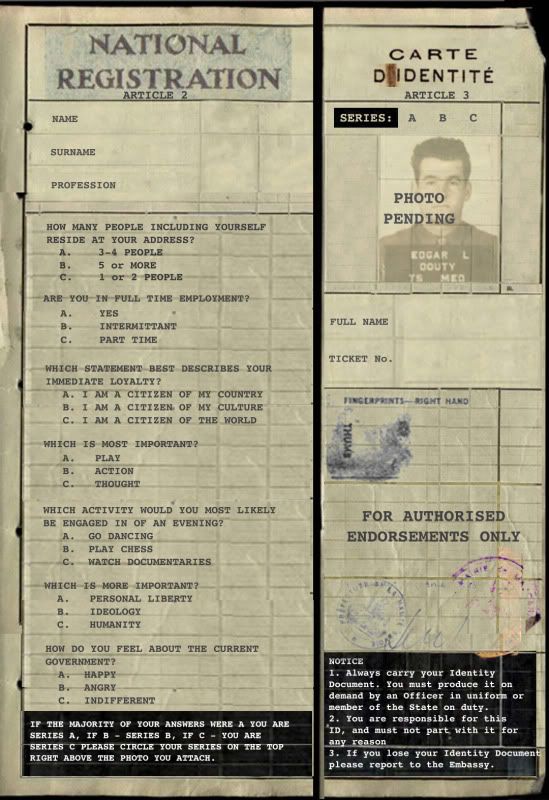
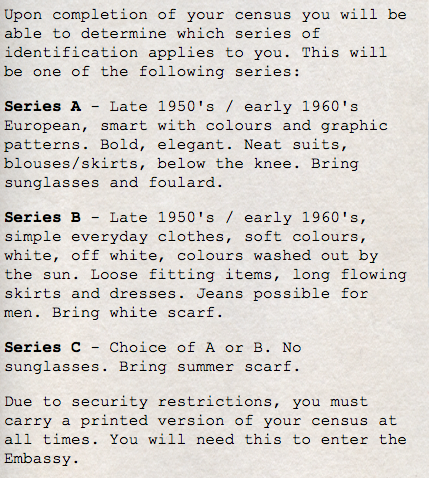
Excitedly, but with more than a little trepidation, I booked my tickets for a Saturday matinee. I dutifully filled in the identity forms, as outlined in my ticket briefing, and discovered myself to be a ‘Group C’ (answers cbbcccc, if anyone’s interested) and checked the corresponding dress code. Luckily I could choose either of the first two and opted for the second, which I had more of a chance approximating at short notice from things in my wardrobe. Though I did have buy a white scarf, which luckily wasn’t too hard to find. Still, I think I ended up looking more like the female friend in 8 1/2 in aviator mode more than anything else, oh well at least I tried!

Knowing pretty much where I was going, but still paranoid about exactly how to get there, I set off with a little bit of time over for potentially getting lost. No fear, it was where I expected, pretty much opposite the London Eye, straight down the end of a *fairly* dodgy alleyway which looked more like something out of ’80s Berlin than the Algeria of the 1960s, but anyway I’m getting ahead of myself. I passed another couple of questionably dressed girls, and surmised I must be heading in the right direction. Being a little early they hadn’t quite set up so I hung around a bit watching some other early birds take photos, and the ’embassy staff’ set up the check point. Soon enough a couple of tables appeared in front of a doorway surrounded by barbed wires and barricades. A loud speaker could be heard reminding us to be vigilant, have our papers ready and that the army was there for our safety (this was in English by the way). While I was queuing to go in an actress pretending to be a child asked me if I wanted to play with her ball/cup thing (what are those called?) at least I think she did, she asked in French so I didn’t really understand, but adults dressed as children freak me out a bit so I think I just shook my head and hoped she’d go away. Which she did. Anyway I presented my completed census form to the lady at the table who checked me off the list and told me to go ahead. I also noticed that some people had really gone to town with their forms, sepia toning their photos and filling them in more officially and I really wished I’d done the same instead of filling it in in biro and attaching an old driving license photo. I proceeded and handed my ‘papers’ to the army officers at the barricades, who took ages reading it and looking over the top giving me filthy looks, eventually they had a quick look in my bag and let me though.

The walk along the path blocked off by barricades and barbed wire was quite short, but we were stopped at the next door for a couple of minutes until the soldier opened it and let us into the main area, that is ‘the casbah’. As we walked in we entered another passage way, dimly lit with white washing hanging about halfway down and a very impressive lighting design. At the end of this passageway was a central square which led off in several different directions. One end contained some food stands which weren’t operational and led through to a cushioned bar area, and at the opposite end a colonnade containing some stairs and an Air France travel booth, at which one could book flights! Leading off left and right were traditional North African style buildings with various peoples occupying them, there was the Milk Bar/disco, a room for chess playing, a little hut which seemed to contain the HQ of some kind of movement (the liberation movement as I would later find out), I saw several people talk to the man here and present their papers, they were either asked to leave, rudely, given a mission/message or nothing really at all. Another entrance off the central square led into the main bar area where food/drink was available, and next to this a screening room showing documentaries. A passage off here led into the prison where a suspect was being detained and ‘questioned’, rather vigorously. I also saw several people fall foul of the guards and get marched into this area, I’m not really sure what happened to them then but I’m sure it all worked out for them in the end. The prison area also lead out into the police station, complete with briefing room and period telephone.

We were free to roam around the area for about ninety minutes or so, interacting with the various actors inhabiting the ‘set’. I’m quite a shy person and didn’t volunteer myself all that much but was approached by a few of the actors and asked questions/yelled at in French, I think I though one of them was asking me the time, but even that much school girl French had deserted me, so I just held up my arm (with a watch obviously). I hope they were asking the time, or I’ll feel even more stupid! Various things occurred, a band turned up for a bit in the square, people were taken in and out of prison etc. Then at one point everyone started shouting ‘Vite! Vite!’ which I DID get the gist of and we all ended up in a courtyard area next to the little hut with the alleged HQ, where a square of white material had been lowered. One of the military drummers from the band was beating out a super fast rhythm and three women were taking off their white muslim clothes and changing into stylish 1960s Parisian fashion, complete with stockings and make up. When they’d nearly finished this the men came out of the hut with suitcases, into which they put the women’s normal clothes and out of which they took something that resembled bombs, each of the women put one of these into the stylish handbag. The men said something to the women in arabic, then they quickly left the area. To my surprise, and mild horror, one of the women grabbed me and wouldn’t let go! she removed the white scarf from around my neck and led me through the central square, past the checkpoint in the middle being careful not to alert the soldiers and into the cafe area. We stood next to the popcorn stand for a bit, in quite  suspicious manner, then she very unsubtly threw the stylish bag behind the popcorn stand and led me off again into the cushioned area at the back, where she got me to help her take off her necklace (which was a bit weird, didn’t really get that bit). Then the man with her told me to go back to the central square and join the crowd there.

A little while later a military parade started, there was the band playing, some ceremonial maneuvers, everyone sang La Marseillaise, then there was a speech in French I think in praise of the army and their defense of the people but I’m not sure and then…..there was a massive BANG as all these ‘bombs’ dropped by the women (as I would later find out in the film at the Cafe, Air France, and the Milk Bar) went off and everything went pitch black. Some lights appeared from somewhere and everyone was running, some ‘vite! vite’ing again and seeing as I was at the back of the crowd I was urged to run back the way I’d come, towards the courtyard again but up some stairs that led to an open air corridor above it. I was directed towards I presume a friendly house, through to a bedroom, over the bed, out the window! onto some more stairs down where upon I found myself in a screening room!

Being one of the first in I bagged myself an aisle seat, but then inevitably a giant bagged the one in front and had a left leaning bias, which kept blocking my view but it was mostly OK. Sadly I’d wound up in the screening room with hard wooden chairs, which wasn’t the most comfortable thing and I wished I brought something to sit on but you can’t have everything. We waited for the room to fill up, and I guess for them to bring in overflow people from the other rooms, then the chief man from the HQ gave a speech (in Arabic) which no one understood and the film finally started.

If you haven’t guessed by now, the film was Battle of Algiers, Pontecorvo (1966) about the liberation movement in Algeria from French Colonial rule in the late 1950s and ’60s. The action spans the movement from 1954 through to 1957, detailing the rise of the revolutionary cells in the casbah, the increasing acts of violence on both sides, the eventual ‘victory’ of the French forces eliminating the ‘terrorist’ element in Algiers but then eventually losing Algeria to public revolutionary fervour a few years later. We see policemen murdered, bombs placed in public places (as reconstructed in the pre show), but also public check points, the native North Africans repeatedly harassed and poorly treated, beaten, spat at, despised. Suspected activists taken and routinely tortured to reveal information on terrorist cells. Although Pontecorvo largely manages to avoid obvious bias, and condemns both sides equally it does seem to me that what results is an anticolonial film, which isn’t say that it approves terrorism or armed struggle anymore than institutionalised abuse and torture, but it does sympathise with a people’s desire to be free. There were quite a few walkouts during the screening, I can understand why this film wasn’t to everyone’s taste though I’m very glad I saw it as it’s not something I’d probably seek out on my own, and I can understand why some people felt it to tip over the line from topical to poor taste given the current events in North Africa and the Levant. However, I’m very glad Secret Cinema choose to present a film like this, at this time, and I certainly hope they continue to do more in this vein in the future. I highly recommend this film to anyone who’s interested in political cinema or French involvement in North Africa.

When the film eventually finished we left the screening room down a path strewn with nutshells, past a spectacularly lit praying muslim, whilst a powerful sounding Arabic song played in the background. We then turned and followed the way out past more white clad muslim’s some with their arms outstretched, some in prayer and the atmosphere was one of absolute peace. The overall effect was really quite stunning, the convergence of the atmosphere, the lighting and the music was really incredibly moving. On exiting the doorway we were then given a newspaper with further information about the film, the background and secret cinema itself. I really found this a wonderful and immersive experience and I’ve every intention of visiting their next presentation, whatever and wherever that may be!