Duel to the Death (生死決, Tony Ching Siu-Tung, 1983)

What is the essence of martial arts, self-improvement and defending the weak, or victory at all costs? The debut directorial feature from action choreographer Tony Ching Siu-Tung, Duel to the Death (生死決) may have a familiar theme but is unusual in its even-handedness focussing instead on the bond between its martial artist heroes who are each as it turns out pawns of greater powers and the mercy of a world in nothing is fair or righteous.

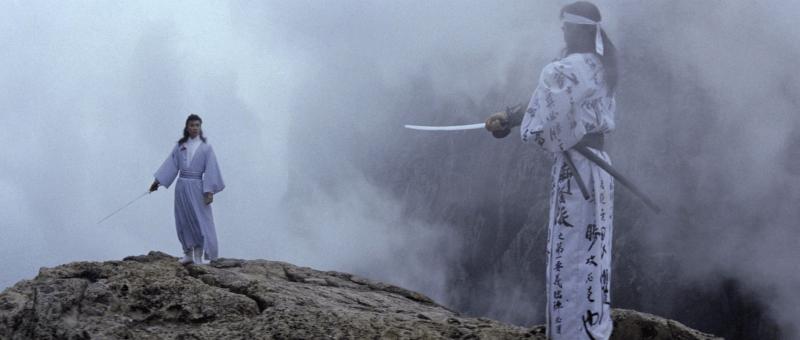
This is obvious right from the high impact opening sequence in which Japanese ninjas raid a Chinese temple to steal “The Lost Manual to Breaking the Swordplay Stances of All Clans.” Obviously, the scroll wasn’t very lost, in fact quite easy to find along with the names of all the martial artists in China which will come in handy later, but right away sets up the Japanese as essentially duplicitous and underhanded. The central drama revolves around a contest held every 10 years between a representative from Japan and China to decide whose martial arts is best, but it’s obvious that the Japanese plan to win by cheating which they attempt at every opportunity. 

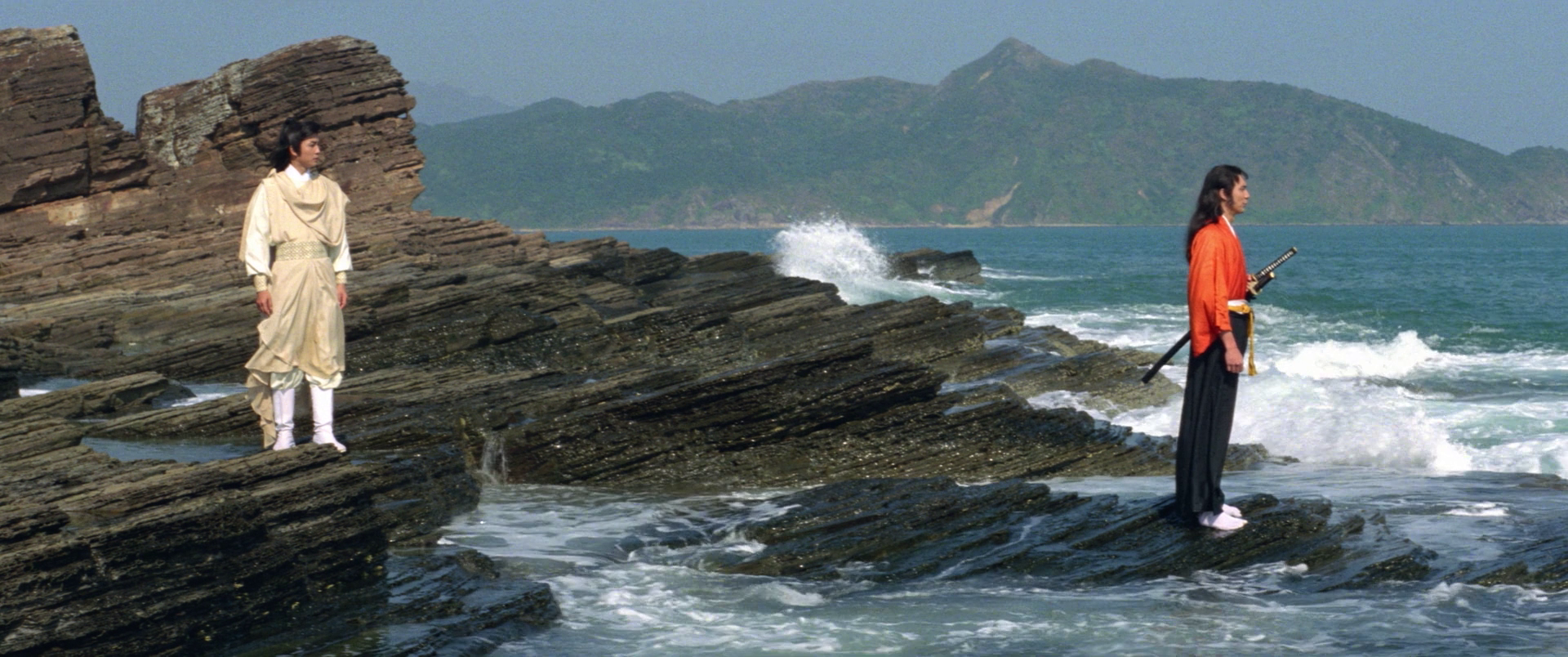
This remains largely unknown to earnest swordsman Miyamoto (Norman Chui Siu-keung) who genuinely believes he’s engaging in a test of skills with a worthy opponent. In contrast to that advocated by the Shaolin monks, the philosophy fed to Miyamoto is that he must win at all costs even if it meant turning a sword on Buddha. His own master challenges him in disguise and is pleased when he is killed because it means his pupil has eclipsed him and there is no greater honour than dying at the hands of a superior samurai. Destructive as he maybe, Miyamoto is no villain for he has a pure-hearted attachment to his code only to have his illusions shattered when he realises he’s just a patsy set up for an easy victory by the shogun who has already cut a deal with the contest’s organisers to have his opponent kidnapped so he’ll have to fight the organiser’s daughter instead.

The authorities in China are shown to be duplicitous too, and despite the prevailing Shaolin philosophy it becomes apparent that Hsia-hau, the current guardian of the House of the Holy Sword, cares quite a lot about fame and fortune. Desperate to restore the name of his clan and perhaps irritated not to have had a son, he’s raised his daughter Sing Lam (Flora Cheong-Leen) as a boy but does not seem to fully trust her ability to improve their fortunes despite the supposed gender equality of the jianghu society. Notably, Miyamoto refuses to fight her after realising she is a woman signalling once again the destructive qualities of his code in its rigid misogyny where Ching Wan (Damian Lau), the Chinese challenger, fully accepts her but seems unwilling to let their potential romance disrupt his own commitment to pursuit of his skill.

Like Miyamoto, Ching Wan sees the contest as a means of testing himself yet places no importance on winning or losing. Ching Wan often often comes to Miyamoto’s defence, stating that the Japanese were only acting in accordance with the their national character and they could learn a lot from their perseverance, while Miyamoto too refuses to rise to the bait when Sing Lam remarks that Japan must be a very poor place if the simple dinner they’ve been offered seems like an extravagant feast so it’s understandable that they always seem to be trying to plunder China. Trying to plunder China the shogun most definitely is, or least hoping to dominate it, but all the two martial artists want is the impossibility of a fair fight in a world in which double dealing is the norm and nothing’s quite as it seems. 

The full-on weirdness of Ching’s action sequences underline just how absurd this world is. Ninjas lurk everywhere including in the sand, while during one fight one giant ninja suddenly explodes into lots of tiny little ones. In the opening raid, they use dynamite for suicide attacks and are later seen flying in massive kites. The shogun keeps all the kidnapped martial artists he was planning to take back to Japan to steal their knowledge in a giant spider web-like network of ropes underground, hanging around until the ninjas load them into palanquins. Nevertheless, despite the obviousness of his use of Korean sets standing in for Japan, Ching injects a degree of realism in a painstaking attempt to maintain authenticity in depicting Japanese sword style. Cutting fast and furious with delirious wire work, the most impressive action sequence may well be that of Sing Lam effortlessly setting up a pair of obnoxious Japanese swordsmen. “Why dwell on determining whose martial arts is better?” a monk idly asks, and indeed there is no real answer save a vicious cycle of violence of retribution that remains unfinished even at the nihilistic conclusion. 


Original trailer (English subtitles)

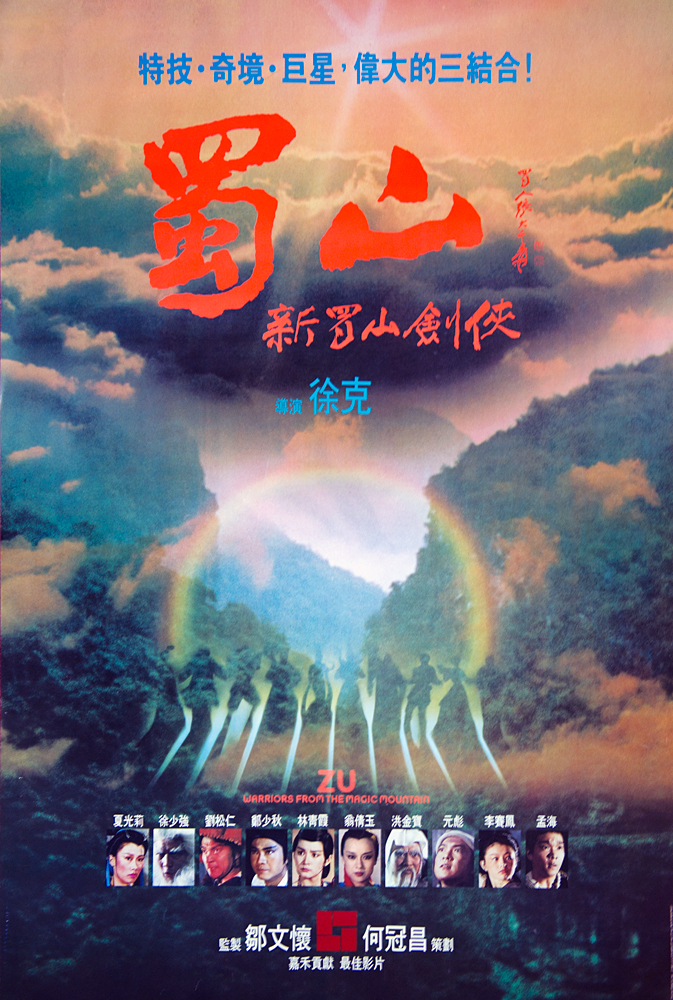
Zu: Warriors from the Magic Mountain (新蜀山劍俠, Tsui Hark, 1983)

“I never imagined that the righteous would not only refuse to unite, but also be incapable of action” laments a reluctant soldier realising there are no heroes coming to the rescue in Tsui Hark’s SFX-laden fantasy wuxia, Zu: Warriors from the Magic Mountain (新蜀山劍俠). Inspired by the work of Huanzhulouzhu (Li Shoumin), Tsui’s feudal fable marked a departure from the more “realistic” swordplay movies which were popular at the time harking back to an earlier era of fantastic adventures which drew inspiration from traditional Chinese folklore. It was also, however, an attempt to prove that Hong Kong could rival Hollywood in the post-Star Wars world, blending what might now be viewed as fairly camp but then cutting-edge special effects with classic wuxia action. 

Accordingly, after a brief voice over, Tsui opens with a world in chaos in which several factions are currently vying for hegemony over the hotly contested, mystical and mountainous terrain of Shu. Lowly retainer Ti Ming-Chi (Yuen Biao) has been tasked with delivering a message regarding troop movements to his superiors, but there is a difference of opinion in the chain of command as to whether to attack by land or sea. Placed in an impossible position, Ming-Chi eventually sees himself pledge to obey both captains, only for infighting to emerge within the group forcing him to flee for his life which is how he encounters “Fatty” (Sammo Hung Kam-Bo), a soldier from a rival faction and discovers, quite ironically, that they are from neighbouring villages which makes their rivalry all the more ridiculous. In the course of his attempt to escape, Ming-Chi falls into a mountain crevasse and finds himself entering a mysterious cave which takes him to another world in which he becomes similarly embroiled in a war against the evil Demon Cult which apparently practices child sacrifice and then uses the bones as a kind of magical armour. 

A reluctant soldier, Ming-Chi finds himself captivated by the “Great Hero” Ting Yin (Adam Cheng Siu-Chow) and determines to become his disciple while the pair form an uneasy alliance with a pair of similarly matched Buddhist monks, master Hsiao Yu (Damian Lau Chung-Yan) and his assistant I-Chen (Mang Hoi), also hot on the trail of the Demon Cult. Finding this world also confusing, he is nevertheless reassured by I-Chen’s simple explanation “they’re bad, we’re good” as the two masters face off against the Demon Lord, but comes to discover it’s not quite all as black and white as it seems and this world too is torn apart by chaos and disorder because “the hearts of men are so corrupt.” Ming-Chi begs Ting Yin to use his “peerless martial arts skills” to “save mankind”, but Ting Yin cynically tells him his best course of action is to retreat into the mountains and avoid human society because “neither you nor I have the ability to bring about change”. 

Yet Ming-Chi remains pure of heart, certain that “as long as everyone puts in the effort, peace can be restored under heaven”. “Teach me martial arts and once I’ve mastered it, I can fight oppression, help the weak, and save the masses” he pleads, but Ting Yin once again refuses him. In fact, in one of the later SFX sequences, Ting Yin will “transfer” his martial arts knowledge near instantly via a laying on of hands assisted by some elaborate prosthetics which see Ming-Chi’s body warp and bubble to accept it. Nevertheless, the lesson that Ming-Chi begins to learn, bonding with fellow assistant I-Chen who ignored his master’s petty parting words to bid him goodbye to hope they meet again along the way, is that the masters care only for themselves and are no better than the warring nobles from his own lands, obsessed with their rival sects and ideologies. If they want to save the world they’ll have to save themselves through mutual solidarity in pursuit of their goal, tracking down a pair of mystical swords which are the only way to end the demonic threat for good. 

There might of course be an added dimension to this allegory in the Hong Kong of 1983 which is perhaps also beginning to feel like disputed territory coveted by duplicitous elites who fight amongst themselves while ordinary people suffer, but Tsui is in any case more interested in zany action and excuses to employ zeitgeisty special effects making full use of the technology of the day from lasers to animation along with in-camera stunts to recreate his epic fantasy world in which old men can keep evil at bay for as long as 49 days using nothing but their powerfully hairy eyebrows and a fancy mirror. With small roles for Brigitte Lin and Moon Lee as an ice queen with a warm heart presiding over an all female palace and her spiky guard respectively, Tsui’s bonkers fairytale moves on at a glorious, confusing pace but is nevertheless filled with warmth and humanity as the goodhearted heroes attempt to head off the folly of war with human solidarity. 


Zu: Warriors from the Magic Mountain streams in the UK 9th to 15th February as part of Focus Hong Kong

Eureka release trailer (english subtitles)