Little Blue (小藍, Lee Yi Fang, 2022)

Mother and daughter find themselves in eerily similar situations when dealing with a social double standard in Lee Yi Fang’s pointed drama, Little Blue (小藍). At heart refreshingly sex positive, the film nevertheless asks why some people seem to be hung up on what is a perfectly normal part of life while simultaneously exploring how sexuality can be misused or exploited and mostly particularly that of the young and naive. “I sometimes feel like my body’s not mine,” the titular Xiaolan (Wang Yu-xuan) confesses to a befuddled teacher who explains to her that she’s gone “astray”, while she might as it happens have a point. 

The opening sequence is witness to the transformation Xiaolan subsequently undergoes. Describing herself as incredibly confused, unable to understand what the teacher is getting at when he asks her why she didn’t come to him when it started, this Xiaolan is wearing makeup and has a fashionable hairstyle. But flashing back a few weeks, the Xiaolan we then encounter is shy and mousy. She has long, lank hair and glasses in contrast to her more glamorous friend Kyueiyu who needles her about hair removal techniques and the realities of contemporary dating. 

This Xiaolan is mildly resentful of her mother whom the other kids brand as “hot” when she turns up with a lunch box Xiaolan had forgotten. Vivi (Helena Hsu) is an estate agent who works late and leaves Xiaolan to get her own dinner but also has a very active sex life and an annoying boyfriend who keeps sexting her and sending videos of questionable taste at inappropriate moments. There’s probably something in the fact that aside from Xiaolan’s high school boyfriend Wu Miao (Ye Ting-qi), the otherwise unavailable men all have Western names. Vivi’s sleazy boyfriend goes by Matt, while she later starts an affair with a married client, Kris, and Xiaolan finds herself drawn to a slightly older guy she hooks up with on a dating app who tells her that he has a girlfriend and his name is “Tim” (Roy Chang). 

Just as Wu Miao had after seducing her on a beach, Tim soon starts ignoring Xiaolan’s messages. After all, he has a girlfriend and probably doesn’t want to be bothered by a genuine connection with a dating app hook up. Xiaolan experiences a kind of breakdown after handsome footballer Wu Miao shares an explicit photo of her with a friend who then “accidentally” posts it on the class chat if only to delete it seconds later. Wu Miao isn’t visible in the photo even if everyone knows he’s on the other side of it, but in any case it’s only Xiaolan who suffers a repetitional loss and is shamed by her classmates. It’s in the wake of his shunning that Xiaolan turns to dating apps, hoping to satiate her curiosity and desire but in the end discovering only more loneliness. Taking her to task, Vivi claps back that at least she gets a “thrill” from her otherwise painful love affairs whereas Xiaolan doesn’t seem very happy at all and gives the impression that her dating app odyssey is at least in part an act of self harm. 

Nevertheless, mother and daughter eventually begin to bond over the irony of their parallel crircumstances if only in the knowledge that it doesn’t really get any better and in the end female solidarity may be all there really is. Lee shoots the changing Xiaolan in melancholy shades of blue that of course eco her name but also lend her world an isolating quality that traps her within her own shame and uncertainty. Even the teacher who attempts to talk to her about her waywardness ends up becoming inappropriately aroused. Xiaolan tells him that he’s “very normal” and hasn’t done anything wrong in a moment that seems both a mic drop and somehow transgressive, allowing Xiaolan to offer the sex positive message she should have received while ironically highlighting that the teacher’s response, as unconscious as it may have been, is necessarily problematic. 

In any case, Xiaolan is finally able to reclaim herself and sexuality as perhaps is Vivi as something that belongs to her alone rather than for others. She’d begun to change herself to be accepted, getting contacts, stealing her mum’s makeup and following her friend’s beauty techniques but still found herself rejected and reduced to a mere body much as Vivi is described as a spare time girl realising that Kris only sees her as a temporary escape from his familial responsibilities. Maybe Vivi saw it the same way, too wrapped up in her own problems to deal with her daughter’s, but what emerges between them seems to be healthier kind of emotional honesty that, ironically, neither found in the arms of their duplicitous men. 


Little Blue screened as part of this year’s London East Asia Film Festival.

Original trailer (Traditional Chinese / English subtitles)
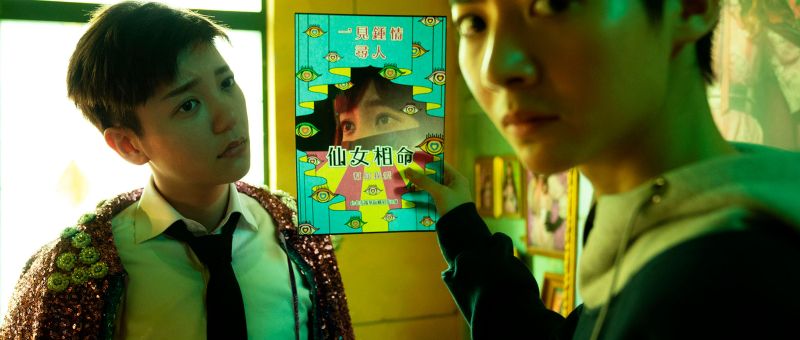
As We Like It (揭大歡喜, Chen Hung-i & Muni Wei, 2021)

“It’s the crazy madness we call love” according to a series of bemused bystanders in Chen Hung-i and Muni Wei’s modernist take on the Shakespeare play, As We Like It (揭大歡喜, Jiēdàhuānxǐ). As the reframing of the title implies, no longer pleasing “you” but “we”, Chen and Wei’s all-female adaptation is an attempt to reclaim the stage taking a swipe at the Elizabethan prohibition on actresses while undermining the notion of a gender binary as the various lovers pursue their romantic destiny in defiance of heteronormative ideas of sex and sexuality. 

Rather than palace intrigue, however, the force which sends Rosalind (Puff Kuo) into the forest is romantic failure coupled with filial and financial anxiety. Her father, the Duke, has been missing for seven years and will shortly be declared dead at which point his company will be divided between the father of her best friend, Celia (Camille Chalons), and a random young man named Orlando (Aggie Hsieh) she was previously unaware of. Hoping to locate him, she winds up at a street fight in which she becomes Orlando’s eyes and he falls in love with her at first sight. For unclear reasons and drawing inspiration from traditional Taiwanese opera, Rosalind then decides to pose as a man, taking the name of Roosevelt, and later teaming up with Orlando in the hope of finding the Duke. 

Despite its best intentions, the awkward irony at the centre of As We Like It is that it accidentally ends up re-inforcing the patriarchal ideology it otherwise seeks to critique in that Rosalind’s romantic adventure turns out to be a series of manipulations at the hands of her long absent father. A romantic exile, it is she who remains unsure of her feelings, unwilling to admit the possibility that she is finally in love with Orlando and hiding behind the mask of masculinity in order to test her would-be-lover’s sincerity. The strange scavenger hunt the pair are forced to follow in order to find their way to the Duke amounts to a forced courtship, each of the pitstops another level up in terms of romantic intimacy culminating in an oddly eroticised ear cleaning date. While Orlando vacillates over whether it’s OK to fall for a boy because he reminds you of a girl, Rosalind is tasked with rediscovering her faith in romantic love which she does but only after talking to her father first. 

Celia, by contrast, seizes her own agency by defiantly seducing sometime antagonist Oliver (Joelle Lu) and becoming pregnant by him even before marriage. In this instance, Oliver is still the villain attempting to steal the business, even going so far as to send his thugs to chase Orlando down, the implication being that Celia’s love softens and then corrects him so that he might reconcile with his brother. Yet the final showdown introduces a new villain in the figure of Charles (J.C. Lei), Oliver’s chief thug apparently harbouring an unrequited crush on his boss and therefore extremely resentful of Celia. Yet her taunting of him asserting that hers is the final victory because she has done what Charles never could in conceiving Oliver’s child seems to fly in the face of the film’s otherwise egalitarian views on love, negating not only same sex love but also love between those unable to produce children uncomfortably heading back into a gender binary which makes maternity the essence of womanhood. This message is perhaps undercut by the closing moments in which Oliver and Celia argue about whether to buy boy clothes or girl clothes for the baby only for the shop assistant to advise a neutral white and cede the “choice” to the child in time but nevertheless seems an odd means of defeating the spectre of the unexpected antagonist driven to a dark place by the “madness” of love. 

Love’s “madness” may be the central theme though the sense of a world turned upside down is undermined by Celia’s maintenance of her position as a princess rather than relegation to the role of a peasant even as it affords her unexpected agency over the surprisingly pliable Oliver. The world’s uncanniness is fulfilled by its unreachability, set in an “internet-free” district of near future Taipei enhanced with frequent onscreen graphics where people send each other “slo-express” letter-pressed telegrams in place of “text messages” delivered by the human touch, implying perhaps that our increasingly depersonalised society is actively frustrating the path to love even while the idea of the idyllic and utopian Forest of Arden seems to have been co-opted by venal developers. Nevertheless, journeys end in lovers meeting to quote another play and love’s madness is eventually cured in its fulfilment. 


As We Like It screens on July 8 and streams online in Switzerland until July 10 as part of this year’s Neuchâtel International Fantastic Film Festival (NIFFF). Readers in London will also have the opportunity to see As We Like It at Genesis Cinema on 16th July courtesy of Chinese Visual Festival & Queer East

Original trailer (English subtitles)