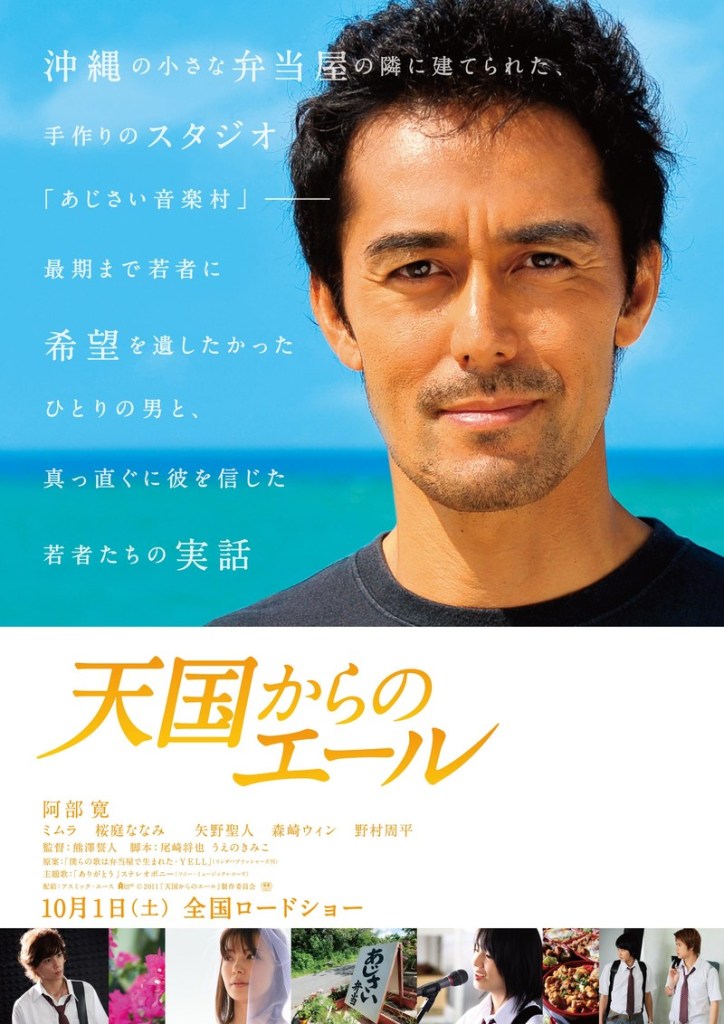
Cheers from Heaven (天国からのエール, Chikato Kumazawa, 2011)

tengoku_teaser_“üeolOkinawa might be a popular tourist destination but behind the beachside bars and fun loving nightlife there’s a thriving community of local people making their everyday lives here. Just like everywhere else, life can be tough when you’re young and the town’s teenagers lament that there’s just not much for them to do. A small group of high schoolers have formed a rock band but they’re quickly kicked out of their practice spot at school after a series of noise complaints from neighbours.

The school kids all buy their lunches from the bento shop down the street run by Hikaru “Nini” Oshiro, his wife and his mother. Whilst there, Aya – the rock band’s female singer, starts eying up a covered courtyard area and remarks that it’s a shame they can’t practice there. Nini overhears and gives them the space but once again the neighbours complain ,so the kids reluctantly decide to give up on the band for now because there aren’t any studio spaces on the island and they wouldn’t have the money to hire somewhere anyway. At this point, Nini makes a surprising decision – digging deep into his family resources, he buys the materials and commits to building a studio space on a patch of disused land next to the bento shop with his own hands.

Based on a true life story, Cheers From Heaven (天国からのエール, Tengoku kara no Yell) is a tribute to Hikaru Nakasone who really did build a studio space for the local kids that turned into something more like a youth centre offering support to all kinds of youngsters so long as they obey the rules. In the film, Nini is a fairly gruff but big hearted man who’s big on discipline and doing the right thing. His rules include being courteous to the other kids, sticking to your allotted time and crucially that your grades don’t suddenly start dropping because you’re hanging out in the studio all the time.

Nini’s wife is, perhaps unsurprisingly, originally horrified by the idea of the studio especially as it will require an additional financial burden for the family, not to mention that Nini failed to run the idea by her before launching headlong into it. However, eventually the entire family comes around and they even start catering for the kids too. When his wife asks him why he’s doing this Nini remarks that in his day people were poor, yes, but they helped and supported each other. Older people taught younger ones how to do things and how to behave but that doesn’t seem to happen now and he doesn’t want his daughter to grow up in a world like that.

The building of the studio becomes a real community project as half the kids from the local area suddenly turn up to help. The project that Nini assumed he’d be finishing with his two hands alone becomes a symbol of pride for the various teenagers who commit their time and hard work into making it happen. They’ve built something together that’s now their collective responsibility and a place where they can go to practice their music or just express themselves creatively.

Nini doesn’t stop there, he wants to help the kids in the band make it big. Convincing a fourth member to join them, taking demos around radio stations, organising live gigs – he’s their unofficial manager. The band’s young struggles hit a chord with Nini because he also had a friend with dreams of becoming a musician that were tragically cut short just as he was finally getting somewhere. It also transpires that Nini came home to Okinawa with his family following an illness which has now returned and this headstrong determination to make a difference is, in part, because he feels as if he’s running out of time.

Despite his failing health, Nini continues to do everything possible to look after the kids from the band even going so far as to discharge himself from hospital to go check on the leaking roof of the studio during a storm only to discover the kids already have it covered. A warm tribute to its real life inspiration, Cheers from Heaven proves far less sentimental than its rather melodramatic title suggests preferring to emphasise its themes of togetherness and legacy which bear out the way in which one committed soul can leave an indelible mark on its community.


Reviewed at the Japan Foundation Touring Film Programme 2016 at the ICA London on 6th February 2016.
http://www.youtube.com/watch?v=LSYWW2W4U24

Wings of the Kirin 麒麟の翼

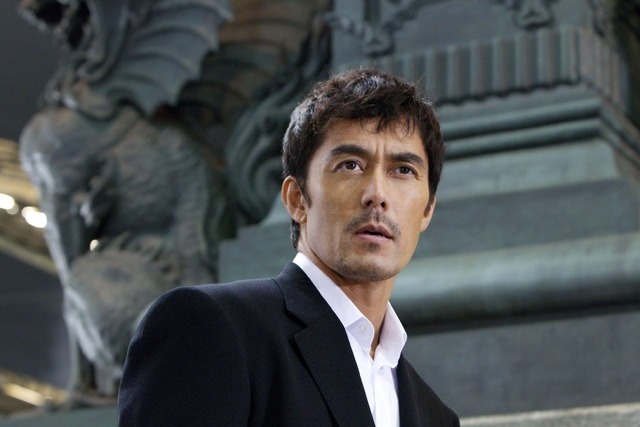
Wings_of_the_Kirin-002Based on the novel by Keigo Higashino (The Devotion of Suspect X), Wings of the Kirin is the latest big screen outing for Higashino’s famous detective Kaga. Previously played on TV by Hiroshi Abe who reprises his role as the much loved sleuth here, this latest instalment sees Kaga’s particular expertise put to use in the case of a salary man who appears to have staggered some distance from the subway tunnel where he was stabbed only to die right under the famous Kirin statue on Nihonbashi Bridge. Around the same time, a younger man calls his girlfriend to tell her he’s in ‘big trouble’ before being chased out into the road by police, whereupon he’s suddenly mown down by an oncoming truck. As this man had the salaryman’s briefcase the case seems open and shut – a mugging gone tragically wrong leading to the death of both perpetrator and victim. Kaga though feels differently and as always, the case is not quite as straightforward as the authorities would like to believe.

As with many of Higashino’s stories, the mystery itself is almost a macguffin as Higashino is more interested in investigating human behaviour and psychology with half an eye on traditional morality. Wings of the Kirin is no different in this respect as it has a heavy interest in the relationship between fathers and sons and the importance of taking personal responsibility for your own transgressions. However, that isn’t to downplay the mystery element as Higashino once again proves himself a master at wrong footing the audience. Many viewers may feel they have a pretty solid idea of who did it and why fairly early on the film only for it takes off in an entirely different direction in the final third. That said, although it is heavily pushing your intuition in one direction, there are perhaps an over abundance of subplots including illegal work practices and unfeeling employers, the difficulties faced by young people coming out of the foster system, complicated teenage friendships and misunderstandings brought about by people’s own sense of guilt. Consequently the film does run quite long as it manages to pack in just about as many wrong turns and red herrings as possible, however it largely earns its right to run as each of the characters and sub-plots manages to be compelling in its own right.

Though Wings of the Kirin is technically the big screen spin off of the Detective Kaga TV drama, no previous knowledge of Kaga and co is strictly necessary though familiarity with some of the peripheral characters may help. Hiroshi Abe excels once again as the slightly distant if all seeing detective who alone is capable to putting all the pieces together in the right order. Perhaps due to its TV roots, the film has a rather strange and quirky soundtrack which is frequently at odds with the serious nature of the drama yet it never quite tips over into being distracting enough to derail the film. Occasionally it does feel like more like a big budget TV special than a major feature but again perhaps that’s in keeping with the previous instalments in the series. Like all good mysteries, the solution involves a great deal of improbable coincidences yet watching Kaga shuffling them all into place to reveal the overall solution is quite masterful.

However, Higashino’s moralising does take over at times and there was at least one instance where it seemed Kaga had gone too far, or at least the actions of one character did seem reasonable. After all, if you can ‘save’ one person when there’s nothing to be done for another, is it really so wrong to try and help the people who are left behind? The actions in that case did seem altruistic, not born of any desire to ‘cover-up’ wrong doing but only to try and prevent more lives being ruined. Yes, Kaga’s assertion that you’ve effectively taught someone that it’s OK not to admit you’ve done wrong or that it’s OK to let others take the blame for your own mistakes is obviously true, but the consequences here are perhaps too extreme and dramatically neat to bear it out. Occasionally the film does feel preachy and its message is anything but subtle, however, thankfully it never manages to disrupt the pleasure of its finely constructed mystery. A little bit long and necessarily meandering, The Wings of the Kirin is another impressive crime thriller from the pen of Higashino that manages to entertain with a finely crafted central narrative but is also unexpectedly moving in its curiously small scale climax.

Thermae Romae

THERMAE ROMAE-T

Lucius ambulat in Tokyo? Review of improbable time travel comedy Thermae Romae up at UK-anime.net.


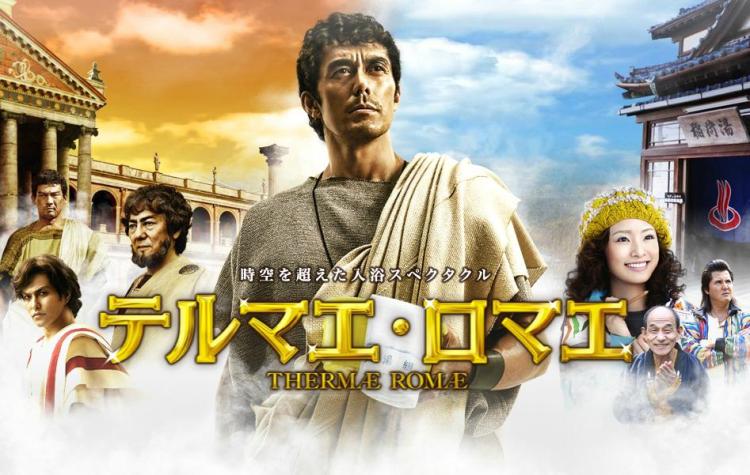
Pop quiz – what do modern day Japan and Ancient Rome have in common? Fish sauce? Emperor worship? Sandals? More than you thought, wasn’t it? Well, the correct answer is public bath houses and sure enough the people of modern day Tokyo still love going to the public bath even though they enjoy the luxury of being able to bathe at home! Of course, bath house culture with all its social and political uses and divisions was one of the things the Roman Empire took with it wherever it went. However, there must have been a time when some Romans began to feel their baths were getting a bit stale and in need of a new ‘modern’ twist, but what to do? What if they could leap forward in time and learn from the 21st century bath culture of modern Japan! Enter down on his luck architect Lucius who suddenly finds himself in a strange land full of strange looking people who seem to have taken bath technology to its very zenith.

Lucius Modestus (Hiroshi Abe) is a once successful bath architect with a case of serious designer’s block. Replaced on a prime project because he’s been unable to come up with any ideas he decides to go for a soak at the local bath house but whilst clearing his head underwater he finds himself sucked through a passage way only to reappear in a very strange looking place – it’s a bath house alright, but not as we know it! As they’re speaking a strange language he doesn’t understand, Lucius assumes the elderly men bathing here must be slaves and he’s been sucked into the “slaves only” part of the baths. Some of this stuff is kind of cool though – what are these funny spigot like things for, and these handy little buckets? Wait – they have baskets for their clothes?! We could do with some these in our bit! And so Lucius experiences the wonder of public bathing in Japan to the extent that it makes him cry with joy at which point he returns to Ancient Rome and begins to put some of these techniques to use in his designs. Travelling back and fore, Lucius always seems to run into the same Japanese girl who wants to make him the star of a manga and group of kindly old men. Can Lucius finally build the bath house of his dreams and stop a conspiracy against his beloved Emperor Hadrian at the same time?

Based on Mari Yamazaki’s manga of the same name (which also received an anime treatment from DLE), Thermae Romae sticks fairly closely to a fish out of water format for the the first half of the film as Lucius becomes by turns confused and then entranced by the various pieces of modern bathing technology he encounters on his travels. As a Roman encountering other people who are obviously not Roman, he of course adopts a superior attitude and assumes these people are either slaves or ought to be and so is extremely bewildered that their advancements seem to have eclipsed those of his own beloved Rome. These situations obviously provide a lot of room for humour as Lucius encounters various things that seem perfectly normal to us but strange and alien to him – his pure joy at discovering the wonder of the multifunctional Japanese toilet being particularly notable. It does though become fairly repetitive as Lucius finds himself in different situations which are essentially the same joke in different colours but then when the plot element begins to kick in later in the film it too fails to take off and feels a little too serious when taken with the wacky time travelling antics we began with.

Aided in his quest Lucius meets several amusing supporting characters including the group of elderly men from the baths who didn’t really need the help of an improbable ancient Roman to get themselves in trouble and Mami who functions as a kind of love interest who’s cast Lucius as the hero in her next manga. Mami begins learning about the Roman Empire and takes a course in Latin which helps a lot when she too finds herself in Ancient Rome and facilitates a kind of cross cultural exchange as she steals ideas from Rome for her manga as Lucius stole for the baths. However, the romantic comedy element never really comes together and even as Mami continues to pine over her noble Roman, Lucius remains aloof in the universal belief that all non-Romans are inferior. Though he does come to grudgingly acknowledge that the ‘flat faced people’ as he calls them have particular strengths such as their willingness to work as a team and put collective success ahead of personal gain, he never quite sheds his Roman arrogance.

It’s all very silly but undeniably quite funny if often absurd. We hear everyone in Rome speaking in Japanese and Lucius continues to think in Japanese wherever he actually is but obviously once he gets to Japan he can’t understand what anyone’s saying and attempts to communicate with them in Latin (whilst still giving his interior monologue in Japanese). Likewise, when Mami learns Latin she uses it to communicate with Lucius in Japan but once they get to Rome, all their ‘Latin’ is Japanese too which causes problems when the old men arrive because they’re speaking the same language as everyone else yet can’t understand anyone or be understood – which might be why they don’t get to say very much other than to Mami. It’s all quite strange and disorientating but kind of works as does the largely Puccini based score which screams 19th century Italy much more than Ancient Rome but helps to give the film the air of classical pomposity it’s aiming for. Big, ridiculous, silly fun – no one could accuse Thermae Romae of having any kind of serious message but it does provide genuinely entertaining silliness for the majority of its running time.


I Wish (Kiseki) 奇跡

IMG_0227

Review up over at UK-A for the latest Kore-eda  to fetch up on out shores. Well, actually, I reviewed this at the LFF in 2011 as well but I like to think I’ve come on as a writer since then (maybe not though, oh well, I still have a ways to go). If this is playing anywhere near you I very much urge you to go and see it even if just to show there is still an audience out there for seeing Asian films in the cinema. It’s a great movie though!