
What Happened to Our Nest Egg!? (老後の資金がありません!, Tetsu Maeda, 2021)

A minor controversy erupted in Japan in 2019 when then finance minister Taso Aso issued a statement recommending that couples should have 20 million yen (£104,620 total at the time of writing) saved for their retirement on top of the state pension in order to live a comfortable life in old age. All things considered, 20 million yen actually sounds like quite a low sum for two people who might live another 30 years post-employment. Nevertheless, Atsuko (Yuki Amami) and her husband Akira (Yutaka Matsushige) are now in their mid-50s and don’t have anywhere near that amount in savings. They’re still paying off their mortgage and though their children are grown-up, neither of them seem to be completely independent financially and both still live at home. 

Tetsu Maeda’s familial comedy What Happened to Our Nest Egg!? (老後の資金がありません!, Rogo no shikin ga arimasen!) explores the plight of the sandwich generation which finds itself having to support elderly relatives while themselves approaching retirement and still needing to support their children who otherwise can’t move forward with their lives. Seeing an accusatory ad which seems to remind her personally that even 20 million yen isn’t really enough when you take into consideration the potential costs of medical treatment or a place in a retirement home, Atsuko has a sudden moment of panic over their precarious financial situation. The apparently sudden death of Akira’s 90-year-old father acts as a sharp wake up call especially as Akira’s apparently very wealthy but also selfish and materialistic sister Shizuko (Mayumi Wakamura) bamboozles him into paying for the entirety of the funeral while pointing out that they’ve been footing most of the bill for the parents’ upkeep over the last few years.

There was probably a better time to discuss the financial arrangements than with their father on his deathbed in the next room, but in any case Shizuko doesn’t pay attention to Atsuko’s attempt to point out they’ve been chipping in too. Akira’s mother Yoshino (Mitsuko Kusabue) also reminds them that their family was once of some standing and a lot of people will be attending the funeral so they need to make sure everything is done properly. The funeral arranger is very good at her job and quickly guilts Atsuko into spending large sums of money on pointless funeral pomp to avoid causing offence only to go to waste when hardly anyone comes because, as she later realises, all of the couple’s friends have already passed away, are bedridden, or too ill to travel. 

Yoshino is however in good health. When Shizuko suddenly demands even more money for her upkeep, Atsuko suggests Yoshino come live with them but it appears that she has very expensive tastes that don’t quite gel with their ordinary, lower-middle class lifestyle. Having lived a fairly privileged life and never needing to manage her finances, Yoshino has no idea of the relative value of money and is given to pointless extravagance that threatens to reduce Atsuko’s dwindling savings even more while in a moment of cosmic irony both she and Akira are let go from their jobs. Now they’re in middle age, finding new ones is almost impossible while their daughter suddenly drops the bombshell that she’s pregnant and is marrying her incredibly polite punk rocker boyfriend whose parents run a successful potsticker restaurant and are set on an elaborate wedding.

The film seems to suggest that Atsuko and Akira can’t really win. They aren’t extravagant people and it just wasn’t possible for them to have saved more than they did nor is it possible for them to save more in the future. Instead it seems to imply that what they should do is change their focus and the image they had of themselves in their old age. One of the new colleagues that Akira meets in a construction job has moved into a commune that’s part of the radical new housing solution invented by his old friend Tenma (Sho Aiwaka). Rather than building up a savings pot, the couple decide to reduce their expenses by moving into a share house and living as part of a community in which people can support each other by providing child care and growing their own veg. Yoshino too comes to an appreciation of the value of community and the new exciting life that she’s experienced since moving in with Atsuko. It may all seem a little too utopian, but there is something refreshing in the suggestion that what’s needed isn’t more money but simply a greater willingness to share, not only one’s physical resources but the emotional ones too in a society in which everyone is ready to help each other rather than competing to fill their own pots as quickly as possible. 


What Happened to Our Nest Egg!? screens as part of this year’s Japan Foundation Touring Film Programme.

Trailer (English subtitles)

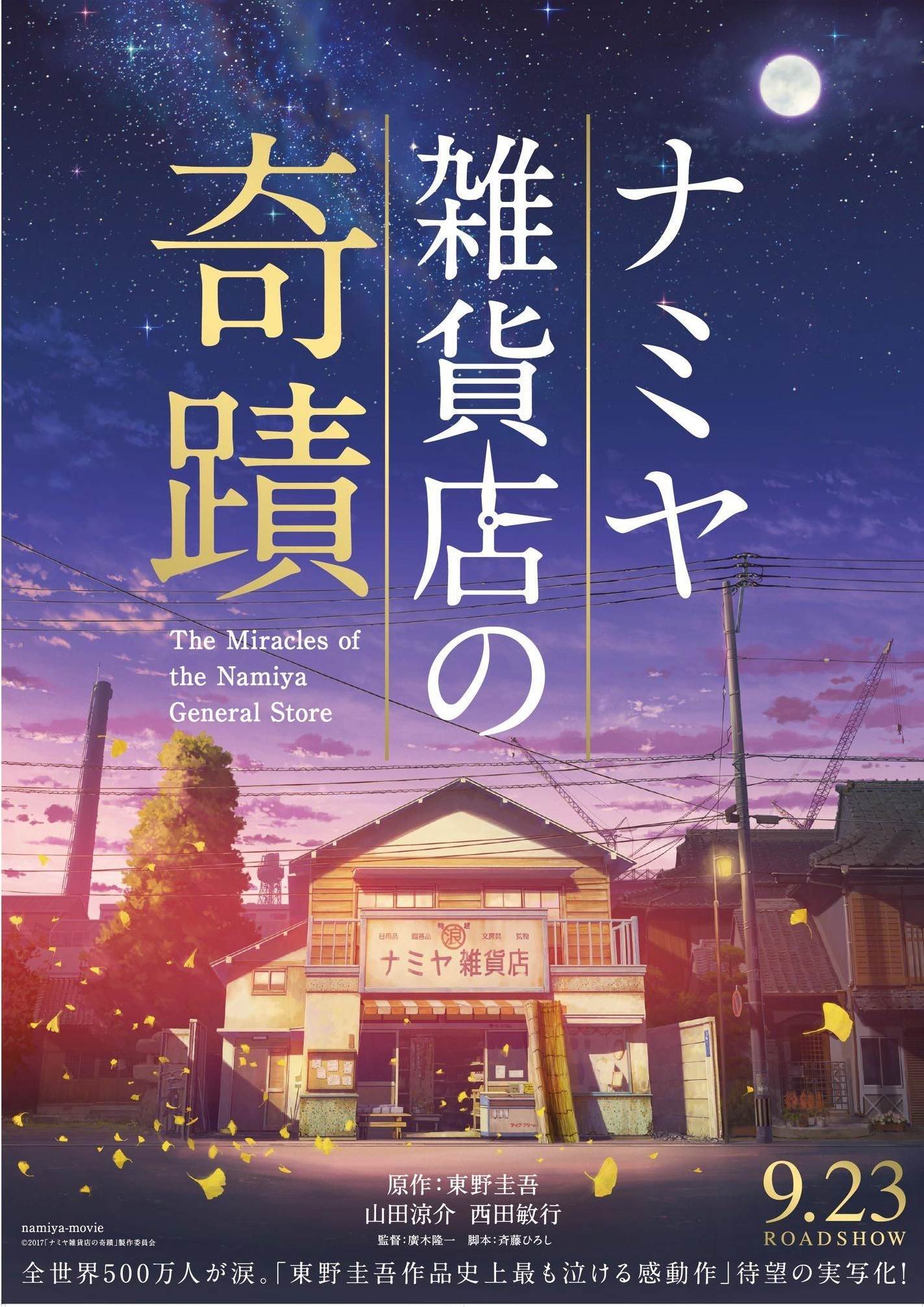
Miracles of the Namiya General Store (ナミヤ雑貨店の奇蹟, Ryuichi Hiroki, 2017)

Miracles of the Namiya General Store posterKeigo Higashino is probably best known for his murder mysteries, most particularly the international best seller The Devotion of Suspect X. His literary output is however a little broader than one might assume and fantastical hypotheticals are very much a part of his work as in the bizarre The Secret in which a mother wakes up in her daughter’s body after a fatal accident. Miracles of the Namiya General Store (ナミヤ雑貨店の奇蹟, Namiya Zakkaten no Kiseki) is indeed one of his warmer stories even if it occasionally veers towards the author’s usual taste for moral conservatism in its yearning for a more innocent, pre-bubble Japan that is rapidly being forgotten.

Back in 1980, Mr. Namiya (Toshiyuki Nishida) runs the local store and is a much loved member of the community. As an older man with plenty of life experience, he also offers an agony uncle service. People with problems can simply write him a letter and drop it through his box. He’ll have a bit of a think about it and then either paste up a response on the village noticeboard outside or, if the question is a little more delicate, place his reply in an envelope in the milk box.

32 years later, a trio of delinquent boys end up taking refuge in the disused store after committing some kind of crime. While they’re poking around, what should pop through the letter box but a letter, direct from 1980. Freaked out the boys try to leave but find themselves trapped in some kind of timeslip town. Eventually they decide to answer the letter just to pass the time and then quickly find themselves conversing with an earlier generation by means of some strange magic.

At the end of his life, what Mr. Namiya is keen to know is if his advice really mattered, and if it did, did it help or hinder? His introspection is caused in part by a news report that someone he advised on a particularly tricky issue may have committed suicide. Mr. Namiya isn’t now so sure he gave them the right advice and worries what he told them may have contributed to the way they died. This itself is a difficult question and if it sounds like a moral justification to point out that no one was forced to follow Mr. Namiya’s “advice” and everyone is ultimately responsible for their own decisions, that’s because it is but then it doesn’t make it any less true. Then again, Mr. Namiya’s advice, by his own admission, was not really about telling people what to do – most have already made a decision, they just want someone to help them feel better about it. What he tries to do is read between the lines and then tell them what they want to hear – the decision was always theirs he just helped them find a way to accommodate it.

The boys have quite different attitudes. Kohei (Kanichiro), who takes the initial decision to write back, is compassionate but pragmatic. As we later find out, the three boys are all orphans and Kohei counsels a melancholy musician who wants to know if he should give up on his Tokyo music career and come home to run the family fish shop that he should count himself lucky to have a place to come back to and that if he was going to get anywhere in music he’d have got there already. Mr. Namiya’s philosophy proves apt – the musician writes back and argues his case, he wants to carry on with music but feels guilty and hopes Mr. Namiya will tell him it’s OK to follow his dreams. For the boys however, “dreams” are an unaffordable luxury and like a trio of cynical old men they tell the musician to grow up and get a real job. That is, until he decides to play them a tune and they realise it’s all too familiar.

Similarly, a conflicted young woman drops them a letter wanting advice on whether to become the mistress of a wealthy man who claims he will help her set up in business. The boys say no, do not debase yourself, work hard and be honest – that’s the best way to repay a debt to the people that raised you. Again she writes back, she wants her shot but it is a high price. That’s where hindsight comes in, as does advance knowledge about Japan’s impending economic boom and subsequent bust.

As expected, everything is connected. Higashino maybe romanticising an earlier time in which community still mattered and the wisest man you knew ran the corner store, but then there’s a mild inconsistency between the idealised picture of small town life and the orphanage which links it all together – these kids are after all removed, even perhaps exiled, from that same idea of “community” even if they are able to create their own familial bonds thanks to the place that has raised them. The most cynical of the boys once wanted to be a doctor, but as another boy points out it takes more than just brains to get there. While it’s a nice message to say that there are no limits and nothing is impossible, it is rather optimistic and perhaps glosses over many of the issues the kids face after “graduating” from the group home and having nowhere else to go. Nevertheless, seeing everything come together in the end through the power of human goodness and the resurgence of personal agency is an inspirational sight indeed. The world could use a few more miracles, but as long as there are kind hearted people with a desire for understanding, there will perhaps be hope.


Original trailer (English/simplified Chinese subtitles)