XX: Beautiful Hunter (XX ダブルエックス 美しき狩人, Masaru Konuma, 1994)

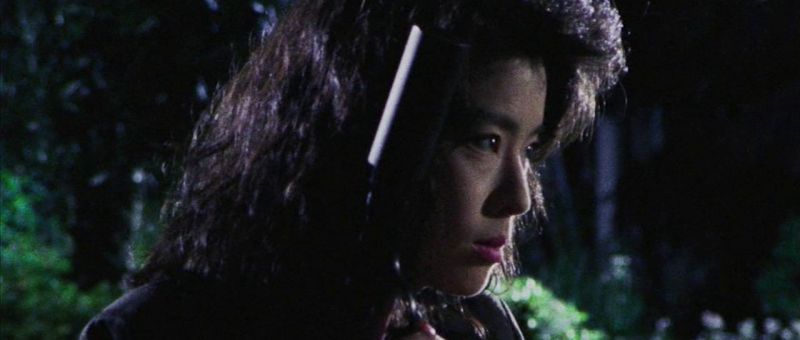
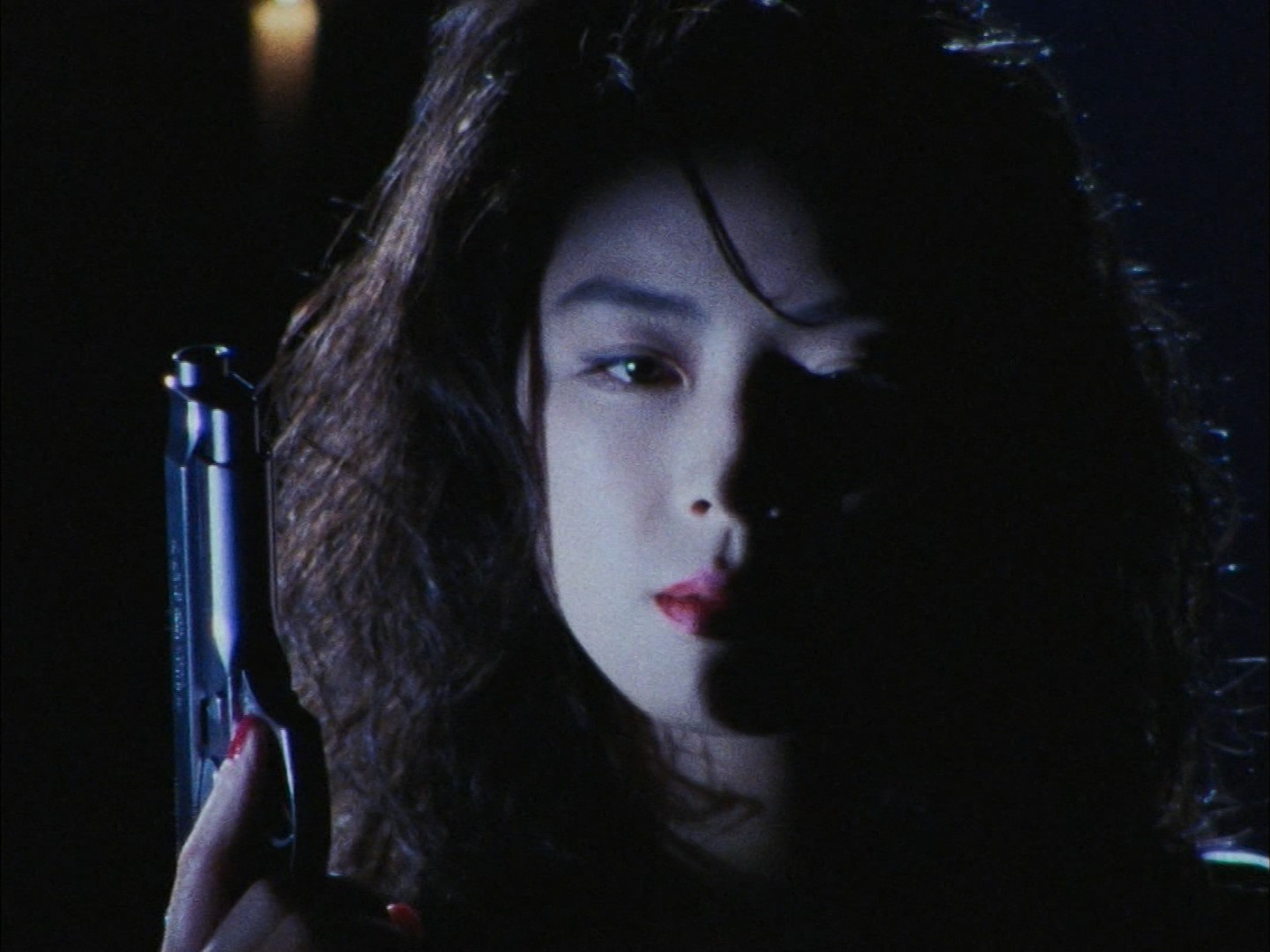
An assassin raised inside a weird Catholic hitman cult begins to reassess her life after falling for a reporter trying to expose the cult’s wrongdoings in Masaru Konuma’s adaptation of the novel by Mangetsu Hanamura, XX Beautiful Hunter (XX ダブルエックス 美しき狩人, XX: Utsukushiki Karyudo). In the classic V-Cinema mode, the film is a guns and girls crime thriller, though in other ways perhaps unusual in exploring the heroine’s gradual liberation in the wake of her sexual awakening. 

Shion (Makiko Kuno) comes of age twice, in the sense that in the opening sequence in which she undergoes a kind of baptism to become a “warrior of God,” she appears to get her period shortly after shooting her first target. Raised by the priest whom she calls “Father”, Shion is an emotionless killing machine with seemingly no thoughts at all beyond completing her mission. She does not even really seem to subscribe to the religion and is killing because Father told her to rather than for the glory of God while most of her targets are political figures that have become inconvenient. We can see both how little women are valued in this world and what a bad guy Ishizaki is when he uses his wife as a human shield before being dispassionately assassinated by Shion who does not particularly care about the collateral damage as long her primary target is killed. When the reporter she falls in love with, Ito (Johnny Okura), asks her what she’d do if he tried to run in a crowded public place, she says that she’d shoot him and that a lot of people would die, as if didn’t matter to her on either moral or practical grounds. Strangely, no one seems to react very much to the sound of a gun being fired even when Shion uses hers to bust open a coin locker, so perhaps she simply doesn’t worry about the laws of man.

But she is rattled by Ito’s photo of her executing his friend Sakuma because it reflects something of herself she didn’t want to see and has perhaps been repressing. Ito suggests that maybe she just likes killing people, which seems to bother Shion on some level, but an attempt to masturbate with her gun does indeed suggest a link between killing and sexual pleasure. It is though sexual contact with Ito that seems to awaken her when he rather strangely begins giving her oral sex after tearing at her clothes pleading for his life. As though imprinting on him, Shion becomes fascinated by Ito and the “normality” he represents. He gives her a crash course in dating while seemingly deprogramming her by getting her to eat meat and do “normal” things like going on drives in her sports car. Shion also starts dressing in more noticeably feminine fashions echoing the link between her baptism and coming of age with the suppression of her womanhood. 

It’s through this sexual liberation that Shion begins to break away from her programming and ask questions of the cult such as who her real parents were. Father seems to have a stoical attitude, exclaiming that “women are all the same” as if he knew this day would come and that Shion has evolved on falling in love. He seems to welcome this development on one level, but at the same time reduces Shion from the beautiful weapon he’s created to maternal vessel in suggesting that her true destiny lies in childbirth and that his dream is to hold her child whom he will presumably also train as an assassin. 

Meanwhile, the cult also paradoxically tries to use sex to control by subjecting her to a torture session at the hands of a lesbian dominatrix who insists she’ll show her a heaven men can never know and make her forget all about men. She does this by inserting a giant electrified dildo, which paints a very confusing picture of the cult’s views on sex, whether hetero or homosexual, penetrative or not. Ito turns up to “save” her, but thankfully it isn’t a case of a random man walking in and taking over, so much as providing a distraction for Shion to save herself while further empowering her with the motivation of love. In this world, however, love is futile and elusive. Even after freeing herself from the oppressive control of Father, Shion loses everything and intends to end her life only to turn around with another gesture of defiance though whether one of the killing machine reasserting itself or the desire for life overriding her nascent pain is difficult to say.


Ringu (リング, Hideo Nakata, 1998)

As the investigative duo at the centre of Hideo Nakata’s eerie supernatural horror Ringu (リング) begin to unlock the mystery of Sadako, we’re told that a strange woman who may have had some kind of psychic powers was loathed by those around her in part because of her habit of sitting and staring at the sea. Nakata opens the film with waves and often returns to them as if suggesting in this millennial horror that what we fear is a transmission we cannot see. In the end there may not be so much difference between the magic of an analogue TV broadcast and a message from another plane. 

In any case, perhaps the central message is that one should pay more attention to the words of those whose warnings are often dismissed on the grounds of their age and gender. Journalist Reiko (Nanako Matsushima), for example, doesn’t seem too invested in a video she’s making about a cursed video related by a trio of high school girls in a cafe who explain that they don’t personally know anyone who’s died after watching it but have been reliably informed by friends of friends who apparently do. As will later be discovered, the girls actually give Reiko crucial information but for whatever reason she does not remember it until coming to the same conclusion herself. In any case, it’s not until her own niece, Tomoko (Yuko Takeuchi), dies in mysterious circumstances that Reiko starts to wonder if this is more than a spooky story elevating the chain letter to new technological heights.

According to the urban legend, if you watch the cursed tape you’ll immediately get a phone call telling you you’ll die in seven days. The supernatural entity now synonymous with the film, Sadako, is manipulating these still analogue waves for herself. Sending her messages via television and telephone she is a literal ghost of the airwaves and as Reiko’s ex-husband Ryuji later puts it radiating her sense of rage in her own mistreatment, insisting that her story be known and that those who refuse to acknowledge it should not be allowed to survive. Just as Reiko should have listened to the high school girls, someone should have listened to Sadako and because they didn’t others now have no choice. 

In a sense Sadako represents this nascent fear of technological advancement. When Reiko answers her flip phone, it’s a reminder that there’s no escape from unwanted communication even if you can in theory try to switch it off. The girl with Tomoko when she died was driven out of her mind and now won’t venture anywhere near a television, as if you could escape Sadako’s wrath by merely keeping your distance from the portal. The two teenagers who died around the same time as Tomoko were in a car in the middle of nowhere, but cars have radios which receive radio waves. Sadako travels through the air, invisible until she chooses not to be. She may only have a direct line, but it is in one sense a call for help she’s issuing only in the very inefficient manner of a vengeful ghost whose rage has become indiscriminate or at least directed towards the society that wronged her and everyone in it rather than a single guilty party. 

In a certain sense, you can cure the curse only by spreading it. If everyone everywhere suddenly understood, learned Sadako’s painful history, then the curse would wither and die with no new hosts to go to which is perhaps what Sadako wants. Yet it leaves Reiko with a dilemma, knowing that to save the lives of those closest to her she may have to ask someone else to risk their life or even expose them without their consent. Throughout the film she’s been depicted as an imperfect mother, divorced and often leaving her small son Yoichi to fend for himself at home while the boy at one point walks past his own father in the street and does not seem to recognise him so absent had he been in his life. Through their shared quest to undo the curse, the pair in a sense reclaim their parental roles and repair their familial ties in working together to save their son’s life in contrast to the parental figures surrounding Sadako who may have done the reverse. Sadako frightens us because of her transgressive qualities, quite literally transgressing the barriers between ourselves and the stories we tell by crawling out of them and finding us here, on the other side of the screen, where we thought we were safe to remind us not to look away and to listen to those whose voices are all too often ignored. 


Ringu screens at Japan Society New York on Oct. 7 as part of the Monthly Classics series.

20th anniversary trailer (English subtitles)