
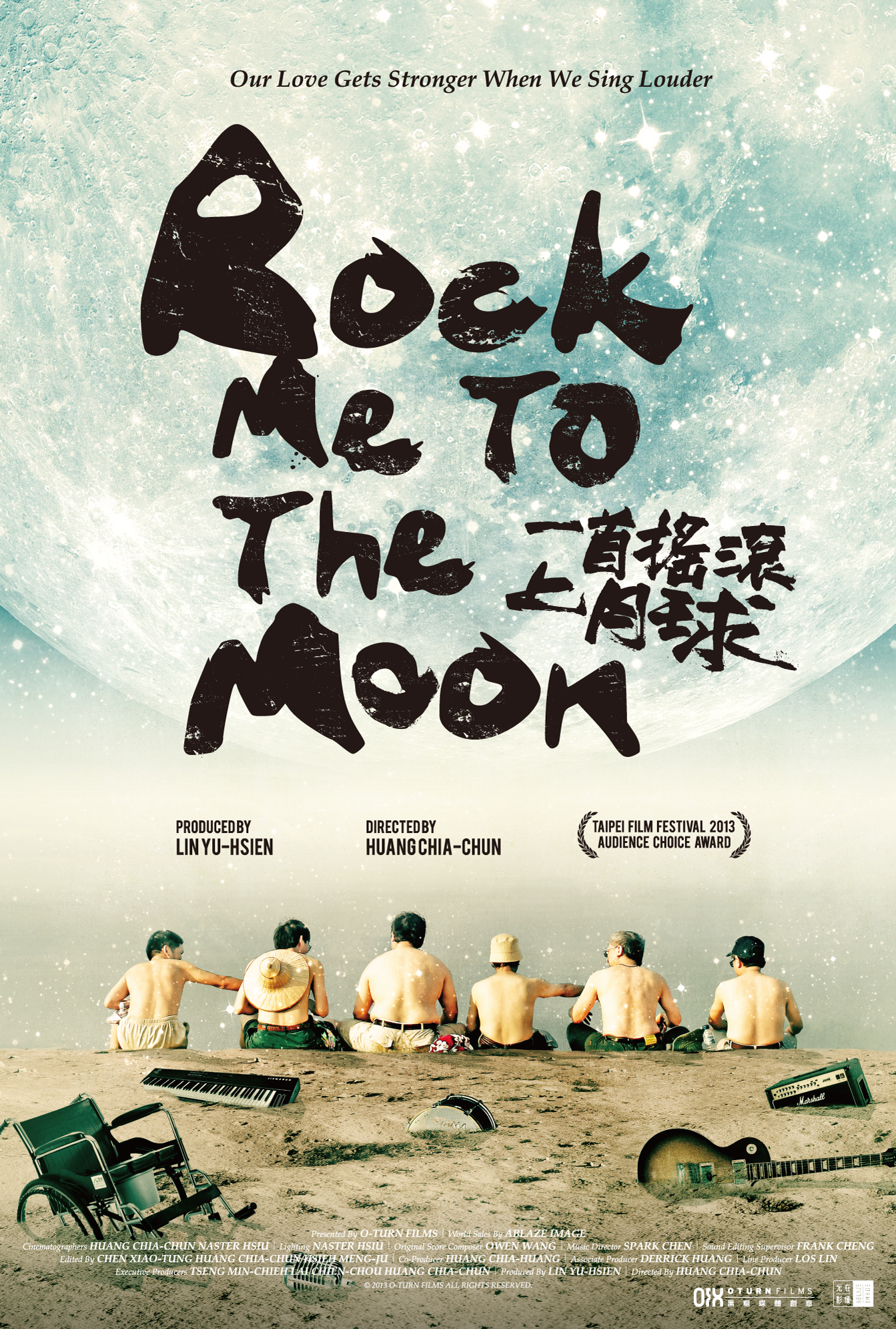
“Finally, I understand to be strong is to be gentle” sings the lead vocalist of Sleepy Dads, a rock band comprised entirely of middle-aged men who are each fathers of children with rare medical conditions. Documentarian Huang Chia-Chun first encountered the men while working as a volunteer with Taiwan Foundation for Rare Disorders where he was struck by their intense love for their children continuing to give all for their families while also obviously facing their own difficulties as they try to balance economic support with the emotional. Charting the Sleepy Dads’ quest to play at a high profile rock festival, Rock Me to the Moon (一首搖滾上月球, Yī Shǒu Yáogǔn Shàng Yuèqiú) is not only an exploration of living with disability but also a quiet re-evaluation of notions of masculinity as the fathers find themselves members of a minority when it comes to their children’s care.
That was in fact one of the motivations which led to the founding of the band, one of the dads remarking that as they looked around at various support groups it was almost all mothers with very few men, lamenting that unfortunately many fathers either reject their children or abandon their families entirely. A news report later in the film, meanwhile, relates the tragic story of a single-father who was pushed towards suicide because of the difficulties of caring for his daughter alone which left him unable to earn the money to support them both and eventually overburdened with debt. Though one of the Sleepy Dads is a school teacher with a steady job, many of the others are in precarious freelance employment struggling to balance the need to earn money with the physical need to be there for their children each of whom has differing needs especially as some of them have more than one child suffering with longterm illness.
The band provides a place where the men can come together to relax with others in a similar position, finding mutual support and solidarity while investing themselves in mastering a new skill. Guided by Spark, the lead singer of top rock band Quarterback, who offers them the opportunity to open at one of their concerts, the Sleepy Dads do their best to perfect their skills with the hope of eventually playing at a top festival despite their comparatively advanced age and lack of experience. Training hard to achieve their goal, it’s less the end point that matters than the process as they work through their difficulties together with good humour and determination.
As another of the fathers puts it, however, Taiwanese men are raised to be brave and strong but he’s also under an intense amount of pressure. Poignantly his wife, preparing to undergo medical treatment herself, expresses that she’d just like her husband to give her a hug but he says he doesn’t know how because he wasn’t brought up to show emotion in that way. She also worries that he sometimes doesn’t see that she’s under a lot of pressure too and prefers to think of her as a kind of superwoman with an innate ability to cope with anything life throws at her. Nevertheless, the Sleepy Dads have fierce love for their children and are never afraid to show it, doing everything they can to care for them while knowing in some cases that their kids may not survive them and so their time together is even more precious. As the song says, they’ve learned that true strength lies in being gentle.
While one of the mothers laments that she feels isolated even within her own family because her in-laws will not accept the children, asking her not to bring them to a family gathering, the Sleepy Dads have formed an extended family of their own coming together to celebrate one of the dad’s moves into a new home he’s had designed to better meet his family’s needs with all the kids playing together happily. They don’t pretend that their lives are easy, but they share their joys and sorrows equally and work out their frustrations through the medium of song. A warm and empathetic tribute to these selfless men and their infinite love for their children, Rock Me to the Moon is also a celebration of friendship and solidarity not to mention the power of music to overcome all hardships.
Rock Me to the Moon streams in the US Dec. 11 – 13 as part of Asian Pop-Up Cinema & TACCGC’s @Home with Taiwan Cinema: Love & Hope.
Original trailer (English subtitles)
 Windows on Worlds