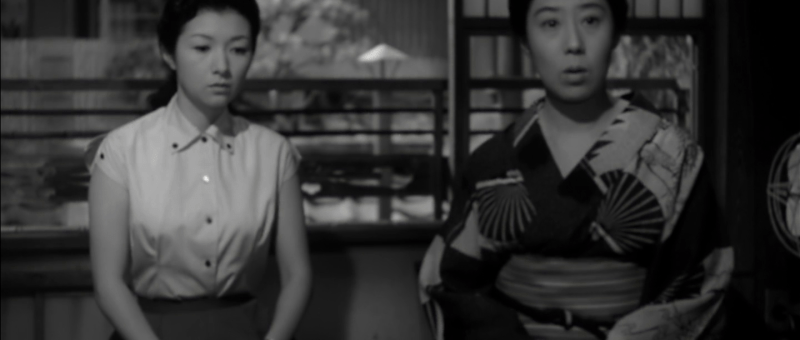
Flowing (流れる, Mikio Naruse, 1956)

The denizens of a moribund geisha house contemplate visions of independence in post-war Japan Mikio Naruse’s thriving ensemble drama, Flowing (流れる, Nagareru). There is indeed a flowing through the geisha house, a tumble of comings and goings though mostly connected to money which is itself constantly flowing though the for geisha mainly in the wrong direction. Released in the year of Prostitution Prevention Law, the film casts a shadow over the lives of these women who are unwittingly living in their industry’s twilight but asks if it’s really possible for a woman to survive without a man while each of them is in one way or another badly let down by an inconstant lover. 

We’re constantly told that Tsutanoya is the most respectable geisha house in town yet despite its well appointed interiors, it’s clear that business is not good. As the film opens, a young geisha, Namie, is accusing the owner’s daughter Katsuyo (Hideko Takamine) of diddling her on her pay. Katsuyo acts indignant and tries to shift the blame back onto Namie but later admits that the house has indeed been skimming a little more off their wages than was agreed claiming all the geisha houses do it which is probably true but doesn’t make it right. In any case Namie will eventually quit and end up working at “some third rate place” while her uncle (Seiji Miyaguchi) causes problems for proprietress Tsuta (Isuzu Yamada) complaining that Namie was exploited and wanting both the backpay he feels she’s owed and compensation though it seems unlikely any of that money is finding its way back to Namie. Meanwhile the house is a geisha down with only former office worker Nanako (Mariko Okada) and 50-year-old veteran Someka (Haruko Sugimura) on the books.

Despite their financial situation, Tsuta hires a new maid, Rika (Kinuyo Tanaka) who is immediately renamed “Oharu” on her arrival. Oharu is a salt of the Earth type, infinitely capable, maternal, kind and loyal bringing a much needed sense of stability to the ever flowing geisha house while also fascinated by this exotic and arcane world. But then as Tsuta cautions her geisha houses may look glamorous from the outside but the life inside them isn’t always fun. Oharu runs into trouble on her first trip to the grocers when they inform her Tsuta hasn’t paid her tab and they can’t let her add to it until she does. A 45-year-old widow whose only child died a year previously, Oharu is also trying to live an independent life, a conflicted Tsuta struck with wonder at her ability to survive without a man, but may also have struggled, grateful to have been offered the job which others might have declined because of the stigma towards the sex trade as finding employment as a middle-aged woman is near impossible. 

At the film’s conclusion even she may imply it isn’t really possible to live as a woman without some kind of support or losing one’s humanity suggesting that she may return to her husband’s hometown and the family she claims not have gotten along with after learning of Tsuta’s betrayal at the hands of an old friend and former geisha, Ohama (Sumiko Kurishima), who at any rate seems to be living quite well as the proprietress of a restaurant. Traditionally, the profession of geisha was seen as a kind of independence in itself but it’s also one that by its nature is reliant on men. Tsuta is often described as someone who is not able to do anything else yet is highly skilled at music and dance having spent a lifetime in training. Without a patron she is stuck and as we learn she threw hers over to pursue a man she loved but he left her in the lurch having mortgaged the geisha house to invest in his business by taking a loan from her older sister who seems to have a nice sideline as a polite loan shark also having loaned money to Someka. 

The most outwardly cheerful, Someka is in other ways a dark vision of a geisha’s future surviving on nothing but nihilistic hedonism while apparently living with a much younger man who eventually leaves her to marry into another woman’s family. Katsuyo has rejected the geisha life explaining that she is unable to, as Nanaka puts it, say silly things to men in order to earn her keep and is essentially incapable of ingratiating herself with men she doesn’t like. She claims she has no desire to marry, unconvinced that any man would be interested in a geisha’s daughter while certain that for a man marrying into a woman’s family is humiliating while suggesting the same would be true for her. Putting her faith in industry, she buys a sewing machine and sets about figuring out how to use it less because she envisages being able to support herself and her mother through taking in needlework than she just wants to feel as if she’s doing something. 

Meanwhile, Tsuta’s niece Fujiko observes all the comings and goings of the geisha house learning the traditional arts in preparation for a future which will soon be obsolete. In a typically Narusean touch, Tsuta comes to a resolution about her future and envisages a new beginning for herself but is unaware the rug is soon to be pulled from under her by the underhanded capitalist Ohama who plans to turf her out to turn the geisha house into another restaurant. “My days of seeking favours from men are over,” Tsuta admits, not of her own volition but simply understanding that she no longer has access to that kind of independence though in essence surrendering her autonomy in leaving herself to the mercy of Ohama in order to escape her older sister’s control. Someka had laughed raucously at Katsuyo’s insistence that she need not be dependent on a man (and after everything she’s seen why would she want to be?) but the younger woman is undeterred even as we see her struggling, doubting that her efforts will in the end be enough to win her her freedom. Ever the optimist, Tsuta is perhaps doing something similar but even Oharu is considering giving up and going home, too good to survive in the dog eat dog world of the contemporary capital where the flow of currency is the lifeblood of the city implying that perhaps the answer to her question is no, a woman can’t survive alone, nor can she rely on female solidarity, but she’ll have to try anyway because there is no other choice. 


The Angry Street (怒りの街, Mikio Naruse, 1950)

As its opening text explains, Mikio Naruse’s The Angry Street (怒りの街, Ikari no Machi) takes place in a world in which a love of justice and faith in others has been crushed under foot. That might equally apply to any other of Naruse’s films and well enough reflects his generalised philosophy that the world in which we live betrays us, but in this case it’s more than usually true as he adopts the trappings of film noir to consider the series of reversals that have taken place amid post-war chaos chief among them class and gender. 

Sociopathic student Shigetaka’s (Yasumi Hara) primary motivation is to earn money for his family, once upper middle-class but now fallen on hard times, but he’s also engaged in an act of class warfare taking revenge on the “nouveau riche” who he feels have usurped his class privilege. His chief weapon is his good looks along with his seductive charm which he puts to full use on the dance floor flirting with naive young women to whom he sells sob stories of his poverty to extort money out of them. He and his friend Mori (Jukichi Uno) have an “agreement” that what they’re doing’s alright as long as they only take advantage of the women financially rather than sexually though at this point Shigetaka seems to have little interest in that anyway insisting that women are just business to him so he little cares for their feelings. 

Their sense of class resentment is rammed home by their mocking of their classmates who have to do “humiliating” jobs to support themselves such as selling lottery tickets in the streets. Trying to get them to attend a meeting about student employment, their classmates describe them as “privileged” suggesting they may feel it’s not their problem because they don’t need to work little knowing that each of them is impoverished and dependent on exploiting women for their income.

There is however also a gender reversal in play as Shigetaka misogynistically takes on a feminised role, playing the gold digger in attempting to manipulate women, who are now in a position of power, into supporting him financially. He even tells some of them that he’s being forced into a financial marriage by his “old-fashioned” family, playing the damsel in distress and hoping that his target will swoop in to rescue him. When one of the women writes to his home after he abandons her, his grandmother is scandalised by the idea that he might have formed an attachment to a woman to whom he had not been formally introduced but equally that he might have been frequenting “effeminate” places such as dance halls. Unmanliness is something he’s accused of several times but also the tool which he uses to seduce women who are taken in by his feminine features and graceful dancing. Closely echoing Alfred Hitchcock’s Rope, it’s near impossible not to read both Shigetaka and Mori as queer coded and the relationship between them filled with homoerotic tension as Mori looks on in jealously while Shigetaka goes about his business seducing naive young women they’ll swindle together. 

A point of crisis arrives when the pair bite off more than they can chew in getting involved with a woman who is slightly older and sophisticated in her dealings with men. An independent woman, Tagami (Yuriko Hamada) claims to be a dentist but actually makes her money through smuggling and the black market if drawing her line at drugs. Shigetaka thinks he’s using her, but Mori warns him she’s really the one in charge and playing him at his own game planning to drop him once she’s got what she wanted which in this case is his youthful flesh (realistically the only thing he could possibly offer her). Tagami draws him into a wider and more dangerous world of crime than he’s equipped to deal with just as Mori receives twin blows that break the spell and encourage him to want out of Shigetaka’s schemes firstly in discovering that one of their targets, Kimiko (Mayuri Mokusho), is the sweetheart of an old war buddy, and then into running into Shigetaka’s earnest sister Masako (Setsuko Wakayama) who is the film’s de facto moral authority pulling him away from Shigetaka’s dark machinations back towards a more conventional morality. 

In a series of flashbacks, he remembers more innocent times before the war when he too sold tickets on the street and worked in a shop washing windows while going on innocent dates with Masako. The implication is that it’s his wartime service along with the world he came back to that have filled him with nihilistic cynicism while he later says that he indulges in Shigetaka’s schemes as a means of staying close to him and earning his favour. But Shigetaka is already far too corrupt, filled with class resentment over his lost privilege along with a deep-seated misogyny as a reflection of his sense of emasculation in this new world in which young women wield significant economic power. Kimiko in particular is brash and insensitive even aside from her naivety remarking on the piles of money that turn up at her home every day before virtually throwing cash at Shigetaka with seemingly no thought as to how that might make him feel even if he weren’t conning her in offending his pride and masculinity. 

Mori wonders how he can save himself if Shigetaka remains so irredeemable and is instructed by Masako that they must work together and live honestly though even she hangs on to her ideas of social class scandalised by the revelation that her mother too has begun selling things in the street, in her case knitted socks which is a fairly labour intensive activity for an incredibly small profit margin. Echoing film noir, Naruse opens and closes with scenes of the present day city teeming with life yet in a way that seems more ominous than exuberant even in the myriad dance halls where youngsters come to look for love but soon find themselves lost amid the contradictions and confusions of a rapidly changing city.


Floating Clouds (浮雲, Mikio Naruse, 1955)

(C) 1955 Toho

floating clouds poster“The past is our only reality” the melancholy Yukiko (Hideko Takamine) intones, only to be told that her past was but a dream and now she is awake. Adapted from a novel by Fumiko Hayashi – a writer whose work proved a frequent inspiration for director Mikio Naruse, Floating Clouds (浮雲, Ukigumo) is a story of the post-war era as its central pair of lovers find themselves caught in a moment of cultural confusion, unsure of how to move forward and unable to leave the traumatic past behind.

We begin with defeat. Shifting from stock footage featuring returnees from Indochina, Naruse’s camera picks out the weary figure of a young woman, Yukiko, drawing her government issue jacket around her. She eventually arrives in the city and at the home of an older man, Kengo (Masayuki Mori), whom we later find out had been her lover when they were both stationed overseas working for the forestry commission but has now returned “home” to his family. Kengo had promised to divorce his wife, Kuniko (Chieko Nakakita), in order to marry Yukiko but now declares their romance one of many casualties of war. With only the brother-in-law who once raped her left of her family, Yukiko has nowhere left to turn, eventually becoming the mistress of an American soldier but despite his earlier declarations the increasingly desperate Kengo cannot bear to let her go and their on again off again affair continues much to Yukiko’s constant suffering.

Floating Clouds is as much about the post-war world as it is about a doomed love affair (if indeed love is really what it is). Kengo and Yukiko are the floating clouds of the title, unable to settle in the chaos of defeat where there is no clear foothold to forge a path into the future, no clear direction in which to head, and no clear sign that the future itself is even a possibility. Naruse begins with the painful present marked by crushing defeat and hopelessness, flashing back to the brighter, warmer forests of Indochina to show us the lovers as they had been in a more “innocent” world. At 22, Yukiko smiles brightly and walks tall with a lightness in her step. She went to Indochina in the middle of a war to escape violence at home and, working in the peaceful environment of the forestry commission, begins to find a kind of serenity even whilst dragged into an ill-advised affair with a moody older man more out of loneliness than lust.

Yet, Yukiko’s troubles started long before the war. Assaulted by her brother-in-law she escapes Japan but falls straight into the arms of Kengo who is thought a good, trustworthy man but proves to be anything but. Kengo, frustrated and broken, attempts to lose himself through intense yet temporary relationships with younger women. Every woman he becomes involved with throughout the course of the film comes to a bad end – his wife, Kuniko, dies of tuberculosis while Kengo was unable to pay for treatment which might perhaps have saved her, an inn keeper’s wife he has a brief fling with is eventually murdered by a jealous husband (a guilty Kengo later attempts to raise money for a better lawyer to defend him), Yukiko’s life is more or less destroyed, and goodness only knows what will happen to a very young errand runner for the local bar whom he apparently kissed in a drunken moment of passion.

The lovers remain trapped by the past, even if Kengo repeatedly insists that one cannot live on memory and that their love died in Dalat where perhaps they should have remained. Yukiko’s tragedy is that she had nothing else than her love for Kengo to cling to, while Kengo’s is that he consistently tries to negate the past rather than accept it, craving the purity of memory over an attainable reality, chasing that same sense of possibility in new and younger lovers but once again squandering each opportunity for happiness through intense self obsession. “Things can’t be the same after a war”, intones Kengo as an excuse for his continued callousness, but they find themselves retreating into the past anyway, taking off for tropical, rainy Yakushima which might not be so different from the Indochina of their memories but the past is not somewhere one can easily return and there can be only tragedy for those who cannot let go of an idealised history in order to move forward into a new and uncertain world.