Rainbow Hill (虹立つ丘, Toshio Otani, 1938)

The cheerful life of a brother and sister in Hakone is disrupted by an unexpected revelation in Toshio Otani’s heartwarming drama, Rainbow Hill (虹立つ丘, Niji Tatsu Oka). In some ways, displaying an affluent quality of life perhaps unrealistic for the Japan of the late 30s, the theme is really family is and the importance of blood relations as one family is broken so another can be restored in a moment of healing and reconciliation with the traumatic past.

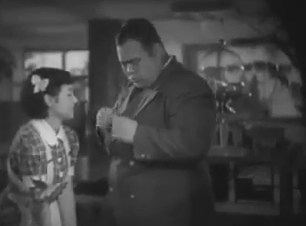
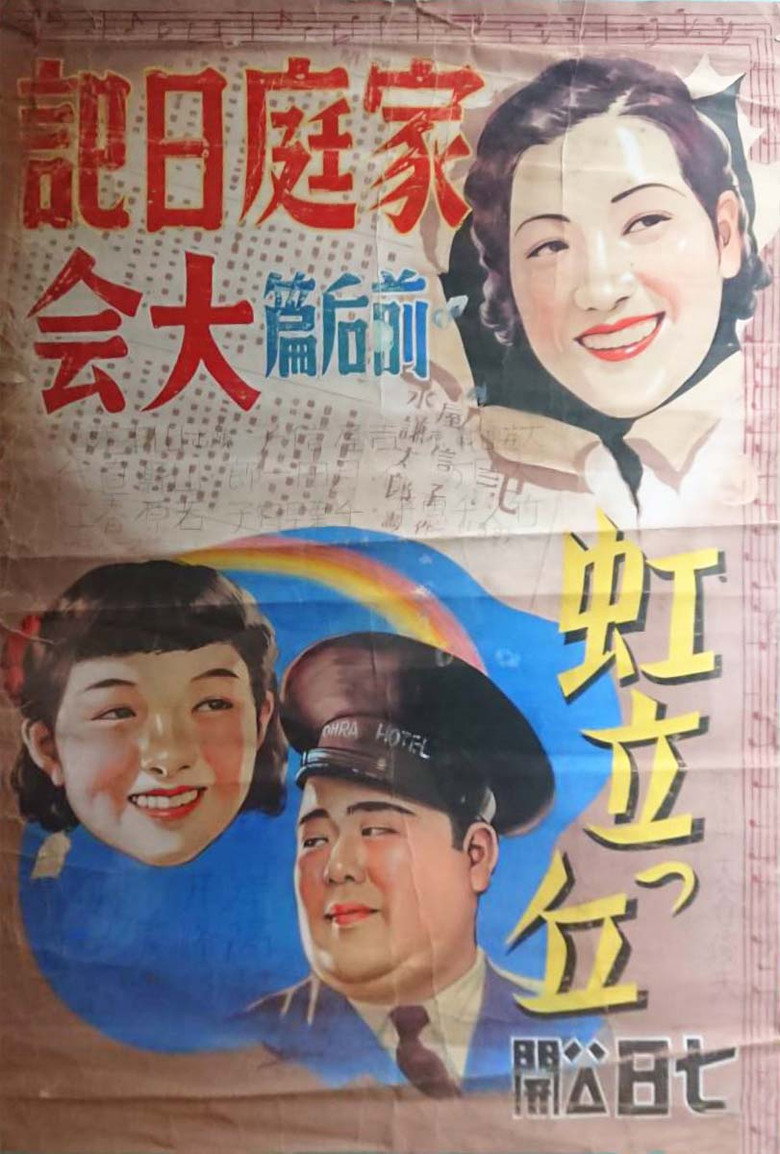
Shot predominantly on location at the luxury Gora Hotel in Hakone, the film revolves around a young girl, Yuri (Hideko Takamine), who works in the hotel’s shop while her bother Yatahachi (Akira Kishii) is also works at the hotel as a porter. The pair are incredibly close and would do anything for each other, though Yatahachi is also forced to conduct a romance somewhat clandestinely. He generally waits for Yuri to go to sleep before meeting his girlfriend, Fuji (Chizuko Kanda), who works in a local amusement centre. Yuri, however, is getting older and doesn’t always want to go to sleep early, which is the first note of discordance in their relationship in implying that Yatahachi’s childcare responsibilities stand in the way of marriage. Fuji, however, is also very fond of Yuri and sometimes looks after her when Yatahachi is not able to. 

The second note of discordance is when Yatahachi is dismissed from the hotel for having deserted his post after hearing that Yuri has fallen off a cliff and running off to save her. Though this is quite a valid reason for abruptly leaving work without permission, Yatahachi does not explain to his boss but only accepts his fate stocially while accepting that it was wrong of him to leave and that his actions caused the hotel reputational harm. Important guests were due from Manchuria and were apparently forced to carry their own bags. 

Another hotel guest who has become friendly with Yuri, Mrs Hayakawa (Sachiko Murase), who is staying at the hotel to recover from an illness, complains to the manager and gets Yatahachi reinstated with a promotion. Frequent guests the Hayakawas have some clout at the hotel, as perhaps do their friends the Mizutanis whose bag Yatahachi ends up tearing when asked to open it after the little boy loses his key. The film doesn’t really draw much of a contrast between the worlds of the people who stay in this luxury hotel and those who work in it, save that Yuri is full of tales of Mrs Hayakawa’s Western-style Tokyo home where she apparently has two dogs the size of Yatahachi. The pair, by contrast, live in quite a nice, if humble, traditional home and appear to have a good standard of life. 

Yuri is, however, somewhat drawn to Mrs Hayakawa who seems to fulfil the missing maternal role in her life by giving her gifts and taking her on outings. It’s not until Mrs Hayakawa visits her home and sees a familiar doll that she begins to suspect she could be the daughter from whom she was separated during the Great Kanto earthquake of 1923. The question then becomes whether it is right to disclose Yuri’s true identity and take her away from the brother with whom she has been so close. In another sign of his goodness, Yatahachi presumably found Yuri amid the chaos. Lacking any means of identifying her and believing that her parents were likely dead, he raised her himself as his sister. Though sensitive to the situation, the Hayakawas want her back. With them Yuri would have more opportunities and a better quality of life as a wealthy young woman in the capital, but it would also break Yuri and Yatahachi’s hearts. That Yuri agrees to go with them while Yatahachi accepts he must let her go to her biological parents hints at the importance of bloodlines and the necessity of familial restoration that acts as a means of laying the traumatic event of the earthquake to rest. Mrs Hayakawa’s malady is cured on having found her missing daughter, though she still vows to return to the hotel in the spring so Yuri and Yatahachi can be reunited. This also paves the way for a marriage between Fuji and Yatahachi as the pair look forward to welcoming Yuri’s return together.

An early leading role for Takamine, the film also features cameos from a series of other Toho stars as the hikers who rescue Yuri after she falls off the cliff, while Akira Kishii performs a few songs including a Japanese version of Home on the Range enhancing the film’s international feeling. It is perhaps unexpectedly breezy for the time period and basks in the lives of the super rich at a time when others are struggling to get by, but nevertheless offers a bittersweet and heartwarming tale of familial reconciliation and renewed hope for the future.


The Angry Street (怒りの街, Mikio Naruse, 1950)

As its opening text explains, Mikio Naruse’s The Angry Street (怒りの街, Ikari no Machi) takes place in a world in which a love of justice and faith in others has been crushed under foot. That might equally apply to any other of Naruse’s films and well enough reflects his generalised philosophy that the world in which we live betrays us, but in this case it’s more than usually true as he adopts the trappings of film noir to consider the series of reversals that have taken place amid post-war chaos chief among them class and gender. 

Sociopathic student Shigetaka’s (Yasumi Hara) primary motivation is to earn money for his family, once upper middle-class but now fallen on hard times, but he’s also engaged in an act of class warfare taking revenge on the “nouveau riche” who he feels have usurped his class privilege. His chief weapon is his good looks along with his seductive charm which he puts to full use on the dance floor flirting with naive young women to whom he sells sob stories of his poverty to extort money out of them. He and his friend Mori (Jukichi Uno) have an “agreement” that what they’re doing’s alright as long as they only take advantage of the women financially rather than sexually though at this point Shigetaka seems to have little interest in that anyway insisting that women are just business to him so he little cares for their feelings. 

Their sense of class resentment is rammed home by their mocking of their classmates who have to do “humiliating” jobs to support themselves such as selling lottery tickets in the streets. Trying to get them to attend a meeting about student employment, their classmates describe them as “privileged” suggesting they may feel it’s not their problem because they don’t need to work little knowing that each of them is impoverished and dependent on exploiting women for their income.

There is however also a gender reversal in play as Shigetaka misogynistically takes on a feminised role, playing the gold digger in attempting to manipulate women, who are now in a position of power, into supporting him financially. He even tells some of them that he’s being forced into a financial marriage by his “old-fashioned” family, playing the damsel in distress and hoping that his target will swoop in to rescue him. When one of the women writes to his home after he abandons her, his grandmother is scandalised by the idea that he might have formed an attachment to a woman to whom he had not been formally introduced but equally that he might have been frequenting “effeminate” places such as dance halls. Unmanliness is something he’s accused of several times but also the tool which he uses to seduce women who are taken in by his feminine features and graceful dancing. Closely echoing Alfred Hitchcock’s Rope, it’s near impossible not to read both Shigetaka and Mori as queer coded and the relationship between them filled with homoerotic tension as Mori looks on in jealously while Shigetaka goes about his business seducing naive young women they’ll swindle together. 

A point of crisis arrives when the pair bite off more than they can chew in getting involved with a woman who is slightly older and sophisticated in her dealings with men. An independent woman, Tagami (Yuriko Hamada) claims to be a dentist but actually makes her money through smuggling and the black market if drawing her line at drugs. Shigetaka thinks he’s using her, but Mori warns him she’s really the one in charge and playing him at his own game planning to drop him once she’s got what she wanted which in this case is his youthful flesh (realistically the only thing he could possibly offer her). Tagami draws him into a wider and more dangerous world of crime than he’s equipped to deal with just as Mori receives twin blows that break the spell and encourage him to want out of Shigetaka’s schemes firstly in discovering that one of their targets, Kimiko (Mayuri Mokusho), is the sweetheart of an old war buddy, and then into running into Shigetaka’s earnest sister Masako (Setsuko Wakayama) who is the film’s de facto moral authority pulling him away from Shigetaka’s dark machinations back towards a more conventional morality. 

In a series of flashbacks, he remembers more innocent times before the war when he too sold tickets on the street and worked in a shop washing windows while going on innocent dates with Masako. The implication is that it’s his wartime service along with the world he came back to that have filled him with nihilistic cynicism while he later says that he indulges in Shigetaka’s schemes as a means of staying close to him and earning his favour. But Shigetaka is already far too corrupt, filled with class resentment over his lost privilege along with a deep-seated misogyny as a reflection of his sense of emasculation in this new world in which young women wield significant economic power. Kimiko in particular is brash and insensitive even aside from her naivety remarking on the piles of money that turn up at her home every day before virtually throwing cash at Shigetaka with seemingly no thought as to how that might make him feel even if he weren’t conning her in offending his pride and masculinity. 

Mori wonders how he can save himself if Shigetaka remains so irredeemable and is instructed by Masako that they must work together and live honestly though even she hangs on to her ideas of social class scandalised by the revelation that her mother too has begun selling things in the street, in her case knitted socks which is a fairly labour intensive activity for an incredibly small profit margin. Echoing film noir, Naruse opens and closes with scenes of the present day city teeming with life yet in a way that seems more ominous than exuberant even in the myriad dance halls where youngsters come to look for love but soon find themselves lost amid the contradictions and confusions of a rapidly changing city.