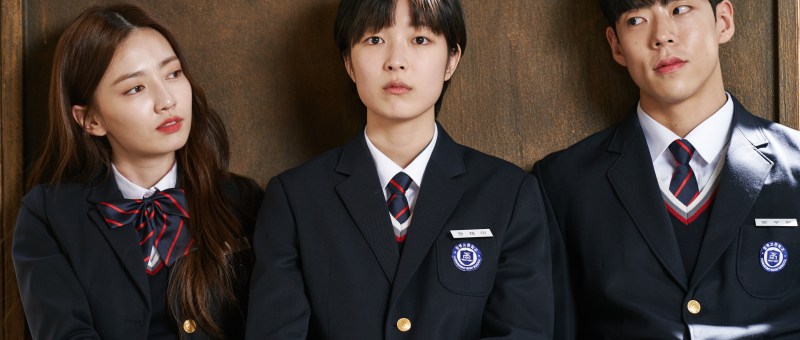
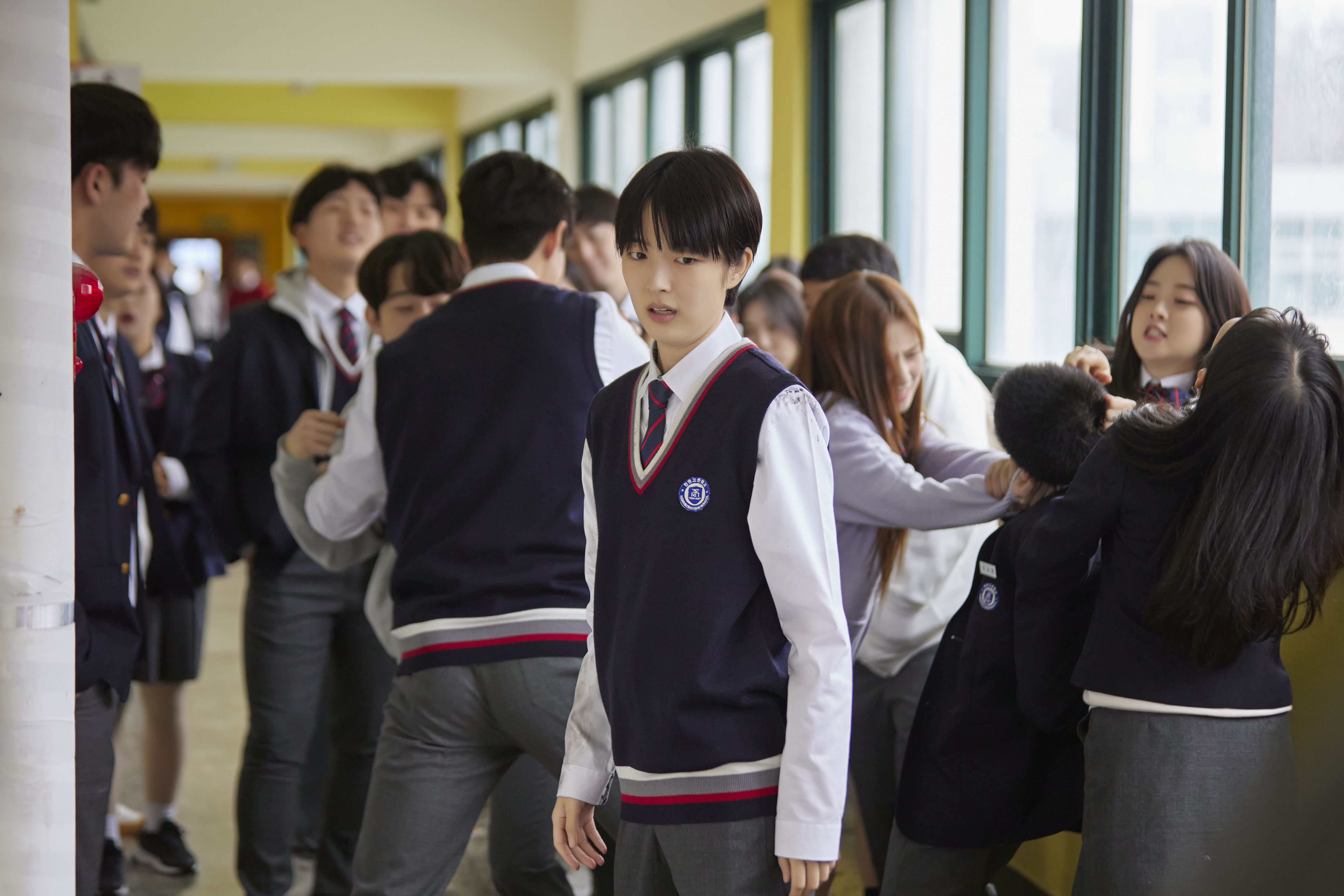
XX+XY (Lee Soh-Yoon, 2022)

According to the voiceover narration that opens Lee Soh-yoon’s lighthearted teen drama XX+XY, we live in an age of choices yet sometimes choice can itself be a burden. At least that’s how Jay comes to see it having been born intersex but encouraged to think that at some point they’re going to have to choose whether to live as a man or a woman as if those are the only options or the choice to continuing living just as they are is not available to them. 

In essence many of their problems could be solved by reducing social dependence on the gender binary. Having been mainly home schooled, Jay has decided to attend a regular high school in part to help them figure out who they are through interacting with other teenagers who, they discover, are also struggling with many of the same questions in trying to decide who they’ll be. Yet for Jay, there’s also the issue of social stigma surrounding the reality of their life as an intersex person which is little understood by the world around them. When their identity is exposed by a malicious person, Jay’s teacher sighs and asks “Why didn’t you hide it better?”, prompting their response that their identity is not something shameful that needs to be concealed while suggesting that the school is on one level at least failing in their duty of care in refusing to protect them from the fallout of being outed which is in part their fault in stemming from the indiscretion of a teacher. 

The idea that they have something to hide is also particularly hurtful to Jay because of their unusual family circumstances given that they were adopted by a couple in a happy marriage of convenience between a closeted gay man and a woman otherwise uninterested in marriage. Their father’s partner now also lives with them and is very much a part of the family as can be seen in cheerful family photo they have hanging on their living room wall. Jay’s father tells them that he wants them to live in a world where they can love freely without fear of judgement or of feeling forced into the kind of arrangement he and their mother have made, their happy partnership not withstanding. On the other hand, it’s also he who first raises the potentially problematic idea that Jay should decide their binary gender based on their sexual orientation only to be firmly slapped down by their mother. 

This is partly the thesis of the film, that Jay is figuring themselves out based on their feelings towards two potential suitors in childhood best friend Sera who’s always known that Jay is intersex and the smitten Wooram who fell for Jay thinking they were a girl and then confused by their more masculine presentation on arrival at school. As Sera later points out, Jay never directly states they are a boy but everyone assumes them to be one because they are wearing a boy’s school uniform and have short hair. It is the school that force Jay to make a concrete choice because of its persistent gender segregation which extends from uniforms, single sex bathrooms, and classroom cliques to different activities for boys and girls in PE. Jay has to make a choice because they have to pick a bathroom, only using the men’s means there’s no bins to dispose of sanitary pads forcing Jay to carry them around until they can find a place to discreetly dispose of them. The boys in Jay’s class are jealous of their popularity with girls, while immaturely gossiping about another boy they regard as effeminate and possibly gay because he is “small” and hangs out with the girls a lot. 

Meanwhile, the conservative attitudes towards sex and romance held by the school and society at large are also in themselves counterproductive. Teens try to buy condoms to be responsible but are turned away because they don’t have ID or a note from their parents and are even shouted at by a nosy old lady at the checkout all of which has them wondering if they should just go ahead without protection rather than giving up on the idea. When Jay’s intersex identity is revealed online, the teachers are more concerned about the concurrent rumour that they and Sera have slept together rather than the breaching of Jay’s privacy, only interested in what the other parents might say or that Jay’s identity on its own may negatively affect their reputation aside from the developing sex scandal. 

In any case supported by their new friends, Jay gains the confidence to believe that they, and everyone else, are good enough as they are and that there isn’t any point in worrying about the people who won’t accept them as they are now. The film may still imply that there’s a binary choice to be made and that whoever Jay decides to pursue romantically has a large impact on it, but nevertheless affirms Jay’s identity as it is and makes clear that it’s they who have a free right to define themselves independently of any social mores or commonly held beliefs. Warmhearted and generous of spirit, Lee’s teen drama finds that largely the kids alright treating each other with kindness and respect when given the opportunity to do so and only waiting for the adult world to catch up. 


XX+XY screened as part of this year’s BFI Flare.

International trailer (English subtitles)
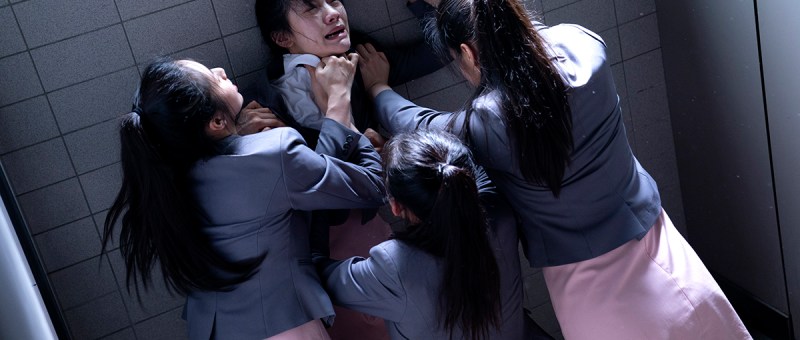
Born to be Human (生而為人, Lily Ni, 2021)

Taiwan is often regarded as among the more liberal of Asian nations, but it is certainly not free of outdated ideas of gender and sexuality as Lily Ni’s powerful sci-fi-inflected drama Born to Be Human (生而為人, Shēng ér Wèirén) makes clear. Like the similarly themed Metamorphosis from the Philippines which also made much of butterfly imagery, Born to Be Human finds a teenager’s ordinary existence upended by the sudden discovery that they are intersex along with the realisation that they have almost no agency over their medical decisions, but is ultimately more concerned with undermining the fallacy of the gender binary along with the sometimes duplicitous actions of the medical profession than with exploring the intersex identity. 

Unpopular at school 14-year-old Shi-nan (Lily Lee) is a regular teenage boy who secretly buys porn mags from the old man on the corner and enjoys playing online video games. Still embarrassed about his body, he is deeply worried on noticing blood in his urine after experiencing painful stomach cramps and half-convinces himself he has bladder cancer while too anxious to tell his parents or seek medical help. When his parents eventually find out they take him straight to the hospital but are fobbed off by an overworked doctor who diagnoses him with a urinary tract infection caused by an infected foreskin, something which they assume can be fixed by circumcision. Returning to school after some time off to recover, however, the problem recurs with Shi-nan collapsing during a sports lesson his shorts stained with blood. A more comprehensive medical exam reveals that Shi-nan is in fact intersex and has a functioning womb directly connected to external male genitalia. 

This unfortunately brings Shi-nan into the orbit of Dr. Lee (Yin Jau-Der), apparently a specialist in urology with an improbably futuristic office, who immediately latches on to Shi-nan’s case as a means of advancing his own career. He recommends to Shi-nan’s parents that they “correct” his physical body according to his chromosomal makeup, explaining that he may be at increased risk of cancer maintaining both sets of sex characteristics. On discovering the analysis has come back female, Shi-nan’s father’s first question is how he can carry on the family name if his son is now a daughter while his mother and the doctor fixate on Shi-nan’s viable womb and the all important ability to procreate. Feeling he will not understand, the parents decide not to share his medical diagnosis with Shi-nan even while he continues to believe that he is dying from bladder cancer, telling him only that he will undergo circumcision signing the consent forms for his gender confirmation surgery without ever consulting him. 

Already 14 years old and having lived all his life as a boy, this forced gender transition provokes a secondary sense of dysphoria as Shi-nan becomes Shi-lan and moves to the capital to attend an elite school presumably offered some kind of financial incentive from Dr. Lee who continues to monitor her progress. Removed from her previous environment, Shi-lan is plunged into hyper femininity as if the entirety of her previous personality had been erased. On her birthday she is given a pink cake with frills and a selection of dolls, while her bedroom is similarly pink and frilly, apparently part of Dr. Lee’s treatment programme to acclimatise Shi-lan to her new identity. Even her mother laments that she’s behind on her feminine education, unable to cook or do chores which she fears will interfere with her ability to get married. Shi-lan says she doesn’t intend to marry, but her refusal is met only with confusion as if a woman’s entire purpose lies in marriage and childbirth. Of course, the secondary issue is that Shi-lan is sexually attracted to women, upset and embarrassed to receive a love letter from a boy at school while pining for her sympathetic deskmate who later becomes her first friend. 

Meanwhile, she is forced to adopt a female personality more or less against her will, later explaining an old photo of herself as one of a younger brother who has unfortunately passed away but will remain always in her heart. Having been bullied at her last school, Shi-lan fears discovery but is subject to a secondary prejudice after a nosy girl goes through her bag and finds a bottle of pills she identifies as being for the treatment of depression later getting her parents to complain to the school that they shouldn’t be forced to share a class with a “mental patient”. 

In fact, Shi-lan has been lied to again, the pills aren’t for depression and she is in fact being tricked to take them against her will as part of her forced transition. She describes herself as a “monster”, neither male nor female, and is acutely compelled to feel that those are her only two options. Her new friend, Tian Qi (Bonnie Liang Ru-Xuan), takes her to a Taiwanese opera performance starring her mother in which a female scholar poses as a man in order to get her education only to fall for a classmate making it clear that an idea of gender fluidity has cultural currency yet Shi-lan has been denied the right to define her own identity, told that what she is is wrong or incomplete, and ultimately reduced to a subject for experimentation by an unethical doctor. Confronting him to be told he has turned her into a “normal person”, she later insists that she can ruin his work just as he has ruined her life, walking through a market witnessing flesh being butchered and fish gutted, before buying a bouquet of sunflowers echoing those on the doctor’s jigsaw puzzle. Whatever her intentions, Shi-lan perhaps comes into herself even if with a dark purpose in mind, actively claiming an identity that is defiantly her own in rebellion against a conservative society that refuses to accept her for all that she is.


Born to be Human screened as part of the 2021 Osaka Asian Film Festival

Original trailer (dialogue free)

Metamorphosis (Jose Enrique Tiglao, 2019)

“Everyone has a secret, but not all secrets are bad” according to Angel (Iana Bernardez), a sex worker and 24-year-old returnee to high school who befriends the lonely Adam (Gold Azeron) as he contends with an adolescence more challenging than most. Exploring the often underrepresented theme of intersexuality, Jose Enrique Tiglao’s Metamorphosis follows its conflicted hero as he struggles to come to an acceptance of who he is and wants to be while faced with the sometimes old fashioned, conservative attitudes of those around him. 

14-year-old Adam is already something of an outcast at school, often getting into fights with one particular boy who who keeps making a point of throwing homophobic slurs at him during class which go completely unchallenged either by the teacher or fellow pupils. Adam gives as good as he gets, but remains very much on the margins, until that is a beautiful young woman transfers into his class and ends up working with him on a class project because as usual no one else wanted to work with him. Somewhat strangely, Angel is 24 years old but in a regular high school class with a bunch of 14 year olds, which is a definite incongruity, but quickly becomes friends with Adam who offers to show her some of the local sites including a picturesque swimming hole. It’s during their outing that Adam discovers a change in his physique – he has begun to menstruate.

Adam and his family have always known that he was intersex though he has been raised as a boy which, for the moment, is what he most closely identifies as. The fact that he has started to menstruate forces him to engage on a deeper level with a sense of identity, struggling to accept the intrusion of this new and definitely female element of his physical body while also embracing his nascent sexuality. It’s Angel, making a somewhat age inappropriate attempt at seduction, who becomes Adam’s first ally, affirming that there isn’t anything wrong with him and suggesting that he reframe his perspective and think of himself as someone who is both rather than neither. 

That’s easier said than done, however, seeing as Adam comes from a conservative home with a father who is a pastor giving sermons about how God created male and female in his own image. Obviously concerned for their son’s health, Adam’s parents consult their family doctor who directs them to a specialist in Manila. Dr. Abraham (Ivan Padilla) is sympathetic, but also perhaps too definitive in immediately trying to offer reassurance with “we can fix this” as if Adam is in someway broken and in need of repair. That idea continues to present a problem when it is discovered that he has a functioning womb and vagina, leading the doctor and Adam’s father to conclude that he is more female than male and should therefore have his maleness removed. Nobody really tries to talk to Adam about this. Dr. Abraham tells him that he needs to be “ready” and also that he has to want this himself, but doesn’t make much of an effort to listen to him, telling him only that “the things that are not needed we will remove”. 

Adam’s father immediately starts referring to him as his daughter and makes arrangements for the surgery without explaining to Adam what exactly will be happening to him. He also suggests selling their mango farm and moving to another town where no one will know them as if Adam is some kind of dirty secret. Meanwhile Adam has begun to explore his sexuality, attracted both to the handsome Dr. Abraham, and the supportive Angel, uncertain if he should be feeling any contradiction between the two. People seem to be telling him that he needs to conform to being only one thing, negating both his own ability to choose and the right not to. Only the family doctor points out that many families in other countries have regretted forcing premature confirmation surgeries on children who later came to resent them, and that whatever happens should be up to Adam to decide, forcing a reconsideration on the part of Adam’s mother who realises her husband has been keeping valuable information from her regarding her son’s health. 

Ultimately, however, Metamorphosis offers a strong message of acceptance as Adam begins to embrace himself as he is rather than conform to a false binary gender identity.  “I only want one thing” he tells Dr. Abraham, “to be happy”. Adam gains the courage to be completely himself, emphasising that intersex identities are not broken or corrupted but beautiful in themselves, while making it plain that if others cannot learn to step outside of socially conservative norms of gender and sexuality then it is they who need to change.


Metamorphosis was screened as part of this year’s Osaka Asian Film Festival.

Original trailer (English subtitles)