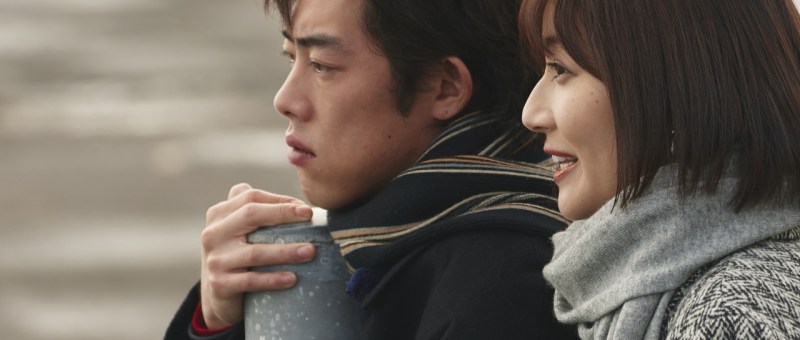
Sin and Evil (罪と悪, Yuki Saito, 2024)

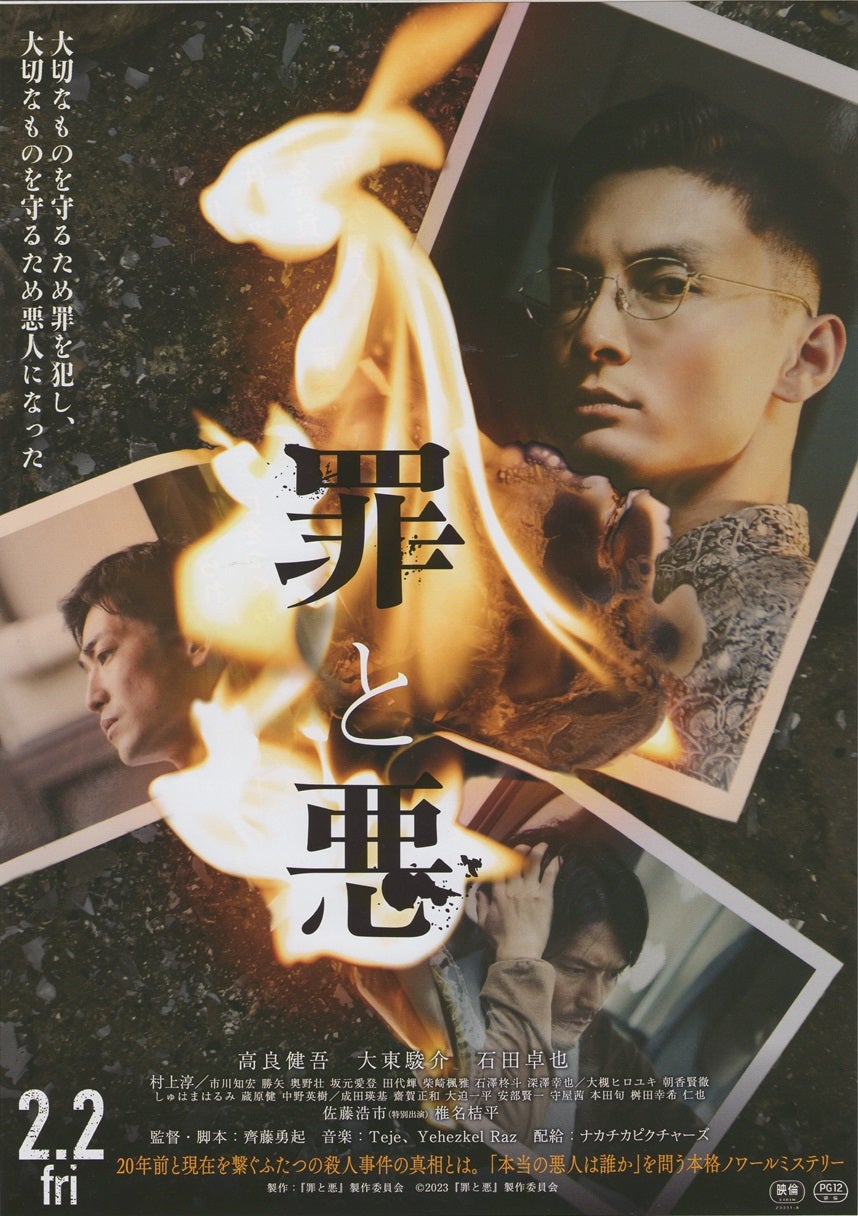
A man not quite a yakuza and perhaps even what might be termed an ethical gangster tells one of his underlings that it isn’t a sin unless you believe it it is, which might in a sense be true in same way as Socrates says that no one does wrong willingly. Yet the heroes of Sin and Evil (罪と悪, Tsumi to Aku), Yuki Saito’s small-town crime drama, are marked by their guilt while trying to come to terms with traumatic events of 20 years earlier and their mutual decision to cover them up.

Echoing similarly themed films such as Stand By Me, Saito opens with idyllic scenes of the boys riding their bikes with the only hint of darkness offered by a disturbing conversation about an elderly man who is rumoured to be abusing children. However, it seems that Haru is living in a difficult domestic situation following the death of his sister with an abusive father and apparently neglectful mother. His best friend, Akira, is the son of a local policeman while the boys are also friends with a pair of twins, Saku and Naoya, whose family operate a tomato farm. Rounding up the group is Masaki who also seems to be living in difficult circumstances though his backstory is never fully fleshed out as he’s eventually found dead in a local river. Saku jumps to the conclusion that the old man must have abused Masaki, who was known to be friendly with him, and then killed him to keep him quiet. He drags Haru and Akira to the old man’s shack where he attacks and eventually kills him with a shovel. Haru decides to take the blame and torches the place, telling the other two boys to flee the scene.

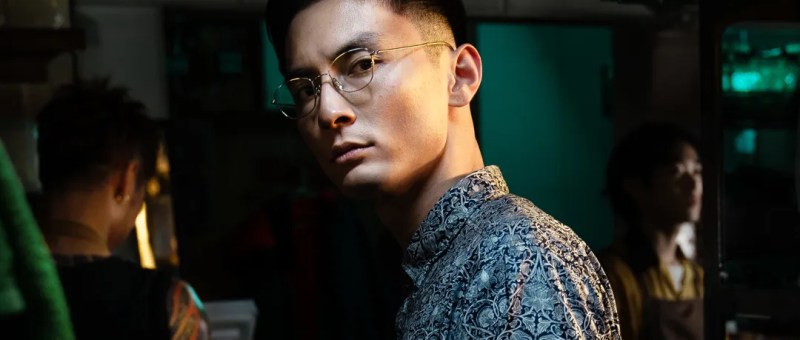
20 years later, it’s clear that each of them are still marked by what happened that day though Haru (Kengo Kora) appears to have built a good life for himself after serving time in juvenile detention even if the construction company he runs is friendly with local yakuza and gets its contracts through small-town corruption. He also operates a cafe where he employs delinquent boys while secretly using them as thieves but also in a more genuine sense looking after them and concerned for their welfare. His machinations are seen to be key in keeping order, working in tandem with police Inspector Sato (Kippei Shiina) who explains to a more idealistic Akira (Shunsuke Daito) how things are done around here which is essentially keeping ordinary people safe by managing crime rather than punishing or preventing it. The balance is only disrupted by some of Haru’s boys who stupidly steal far too much money from the local yakuza. Haru attempts to protect the young man concerned, but his body soon ends up in the river in exactly the same place as Masaki raising a series of questions about the nature of the earlier crime. 

What the film is trying to do is paint the world in shades of grey while looking for the parts where it’s darkest. It seems it’s not in doubt that the old man abused local children, though Haru and Akira now doubt he killed Masaki raising further questions about their killing of him. As the yakuza underling had said, it’s not a sin unless you think it is and Haru feels that he deserved to die for what he did to other kids so doesn’t feel any remorse for his actions even if he didn’t kill Masaki. But for Akira, the trauma lingers in other ways and he’s disturbed on learning his father may have been involved in covering up their crime and at least complicit in police corruption essentially teaching Sato how things are done in small-town policing. The conclusion Haru comes to is that they are all victims of the town itself, unable to break free of its provincial mores and petty prejudices.

Those would largely be a lingering homophobia and deep shame stemming from suffering sexual abuse as a child. As usual with these kinds of mysteries, the solution lies in the desire to prevent the truth being exposed though in this case the resolution is not entirely convincing when using one killing to cover up another couldn’t help but expose the truth anyway even when attempting to pin it on someone else who can no longer defend themselves. It also sidesteps the themes of small-town corruption and the dark heart of suburbia even as Haru points out that someone should have stepped in to support both himself and Masaki when they could see their families were struggling rather than just closing their curtains and pretending not to notice. The disruption of the friendship, which ought to be the heart of the drama, therefore lacks poignancy muddied by the various overlapping plot lines from the present day yakuza drama to the lost paradise that Haru longs to reclaim despite the otherwise apparently happy life he seems to be living now. Sin, the film seems to say, is in the eye of the beholder along with justice and retribution, and evil maybe just the same or merely invisible to those who choose not to see it.


Sin and Evil screened as part of this year’s Camera Japan.


International trailer (English subtitles)
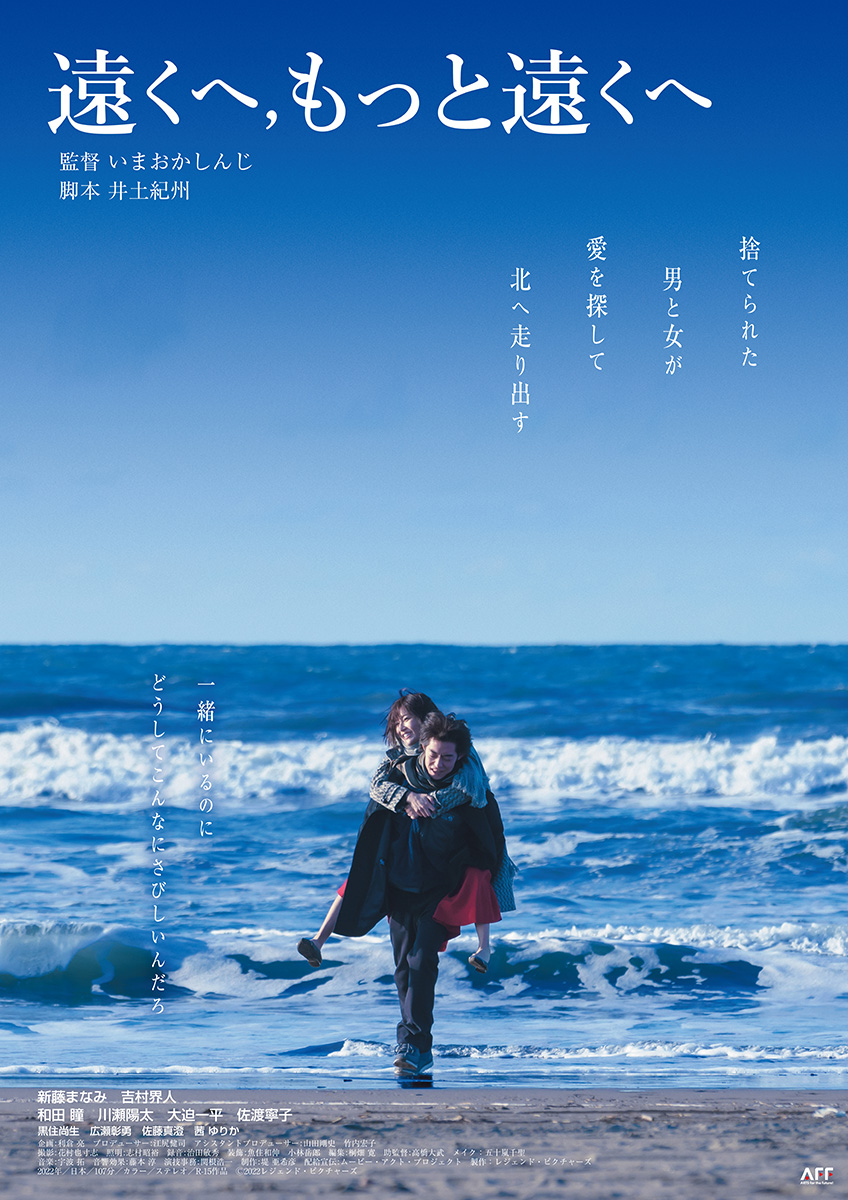
Far Away, Further Away (遠くへ,もっと遠くへ, Shinji Imaoka, 2022)

Is there an ideal way of coming to terms with the end of a marriage, or is better to take it as it comes? The heroine of Shinji Imaoka’s relationship drama Far Away, Further Away (遠くへ,もっと遠くへ, Tooku e, Motto Tooku e) thinks she has it all figured out and has started taking practical steps towards an efficient separation only to have the rug pulled from under her never having considered that her husband may also be unsatisfied and her attempts to mitigate his hurt feelings therefore less than relevant. Imaoka began his career in pink film and is probably best known outside of Japan for the erotic musical fantasy Underwater Love but has in recent years taken to more contemplative drama such as 2019 study in grief Reiko and the Dolphin, here continuing a key theme in the exploration of the difficulties in relationships between men and women. 

The main reason Sayoko (Manami Shindo) wants to leave her husband is that they’ve simply grown apart. Smiling gently at a sweet older couple looking at a two-seater sofa in the furniture store where she works, she reflects on their words that a marriage is weaker without common interests realising that she and Goro have none. A fishing obsessive, Goro usually retreats to his room after dinner to update his blog and fondle fishing equipment while her suggestion that she join him on his next trip is met with less than enthusiasm. Meanwhile, though she likes her job at the furniture store she’s beginning to feel as if she’s stuck in a rut and no closer to achieving her dreams of becoming an interior co-ordinator disappointed to discover a quote she’d written for younger couple who seemed happy enough in the shop screwed up in the park. One might assume they’ve obviously had an argument about it on the way home which probably isn’t anything to do with Sayoko but still she begins to wonder what the point is leading to Goro to advise her to quit her job laying bare the true source of his dissatisfaction in the marriage in that he was looking for a woman prepared to become a conventional housewife which in turn might explain why he’s not interested in the shared interests approach to marriage Sayoko suggests but prefers to maintain a separate lives model in which she takes care of the domestic while he has his work and individual hobbies to blow off steam. 

So distant from each other have they become that Sayoko hasn’t really realised she’s not the only one who wanted to end the marriage nor has he seemingly realised she’s in the process of leaving him. Her plan for a measured exit is nixed by her husband’s request for a divorce but through her quest to find a new apartment she gradually draws closer to lovelorn estate agent Yohei (Kaito Yoshimura) who is particularly interested in her story as his own wife, Mitsuko, left him seemingly out of the blue some years ago and he’s never really come to terms with it a part of him still assuming she’ll eventually come back. In a bid to find some closure Sayoko suggests they take off together to look for her so he can start to move on, heading north on a Hokkaido-bound road trip that takes her back to her own hometown where she reflects on her parents’ marriage after discovering her mother’s second life as a widow in which she has begun to fulfil herself as a singer no longer required to fulfil the role of the traditional housewife which Sayoko had rejected. 

Dealing with their respective baggage the pair grow closer and begin to move on together, further and further away until they reach the coast looking for a ferry to take them on to Sakhalin. The memories of old lovers retreat further and further away too, increasingly blurred and distant eclipsed by new ones even if a sense of loneliness remains. Contrasting the verdant natural vistas of rural Hokkaido with the greyness of Tokyo city life Imaoka adds a sense of childlike wonder as his heroine’s tendency to dance while repeating the same phrase with increasing intensity begins to rub off on her dejected love interest, making the case for striking out for a far off happiness rather than simply resigning oneself to an unsatisfying present. 


Far Away, Further Away screened as part of Osaka Asian Film Festival 2022

Original trailer (no subtitles)

Death Note: Light Up The NEW World (デスノート Light up the NEW World, Shinsuke Sato, 2016)

Death Note- Light up the NEW WorldTsugumi Ohba and Takashi Obata’s Death Note manga has already spawned three live action films, an acclaimed TV anime, live action TV drama, musical, and various other forms of media becoming a worldwide phenomenon in the process. A return to cinema screens was therefore inevitable – Death Note: Light up the NEW World (デスノート Light up the NEW World) positions itself as the first in a possible new strand of the ongoing franchise, casting its net wider to embrace a new, global world. Directed by Shinsuke Sato – one of the foremost blockbuster directors in Japan responsible for Gantz, Library Wars, and the zombie comedy I am a Hero, Light up the NEW World is a new kind of Death Note movie which moves away from the adversarial nature of the series for a more traditional kind of existential procedural which takes its cues from noir rather the eccentric detectives the franchise is known for.

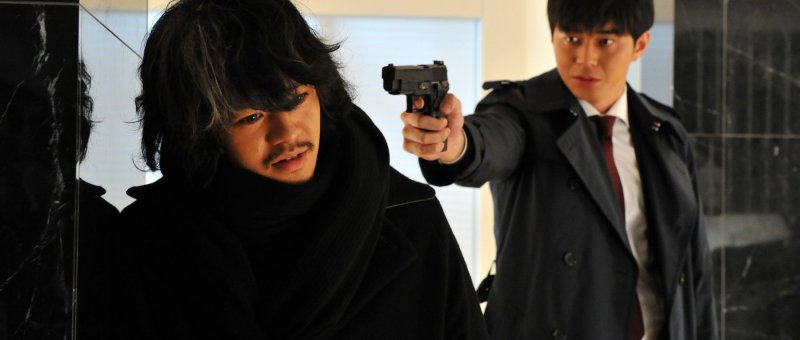
Ten years after Kira, the Shinigami are bored out of their minds and hoping to find themselves a new puppet to play with and so they drop six notebooks at different places across the world and wait to see who picks them up. The first is a Russian doctor who uses it out of curiosity and compassion when faced with the desperate pleas of a suffering, terminally ill man. Others are not so altruistic, as a young girl with reaper eyes goes on a mass random killing spree in the busy Shibuya streets while the police attempt to cover their faces so they can’t fall victim to her relentless writing. Mishima (Masahiro Higashide) of the special Death Note task force hesitates, uncertain whether he should disobey orders and shoot the girl to end her killing spree, but his dilemma is solved when a strangely dressed masked man appears and shoots her for him. He is special detective Ryuzaki (Sosuke Ikematsu) – L’s successor, and a crucial ally in discovering the Shinigami’s intentions as well as the counter plan to obtain the six books and lock them away to permanently disable the Death Note threat.

As in the original series, Kira has his devotees including the cybercriminal Shien (Masaki Suda) who is intent on frustrating the police’s plan by getting his hands on the books and using them to complete Kira’s grand design. This time around, there’s less questioning of the nature of justice or of the police but at least that means there’s little respect given to Kira’s cryptofascist ideas about crime and punishment. At one point a very wealthy woman begins to voice her support of Kira because something needs to be done about “the poor” and all their “crimes” but she is quickly cut down herself as her well dressed friends attempt to rally around her.

The focus is the police, or more specifically their internal political disputes and divisions. Mishima, described as a Kira geek, heads a special squad dedicated to Death Note related crimes, where he is asssited by the flamboyant private detective Ryuzaki who is apparently the last remaining inheritor of L’s DNA. Mishima remains distrustful of his colleague but the bond between the rest of the team is a tight one. In order to frustrate possible Death Note users, none of the squad is using their real names which places a barrier between comrades in arms when it comes to building trust and solidarity in addition to leaving a backdoor open for unexpected secrets.

Sato’s focus, as it has been in the majority of his career, is genre rather than character or exploring the wider themes of the Death Note franchise from the corrupting influence of absolute power to vigilante justice and the failings of the judicial system. The new Death Note world is a more conventional one loyal to the police procedural in which dogged detectives chase mad killers through whatever means necessary whether on foot or online.

The action, however, is generally exciting as the police engage in a cat and mouse game with Shien even if not as complex as that between Kira and L. The Death Notes are an unstoppable force, corrupting otherwise fair-minded people and turning them into vengeful killing machines acting like gods in deciding who should live and who die. Moving away from the series trademark, Light up the NEW World is, essentially, the generic thriller spin-off to the main franchise but is no less fun for it even if it necessarily loses a little of itself in the process.


Death Note: Light up the NEW World was screened at the 17th Nippon Connection Japanese Film Festival.

Original trailer (English subtitles)