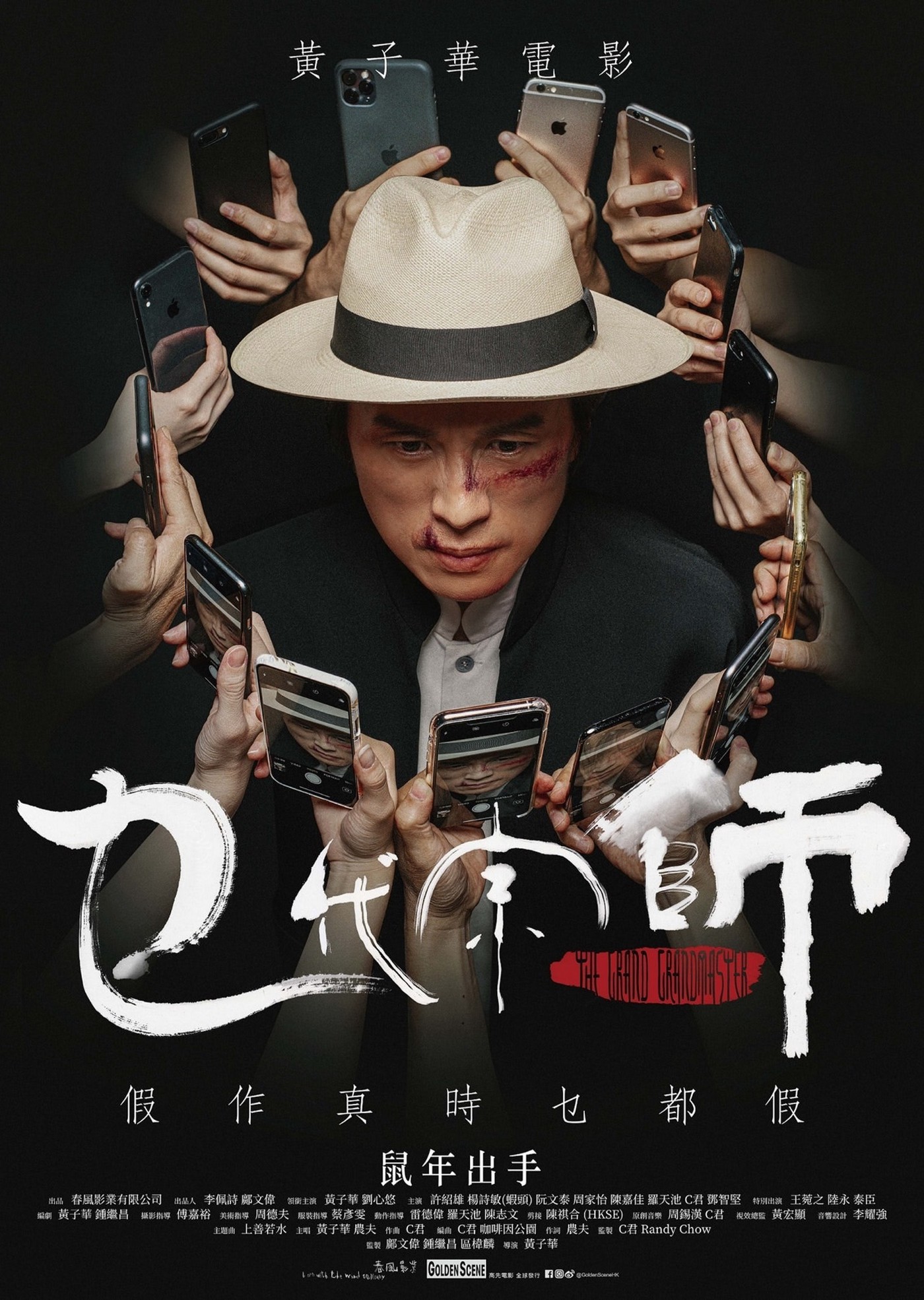
The Grand Grandmaster (乜代宗師, Dayo Wong, 2020)

Are you actually “the grandmaster” or just a bit “grand”, the hero of The Grand Grandmaster (乜代宗師) is eventually forced to ask himself after being confronted with the various levels of his self-delusion. Legend has it that comedian Dayo Wong sold an apartment to finance his second directorial feature in order to produce a purely local film without having to submit himself to the strictures of the Mainland censors’ board or accept funding from the greater PRC, a move which endeared him to the young protestors then still out in the streets campaigning for democracy. The Grand Grandmaster was one of the few New Year films to make into cinemas before they shut down because of the pandemic but aside from Wong’s grand gesture is perhaps light on political content, save for a mild satire on the commercialisation of kung fu. 

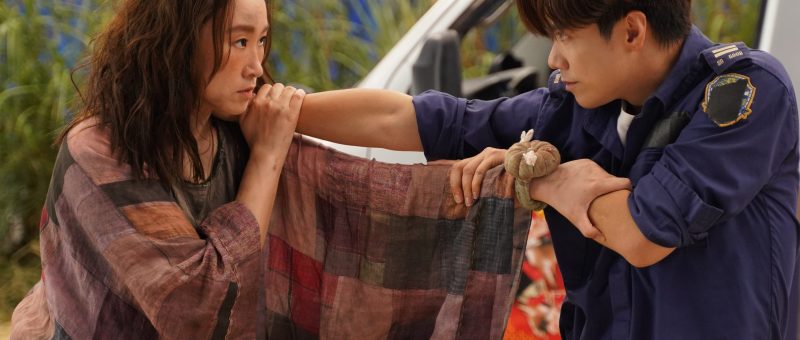
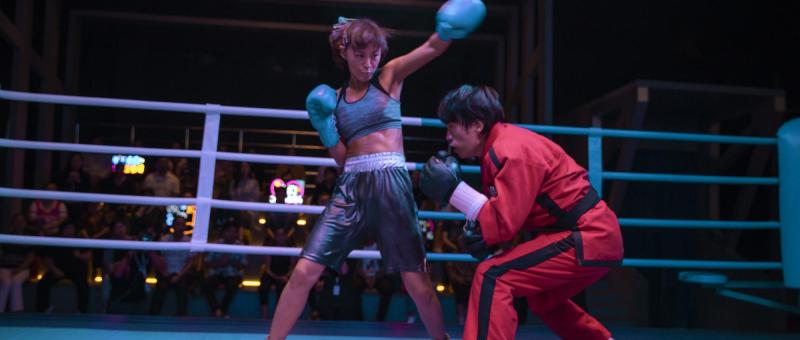
The Grand Grandmaster, Ma Fe-lung (Dayo Wong Chi-Wah), is the latest guardian of the Ma Ka Thunder Style martial art apparently carried by one of his ancestors to Hong Kong from the Mainland during the Song dynasty. Ma Ka Thunder has since become something of a brand with its own dedicated merchandising line and video ads playing on giant billboards featuring Fei-lung himself as the face of the organisation. His hopes for US expansion along with his general business plan are disrupted when he gets into a public altercation with an old man who tries to steal his taxi and then makes a scene claiming that Fei-lung hit him leading Chan Tsang (Annie Liu Xin-You), the “boxing goddess”, to emerge from the shadows and give Fei-lung a public beating. Filmed by everyone in the surrounding area, the event becomes a viral phenomenon that leaves Fei-lung humiliated but while his minions urge him towards a public rematch to regain his reputation, Fei-lung is consumed with despair on realising there is no way he could ever hope to defeat the feisty young woman. 

Wong has fun satirising the lore of kung fu as Fei-lung outlines the strange tenets of the Ma Ka Thunder Style which turns out to make more sense that it first seems only generations of practitioners have it seems forgotten something quite fundamental. Fei-lung and his associates have to ask themselves if the art of Ma Ka is really just “fake fighting”, something suggested to Fei-lung by his loyal assistant who makes a point of overdoing his defeat and admits he only stays with the school because living outside is hard and here he gets room and board. Urged to show his full strength, he effortlessly defeats his master but only by abandoning Thunder Style for a selection of moves from other martial arts. 

The remainder of the film sees Fei-lung trying to “dodge” Tsang, firstly by trying to bribe her to throw the fight for him and then by convincing her to get more “comfortable” with the idea of losing. Events take a rather strange turn when Tsang’s dad gets involved and starts training Fei-lung for real in an effort to get back at his daughter for quitting boxing after a single defeat apparently humiliating him in another nod to the film’s strangely sexist worldview. Tsang bizarrely falls for Fei-lung after witnessing the depths of his self-delusion in his complex relationship with his ex-wife, building to a crisis which accidentally makes a case for domestic violence in insisting that Tsang will only believe that Fei-lung really loves her if he defeats her in the ring. 

Nevertheless, the conclusion is an oddly egalitarian one in which there is no win, no lose, no draw. Fei-lung realises the various ways in which he’s been deluding himself and presumably emerges with a little more clarity, awakened to the true meaning of the “virtue like water” motto of Ma Ka Thunder Style which apparently lies in generosity of spirit, giving without expecting in return and like water trickling down. Which is to say, Fei-lung learns to stop dodging life’s blows, to give up on tricks and fakery, and to be a little more authentic, which is perhaps how he wins Tsang’s heart and respect. A committed performance from Liu helps to mitigate some otherwise flat comedy though the saga of the kung fu con man rediscovering his sense of social responsibility through a true appreciation of martial arts never quite hits home, while a strange mid-credits diversion perhaps proves one move too far.


Trailer (Traditional Chinese / English subtitles)

Table for Six 2 (飯戲攻心2, Sunny Chan Wing-Sun, 2024)

“It’s okay to be screwed, we’ll unscrew you later,” youngest brother Lung (Peter Chan Charm Man) comforts his dejected brother in an accidental advocation of what means to be a family in Sunny Chan’s followup to the phenomenally successful comedy  Table for Six. Like the previous film and in true Lunar New Year fashion, Table For Six 2 (飯戲攻心2) explores the concept of family in a wider sense along with contemporary attitudes to marriage and traditional gender roles.

Even so, it has to be said this table is now uneven as oldest brother Steve has literally run away from his romantic dilemmas taking off for Africa leaving new girlfriend Miaow (Lin Min-Chen) behind claiming she’s too far out of his league and it’s not fair of him to waste her youth. Ironically enough, Bernard (Louis Cheung) has now started a wedding business helping people pull off extravagant public proposals such as the sort of fake one he prepares for Monica (Stephy Tang Lai-yan) as a publicity stunt featuring him dancing in a 90s-style music video. As part of the campaign, they’ve set up Lung and Miaow as a fake couple hoping to build a following for their romance online much to unexpected chagrin of Josephine (Ivana Wong) who has begun to embrace her dreams by becoming a well-known quirky chef who makes food disguised as other food. Though they had agreed to separate so the could both follow three dreams at the end of the previous film, Josephine suddenly proposes leading Bernard to put on an extravagant wedding as promotion for his business. 

In a way, Bernard’s company symbolises the performative qualities of marriage as couples put themselves through a stressful and expensive ritual more out of obligation than real desire. When Lung is prevented from reaching the ceremony on time, Bernard ends up impersonating him in a full body costume making plain that the spectacle is more for show than sentiment and it could really be anyone up there simply fulfilling a role. In fact, no one even checks the certificates were properly signed. Then again, just as in Josephine’s cooking sometimes the “fake” and can actually contain the “real” just in a different way than expected. She may say that once a relationship has cooled the spark can’t be regained, but that doesn’t necessarily mean a new, different, spark couldn’t be found. 

Perhaps that’s what happened for Bernard and Monica who’ve now overcome the awkwardness of Monica having been in a longterm relationship with oldest brother Steve. Ironically enough, they’d more or less decided not to get married only to be blindsided by their reactions to the “fake” proposal but as it turns out more because of the emotional baggage from their parents’ failed relationships that have left them too afraid to get married. Monica is still traumatised by her father’s extra marital affair which resulted in a half-brother she’s never met but has since become a Cantopop star, while Bernard still has bad memories of being treated as a “red-headed” child and like Steve is preoccupied with a desire to keep the family together while worried that he isn’t really up to it. 

The lesson Bernard learns is that family is a burden that’s carried together so he didn’t need to save it on his own and that it’s alright to mess things up because his family will be there to take care of him. Miaow meanwhile is left in the same place as Steve had been in the first film, wondering how long she should wait for love or if Steve is ever coming back, trying to decide whether to accept a promising job offer in Japan or stay in Hong Kong. Part of her reluctance to move on is that she’s become wedded to the family and fears losing her place within it but as Monica says her status wasn’t dependent on blood or relationships and that she’s already been accepted into the family just for being herself. 

Then again, families can also be annoying as Bernard remembers after inviting his gangsterish uncles to one of the weddings only for them to muscle in as a major sponsor for another own insisting on designs the dress themselves complete with a par of shark fin wings to promote their business none of which meshes well with Monica’s passion for conservation. In any case, as Monica reflects family means you can embarrass yourselves together so maybe wearing a stupid dress for a few minutes isn’t such a big deal. Heartfelt and zany, Chan’s farcical drama shifts past the performative aspects of marriage and family to what lies beneath which, like Josephine’s cooking, may not always be what it first appears.


Table for Six 2 is in UK cinemas from 9th February courtesy of CineAsia.

UK trailer (English subtitles)

One More Chance (別叫我”賭神, Anthony Pun Yiu-Ming, 2023)

A feckless gambler gets a final shot at redemption when he’s suddenly asked to take care of an autistic son he never knew he had in Anthony Pun Yiu-Ming’s nostalgic drama, One More Chance (別叫我”賭神). Previously titled “Be Water, My Friend”, the film has had a troubled production history only reaching cinema screen four years after filming concluded in March 2019 and has been retitled in the Chinese “Don’t Call Me the God of Gamblers” which seems to be a blatant attempt to cash in the audience’s fond memories of similarly pitched Chow Yun-fat vehicles from the ’80s and ’90s such as All About Ah Long.

In truth, Chow is probably a little old for the role he’s cast to play as the middle-aged barber Water who’s long since fled to Macao in an attempt to escape problems with loansharks caused by his gambling addition. Of course, Macao is one of the worst places someone with a gambling problem could go and so Water is already up to his neck in debt and a familiar face at the local casino. That’s one reason he ends up going along with the proposal of old flame Lee Xi (Anita Yuen Wing-Yee) to look after her grownup son, Yeung (Will Or Wai-Lam), who is autistic, for a month in return for 50,000 HK dollars up front and another 50,000 at the end assuming all goes well. She claims that Water is Yeung’s father and even provides forms for him to send off for a DNA test if he doesn’t believe her, but at this point all Water is interested in is the cash. 

To begin with, he pretty much thinks of Yeung as cash cow, descending on a Rain Man-esque path of using him to up his gambling game but otherwise frustrated by his needs and ill-equipped to care for an autistic person whom he makes little attempt to understand. For his part, Yeung adapts well enough and tries to make the best of his new circumstances but obviously misses his mother and struggles when Water selfishly disrupts his routines. For all that, however, it’s largely Yeung who is looking after Water, tidying the apartment and bringing a kind of order into his life while forcing him to reckon with the self-destructive way he’s been living. 

Picking up a casino chip in the opening sequence, Water describes it as a “chance” in an echo of the way he’s been gambling his life just as he decides to gamble on taking in Yeung. At one point, he wins big on the horses but takes his winnings straight to the casino where he’s wiped out after staking everything on a single bet only to realise he’s been played by another grifter at the table. It seems that Xi left him because of his gambling problem and the resultant change in his lifestyle that had made it impossible for her to stay or raise a child with him, causing Water to become even more embittered and cynical. Where once he provided a refuge for wayward young men trying to get back on the straight and narrow, now he’s hassled by petty gangsters over his massive debts.

Nevertheless, it’s re-embracing his paternity that begins to turn his life around as he bonds with Yeung and begins to have genuine feelings for him rather than just fixating on the money while simultaneously recognising that Yeung is already a man and able to care for himself in many more ways than others may assume. One could say that he gambles on the boy, staking his life on him rather than endless rolls of the dice to fill an emotional void but also rediscovering a sense of himself and who he might have been if he had not developed a gambling problem and left it up to chance to solve all his problems. Unabashedly sentimental, the film flirts with nostalgia in the presence of Chow and Anita Yuen and largely looks back the Hong Kong classics of the 80s and 90s if with half an eye on the Mainland censors board, Bruce Lee shrine not withstanding, but nevertheless presents a heartwarming tale of father and son bonding and paternal redemption as Water crosses the desert and finally reclaims himself from his life of dissipation. 


Original trailer (English subtitles)

Everything Under Control (超神經械劫案下, Ying Chi-Wen, 2023)

A cocky band of security guards find themselves on the back foot when they’re ambushed by gangsters and one of guys decides to hightail it with the loot in Ying Chi-Wen’s anarchic take on Taiwanese movie Treat or Trick which was itself inspired by the Korean film To Catch a Virgin Ghost. A Lunar New Year release, Everything Under Control (超神經械劫案下) is a typically anarchic affair full of zany nonsense comedy and random gags but is ultimately a redemption story and a defence of community. 

Possibly in a nod to mainland censors the “heroes” are now private security officers rather than actual policemen and have a rather cynical view of their work. The cocky Yau-shing (Hins Cheung King-Hin) who wears sunshades and talks a big game, laughs at rookie recruit Penguin’s questions about about a possible ambush explaining that, in a slice of dark humour, you’d need to rob around 10 convoys before you could afford a Hong Kong flat so it’s not worth the risk nor the effort. Nevertheless in what seems to be at least in part an inside job, the gang are indeed ambushed by gangsters working for Boss Lai (Juno Mak) while transporting diamonds across town on the behalf of an elite tycoon. When Penguin unexpectedly fights back, fellow guard Jelly decides to snatch the diamonds and run with a view to starting a new life in Malaysia. Boss Lai is understandably unimpressed and orders his underling, Monk, to accompany Yau-shing and Penguin as they attempt to track down Jelly and get the diamonds back while he holds their friend Pig Blood hostage as collateral. 

After swerving to avoid what seemed to be the ghostly figure of a young woman in the road, Jelly ends up in a weird village with its own theme song that he has to bribe his way into. His presence is definitely unwelcome and the villagers’ behaviour is undeniably suspicious even in their weird hippie commune aesthetic though the diamonds themselves become something of a MacGuffin as a battle begins between the security guys and the villagers who are understandably keen to defend their territory from incursion especially as it seems there may have been an attempt to force them off their land. “Everyone has something they want to protect” according to weird village chief Wong Cool (Ivana Wong Yuen-Chi) whether it be like her her community, diamonds, status, or the lives of friends though truth be told that doesn’t seem to be at the top of Yau-shing’s list, poor Pig Blood more or less forgotten about by everyone. 

Nevertheless, Ying amps up the weirdness in the quirky village with its rumours of a vengeful ghost who kidnaps “virile men” and gives them what otherwise seems to be a strangely childish punishment adding a note of creepy horror to the guys’ predicament. Penguin even comes to the conclusion that he has psychic abilities and is able to read a crime scene with the power of his mind, committed to the pursuit of justice but also endearingly dim. Monk, meanwhile, is some kind of cinephile gangster who is mocked by his mother for not being a “real man” because he’s never been to a film festival. The guys’ car radio also seems to be permanently tuned to an entertainment program where they offer acerbic comments about the Hong Kong film industry. After a while, we might wonder if we too are being affected by the purple sporing plants found all over the forest which cause Jelly to have a weird fever dream involving a kappa, a Nian beast, and the apparently well-endowed Goddess of Fortune who insists he say “Gong hei fat choy” despite it not being New Year in the movie even though it obviously is to the audience. 

As the radio host admits, redemption doesn’t come from outside forces but by one’s own moral character which explains Yau-shing’s final change of heart, dropping his cynicism and deciding to believe in a better world after all. “Serve with our hearts, protect with our lives” it says on the outside of their van, and Yau-shing may have discovered something worth protecting while the diamonds remain more or less forgotten along with Lai’s ultimatum and Pig Blood’s fate. Decidedly strange, Ying’s genre hoping crime caper strays into some dark corners of human activity but maintains a lightness of touch along with genuine heart even as it does so.


Everything Under Control was released in UK cinemas courtesy of CineAsia.

UK trailer (English subtitles)

Table for Six (飯戲攻心, Sunny Chan, 2022)

“Wherever family is, that’s where home is” the dejected hero of Sunny Chan’s ensemble comedy Table For Six (飯戲攻心) is eventually told after struggling to keep his small family together by refusing to sell the apartment their parents left them in an old barbecue pork kitchen. Like his previous film Men on the Dragon, Chan’s tightly woven farce is a kind of delayed coming-of-age tale in which the hero realises that his familial bonds aren’t necessarily tied to a place and won’t disappear even if he has to leave it, but also the gentle celebration of food and family that has come to define the Chinese New Year movie (even if this one was delayed to the Mid-Autumn Festival for obvious reasons). 

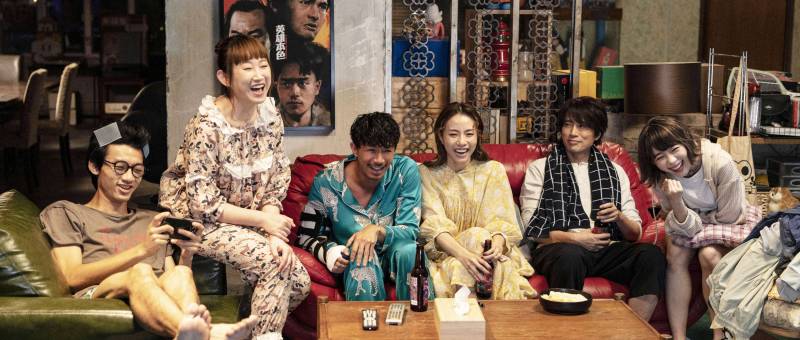
Steve (Dayo Wong Chi-Wah) is the oldest of three brothers and a de facto father figure in the absence of their parents who have each passed away. Under the justification of obeying their late mother’s dying wish, Steve insists each of the brothers come home for dinner every night and now rarely leaves the apartment as if fiercely guarding an interior world he’s afraid he’ll one day lose. Working as a photographer from home, he ends up meeting popular Taiwanese influencer Miaow (Malaysian actress Lin Min Chen) who turns out to be one of his biggest fans and a now grown up woman who once sent him fanmail as a teenager. Miaow makes obvious romantic overtures but Steve tells her he’s not interested because he still hasn’t got over his ex Monica (Stephy Tang Lai-Yan) who broke up with him three years previously. This is also a problem because unbeknownst to him middle brother Bernard (Louis Cheung Kai-Chung) has been secretly dating Monica for the last six months. 

Much of the tension in the apartment stems from trying to integrate the competing desires of the brothers with their relationships as a family. Bernard and youngest brother Lung (Peter Chan Charm-Man) both want to sell the apartment for different reasons while only Steve insists on hanging on to it determined for them all to continue living together as impractical as that may be given that they are all approaching middle age. Lung quit his regular job some time ago to become a professional esports player which has further strained his relationship with longterm girlfriend Josephine (Ivana Wong Yuen-Chi) who is fed up with waiting for him to formalise their union while finding her own hopes and desires stifled by his obsession with esports success. To keep the peace Steve suggests an unusual solution in which he’ll employ Josephine as a cook which is certainly awkward on several levels given the resulting power dynamics but on the other hand not all that different from the status quo in practical terms as much as it annoys Lung who is secretly insecure in his lack of financial standing which is why he’s been putting off marriage. 

Essentially what Steve learns is that keeping the family together isn’t as literal a thing as he’d assumed it to be. If he wants to preserve it he might have to let it go and learn to move on from the past rather than stubbornly trapping himself in the inertia of his parents’ old apartment. Miaow turns out not be quite as vacuous as her online persona suggests, a neat subversion of Teorema as an unexpected guest who immediately sees and understands the unfulfilled needs of each of the family members and helps to guide them towards moments of realisation. Steve struggles to come to terms with the end of his relationship with Monica which turns out to have been caused by a minor misunderstanding while on the other hand processing complex feelings towards his brother trying to be magnanimous in the best interests of the future but on the other hand wondering if he and Monica might still have a future after all. 

Of course that does rather leave out Monica’s feelings though she too seems conflicted even if having made a choice to move on in deciding to date Bernard in the first place. Her pet peeve is that she hates it when people “disrespect” old things and can’t bear to see otherwise obsolete objects thrown away all of which suggests she might have made a mistake in moving on all while filling the apartment with relics of a disappearing Hong Kong such as old street signs and a pair of golden phoenix dragons which seem gloriously out of place in the otherwise industrial environment of the former barbecue pork kitchen. There might then be something of an additional message in Steve’s final realisation that home is where the family is in an era when so many have felt displaced and been forced to leave the place they love because it has changed beyond all recognition while he makes the decision to break out of his self-imposed inertia by moving on from the past to explore new possibilities outside of the apartment. Anarchic yet warmhearted and always forgiving of its sometimes flawed, often confused protagonists Chan’s cheerful family dramedy discovers that home is not so much a place as the people who live in it and that family is still family even if it’s far apart.


Table for Six is in UK cinemas now courtesy of Haven Productions.

Original trailer (Traditional Chinese / English subtitles)