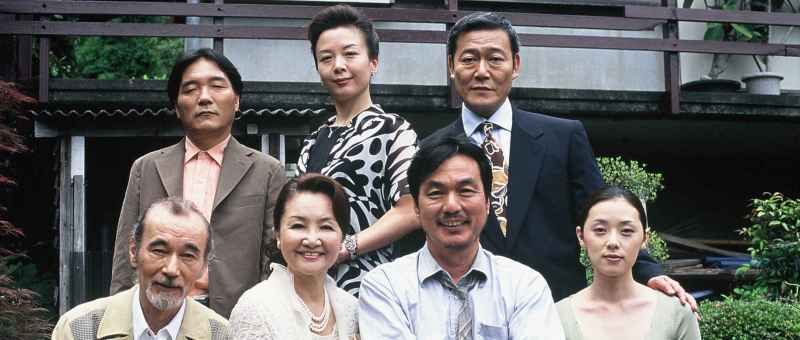
 Ever have a day (or perhaps a lifetime) where you feel so stupid that even the frogs are laughing at you? That’s pretty much how it is for disgraced former bank manager Ippei when he turns up one day at a family holiday home he assumed would be empty but turns out not to be. In Laughing Frog (笑う蛙, Warau Kaeru) director Hideyuki Hirayama deftly dissects the modern family, the gradual redundancy of the middle-aged man, and the way society seems to have of anointing the lucky and the unlucky, in a darkly humorous satire in which even mother nature seems to be mocking our petty human concerns.
33 year old Ryoko (Nene Otsuka) is attending the third memorial service for her late father at which her greedy sister-in-law (Kumija Kim) asks for various things in an attempt to get some of the inheritance in advance while Ryoko’s brother (Shuzo Mitamura) wanders off to chat about silkworms in Chinese on his mobile phone. The event ends with Ryoko’s sprightly mother (Izumi Yukimura) and the sister-in-law urging her to sort out some kind of marital difficulties in order to ease the awkwardness surrounding her lack of external connections.
Meanwhile, Ryoko’s missing husband, Ippei (Kyozo Nagatsuka), rocks up at a rural station and climbs into a familiar house through an open window. Wandering around in his pants, he hears a noise and realises someone lives there after all. Ryoko has moved into her father’s old house in the country and started a whole new life for herself. After a brief discussion, Ryoko agrees to let him stay for a while on the condition that he finally sign the divorce papers but Ippei soon finds himself confined to an especial kind of irrelevance as he starts his new life in the hall cupboard observing his wife’s new freedoms by means of a tiny hole in the wall.
No one seems to have much of a good word to say about Ippei, which is fair enough seeing as he apparently became obsessed with a bar hostess and embezzled money from his bank to pay for a lavish affair before running away and leaving his wife to deal with the fallout. He is, however, paying for it now as his own irrelevance is once and truly brought home to him as he lives out his days like an impotent ghost trapped in a storage cupboard undergoing his wife’s strange mix of kindness and revenge.
Ryoko, the goodly wife, is not quite all she seems. Ippei’s mistress makes a surprise appearance to try a spot of extortion on the wealthy wife but she’s no match for Ryoko’s perfectly practiced poise. One of the oddly cruel accusations the mistress has to offer is that Ippei once referred to a kind of boredom with his wife’s properness, branding her a “fancy pet cat” whilst apparently avowing the mistress’ bedroom superiority. If Ippei’s sheepish behind the wall expression is anything to go by he is guilty as charged but then perhaps the uncomfortable statement leads right back to his uncomfortable place within Ryoko’s upperclass family who seem to look down on a mere bank manager, affecting politeness while secretly bemoaning the fact that their daughter has married beneath herself.
The model upperclass family is a simulacrum. Feigning politeness, elegance and dignity they attempt to disguise their otherwise distasteful affectations. Ryoko’s sister-in-law is at least honest in her constant harping on about the inheritance, plan to steal grandma’s house out from under her to knock it down and build a new one, and constant asides to her apparently hopeless (and unseen) son away at a (not great) university. Meanwhile her husband, Ryoko’s brother, pretends to chat silkworms in Chinese on his phone but is really talking to a Chinese mistress and Ryoko’s mum is planning to get married again to a (possibly dodgy) antiques dealer (Mickey Curtis) who is so deeply in debt there won’t even be any inheritance anyway.
Ryoko too has moved on. Ippei is forced to watch as she entertains her new boyfriend (Jun Kunimura), a stonemason whose main line is headstones, while the frogs outside work themselves into some kind of frenzy. Little by little all his manly affectations are worn away – he’s forced to realise how foolish he’s been, how irrelevant he is in Ryoko’s life, and how perfectly pointless his fugitive existence really is. Ryoko meanwhile remains calm and calculating. She “lies” and she wins in a bloodless victory, allowing her opponents to sentence themselves to the punishments they feel themselves to deserve. Ippei, it seems, is just a weak, unlucky man doomed to ruin himself through a series of poetic failures and petty self involved mistakes. Meanwhile the frogs look on and laugh at our human follies. Makes you feel small doesn’t it….
 Hibari, Chiemi and Izumi reunite in 1964 for another tale of musical comedy and romantic turmoil in Sannin Yoreba (三人よれば). Beginning as teenagers in
 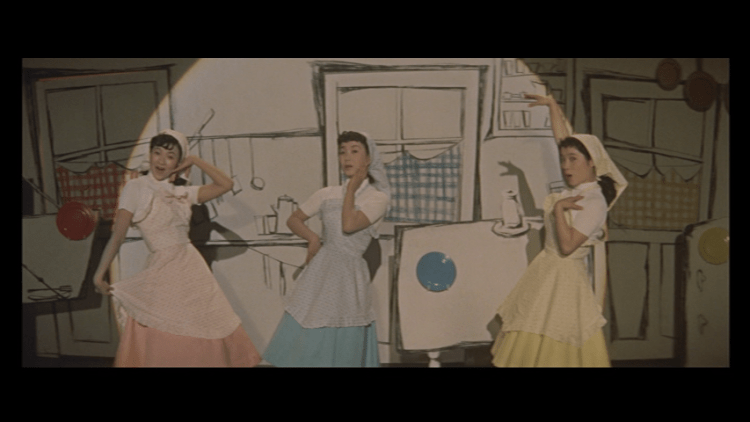 The Sannin Musume girls are growing up by the time we reach 1957’s On Wings of Love (大当り三色娘, Ooatari Sanshoku Musume). In fact, they each turned 20 this year (which is the age you legally become an adult in Japan), so it’s out with the school girl stuff and in with more grown up concerns, or more specifically marriage. Wings of Love is the third film to star the three Japanese singing stars Hibari Misora, Chiemi Eri, and Izumi Yukimura who come together to form the early idol combo supergroup Sannin Musume. Once again modelled on the classic Hollywood musical, On Wings of Love is the very first Tohoscope film giving the girls even more screen to fill with their by now familiar cute and colourful antics.
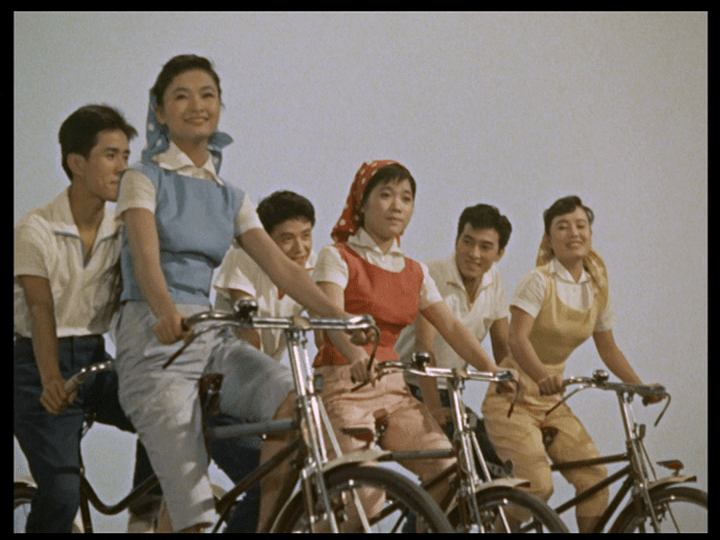 Romantic Daughters (ロマンス娘, Romance Musume) is the second big screen outing for the singing star combo known as “sannin musume”. A year on from
 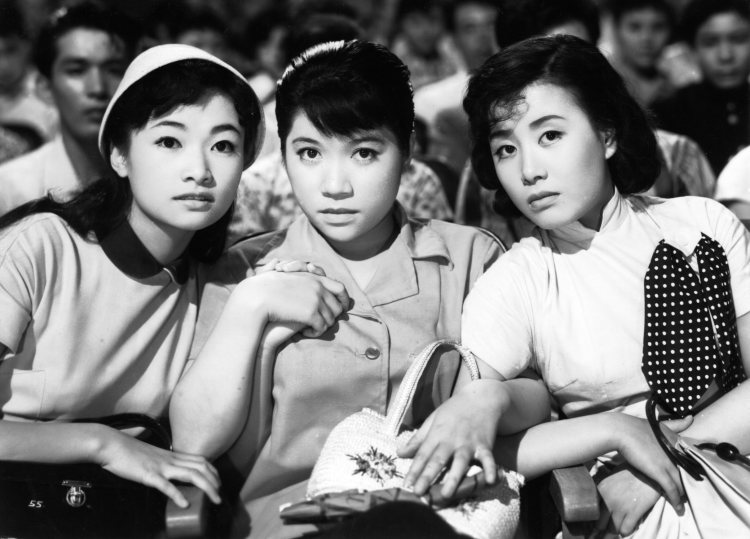 Pop stars invading the cinematic realm either for reasons of commerce, vanity, or just simple ambition is hardly a new phenomenon and even continues today with the biggest singers of the era getting to play their own track over the closing credits of the latest tentpole feature. This is even more popular in Japan where idol culture dominates the entertainment world and boy bands boys are often top of the list for any going blockbuster (wisely or otherwise). Cycling back to 1955 when the phenomenon was at its heyday all over the world, So Young, So Bright (ジャンケン娘, Janken Musume) is the first of four so called “three girl” (Sannin Musume) musicals which united the three biggest female singers of the post-war era: Hibari Misora, Chiemi Eri, and Izumi Yukimura for a music infused comedy caper.
 Windows on Worlds