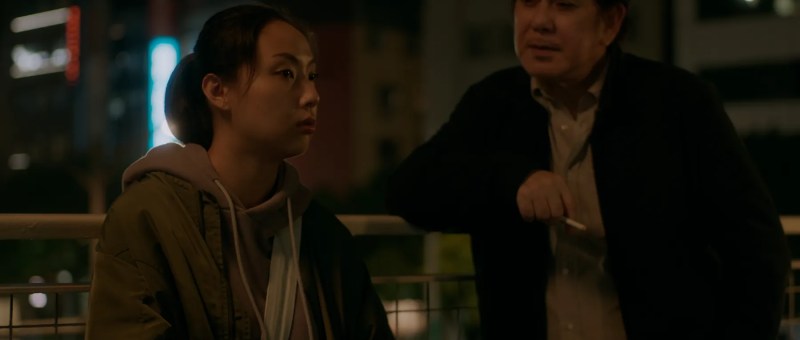

What does “freedom” actually mean? Will money buy it for you or just result in another kind of prison in which you cannot really say you’re free because you don’t feel like you have the choice to leave? Leaving is really at the centre of James Lee’s sensitive drama Next Stop, Somewhere (別來無恙, biéláiwúyàng) in which the protagonists of parallel stories have both left their homelands not altogether by choice in search of a greater freedom that they nevertheless struggle to find.
Hong Kong actor Huang (Anthony Wong Chau-sang) has left Hong Kong in search of political freedom in the wake of the Umbrella Movement, but is immediately constrained by coronavirus quarantine on his arrival in Taiwan. He is constantly trying to get in contact with a man called James who also seems to be in some political trouble and is not always able to answer, which is a problem because James is supposed to be handling the transfer of his money out of Hong Kong. Huang might be “free” of political oppression, but in reality one is never “free” without money and arguably not even then because of the necessity of acquiring it. That seems to be part of the problem for his maid at the hotel, Xiao Qian (Angel Lee), who feels trapped in a relationship that no longer seems to be working while unable to leave it because neither of them can afford the rent on their own.
Xiao Qian’s relationship is with another woman and perhaps it could be argued that in Taipei she at least has the freedom to live with the person she loved, though on the other hand she pointedly refuses to explain when her girlfriend Bae shows up at the hotel looking for her after she stops answering her calls or messages. Bae also seems to have mental health issues that also perhaps prevent Qian from leaving her, though she continues to treat her coldly and repeatedly refuses her requests for intimacy. It seems that Qian wanted to study abroad in America, but so far has been unable to go. A $100 bill to her represents another kind of freedom, though as she later says to Huang in the end freedom about having the choice to leave.
A $100 bill meant freedom for Kim (Kendra Sow) too, but like Huang she finds herself trapped by the realisation that the note did not represent what she was led to believe it would. Not entirely of her own choice, Kim leaves Vietnam to become the mail order bride of a Malaysian man who claimed to be a wealthy businessman in his 40s but in reality is a market trader quite a bit older than that. Mr Li (Mike Chuah) is totally besotted with his new brides, telling his friends that there were cheaper girls available but his is the prettiest. But in the end he’s trapped by this situation too. It’s clear he hadn’t thought through the reality and was acting out a kind of romantic fantasy. Young and naive, Kim recoils from his touch and building a relationship with her is impossible because she doesn’t speak Mandarin and he doesn’t know Vietnamese. They’re hassled by immigration officials and Mr Li’s irate mother who berates Kim insisting that they only brought her here to have a son and heir so she’s not fulfilling her obligations. For his part, Mr Li is partly sympathetic in that it’s clear he has no desire to force himself on Kim and hurt, if understanding, that she rejects him. When he eventually does try to force her, he can’t go through with it because of the sight of her tears.
As her mother-in-law feared she might, Kim finds release though a growing relationship with the immigration officer who’s closer to her in age and also an outsider, rejected by Mr Li’s mother on the grounds of his ethnicity. Through love, she finds another kind of “freedom”, but with it constraint and it remains unclear how this situation will play out even as, like Huang, she surrenders the $100 bill to someone who needs it more. To pass time in quarantine, Huang orders a copy of Mishima’s Temple of the Golden Pavilion, a book about a young monk who sets fire to the temple because he can’t bear the existence of something so beautiful in this profane world. Having not yet finished the book after Huang lent it to her, Qian asks him why the boy did it and he replies that perhaps he felt trapped and that only by burning the temple down could he be free. To that extent, for each of them “freedom” means burning the world behind you and never looking back, if only in a purely symbolic sense in finding the courage to leave a dissatisfying situation, no matter how impossible that might seem, along with the willingness to look for happiness somewhere else.
Next Stop, Somewhere screens as part of this year’s Cinema at Sea.
International trailer


 Windows on Worlds