Ryuzo and the Seven Henchmen (龍三と七人の子分たち, Takeshi Kitano, 2015)

142984037484393493178_ryuzo-7nin-kobuntachi-g4First published on UK Anime Network – review of Takeshi Kitano’s Ryuzo and the Seven Henchman (龍三と七人の子分たち Ryuzo to Shichinin no Kobuntachi) from LFF 2015.


Most people probably know Takeshi Kitano best for his series of ultra violent ’90s gangster movies, his role as the sadistic teacher in the controversial Battle Royale or as the host of bizarre Japanese endurance game show Takeshi’s Castle. However, in Japan he’s probably best known as a comedian though few of his comedy films have ever made it overseas. This may change with his latest effort, Ryuzo and the Seven Henchmen, which both takes him back to his yakuza roots and celebrates his comedic talents.

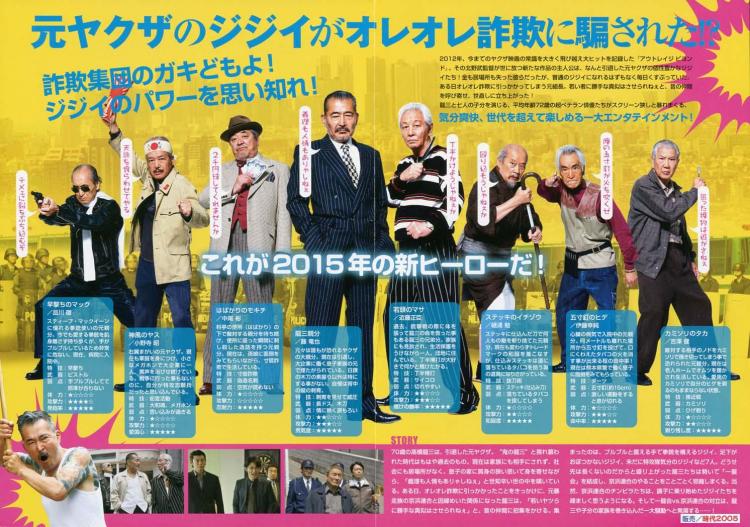
Ryuzo “the demon” was once a yakuza more feared the than respected whose very name alone made women swoon and struck fear into the hearts of men. Now though, he’s a grumpy grandpa living with his ultra conservative son who’d rather the neighbours didn’t know he had a gangster living in his house. After some punks make the mistake of trying an “ore ore” scam on him, Ryuzo gets back into the spirit of his gangster days and takes the guy down in a classic intimidation play. However, some of his other yakuza buddies also seem to be getting into trouble with upstart youngsters and once again it’s up to Ryuzo and his seven old timer yakuza buddies to set the town to rights.

The world has changed since Ryuzo and his guys were ruling the streets. In the old days the yakuza were a family, they had rules and ethics and they stuck to them. They saw themselves both as heroic outlaws and as defenders of the rights of ordinary people (even if they made their money through extorting those very people they claimed to protect). This new brand of crooks doesn’t care about honour, or morality or human kindness – they aren’t above conning the vulnerable into falling for obvious telephone scams or loaning large amounts of money to desperate people at ridiculously high interest just to make a buck. These guys are “business men” running a “legitimate enterprise” where the only rules are that you get rich and stay rich.

Ryuzo and co may be old, but they still have their honour and their pride. Watching the old guys trying to relive their former glory days is often funny, if a little sad as their grand schemes take on the absurd quality of little boys playing cops and robbers. It goes without saying that the film is hilarious though perhaps takes certain instances of low humour a too little far. Each of the main eight old timer yakuza has his own particular strength which endures despite their advanced ages though perhaps in slightly different forms and even if they’re coasting on former glory none of them has forgotten their former status.

Though not quite a return to the artistic highs of Sonatine or Hana-bi, Ryuzo and the Seven Henchmen is nevertheless an entertaining mix of Kitano’s tough guy yakuza and absurd comedian personas. Unlikely to walk away with any awards or lasting praise, Ryuzo and the Seven Henchmen is sure to be remembered fondly for its expertly timed and often gleefully absurd humour.


Reviewed at LFF 2015.
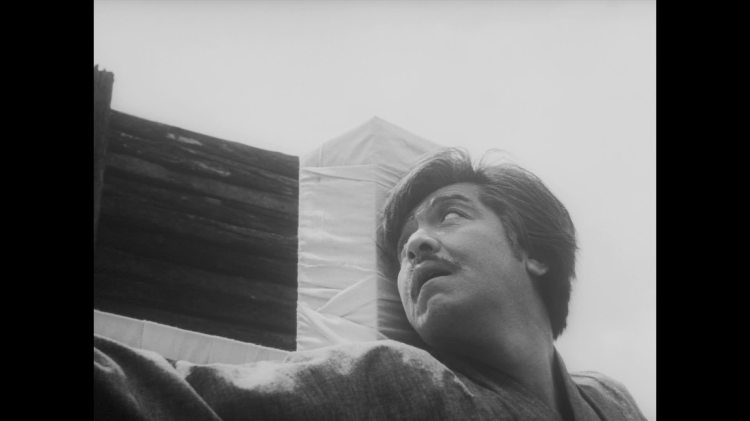
 

Coup d’Etat (AKA Martial Law, 戒厳令 Kaigenrei, Kiju Yoshida 1973)

Snapshot-2015-11-18 at 01_34_49 PM-1660087891Having taken avant-garde story telling to its zenith in Heroic Purgatory, Yoshida returns to the realm of politics with a far more accessible effort in Coup d’Etat (AKA Martial Law, 戒厳令 Kaigenrei). Inbetween the two films, Yoshida had made another more mainstream offering, Confessions Among Actresses, which had been moderately successful with both audiences and critics but with Coup d’Etat he came back to the artistic fare he’d been pursuing since leaving Shochiku. Unlike the other two films in Arrow’s Love + Anarchy boxset, Coup ‘Etat deals with a right wing rebellion rather than the communists and anarchists which are more familiar to the post-war world.
The film begins with a nervous young man brutally stabbing an elderly businessman in the street before taking his own life. On claiming his remains, the man’s sister finds a letter addressed to Ikki Kita – a well known right wing intellectual in favour of the institution of martial law. Kita, or more particularly his work, becomes a figurehead for a putative revolution organised by young army officers who have become disillusioned with the elected government, its plans for increasing Westernisation and treatment of the poor. They seek to overthrow parliament and put the Emperor back in charge for a kind of paternalistic socialist state. Kita remains on the fringes of this movement, coming into contact with a young soldier who wants to join the revolution and advising him but repeatedly making it clear that he is not involved with the coup itself. Nevertheless, even if not directly involved, Kita will still pay the price for his radical ideas.

Less an examination of the historical events of the time or the coup itself, Coup d’Etat is a psychological portrait of Kita’s last days. Marking the only time Yoshida was not involved in the screenplay (this time leaving things entirely to playwright Minoru Betsuyaku) the film follows a much more linear structure rather than playing with time in the same way as Eros + Massacre or Heroic Purgatory. Kita had written a hugely influential book which advocated moving to a system of martial law under the paternalistic care of the emperor alongside nationalisation of industries, minimisation of private property and a better welfare state. However, Kita is a public intellectual not an activist. He takes no personal part in the armed struggle (though he is aware of each of the actions and close to the people who facilitated them), yet still he pays the price. Whether this is an indictment of his lack of physical commitment to the ideals that he spoke of, or an indictment of a system which seeks to shoot the messenger is up for debate but in any case Kita is “betrayed” by the very same emperor that he worshipped as a god.

Having said that, it’s Emperor Meiji who hangs on Kita’s wall. What Kita and the officer class wanted was a “Showa Restoration” in line with the “Meiji Restoration” but almost the reverse as they returned to a form of paternalistic government where personal freedoms were restricted but everyone was well cared for. We actually don’t learn a lot about Kita during the film (a strange thing to say about a “biopic” which is often how the film is described) but it seems that he had a strict childhood in which he was prohibited from feeling fear – each time a boy was a afraid, he was supposed to cut himself as a punishment. Yet Kita is afraid and this tension between intellectual thought and irrepressible emotion is one that restricts his physical actions to the point that he remains a solitary figure entrapped by his own ideology. That he is then betrayed by the very figures that he sought to exult is the very highest form of tragedy and it’s difficult not to believe that the real coup d’etat is being perpetrated against Kita himself.

Perhaps because of its relative narrative simplicity, Coup d’Etat is a visual masterpiece taking Yoshida’s especial gifts for composition to new heights of beauty. Once again shot in black and white 4:3 Academy ratio, the film is an unsettling maze of shadows and light coupled with uncomfortable angles and a musical score that’s almost like a science fiction film. Yoshida’s prognosis is indeed bleak – the young soldier for example who’s unable to carry out his part of the mission and eventually falsely confesses to having been a spy simply because he felt insignificant and wanted to be a part of something is symptomatic of the self-centred ineffectuality of the younger generation. Once again, youth has been evaluated and found wanting though age doesn’t fare much better in the end. The filming of Coup d’Etat was delayed for sometime as Yoshida underwent an operation to remove a tumour from his stomach. His ultimate satisfaction with the film and the feeling of having come to the end of a cycle coupled with the need to recuperate more fully kept Yoshida away from the director’s chair until 1986 though he’d never return to it with the same intensity as in his political trilogy.


Available now on blu-ray in the UK as part of Arrow Films’ Kiju Yoshida: Love + Anarchism box set.

Scene from near the end of the film:

Reviews of the other movies in the set:

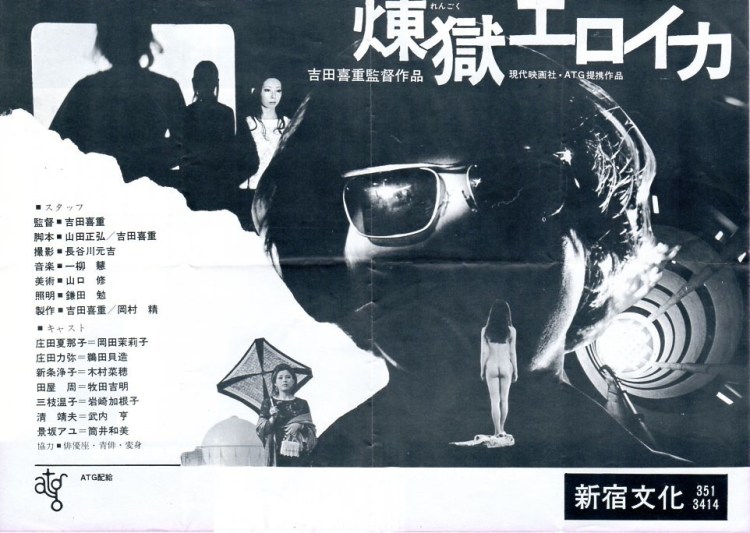
Heroic Purgatory (煉獄エロイカ, Kiju Yoshida, 1970)

Heroic Purgatory PosterThe second film contained within Arrow’s Kiju Yoshida boxset is perhaps his least accessible. Ostensibly, Heroic Purgatory (煉獄エロイカ, Rengoku Eroika) is an examination of leftist politics in the years surrounding the renewal of the hugely controversial mutual security pact between Japan and America. However, it quickly disregards any kind of narrative sense as time periods blur so finely as to leave us with no objective “now” to belong to and characters switch identities with no warning or discernible reason. Yoshida is not really after objective truth here – there is no truth in cinema, film lies repeatedly until it finally exposes the truth.
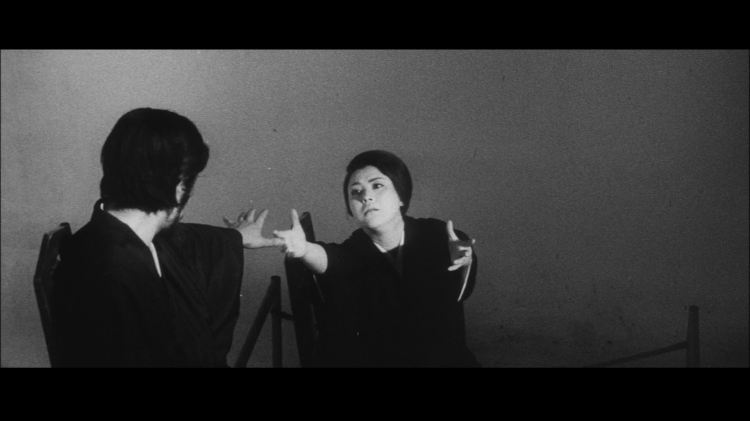
What there is of a plot begins with the scientist Rikiya Shoda who, it seems, may have been a part of a left wing activist group in the ‘50s who were intent on assassinating an ambassador but may or may not have had a mole in their midst. Now, in the contemporary ‘60s era his quiet life is disturbed when his wife, Nanako returns home with a distressed teenage girl who begins insisting Rikiya and Nanako are her parents. Sometime later another man arrives claiming to be Ayu’s father – he’s even installed a spy cam on her because this is apparently something she does quite often. The “father” eventually leaves without Ayu but then we jump back to the ‘50s where Rikiya and the “father” seem to be part of the same left wing cell but for some reason did not recognise each other in the modern part of the film. There are repeated interrogations regarding a spy, confessions, reversals, executions and betrayals but where does it get us in the end?

There’s no making sense of Heroic Purgatory, that’s not really what it’s about. It’s the very essence of avant-garde, gently eschewing literal narrative in favour of a deeper meaning. At the end what we’re left with is a scientist who professes love to be the highest calling and a wife who answers the question “what do you do when your husband’s working?” with “Think about my husband”. This isn’t some kind of anti-feminist statement in so much as a defence of a thirty year marriage which has, apparently, survived all this chaos. What has clearly perished is the left wing student movement which has ultimately failed to instigate any real kind of social change. The film wraps itself around the dates at which Japan’s defence treaty with America was or would be renewed – something to which the leftwing movement was completely opposed to and failed to prevent. Not only did they not succeed in breaking the American security pact in the ‘50s but interest in the protests themselves slowly dwindled. The film ends with a sign reading “Dead End” which you can only read as being in reference to the eventual demise of armed leftwing rebellion in Japan.

Though Heroic Purgatory is in no way Yoshida’s most easily digestible effort, it may be one of the most beautiful. Shot in 4:3 academy ratio and in glorious black and white with Yoshida’s preference for over exposure, every scene of Heroic Purgatory drips with elegance in its exquisite framing. Yoshida pushes focus to the bottom of the frame, rarely having anything other than empty space above the halfway line. Further adding to the sense of pressured claustrophobia and confusion, Yoshida’s gift for strange compositions is the perfect match for his dreamlike, incoherent, floating tale. Pushed to the edges of the frame, the actors are literally left with nowhere to run in Yoshida’s largely industrial wasteland of a stage set.

The film begins with what looks like a suicide, but turns out not to be. Accompanied by violent, stinging music, we’re trained to expect something terrible to have happened though once again Yoshida has fooled us with clever camera trickery. The music throughout is more like something from a horror film, low level thrumming strings and brief breaks of choral singing set us on edge and make us even more uncomfortable than we already were.

Heroic Purgatory is a poem of beautiful incomprehensibility. Strange and elliptical, the film is visual experience which demands emotional over intellectual engagement. Beautiful, fascinating and ultimately inscrutable Heroic Purgatory is a film that haunts with its refusal to explain itself and is likely to reverberate in the mind long after the final credits have rolled.


Available on blu-ray and DVD as part of Arrow Films’ Kiju Yoshida: Love + Anarchism box set.

Original unsubbed Japanese trailer (slightly NSFW – contains nudity)

Reviews of the other movies in the set:

Eros + Massacre (エロス+虐殺, Kiju Yoshida, 1969)

Snapshot-2015-11-17 at 11_12_15 PM-1889818228One of the foremost avant-garde filmmakers of the New Wave era (though he detested this term which, in fairness, is a retrospective and often arbitrary label), Kiju (Yoshishige) Yoshida has remained largely unseen in the West. Some of this is his own fault – fiercely independent, Yoshida nevertheless found himself working with ATG after leaving Shochiku but the relationship was an unusual one and often far from easy. All but the latest film in Arrow’s Kiju Yoshida boxset, Coup d’Etat, were completed more or less independently and only distributed though ATG and as such not truly “ATG” films. Though it bears many of the hallmarks of a late ‘60s ATG movie, Eros + Massacre (エロス+虐殺, Erosu Purasu Gyakusatsu) is one such effort and the one which helped to make Yoshida’s name even if it was only seen in an abridged version.
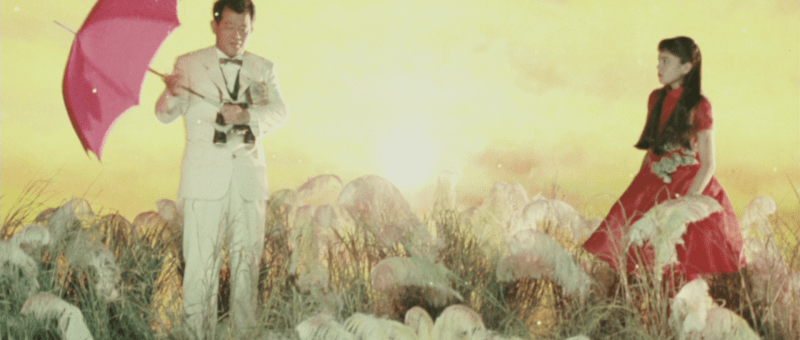
Structurally complex, Eros + Massacre mixes the world of the Taisho anarchists, Osugi Sakae and Ito Noe, with the contemporary Tokyo of the sixties through the prism of two modern students who are running a research project into the events surrounding their ultimate assassination during the panic after the great Kanto Earthquake of 1923. Eiko is a sexually liberated modern woman who engages in casual prostitution and her boyfriend, Wada, is a sexually impotent young man with a traumatic past and habit of playing with fire. The vision we see of the Taisho era is filtered through the perceptions of Eiko and Wada and, in fact, we start to see them as living with us in a real sense as Ito wanders around modern Tokyo, observing the fruits of her struggle and in one notable episode being interviewed by Eiko.

The film exists in two distinct versions – this is less to do with any kind of censorship, either commercial or political, than a legal or possibly moral issue. The fact is, the other of Osugi’s mistresses, Kamichika Ichiko, was still alive at the time the film was completed and had also become a serving politician. Unhappy with her portrayal in the film and unwilling to have a potentially embarrassing event from her previous life dragged back into the spotlight, she threatened to sue and Yoshida voluntarily decided to recut the film to remove many of her scenes as well as renaming the character to distance her from her real life counterpart. The shorter version of the film is the one which helped make Yoshida’s reputation and though nothing in the shorter version is not in the longer one, this version feels a little less “avant-garde” in tone than the intended full cut of the film.

Yoshida often gives way to surreal incidents such as the clash between the Taisho era followers of Osugi and a group of young rugby players tussling over the white wrapped remains of Osugi, the expressionist scene in which the mistress, Itsuko, clutches at a knife hovering in mid air causing the screen to fill with blood raining down from above or the repeated stabbings of Osugi each re-imagined in differing scenarios. His framing is always beautifully idiosyncratic as he makes use of the edges of the frames, disembodying his actors or dividing them with walls and windows. There is no sense of conventional narrative as timelines blur into each other becoming evermore indistinct and the dialogue is often elliptical or poetic rather than offering naturalistic content. Nevertheless, the shorter version retains fewer of these flourishes than are present in the original cut of the film.

Eiko is interested in Osugi because of his free love philosophy rather than any other political aim. Other than their interest in sexual politics, Eiko and Wada do not appear to be particularly politically active in any other way. Osugi’s ideas of total freedom do not even go down very well with his comrades who don’t approve of the way he treats his various women and his disingenuous denial that there is any discord between his band of concubines seems wilfully naive. Osugi’s treatment of the three women in his life – his wife, Yasuko, mistress Itsuko (who is financially supporting both Osugi and his wife despite Osugi’s advocacy of free love insisting on financial independence of all parties), and now his latest lover Noe, is extremely self-centred and unfair. As the first to live in this unorthodox fashion, it’s unsurprising that the arrangement comes in for criticism from all quarters. Yoshida posits that it was Osugi’s free love lifestyle that eventually lead to his shock execution during the chaos following the Great Kanto earthquake as his modern ideals threatened the very idea of the traditional family and ultimately the state itself.

By contrast, Eiko’s modern sexuality appears merely an attempt to ward of her sense of ennui. Where for Osugi sex was a political action (or so he would have it), for Eiko it’s a means of trying and failing to add some kind of meaning to her life. Eiko and Wada are not committed to any kind of rebellious action – they’re simply bored. They literally play with fire without understanding its consequences. Yoshida’s other central tenet is that youth is not beautiful – it is destructive. By implication, Eiko and Wada’s selfish pursuit of personal freedom and the modern commodification of desire is nothing more than willful self destruction.

Yoshida has stated that his primary idea for the film is how to bring about a revolution and to ask the question of what it is that needs to change. Osugi is shown up as a hypocrite whose ideals are imperfect and self centred, though his eventual murder is dictated by his refusal to conform. The fact that he envisioned a different future, wished to live in a different way, was sufficient enough to necessitate his death. The modern couple misuse their own freedom and are willing to watch the world burn just to feel the heat. They are incapable of effecting real social change because their focus is always inwards rather than a dedication to the betterment of all mankind. Confounding, intriguing and beautifully shot Eros + Massacre is far from easy to digest but is an essential entry in the history of Japanese avant-garde cinema.


Available now in the UK as part of Arrow Films’ Kiju Yoshida: Love + Anarchism box set.

Reviews of the other movies in the set:

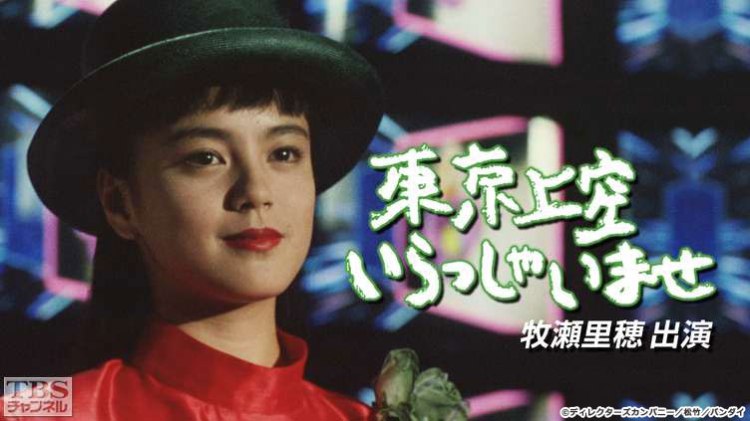
Tokyo Heaven (東京上空いらっしゃいませ, Shinji Somai, 1990)

title-752

In Japan, Shinji Somai is a well known and highly regarded director yet few of his films have ever made it overseas and he remains almost unknown in the West. Even by these standards, Tokyo Heaven (東京上空いらっしゃいませ, Tokyo Joukuu Irasshaimase) seems to be something of a forgotten episode in Somai’s career and is difficult to find even on unsubtitled DVD.

Set in 1990, the film begins with spoilt brat, up-and-coming idol star, and soon to be campaign girl Yu (Riho Makise) at a glitzy launch party. It’s time for 16-year-old Yu to be heading home, but sleazy producer Shirayuki (Tsurube Shofukutei) has other plans and instructs his underlings to set her up with him which they, guiltily, do. However, during the cab ride home Yu eventually escapes his molestations by jumping out into the middle of the road where she’s immediately mown down by an oncoming car. Waking up in a pastoral vision of heaven, Yu meets her guide, “Cricket”, who looks exactly like Shirayuki, the last face she had in her mind before she died. Given the opportunity to return to Earth but not as her old self, Yu tells Cricket to make her the girl on her campaign posters. Waking up in the room of one of the advertising executives working on her account, Fumio (Kiichi Nakai), she discovers resurrection isn’t all it’s cracked up to be.

Taking its queue from A Matter of Life and Death, Tokyo Heaven is first and foremost a fantasy romance (in the broadest sense) though leaning more towards bittersweet comedy than heartrending tragedy or profound human truths. Yu has returned to Earth but is unable to make contact with her family or let her presence be known to anyone other than Fumio. She no longer appears in photographs or mirrors and gradually comes to the realisation that her life really has ended and this small reprieve is only temporary. Many of Somai’s films focus on the emotions of younger people and the irony here is that Yu only grows up once she’s technically dead. Having had the chance to experience a “normal” adolescence with a part-time job at a fast food restaurant and a tentative romance Yu eventually feels ready to move on.

At only 16 years old, Yu was about to become a the face of a large scale advertising campaign. Her image haunts the streets of Tokyo and the loathsome Shirayuki is desperately trying to spin the tragic events into some kind of narrative that will both cover-up his entirely inappropriate behaviour with a school girl in the back of his chauffeur driven car and save some of the hard work already in place on the campaign itself. Hence, no one other than the girl’s parents is being told that Yu is dead and all previous commitments are being cancelled due to “poor health” or “taking a break” etc. Even after death, Yu’s image is being exploited and her soul ignored.

The conflicted trombone player, Fumio, comes to appreciate Yu for who she really is during their brief time together, resents Shirayuki’s treatment of her and wants the campaign to go ahead in an attempt to prolong her “presence” even if in image only. Through his contact with the increasingly vivacious Yu, Fumio who has previously been berated by his brother for not wanting to join their family bathroom fittings business and labeled as someone with an impenetrable shell who prefers his own company by his sometime girlfriend from downstairs, also comes to appreciate the joys of being alive a little more and reconsider some of his previous life choices.

Bearing Somai’s trademark long yet dynamic takes, Tokyo Heaven is a colourful tribute to Tokyo right before the bubble burst. Almost a prescient warning about the dangers of praising image over reality, the film becomes a poignant tale of learning to appreciate the sheer pleasure of being alive. Its slightly strange and perhaps abrupt ending has the potential to be misread, but the general message about the transience of life and the importance of living the way you want to live is one that cannot be overstated.


Screened from film as part of the London Japanese Embassy Filmshow programme on 19th November 2015.

There isn’t even a trailer available for this but if you can understand Japanese there’s a talkshow event with star and comedian Tsurube Shofukutei recorded at the recent Tokyo Filmex Somai retrospective in 2011.

And a musical scene from the film featuring Yosui Inoue’s Kaeranai Futari

Tokyo Fist (東京フィスト, Shinya Tsukamoto, 1995)

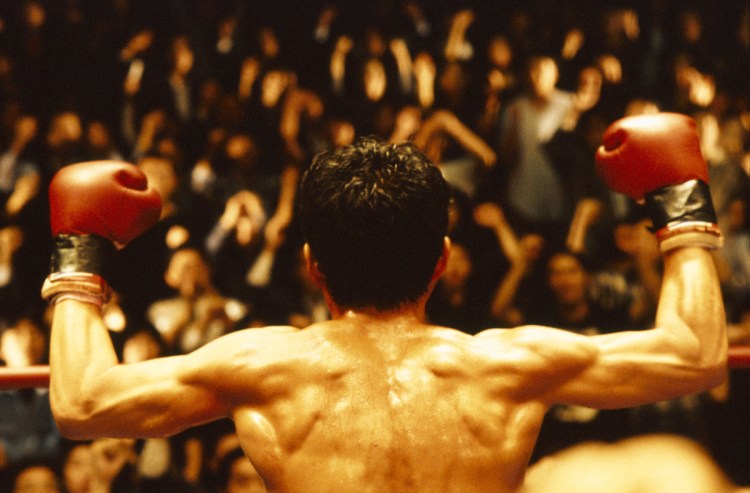
tokyo-fist_still_7Following on from their excellent remastered Tetsuo set and the more recent Kotoko, Third Window Films have again brought us another classic film from the back catalogue of one of Japan’s most underrated auteurs – Shinya Tsukamoto.

Tsuda (played by Shinya Tsukamoto himself) is a hard working insurance salesman in mid ‘90s Tokyo. He lives with a beautiful fiancée in a pretty nice flat and everything seems to be going pretty well for him except that he’s been so unbearably tired lately. Then, one fateful day a colleague asks him to deliver some money to a boxing club (which sounds kind of dodgy in itself) where he’s spotted by an old acquaintance, Kojima (played by Shinya Tsukamoto’s boxer brother Koji). Though it’s clear Tsuda doesn’t wish to resume a friendship with Kojima, somehow he still manages to worm his way into his life. This unwanted intrusion from the past begins to deeply unsettle the civilised life Tsuda and Hizaru had been living up to this point and sets them on a path of atavistic disintegration.

When you look at Tsuda at the beginning of the movie, it’s easy to think he’s ‘happy’ because the life he seems to be living is ‘normal’. He works hard, he lives with a woman he intends to marry and they seem settled and well matched. However, if you look more closely, you can see the cracks are all there even before Kojima turns up. His ‘tiredness’ is perhaps a symptom of the dissatisfaction he might not even realise he’s feeling with his boring, ordinary city life. When Hizaru, his girlfriend, asks him sensitively about his tiredness and suggests maybe he’s overworking and that she wouldn’t mind continuing to work even after they get married Tsuda’s reaction is quite telling. He doesn’t say anything particularly, he doesn’t argue, but it’s clear that he resents the suggestion and is clearly annoyed by it. This, and her subsequent comments to Kojima regarding Tsuda’s physique further undermine his masculinity and you can see that even before the catalyst of Kojima’s arrival, Tsuda’s mental state is quite fraught and his rage is already simmering quietly beneath thin layer of civility that is city life.

When Kojima finally does arrive, he does so like a pathogen infecting Tsuda first at the boxing club. Tsuda brings him home (inadvertently) to his girlfriend who is then also infected with a new strain of individualism. When Tsuda visits Kojima’s apartment to confront him about making a pass at Hizaru, what he finds is a lithe, glistening, insect-like physical force. His movements are uncanny, seemingly too fast for a human yet slightly jerky and lacking in grace. Despite the fact that everyone at the gym thinks Kojima is a terrible boxer (even when he actually wins a fight everyone seems bored) he possesses  the physical strength to knock Tsuda not only across the room but through a wall. The exaggerated, manga-like violence only further intensifies Kojima’s total dominance over Tsuda. Hizaru looks on with a curious expression which seems part way between wonder and disgust at Kojima’s increasingly bug-like appearance.

As a couple, Tsuda and Hizaru seem to have a fondness for watching old, subtitled European movies of an evening – Carol Reed’s The Third Man and Fritz Lang’s Metropolis. Both films, of course, that have something to say about ‘the city’. In The Third Man, Harry Lime’s crimes are only possible because of the unique situation of post-war Vienna. In Metropolis, famously, the city is an organism worked by an underclass of slave workers who are little more than cogs in the machine. The city assumes part of your own personality, strips you of your individuality and replaces it with a job title. It numbs you to the finer emotions and the only way left to re-assert your existence is to open yourself up to pain. In Tokyo Fist, the city is of course Tokyo, but really it could be any city any time. Living in such a codified way etches away at your humanity until barely a husk remains as you live out the day to day demands a city makes of its people. By the end of the film, the three central characters have been through an extended battle with this ‘city tax’ but whether the result is a death of the soul or a recovery is perhaps a matter for debate.

Tokyo Fist certainly a very rich film which repays repeat viewings and is open to a great number of interpretations. Like his earlier Tetsuo: The Iron Man, the film often works on a purely sensory level and needs to be experienced rather than considered but that isn’t to say it’s without plot or action. The fight scenes are intense and frenetic, captured in Tsukamoto’s trademark style, yet the boxing scenes do also have a very authentic ring to them. Tokyo Fist is a masterpiece of modern Japanese cinema that has long been underserved by sub quality releases. This remastered HD presentation from Third Window Films, supervised by Tsukamoto himself, finally restores the film to its rightful position with a truly outstanding blu-ray release. Tokyo Fist is a hugely intriguing and important film which richly deserves a place in any collection.


Available now on blu-ray in the UK from Third Window Films!

More Tsukamoto reviews:

First published on UK Anime Network in November 2013.

Obon Brothers (お盆の弟, Akira Osaki, 2015)

Obon BrothersReview of quirky comedy Obon Brothers (お盆の弟 Obon no Ototo) from this year’s Raindance up at UK Anime Network. I was also lucky enough to interview the director, Akira Osaki, while he was at Raindance to introduce the film which you can also read over at UK Anime Network.


Sometimes you think everything is going to be alright, but then several calamities arrive all at once. Down on his luck film director and stay at home dad Takashi has only been able to get one film made so far and it doesn’t look good for another any time soon. Right now he’s spending sometime apart from his wife and daughter as his elder brother Wataru is ill with colon cancer and as his brother never married, both their parents are dead and they have no other family Takashi has gone to look after him. However, Wataru is anything but grateful and proceeds to mope about the house repeatedly asking when Takashi plans to go home.

When he finally does go home, Takashi’s wife realises she liked it better when he wasn’t there and asks for a divorce. With nowhere else to go except back to Wataru’s, a confused and heartbroken Takashi goes home to Gunma where he reconnects with his screenwriting partner who’s finally met a girl through internet dating. Persuaded to come on a double date, Takashi strikes up a friendship with Ryoko despite still harbouring hopes for a reconciliation with his wife. No job, no home, no wife – what does the future hold for a mild mannered man like Takashi?

Like last year’s Raindance highlight And the Mudship sails away, Obon Brothers stars Kiyohiko Shibukawa though this “Takashi” is a little more sympathetic than the completely apathetic character from Watanabe’s film. With a sort of gentleness of spirit, Takashi is the sort of person who enjoys taking care of others like his ailing brother and cute little daughter and is just as happy keeping house as anything else. For his wife, his passivity becomes a major issue as she finds herself taking on a more independent role and comes to feel she needs someone with more drive at her side rather than the meek Takashi who’s content just muddling through.

Indeed, just muddling through ends up becoming an accidental theme of the film. Every morning, Takashi stops at the local shrine, throws a coin in the donation box and prays for everything to work out…and then goes home and waits for things to happen. However, things don’t just happen no matter how much you want and pray for them – at the end of the day you have to put the effort in which goes for all things in life from marriages to friendships and careers. If anybody gets anything at all out of Takashi’s religious practices, it’s ironically the older brother Wataru who thinks all this religious stuff is hokum – even going so far as to urinate into a sacred pond!

Also like Watanabe’s And the Mudship Sails Away, Obon Brothers is shot in black and white with a preference for long takes and static camera. Consequently it has an innately sophisticated indie comedy feeling which, coupled with its naturalistic tone, bring a kind of warmth and familiarity that it’s hard to resist. Though the film touches on some heavy themes – cancer, the breakdown of a marriage, it treats them all with a degree of matter of factness that never lets them overshadow the main narrative. After all, these things happen and life carries on while they do.

A loving tribute to the prefecture of Gunma from which many of the cast and crew originate including the director Akira Osaki, scriptwriter Shin Adachi and leading actor Kiyohiko Shibukawa, Obon Brothers has more than a little autobiographical content though it doesn’t reflect the actual circumstances of any of the creative team’s lives. It’s a gentle comedy, though one with shades of darkness creeping in around the edges, and moves at an equally gentle pace which gives you ample time to see into these characters and their lives. Osaki’s camera is unjudgemental, it gives equal sympathy and understanding to everyone and even the eventual end of Takashi’s marriage is accomplished with the utmost amicability. Whether or not Takashi has actually changed very much by the end of the film or has just gained a little more knowledge about who he is as a person, Obon Brothers gives you the feeling that it’s alright to start all over again – even if you’re just muddling though!


Obon Brothers is getting a UK release from Third Window Films next year(?) – highly recommended, especially if you like gentle, indie comedies!


Tag (リアル鬼ごっこ, Sion Sono, 2015)

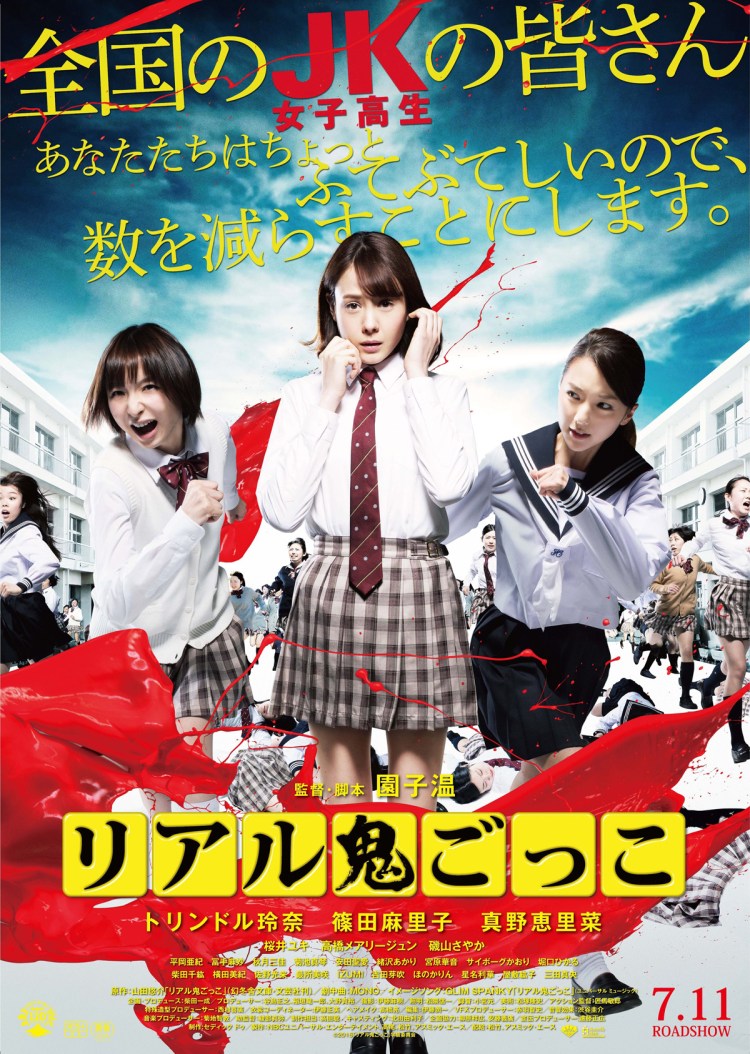
tag posterYou could say Sion Sono is back, though with six films released within a year it’s almost as if he just nipped out to make a cup of tea. At first look Tag (リアル鬼ごっこ, Riaru Onigokko) seems as if it might be towards the bottom of the pile – school girls running away from things for 90 minutes whilst contending with awkward gusts of wind, but this is Sion Sono after all and so there’s a whole world of craziness going on below the surface.
The action begins with a gaggle of school girls on a bus. Two of them start ribbing the girl on the opposite bank of seats, Mitsuko (Reina Triendl), because she’s always writing poetry. The pen gets knocked out of her hand and as she bends down to pick it up she notices a white feather stuck to the clip. Gazing at the improbable symbol, Mitsuko becomes the only survivor when a sudden gust of wind blows the top off the bus taking all of the other passengers’ heads with it. Mitsuko starts running, re-encountering the dreaded wind monster over and over again before stopping at a stream to wash the blood off her face and change into the cleaner set of clothes she finds abandoned there.

After this she finds herself ending up at an entirely different school where everyone seems to know her. Has she gone mad, had a psychotic break? If not then then she’s about to as an attempt to ditch class with some of the other girls results in yet another freak school girl apocalypse.

Running again, Mitsuko ends up at a police box where another woman seems to know her but insists her name’s Keiko (Mariko Shinoda). Oh, and it’s her wedding day today! That’s not even the last time that’s going to happen and it’s far from the weirdest thing that’s going to happen to Mitsuko today. As a friend of Mitsuko 2’s reminds us, “Life is surreal, don’t let it get to you”.

Answers come, after a fashion. Though Tag is nominally based on a novel by Yusuke Yamada (previously adapted into a long running film series), Sono apparently did not even read the book and has only taken its theme – everyone with the same surname being hunted down and exterminated, and repurposed it for his own ends. This time rather than a common surname, it’s an entire gender that is forced to live under constant threat as the plaything of a far off entity that is as invisible and ever present as the wind. It’s no accident that everyone we meet up until the half way point is female, and that the first (presumed) male we meet is wearing a giant pig’s head. Mitsuko and her cohorts have in fact been used as a literal toy by the men on the other side of the curtain. Their very DNA has been co-opted for the “entertainment” of the male world without their consent or even knowledge, and even if she had known, Mitsuko is powerless to resist.

The solution that is found is both very old and very profound. It’s far from an original ending to this kind of story though in these hands, and used in this way, it can, and has, caused offence. Tag wants to ask you about life, about death, about agency and misogyny – but it wants to ask you all those things whilst watching school girls get ripped apart by the same wind that keeps blowing their skirts up. Sono has his cake and eats it too. There will undoubtedly be those that feel that far from satirising mainstream attitudes to women, Sono has, in fact, indulged in the worst parts of them.

If all of that was sounding a little heavy, Tag runs (literally) at breakneck speed with barely any time for conscious thought between the first bizarre case of gore filled mass murder and the next. It’s also strangely beautiful with a hazy, dreamlike veneer full of repeated images and scenes of idyllic serenity. Is any of this real? Who could really say. The ultramodern, indie score also strikes a slightly hypnotic note lending to the feeling of freewheeling weightlessness.

In many ways, Tag has much more in common with early Sono hit Suicide Club thanks to a general thematic sensibility than to any of his more straightforward work since. That said, Tag never quite resolves itself in a wholly satisfying way and though its final moments are filled with a poetic sensitivity, there’s a certain barrier created by its ambiguity that feels unfinished rather than deliberate. Another predictably “not what it looks like” effort from Sono, Tag may just come to be remembered as his most considered effort of 2015.


First Published on UK Anime Network in November 2015.

Playing at the Leeds International Film Festival on 18th November 2015.

Other movies playing at Leeds include Assassination Classroom, Happy Hour, Our Little Sister and Love & Peace.

Can’t find a subtitled trailer for some reason but to be honest you’ll get the gist of it:

Assassination Classroom (映画 暗殺教室, Eiichiro Hasumi, 2015)

photo_4First Published on UK Anime Network in November 2015.


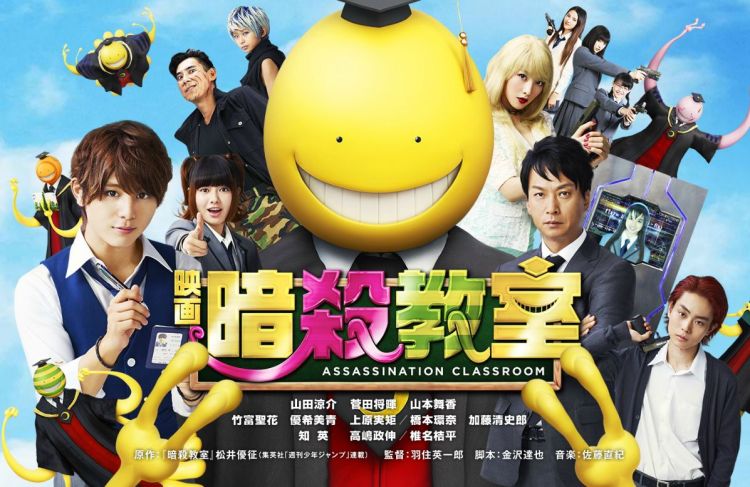
You might make the mistake of thinking that the E in class 3E just means it’s the 5th 3rd year class, or that it stands for “elite” and contains some of the top students in the school. You’d be wrong, “E” stands for “end” because these are the no hoper kids that everyone’s already written off as having no future. However, it’s precisely these kids that a mysterious extraterrestrial being insists on becoming the teacher of in return for not destroying the Earth (just yet). Nicknamed UT (unkillable teacher), the giant yellow octopus-like creature has already destroyed 30% of the moon just for kicks and has now set the challenge that if the boys and girls of class 3E fail to assassinate him before graduation he’ll destroy the Earth too.

The ironic thing is, UT is the best teacher they’ve ever had, but to pass the course (and save the world) they have to kill him. The high schoolers are also under the tutelage of a self defence forces officer for their military training and a sexy assassin who randomly ends up becoming their English teacher (and giving them one of the least appropriate English lessons ever recorded on film). Every morning they bow and then pull out their various kinds of firearms as UT takes the register whilst flitting about dodging bullets. Despite wanting to destroy the Earth, UT is 100% committed to training his students both in the arts of assassination and in the more regular subjects. Because of his super speed and ability to be in several places at once he has time for everybody and is quick to work out each of his charge’s specific weaknesses and help them work on those to become better people as well as ace students.

Still, the students are supposed to kill their teacher and there’s a little bit of sadness creeping in as they inevitably grow closer to UT and his quirky antics. Up ’til now everyone has given up on them and now they’re supposed to kill the one person who’s actually trying to help. Of course, even while this surreal situation is going on these are just regular high school kids undergoing regular high school stuff like wanting to sneak into the girls’ changing rooms or having a crush on someone who hasn’t even noticed you. Despite the impending end of the world, the kids of Class 3E are just enjoying their time trying to work out ever more complex ways of trying assassinate their seemingly invincible teacher.

UT himself is strangely adorable with his giant yellow smiley face style head and bizarre little laugh. He also changes color according to his mood and has a tendency to go off on tangents with one notable example which turns into a long form ‘80s style melodrama about abandoned single mothers before being politely shut down by the bored students. Assassination Classroom is undoubtedly bizarre, surreal and full of absurd humour but all the better for it. It’s just very silly but has an undeniably clever and very witty script that proves near impossible to resist.

To put it mildly, Assassination Classroom is just heaps of zany, crazy fun. It also manages to be genuinely heartfelt as we come to care for this rag-tag bunch of no hopers but also for UT himself as we start to hope the kids will somehow fail and succeed at the same time so we can save both the world and UT. The film drops us a few hints about UT’s backstory but stops short of offering a full explanation for the crazy goings on. Thankfully a sequel, Assassination Classroom: Graduation Day is already in production and even if it doesn’t offer any answers, Assassination Classroom is already one of the most enjoyably absurd offerings to come out of Japan this year.


Assassination Classroom receives its UK premiere at the Leeds International Film Festival on 15th November 2015.

Look out for a review of Tag which is also playing at the festival as it Happy Hour, and Our Little Sister.


Like Someone in Love (UK Anime Network Review)

Like_someone_in_love_quad_v5_HRFirst published on UK Anime Network in June 2013.


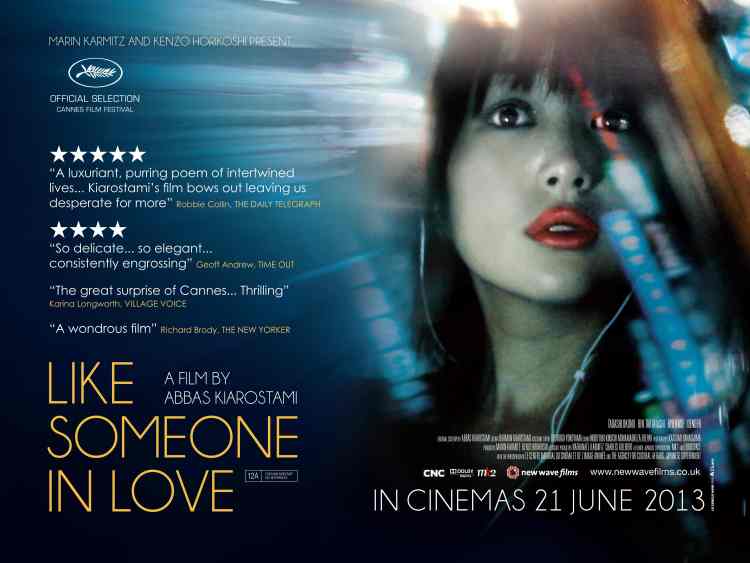
Like Someone In Love is only Iranian director Abbas Kiarostami’s second international venture after 2010’s Certified Copy but this time sees his familiar preoccupations with ambiguities and poetic imagery transported to modern day Tokyo. Although in this case all the characters are quite clearly drawn and presented somewhat unambiguously, the reasoning behind the decisions they make and the way they behave, however, remains oblique. The title implies someone is acting ‘like someone in love’ if not exactly ‘in love’ themselves but who is it, who or what are they (‘almost’?) in love with, and what exactly would that mean – these are all the gentle ambiguities that Kiarostami wishes us to think about in this perfectly excised cross section of modern life.

As the film opens we are placed statically looking onto a scene which appears to be some sort of bar, a woman’s voice can be heard speaking to someone – not us, this clearly isn’t a voice over, there is obviously someone else involved in this dialogue that we cannot hear. We search the screen for the owner of the voice and even though we can see that nobody else is speaking somehow the thought that the woman is off camera hasn’t quite occurred to us. Eventually we find a young woman has been talking on the phone, presumably to her boyfriend – ‘I’m not lying’ she says, though we know she is. The boyfriend suspects her and makes her go to the bathroom to count the number of tiles so he can come there later and compare to see if she’s telling the truth.

Shortly afterwards, an older man (Denden) starts talking to her and encourages her to break up with said jealous boyfriend ‘not just for business reasons’ but as fatherly advice. He wants her to visit ‘a very important man’, she doesn’t want to because she’s tired after cramming all night for an exam and anyway her grandmother is in town and she’d like to see her. The man makes it very clear he isn’t forcing her, but he leaves her no room to refuse and she goes anyway even though she doesn’t want to. He puts her in a taxi for an hour’s drive across the city – on the way she gets a message from her grandmother that she’ll be waiting outside the station until her train so Akiko (Rin Takanashi) asks the driver to pass the station twice just so she can catch a glimpse of her.

Fast asleep in the car she arrives at a rather nondescript little address behind a ramen shop where a retired sociology professor (now sometime translator), Watanabe (Tadashi Okuno), lives. As soon as they enter the phone rings and Akiko takes the opportunity to poke around – she finds some pictures of an older and a younger woman – a wife and daughter perhaps? Strangely they look a little like her, as does the woman trying to teach a parrot to speak in the famous print on one wall.  ‘I always thought the parrot was teaching the woman’ Akiko says and the professor laughs. Still tired she makes straight for the bedroom, undresses and gets into the bed. This wasn’t what the old man had in mind though – he’s cooked a full dinner and bought wine, soft music ‘Like Someone in Love’ is playing in the background. After trying to convince her to eat and failing the professor gives up and turns the light out to let her sleep.

The next morning he drives her to school only to witness an altercation with the jealous boyfriend, Noriaki (Ryo Kase) who’s been lurking in wait after not being able to get through on Akiko’s phone. It’s clear he’s angry, he grabs at her then sulks after she goes inside before trying to talk to the professor, mistakenly thinking he’s her grandfather. He of course keeps up the pretense simply by not (directly) correcting the mistake. It’s clear though that something is coming to head and the meeting of these three people is going to produce a fundamental change in one or all of their lives.

Like Someone in Love might be one of those films where the reaction to it says much more about the viewer than it does about the film. It’s so much more about what isn’t said, the things that one infers from brief snippets of possible backstory than it is about what is actually seen on the screen. We don’t know exactly why Akiko got into this line of work or why she does it or even how she really feels about it. It’s plain in the first scene that she doesn’t want to go, at least tonight, and that she’s refused to go before but when she arrives at Watabe’s house she’s anything but coy and seems every inch the seasoned pro ready to get down to business. She’s a cipher, the clearest thing you can say about her is that she’s defined by her own passivity. She says she won’t go and then bows to pressure and goes, she obviously wants to break up with her awful boyfriend but doesn’t, she wants to see her grandmother but obeys her pimp(?) instead. She seems to spend her entire life bowing to the whims of other people rather than making any sort of decision for herself.

The two men by contrast appear as virtual mirror images of each other. The elderly scholar Watanabe, contemplative and introspective and the violent, obsessively jealous high school dropout garage owning Noriaki. What is Watanabe’s interest in Akiko? Is this something he’s done often? it seems maybe not, perhaps this is a gift from his former student now Akiko’s ‘boss’. At any rate it seems he’s after some kind of romantic evening rather than a torrid few moments in bed with a girl young enough to be his granddaughter. He’s arranged things for her comfort – cooking her local dish, lighting candles, setting the dinner table etc just as someone in love might do. Perhaps he’s just lonely (though his phone is always ringing and he never answers it) and wants to relive fondly remembered memories of his wife. Noriaki by contrast seems much more territorial – he wants to own Akiko, he’s decided she’s useless on her own and needs his protection but he’s obviously terrified someone’s going to steal her out from under him. He’s also hugely over sensitive about the phone box card which looks like Akiko (because we know it is) maybe because he’s got a Madonna-whore conception of women to begin with.

The film ends as abruptly as it started which is inevitably going to be a problem for many viewers. This is not the end, but it is an end – perhaps the beginning of something new rather than the end of something old. An internal world is penetrated – like the intrusion of falling in love into an otherwise dull life, old securities prove inadequate and perhaps it’s harder to protect the things that are precious to you than you might hope (especially if you are old and your aggressor is not). In many ways we are like the old curtain twitcher whose sole entertainment is her window onto Watanabe’s doorstep – we can’t know what happened before our one and only window was opened, nor can we know what will happen once it’s closed but still we can’t help but wonder.


Available now in the UK from New Wave Films.