#Alive (#살아있다, Cho Il-hyung, 2020)

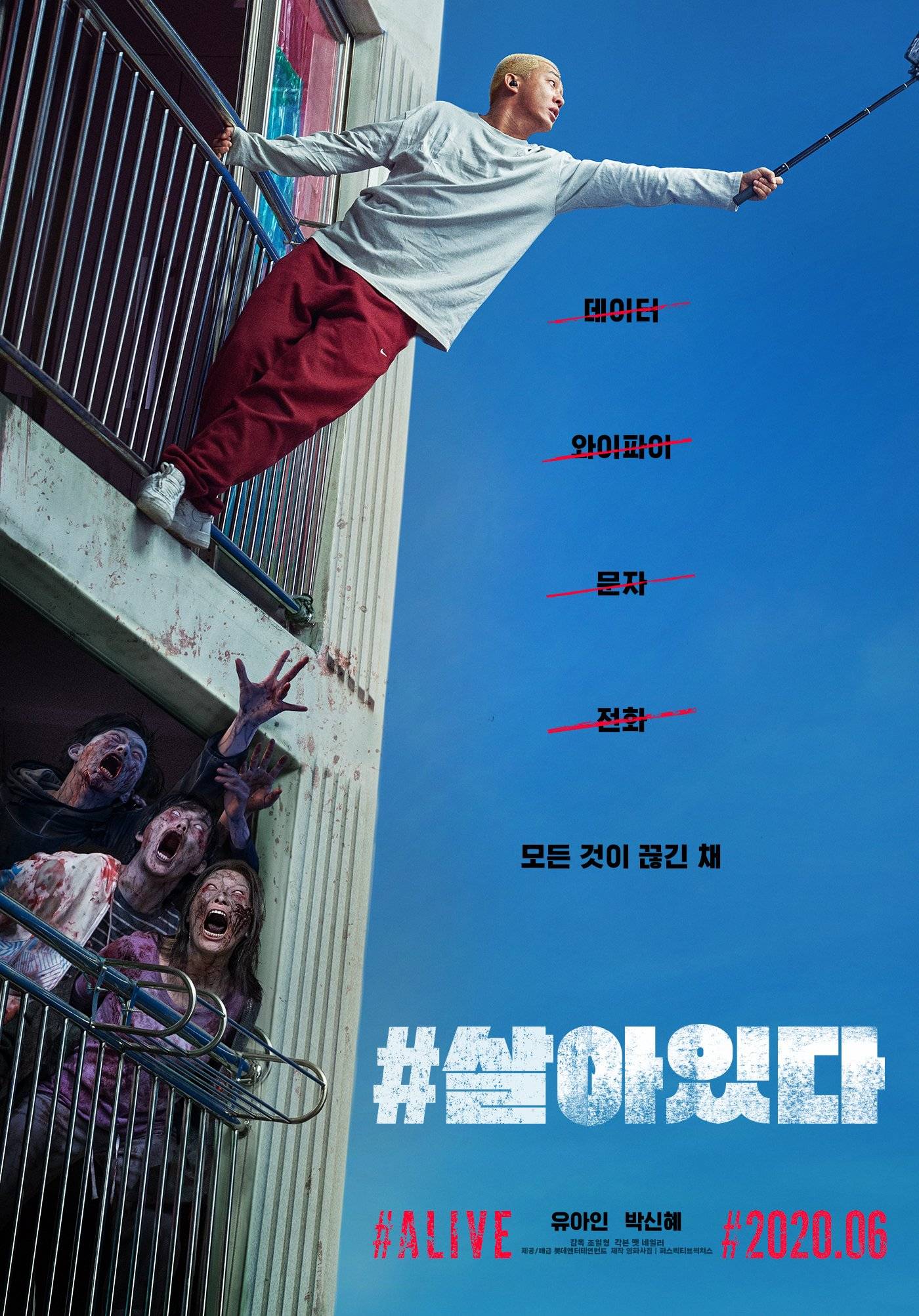
Is solidarity really the answer to alienation? The latest in a short line of zombie-related crisis movies, Cho Il-hyung’s oddly prescient #Alive (#살아있다, #Saraitda) presses directly into what it means to live in a time of isolation as its already introverted hero discovers the existential dread of true aloneness, orphaned by his society and quite literally surrounded by cannibalistic threat only to rediscover the desire for life in the company of others vowing to survive not out of obligation but individual will. 

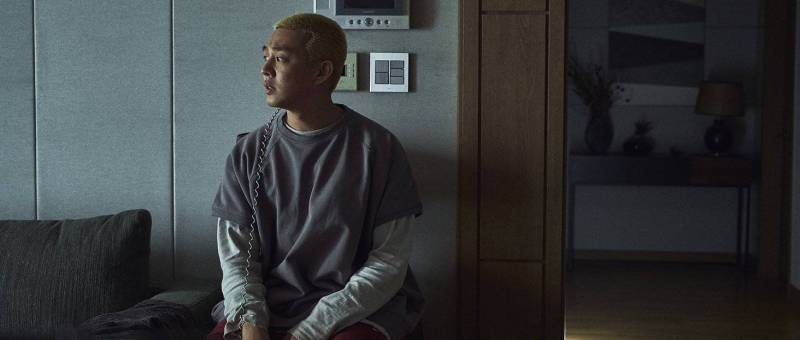
A young man in his 20s, Jun-u (Yoo Ah-in) lives at home with his parents and seems to be a virtual shut-in not quite supporting himself as a pro-gamer/vlogger. He ought to be in his element when he turns on his television one day to discover that a violent riot has apparently erupted all over the city, apparently spreading like a virus which causes aggressive behaviour and cannibalistic frenzy. Unfortunately, Jun-u’s parents left early that morning and didn’t have time to prepare food, leaving him money to go out for groceries but obviously it’s too late for that now and it looks like they won’t be coming home. Jun-u is entirely alone, and all the more so when his usual lines of communication are cut. 

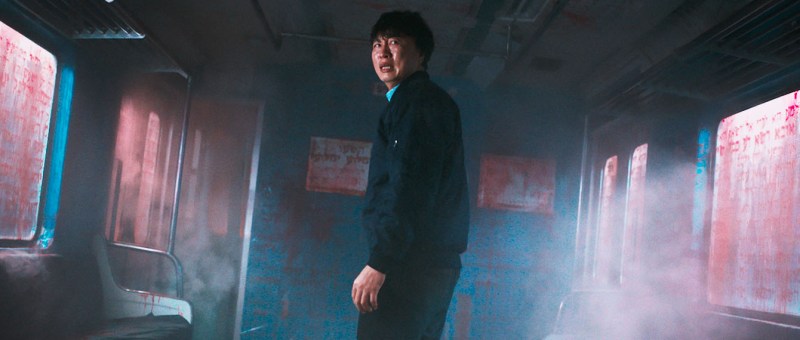
Like the thematically similar EXIT, with which #Alive shares its faith in mountaineering, #Alive concerns itself less with the zombie threat than with youthful alienation and a sense of hopeless despair. Jun-u ought to be in his element, but finds himself ill-equipped for surviving the apocalypse given that he lacks basic adult life skills and those he does possess are now ironically unhelpful. Resourceful as he is, he remembers a smartphone app that would help him communicate via FM radio and all he’d need would be a standard earphone jack only all his earphones are wireless. Making the most of his unstable connection he uploads a single photo of himself holding his address written on the side of a cardboard box with the hashtag #I_MUST_SURVIVE to his Instagram in the hope that someone will see him but becomes increasingly despondent as his food and resources dwindle and he receives a disturbing voicemail which suggests his family may not have escaped the disaster. 

Hitting rock bottom he considers taking his own life but is saved by a literal light in the darkness, a laser shone from an opposing apartment signalling another presence he had previously missed. Believing he was alone in the world, Jun-u lost the will to live and faced with the prospect of waiting to starve to death or venturing out among the zombie hoards chose the only agency available to him in deciding the time and manner of his death. Realising he is not alone restores his desire for life, yet Yu-bin (Park Shin-hye), though much more well prepared, is also dealing with her own trauma in the face of crisis in the memory of a climbing fall that leaves her additionally anxious and fearful of physical risk. Where Jun-u flounders, lamenting as so many of us has in recent years, that no one seems to know what’s going on, the news continually flashing the same info screen while telling viewers only to stay home, Yu-bin has constructed a mini fort complete with a series of booby traps perhaps content in her independence having resolved to live and glad to have discovered she is not entirely alone. 

In contrast to disaster movie tropes, the pair instantly bond in their shared bounce back from despair, developing unconventional means of communication while Yu-bin willingly shares her food stash which in turn gives Jun-u the courage to venture outside for supplies. Eventually reuniting they do their best to withstand the zombie hoards, standing in as they are for the various anxieties which otherwise surround and oppress them, only to find themselves betrayed, worried that perhaps they have after all been abandoned and that no one is there looking out for them. Their salvation lies in their connection, the derided social media proving a lifeline that both affirms their existence and restores a sense of community that returns their safety, airlifting them from the locus of despair finally #Alive and returned to the world secure in the knowledge that they are not alone.


Netflix trailer (English subtitles)

Kingmaker (킹메이커, Byun Sung-hyun, 2022)

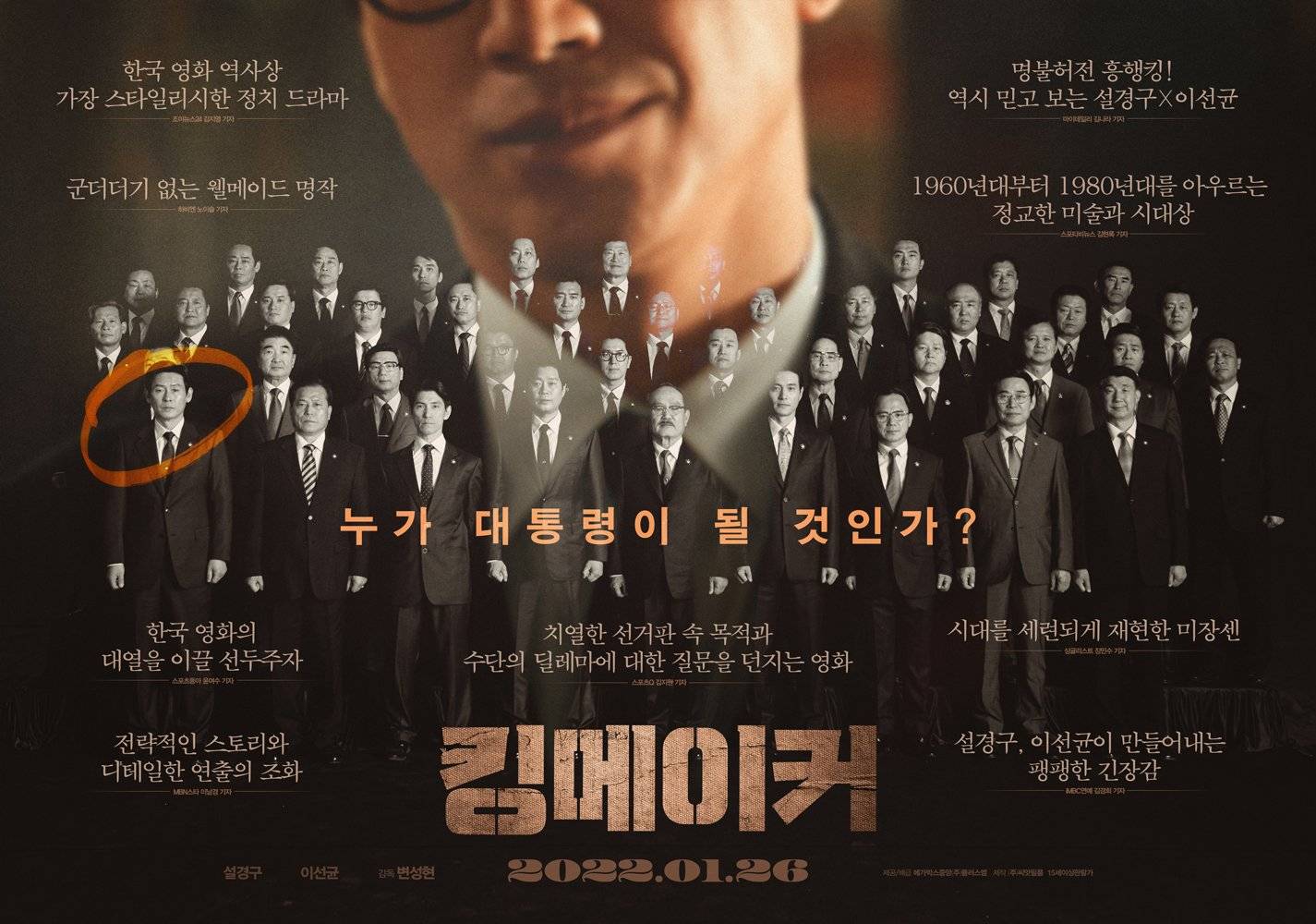
It’s the political paradox. You can’t do anything without getting elected but to get elected you might have to abandon whatever it was you wanted to do in the first place. Loosely based on the real life figures of Kim Dae-jung and his political strategist Eom Chang-rok, the heroes of Byun Sung-hyun’s Kingmaker (킹메이커) are obsessed with the question of whether the ends justify the means and if it’s possible to maintain integrity in politics when the game itself is crooked while the film suggests that in the end you will have to live with your choices and your compromises either way and if it’s a better world you want to build perhaps you can’t get there by cheating your way to paradise.

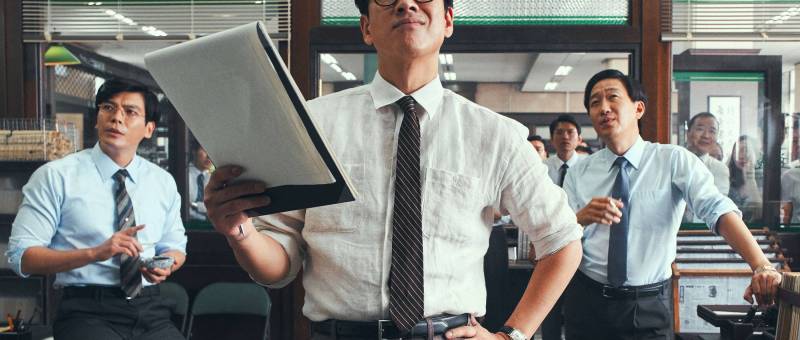
The son of a North Korean migrant, Seo Chang-dae (Lee Sun-kyun) is an embittered and frustrated pharmacist with a talent for spin. When his friend complains about a neighbour stealing his eggs from his chicken coop and denying all knowledge because he’s well connected and knows he can get away with it, Chang-dae’s advice is to plant one of his own chickens in the other guy’s coop and catch him red handed. Impressed by the impassioned political speechmaking of labour activist Kim Woon-bum (Sol Kyung-gu), he writes him a letter offering his services and then marches down to his office to convince him that he is the guy to break his losing streak and finally get him elected so they can “change the damned world”. 

The problem is that all of Chang-dae’s ideas are like the chicken scam, built on the manipulation of the truth, but you can’t deny that they work. He plays the other side, the increasingly authoritarian regime of Park Chung-hee, at their own game, getting some of their guys to dress up as the opposing party and then set about offending a bunch of farmers by being generally condescending and entitled. They stage fights and perform thuggish violence to leave the impression that Park’s guys are oppressive fascists while asking for the “gifts” the Park regime had given out to curry favour back to further infuriate potential voters. Later some of their own guys turn up with the same gifts to send the message that they’re making up for all Park’s mistakes. At one point, Chang-dae even suggests staging an attack on Woon-bum’s person to gain voter sympathy, an idea which is met with total disdain by Woon-bum and his team many of whom are at least conflicted with Chang-dae’s underhanded tactics. 

But then as he points out, if they want to create a better, freer Korea in which people can speak their minds without fear then they have to get elected first. It may be naive to assume that you can behave like this and then give it all up when finally in office, but Chang-dae at least is committed to the idea that the ends justify the means. Woon-bum meanwhile is worried that Chang-dae has lost sight of what the ends are and is solely focussed on winning at any cost. He has an opposing number in slimy intelligence agent Lee (Jo Woo-Jin) who serves Park in much the same way Chang-dae serves Woon-bum, but Chang-dae fatally misunderstands him, failing to appreciate that for Lee Park’s “revolution” is also a just cause for which he is fighting just as Chang-dae is fighting for freedom and democracy. In an uncomfortable touch, Lee seems to be coded as gay with his slightly effeminate manner and tendency towards intimate physical contact adding an additional layer to his gradual seduction of Chang-dae whose friendship with Woon-bum also has its homoerotoic qualities in its quiet intensity. 

The final dilemma lies in asking whether or not Woon-bum could have won the pivotal election of 1971, preventing Park from further altering the constitution to cement his dictatorship and eventually declaring himself president for life, if he had not parted ways with Chang-dae and tried to win more “honestly”. If so, would they have set Korea on a path towards the better world they envisaged or would they have proved little different, their integrity already compromised by everything they did to get there poisoning their vision for the future? The fact that history repeats itself, Woon-bum and his former rival Young-ho (Yoo Jae-myung) splitting the vote during the first “democratic” presidential election and allowing Chun Doo-hwan’s chosen successor to win, perhaps suggests the latter. In any case, it’s Chang-dae who has to live with his choices in having betrayed himself, as Woon-bum had feared too obsessed with winning to remember why he was playing in the first place. “All my ideas about justice were brought down by my own hand” he’s forced to admit, left only with self-loathing defeat in his supposed victory. Some things don’t change, there is intrigue in the court, but “putting ambition before integrity will get you nowhere” as Chang-dae learns to his cost. 


Kingmaker screened as part of this year’s London Korean Film Festival.

International trailer (English subtitles)

Seven Years of Night (7년의 밤, Choo Chang-min, 2018)

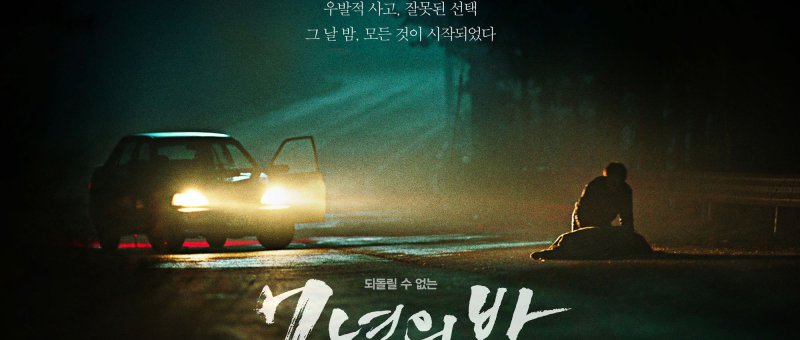
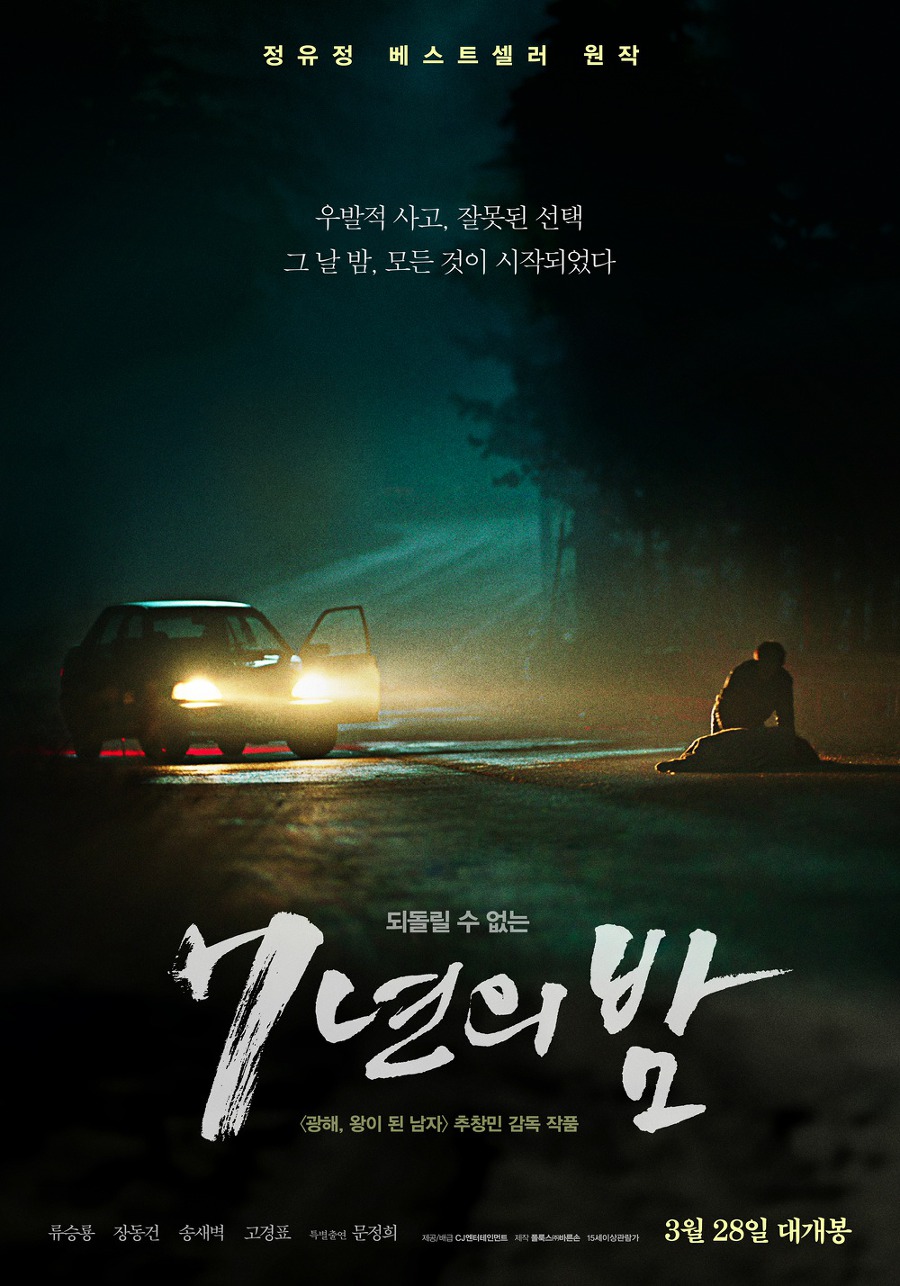
Seven Years of Night posterThe sins of the father are visited upon the son. Cycles of abuse and fatalistic retribution are a persistent theme in Korean cinema but Choo Chang-min plunges them to new depths of tragic inevitability in his adaptation of the best selling novel by Jeong You-jeong. The biblically titled Seven Years of Night (7년의 밤, 7 Nyeonui Bam) pits two visions of failed fatherhood against each other as two broken men attempt to restore order to their lives but damn their children in the process through their own refusal to engage with past trauma.

In 2004, security guard Hyun-su (Ryu Seung-ryong) buys an apartment he can’t afford in order to placate his wife who is in constant worry over their precarious financial circumstances. Hyun-su can’t really manage the interest payments on the mortgage so the family will be renting out the fancy apartment and moving to a remote house provided by his new employers at a hydroelectric dam. On the day that he was supposed to go and check over his new accommodation, Hyun-su partied hard with his former colleagues and set off drunk, getting into an altercation with another driver on the way. Lost in a thick fog and fuzzy from the drink, he hits a little girl who ran out in the middle of the road, panics and hides her body, planning to forget any of this ever really happened.

Forgetting is not, however, something anyone is permitted to do in Choo’s world of elemental retribution in which the buried past is always destined to make its way to the surface sooner or later. The lake around the dam was once home to a village which was sunk, intact, to make way for its construction. Locals fear the water with superstitious dread, believing the lake sucks the souls of men and is polluted with something darker and older than industrial corruption. Attempting to drown the inconvenient may have its appeal, but nothing stays underwater for long and the harder you try to push it down, the faster it will rise.

Unfortunately for Hyun-su, the father of the girl he has killed, known to all as Dr. Oh (Jang Dong-gun), is not a man to be messed with. Dr. Oh, apparently an upscale dentist in the city, rules over all with a tyrannical authority and, as he owns almost all the land around here, enjoys a near feudal level of deference from the villagers. Violent and controlling, Oh’s wife, who describes him as the Devil incarnate, has recently escaped and gone into hiding leaving their small daughter Se-ryung (whose name is coincidentally the same as that of the sunken village) alone to face his wrath. Doubtless, Dr. Oh was raised with an authoritarian father of his own and is unable to see beyond himself and understand that his reign of terror prevents him from achieving the very thing he craves – the love of his wife and daughter.

Desperate for revenge, needing to prove that this is all someone else’s fault to avoid admitting that his own violence drove his wife from him and his daughter into the path of another violent man, Dr. Oh vows poetic retribution by targeting the life of Hyun-su’s innocent son, Seo-won (Go Kyung-pyo). Increasingly disturbed by his crime, Hyun-su dreams of his own father – a violent drunk with PTSD from a pointless war whose death he longed for and who he swore never to become, only to be confronted with a vision of himself as a small boy in the face of his own son watching his father strike his mother in anger. Hyun-su sees. He sees what his father passed to him and what he fears he will pass to his own son. He wants to break the curse, but doesn’t know how. 

Still, Hyun-su would drown the world to save his son even if he hates him for it. Seo-won, left with a series of dubious legacies, struggles to emerge from the shadow of his father’s crimes, is disowned by his family as the son of a murderer and cast out from regular society as one polluted by murderous blood but eventually saves himself through skills learned from a second father, himself hoping to atone for a selfish decision that led only to tragedy. Deliberately disjointed and self-reflexive, Seven Years of Night is a dark tale of supernatural dread masking a horror all too real in the impossible task of exorcising the living ghost of defeated male pride.


Seven Years of Night was screened as part of the 2018 London Korean Film Festival.

International teaser trailer (English subtitles)