A Witness Out of the Blue (犯罪現場, Fung Chih-chiang, 2019)

“The world is not supposed to be like this” a failed revenger exclaims as he breathes his last in Fung Chih-chiang’s absurdist noir crime thriller A Witness Out of the Blue (犯罪現場) in which the career criminal on the run turns out to be the only noble soul. In a world like this, an eccentric policeman later suggests, good people can commit crimes while those who prosecute or are victimised by them are often no better than that which they claim to hate, eagerly taking advantage of a bad situation to take what they feel at least they are entitled to. 

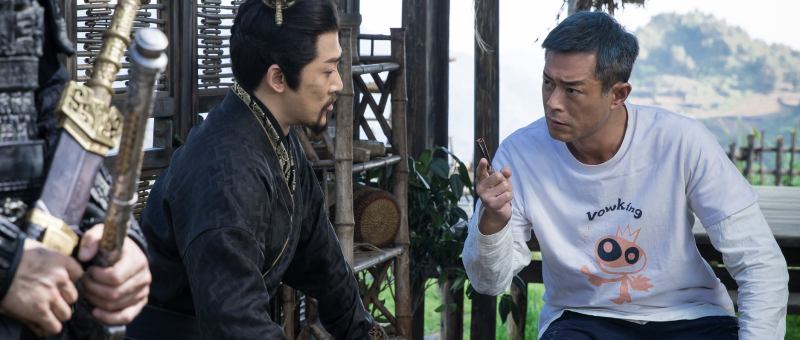
It all links back to an unsolved murder, one of the many “crime scenes” referenced in the Chinese title. The dead man, Tsui (Deep Ng Ho-Hong), is believed to be part of a gang led by notorious underworld figure Sean Wong (Louis Koo Tin-lok) who was responsible for a botched jewellery store robbery which went south when the police stooge blew his cover trying to stop one of the gang members getting violent with a hostage. Wong shot the undercover policeman and opened fire on the police, eventually escaping our second scene of crime with the loot, while an old lady was so frightened she had a heart attack, and the store assistant who tried to raise the alarm was left paralysed. Police inspector Yip (Philip Keung Ho-man) who ran the undercover operation against Wong’s gang is convinced that Wong killed his associate during a dispute over dividing the loot and is fixated on bringing him in. Eccentric cop Larry Lam (Louis Cheung), however, is not convinced in part because he’s patiently listened to the only eye witness, a parrot, who says Wong didn’t do it. 

Nicknamed “garbage” and apparently a model cop until some kind of accident a few years previously, Lam is certainly an unusual law enforcement officer. For one thing, he’s in deep debt to loan sharks after borrowing money to start a cat sanctuary because he felt sorry for the abandoned felines left to cower in the rain in the face of the world’s indifference. Lam is convinced that he can get the parrot to talk, if only he can figure out how to communicate with it seeing as the only words it knows are “help me”, “genius”, and “idiot”. Based on the parrot’s testimony and his own gut feeling, Lam doesn’t think Wong is guilty so he has three other suspects: the son of the woman who died who works as a butcher at the market, the paralysed store assistant who has since got religion, and her security guard boyfriend (Andy On) who was rendered powerless in the attack, unable to protect her and apparently still carrying an immense amount of anger and resentment towards the criminals. Lam also comes, however, to doubt his superior wondering if his war against Wong is less in the pursuit of justice than revenge for the death of his officer. 

Yip and Wong are in some ways mirror images of each other, the morally questionable cop and the noble criminal. On the run, Wong takes up lodging with a cheerful woman named Joy (Jessica Hsuan) who is visually impaired but seems to think Wong is a good person even though she can’t “see” him. All of Joy’s other residents are extremely elderly, one of them sadly lamenting that the man who previously inhabited Wong’s room died peacefully in his sleep though he was “only 95”. “Money is no use after you die”, they tell him in an effort to persuade him to join in some 100th birthday celebrations, “life is all about contribution”. Quizzed on what he’d do with the money, all Wong wanted was to be able to sleep and as we see he seems to be suffering with some kind of psychosis, experiencing visual and auditory hallucinations of teeming ants and the ghostly voices of his former gang members. Yet he’s not “bad” in the way Yip characterised him to be, he never kills anyone he didn’t have to, is indignant about being accused of betraying his own, and is just as resentful towards Yip as Yip is towards him for the unfairness of his petty vendetta. 

But like all the best crime stories, all there is in the end is futility. The world shouldn’t be like this, but it is the way it is. Maybe Joy and her pensioners have it right, quietly living their lives of peaceful happiness being good to each other while evil developers breathe down their necks trying to destroy even their small idyll of goodness. Wong is drawn to them, but perhaps knows he’ll never belong in their world of infinite generosity though perhaps oddly he’s the only one who doesn’t really seem to care so much about the loot. Still, as Lam has it “Life is full of wonders” like crime-fighting parrots and eccentric policemen who stand in line buying limited edition trainers on behalf loansharks to finance their animal sanctuaries. Good people also break the law. “In memory of lost souls” reads the sign above the final scene of crime, and it’s not without its sense of irony. 


A Witness Out of the Blue streams in the US via the Smart Cinema app until Sept. 12 as part of this year’s New York Asian Film Festival.

Original trailer (English subtitles)

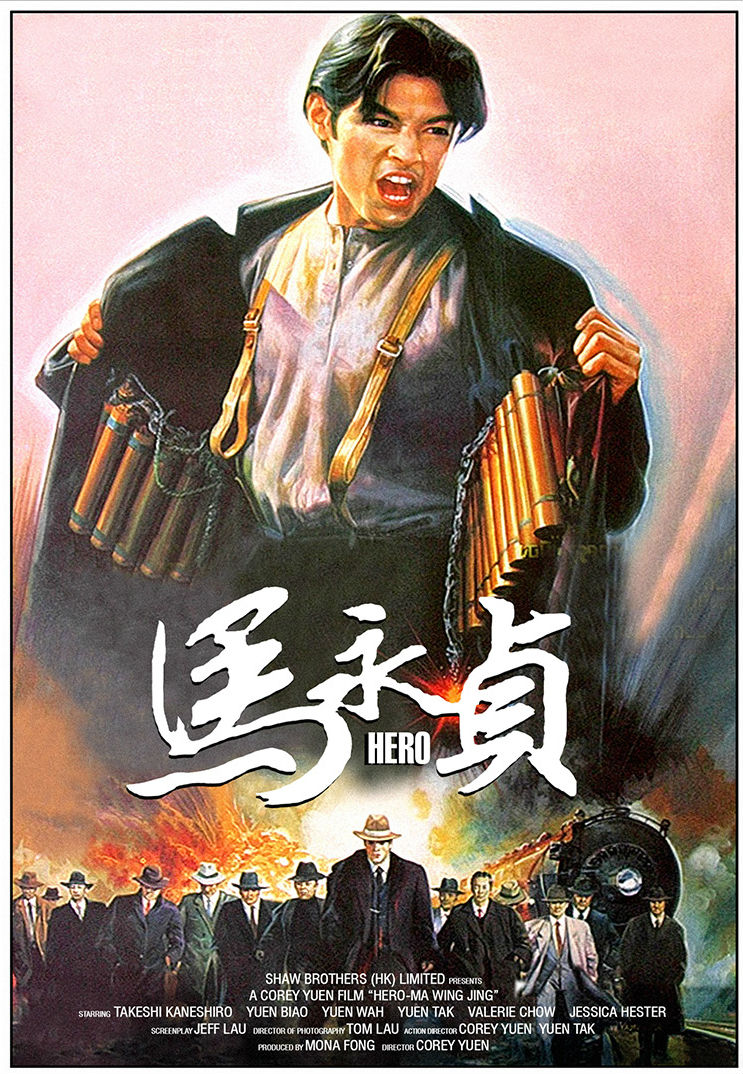
Hero (馬永貞, Corey Yuen, 1997)

hero 1997 posterIt’s an old ‘un but a good un. Young gun from the country hits the city, decides to do things his own way, becomes the top dog but loses himself in the process and is then faced with a choice between his better nature and potential gains. Corey Yuen’s remake of the Shaw Brothers classic Boxer from Shantung, Hero (馬永貞, Ma Wing Jing), stars Taiwanese heartthrob Takeshi Kaneshiro in his first big action lead as the titular good guy who nevertheless finds himself wavering under the oppressive skies of turn of the century Shanghai.

Ma Wing Jing (Takeshi Kaneshiro) and his brother Tai Cheung (Yuen Wah) have left their old country home to seek their fortunes in the city following a devastating drought. The Shanghai International Settlement, nominally under the control of the British, was a bustling, international port city but also lawless place where gangsters ruled – Tam Sei (Yuen Biao), who is supported by the Brits, controls half the territory with his rival Yang Shuang (Yuen Ta), backed by the local police, taking the rest. The Ma brothers hoped to make something of themselves in the brave new world of Shanghai but are simply two of thousands of refugees fleeing famine and can only find dock work where they are exploited and treated poorly.

Their fortunes pick up, however, when Wing Jing gets an early opportunity to show off his hero qualifications by saving Tam from certain death during an ambush. Tam, grateful, somewhat humiliates Wing Jing by forcing him to bend for a silver dollar before berating him for doing it but the pair eventually bond in a good old fashioned fist fight. Tam offers him a job, but Wing Jing has learned his lesson – he’ll be his own man and make his own name.

A melancholy love story plays in the background behind the otherwise macho dynamics. Arriving at Tam’s saloon, Wing Jing falls in love at first sight with the beautiful singer, Ling-tze (Jessica Hsuan), but is unable to pursue his romance with her thanks to his brotherly debt to Tam, who is in love with the bar’s landlady, Yam (Valerie Chow), but has broken things off because the of precariousness of his gangster lifestyle. Tam disappears for a bit, leaving the bar and his territory to Wing Jing, but doesn’t bank on Yam’s machinations as she gets rid of Ling-tze and takes up with Wing Jing while working with Yang on an evil plan that turns out to be a weird way of protecting her one true love.

Nevertheless, Wing Jing takes centre stage as he quickly climbs the local tree and becomes the big guy in town, little realising that his bravado has irked just about everyone in sight – he’s not only made himself a target for Yang but for the local Chinese police while Tam’s old associations with the British can’t be counted on forever. Yang, ironically enough, is playing divide and conquer but Wing Jing is too naive to see and too hotheaded to listen to Tam’s advice even when he returns to offer it.

Then again, a hero is a hero through and through and so it’s not long before Wing Jing’s moral goodness begins to resurface and he realises where his loyalties really lie. Given that Hero is a Hong Kong production released in 1997, perhaps it’s less surprising that the good guys are the ones backed by the British rather than local law enforcement which is, of course, deeply corrupt and and immersed in Yang’s world of internecine scheming. Still, this Shanghai is one of scrapping poor boys fighting for freedom from oppression (if accidentally veering into the role of oppressor in the process) much more than it is about international politics or the or the increasingly global milieu of the late 19th century city and its position as the gateway to the East for an avaricious Europe.

Mixing classic Shaw Brothers style with a modern New Wave edge, Yuen gives Kaneshiro his time to shine as an ultra cool action hero complete with a series of hugely impressive action sequences culminating in a fantastically satisfying final shoot out where blood and brotherhood take centre stage. But there can be no winners in this world of betrayals and counter betrayals, and so our Hero may have to leave it behind for pastures new as he takes his heroism with him into a hopefully better future.


Currently available to stream on Netflix in the UK and possibly other territories.

Original trailer (no subtitles)