Hero (英雄, Zhang Yimou, 2002)

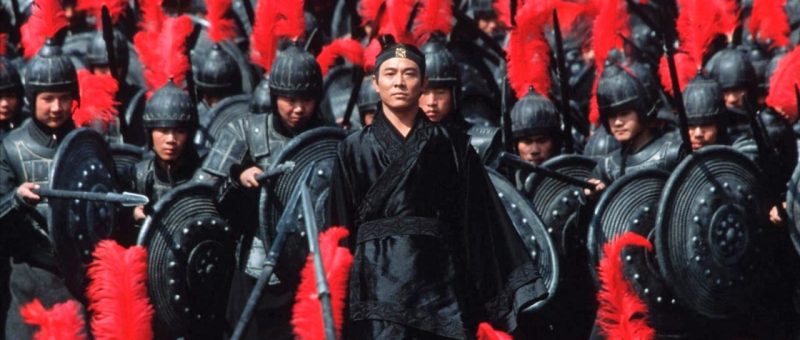
In the closing moments of Zhang Yimou’s Hero (英雄, Yīngxióng), what we see is an empty space. The outline of a person surrounded by arrows, or perhaps the doorway they protected with their body that nevertheless remains closed. On its initial release, Zhang’s film received criticism for what some saw as an overt defence of authoritarianism. After all, what we may come to understand is that the hero of the title is the Qin emperor (Chen Daoming), the founder of the modern China, but also in historical record a brutal tyrant whose tyranny is therefore justified in the name of peace, just as contemporary authoritarianism is justified in the name or safety and order.

This reading is only reinforced by the demeanour of Qin himself who condemns the nameless “hero” to death because he has chosen authority and this is what authority demands. No forgiveness, no compassion, only brutality and an iron first. Yet he cries because he is a compassionate man and understands the sacrifice he is asking his remorseful assassin to make. He does not do it because he is cruel or out of vengeance or anger, but because he believes it necessary to ensure peace for “all under heaven”. Now we may find ourselves asking again if the assassin is the hero after all because he willingly submits himself to and sacrifices himself for a tyrannous authority because he believes it to be the best and only choice that he can make for the wider society.

Nevertheless, there is something chilling in the vision of a thousand arrows flying toward one man who does not flinch while the man who ordered them sent appears to shake with his own power. The soldiers retreat, and the king is left alone, dwarfed by the immense architecture of the palace and the blood-red calligraphy of the character for sword reimagined by another potential hero whose name echoes his final conviction that in the end the apotheosis of the swordsman lies in the realisation that there is no sword. It’s this that leads him to abandon is own desire to assassinate the king and submit himself to a greater authority in the name of peace. In the end what he rejects is the tyranny of the sword itself, yet the king is also an embodiment of that tyranny because his authority is only possible through terrifying violence. 

In this way, the assassin, ironically named “Nameless” (Jet Li), may stand in for the everyman refusing to bow to the authority of a corrupt king who cares only for power. In one of the many tales he tells, Nameless remarks that he fought with the first of Qin’s three assassins in his mind and it’s true enough that what passes between the two men is a duel of words which is eventually won by the king. Qin tells Nameless of his desire to increase his influence beyond the other six kingdoms of Warring States China and create an empire that encompasses “all under heaven”, but Nameless later cautions him to remember those who gave their lives for the highest ideal, peace, and refrain from further killing. The closing title card is displayed over the Great Wall, making plain that Qin did in fact stop after conquering the six other kingdoms to unite all of China while building the wall to protect his citizens from “northern tribes,” or perhaps competing imperialists.

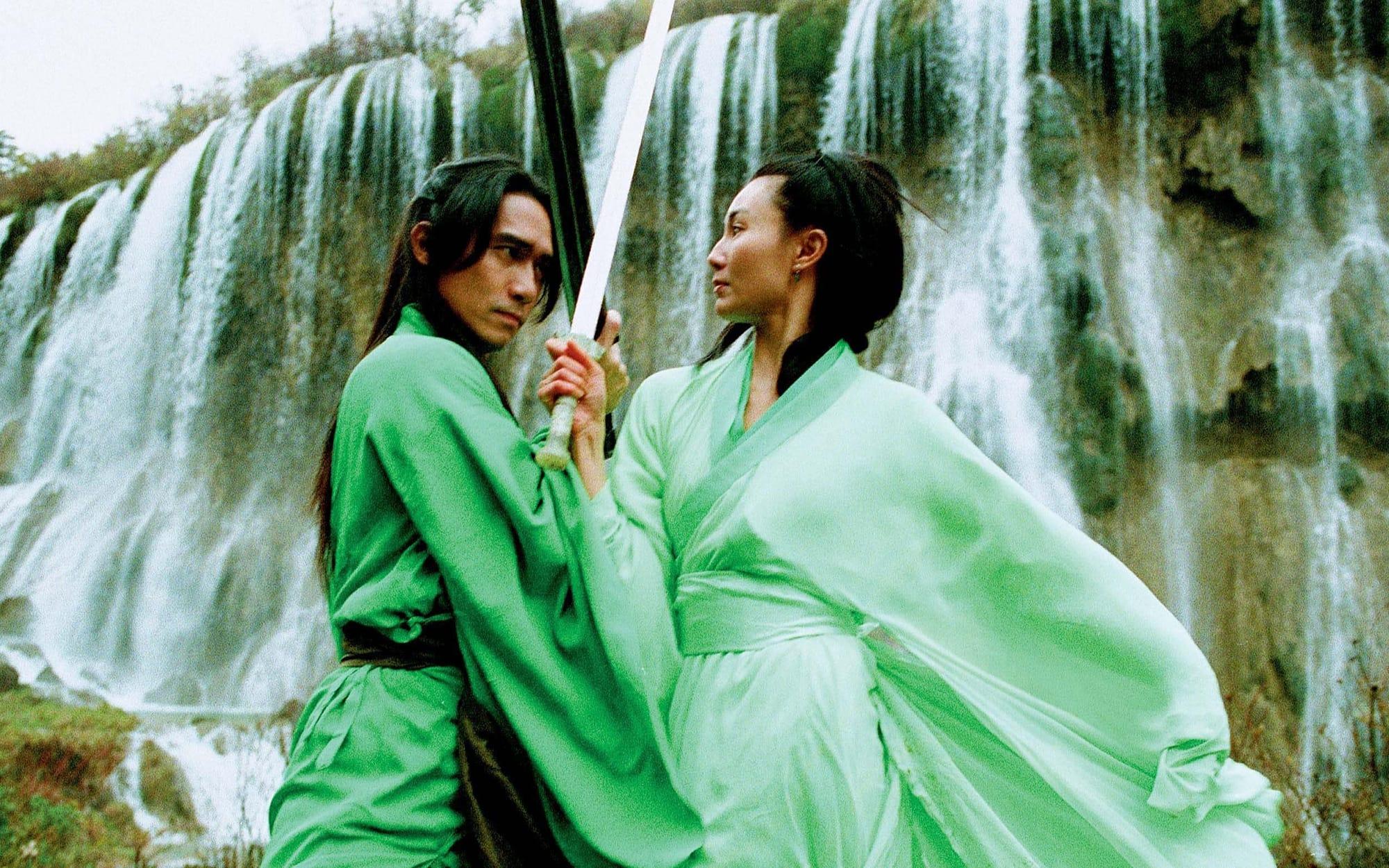
But walls keep people in as well as out and are in fact another facet of the king’s tyranny and a symbol of enduring authoritarianism. The problem is that it isn’t tyranny or authoritarianism that any of the assassins oppose for they are driven only by hate and vengeance and have no greater ideology or vision for the future. The argument is that peace under the iron fist of Qin is better than the chaotic freedom of the Warring States society, yet what we’re left with is nihilism. The love between assassins Flying Snow (Maggie Cheung Man-yuk) and Broken Sword (Tony Leung Chiu-wai ) is disrupted in each of the tales Nameless relates of them, firstly by romantic jealously and then secondly ideological divide. The conclusion that Broken Sword comes to is that they must not resist, but Flying Snow cannot live without recrimination with the past and the sealing of its tragic legacy. Her revolution fails, and as such “all under heaven” there is only death and only in death is freedom to be found.

The sense that these assassins are already dead is echoed in the choice of white for the final sequence of the film. Zhang frames each of his sequences in vibrant colour, the red of the first tale in which the lovers are destroyed by a supposed love triangle, the blue of the second in which tragedy and sacrifice do not so much destroy as deify it, the green of the penultimate in which jade curtains billow and fall inside the imperial palace, and finally the cold white of death in which the lovers eventually find their home leaving their surrogate child alone in a windy desert of futility. Yet each of these sequences is filled with an intense beauty and the romanticism found in classic wuxia. What remains in the mind is the balletic fight between the tragic heroine Flying Snow and the orphaned pupil Fading Moon (Zhang Ziyi) in an autumnal forest that’s suddenly drenched in red, or feet dancing across the water, an image of an idealised past and lost love among wandering ghosts with no home to go to. Here there are no heroes, only lonely souls and frustrated ideals. 


Swordsman II (笑傲江湖之東方不敗, AKA The Legend of the Swordsman, Tony Ching Siu-tung, 1992)

Swordsman II still 1In a world filled with chaos, is the answer to all life’s problems retreat or attack? After the unexpected success of Swordsman which survived the withdrawal of legendary director King Hu to go on to be a box office hit, a sequel was quickly set in motion to be directed by action choreographer Tony Ching Siu-tung. Swordsman II (笑傲江湖之東方不敗) would be the second in a trilogy inspired by Louis Cha’s novel The Smiling, Proud Wanderer and largely dispenses with the cast of the original film for a virtual reboot led by action star Jet Li and actress Brigitte Lin as an extraordinarily sympathetic villain.

Picking up soon after the end of the first film, Ling (Jet Li) and his female comrade nicknamed “Kiddo” (Michelle Reis) are on the run with the intention of retiring from the world of martial arts to live simply among honest people. However, they are about to ride straight into the heart of conflict. At this particular point in history, the “Highlanders” feel themselves oppressed by the ruling “Mainlanders” and would be set on rebellion if they weren’t so busy fighting amongst themselves. Meanwhile, a number of Japanese troops are also holing up in China to wait out political strife in Japan. “Invincible” Dawn (Brigitte Lin), a Highlander, appears to have gotten a hand on the first film’s MacGuffin – the “Sacred Volume” which holds the key to untold martial arts power. Teaming up with the displaced Japanese, Dawn plans to use the powers of the Sacred Volume to dominate the Highlanders and then eventually take over the entire nation.

Dawn happens to be the uncle of a woman, Ying (Rosamund Kwan), with whom Ling began something like a romance back in the first film. Ying’s father, Wu (Lau Shun), the chief of Highlander tribe Sun Moon Sect, has gone missing – presumed taken prisoner by Dawn as a prelude to seizing power. Despite his desire to escape the duplicitous world of martial arts, Ling finds himself on a quest to save Ying’s father and with it the Sun Moon Sect if not the entire nation from the tyrant that Dawn seems primed to become.

Ling, as heroes go, is very much of the wine, women, and song, school. Indeed, he’s not much for anything without a good cup of booze – something that provokes an instant connection with the unusual figure of Dawn when he spots her bathing in a local pool and she offers him some of her upscale alcohol in a pretty bottle. The powers of the Sacred Volume come with a price – in order to embrace them, Dawn must transform herself into a woman (or in the less poetic rendering of the text, simply cut off her penis). Dawn’s transformation is a gradual process and she continues to play her male role as the head her clan, even parading her mistress in front of her captives in a noticeably salacious manner. However, Dawn is also caught off guard by an unexpected attraction to the cheerfully tipsy Ling and the transformation seems to accelerate – she begins wearing makeup, her voice changes into a more feminine register, and her sexual relationship with her mistress appears to be definitively over.

Meanwhile, Ling is fighting a romantic war on three fronts – he’s captivated by the mysterious woman who avoided speaking to him never knowing she is really his enemy, but is still half in love with Ying, and the subject of Kiddo’s unrequited crush. While Dawn wrestles with a deeper transformation, Kiddo is also trying to process her place as a woman among men in attempting to shed her tomboyish image by styling her hair in more classically female fashions and wearing makeup – something which can’t help but arouse mild hilarity among her comrades who collectively think of her as a tough little sister. Trying to explain her new persona to her mistress, Dawn insists that she will never forget her and that essentially nothing has changed, while the guys partially mock Kiddo’s new desire to embrace her femininity by avowing that male/female/non-binary gender is an irrelevance. Even so, on realising Dawn is the person he’d been looking for and was once Ying’s uncle, Ling’s parting questions are all about whether he might have accidentally slept with a man which he seems to find embarrassing. Nevertheless, it’s “femininity” which finally does for Dawn as she finds herself weakened by love and eventually pushed towards a “heroic” act of romantic sacrifice.

Having defeated one tyrant, Ling finds himself threatened by another as Wu’s maniacal need for revenge provokes a wide scale purge of those who had “betrayed” him. Ling’s desire to remove himself from this world of betrayals, violence, and complex moralities seems ever more understandable but cannot be his answer even as he finds himself unwillingly exiled. If you turn your back on trouble, it will eventually engulf you and everything you love – as will a failure to resist a trusted ally’s descent into darkness. Strangely affecting in its hero/villain symmetries and air of tragic romance, Swordsman II’s beautifully choreographed action sequences are only surpassed by its fierce commitment to fantasy.


Swordsman II was screened as part of An Evening with Tony Ching Siu-tung presented by the Chinese Visual Festival.

League of Gods (3D封神榜, Koan Hui & Vernie Yeung , 2016)

league of godsOften, people will try to convince of the merits of something or other by considerably over compensating for its faults. Therefore when you see a movie marketed as the X-ian version of X, starring just about everyone and with a budget bigger than the GDP of a small nation you should learn to be wary rather than impressed. If you’ve followed this very sage advice, you will fare better than this reviewer and not find yourself parked in front of a cinema screen for two hours of non-sensical European fantasy influenced epic adventure such as is League of Gods (3D封神榜, 3D Fēng Shén Bǎng).

Based on a classic Chinese text – the Ming Dynasty epic Investiture of the Gods by Xu Zhonglin, League of Gods begins with its despotic monarch, King Zhou (Tony Leung Ka-fei) and the story of how it was he came to lose his soul to Black Dragon and fall under spell of the nine-tailed fox, Daji (an underused Fan Bingbing). The couple have kidnapped Wizard Jiang (Jet Li), who may have been the only one with the knowledge to end their demonic rule – if it weren’t for the fact he’s subject to an anti-ageing curse and keeps regressing each time he uses his powers. Nevertheless, a group of warriors from Xiqi attempt to rescue Jiang and a group of orphan children who are also being held prisoner though their partial success leads them to undertake a new mission to find the Sword of Light which may finally help them to cut through the darkness and restore their kingdom to glory.

The primary bearer of this quest is Lei (Jacky Heung) who is second heir to the Wing Kingdom though also an embarrassment to his father because unlike his countrymen, he’s never been able to find his wings and fly like the rest of his brethren. Jiang entrusts him with three bags to help on his journey, one of which contains “magic grass” (ahem!) which is basically a healthier version of Clippy, the second a CGI baby version of once ruthless warrior, Naza, and the third a baby Merman who had his spine removed by Naza to stop him growing up and just wants to go home. Lei runs into automaton spy and tragic love interest Blue Butterfly (Angelababy) who does at least lend a degree of pathos to the proceedings and Louis Koo also turns up riding a giant panther, which is quite a ride, it has to be said.

The biggest problem facing League of Gods is one common to every fantasy film – that is, constructing a fantastical world which is still 100% internally consistent and completely believable throughout. League of Gods throws so much information out so quickly that it’s impossible to keep a handle on everything that’s going on, let alone try to work out how all of these various warring kingdoms fit together. There is a lot of story to go around, and directors Koan Hui and Vernie Yeung have recruited a host of China’s biggest stars to help tell it. This obviously means that some stars are appearing for mere minutes with barely anything to do save show their face, making an already bloated premise overloaded beyond any sustainable level.

Narrative excitement has largely been sidelined in favour of visual flair but League of Gods is constantly let down by poor quality CGI some of which might look more at home in a late ‘90s video game. League of Gods operates as a kind of hybrid movie, mixing heavy CGI animation with live action actors but can’t decide just how po-faced it really wants to be. Lei is accompanied on his quest by a fearsome warrior, Naza, apparently an arrogant and dangerous criminal who has been imprisoned in the body of a toddler. This CGI baby grins, burps, farts, and high kicks his way out of trouble in a decidedly bizarre fashion with his grown up language offered from a cute baby face. Naza is countered by his sometime enemy – an adorable Merman baby who just misses his dad but seems to have no other purpose so it’s a mystery why Jiang gave Lei this particular bag. Magic Grass is obviously an advisory figure, but is an apt way to try and explain what’s going on.

League of Gods moves from set piece to set piece with some muddled character development along the way as Lei finds love and develops his wings but never makes any kind of attempt at unifying its disparate plot strands. Squandering the talents of its extremely high level of A-list stars, League of Gods relies of campy fun to get by but is far too serious to make the most of its over the top potential. Disappointingly, after it’s intense build up League of Gods refuses to stage its finale – ending on a cliff hanger which is heralded by the most ridiculous evil laugh offered by a despot clutching a baby which is actually the regressed form of his rival and a formerly powerful wizard. It sounds good, but it isn’t. Read the small print, sign with caution.


US release trailer (English subtitles)