Dear Stranger (ディア・ストレンジャー, Tetsuya Mariko, 2025)

The Japanese film industry is generally regarded as fairly insular and focused solely on the domestic market with half an eye on other Asian territories where its stars are already popular. It has, however, made some attempts to enter Hollywood particularly in the 1970s with films such as Kinji Fukasaku’s Virus which for various reasons was largely unsuccessful in either market and suffered artistically from its attempts to bend itself to an international audience. 

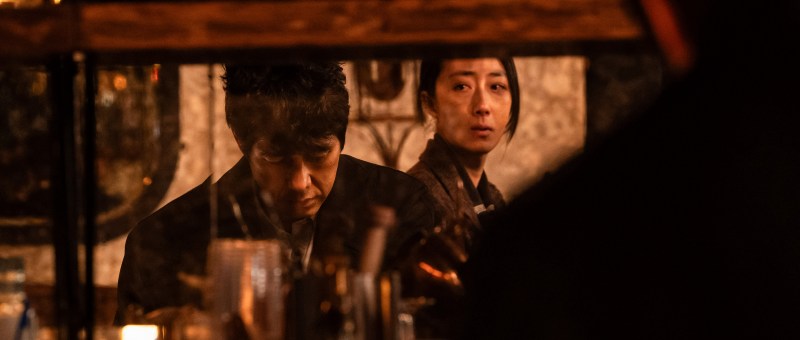
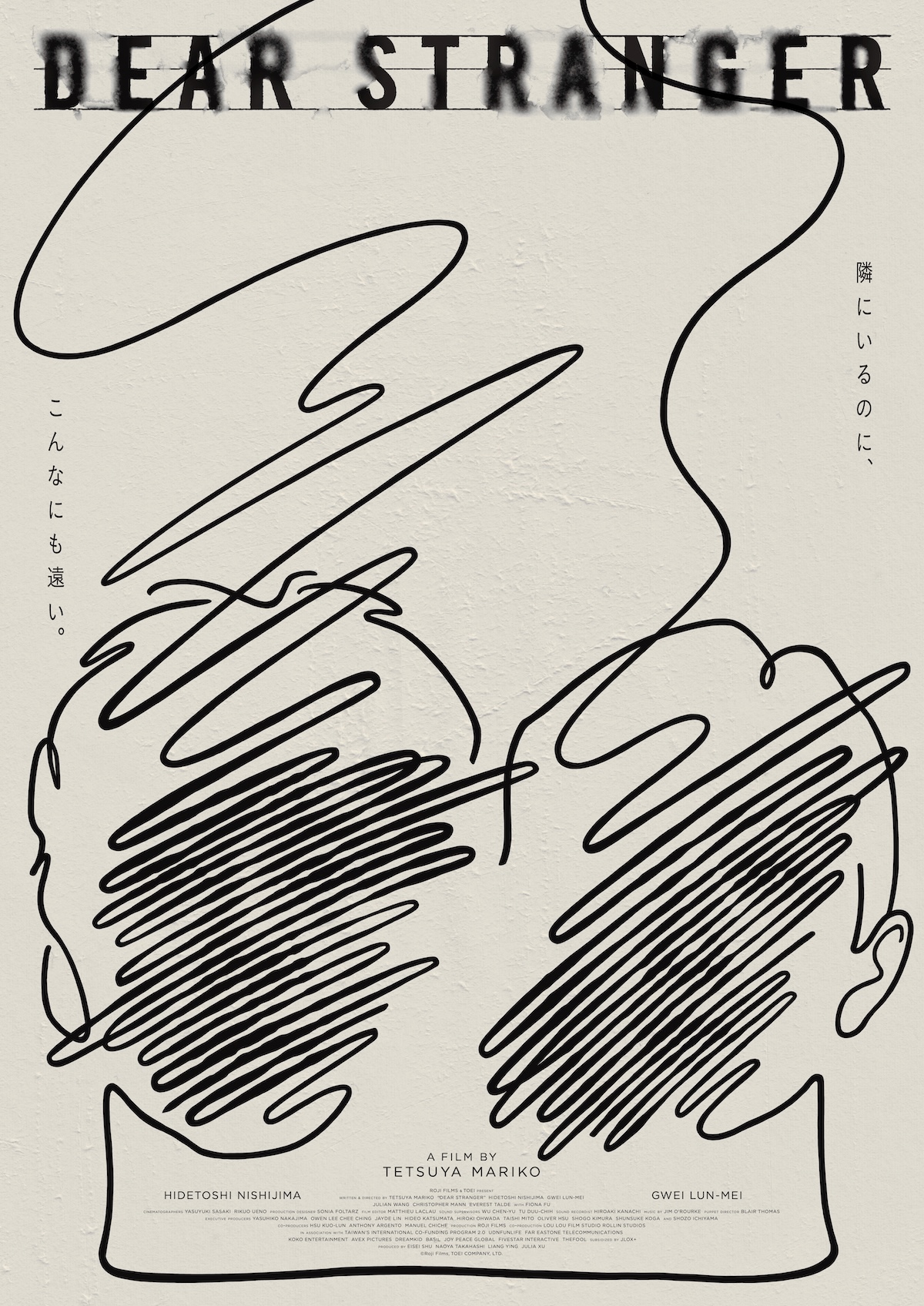
Tetsuya Mariko’s Dear Stranger (ディア・ストレンジャー) is the first in Toei’s contemporary attempt to court an audience outside of Japan as part of its Toei New Wave 2033 initiative, but it seems to be suffering from some of the same problems. The biggest is that 90% of the film is in English but the delivery is often stilted and inauthentic from both the international and native-speaking cast. That may in one way be ironic, as one of the major themes is the impossibility of communication. Emotional clarity is only really revealed during the puppetry sequences when no dialogue is involved. Set in New York, the film shifts between Mandarin, Japanese, Spanish, English and sign language, but simultaneously suggests the problem is less an external language barrier than an internal one that prevents people from saying what they really mean or encourages them to keep the truth of themselves hidden.

It’s living in this liminal third space that disrupts the marriage between Taiwanese-American Jane / Yi-zhen (Gwei Lun-mei) and her Japanese husband Kenji (Hidetoshi Nishijima) as she points out that they speak to each other in a language is not their own. At moments of high tension, they argue in Mandarin and Japanese, though as we largely discover there are more issues in play, beginning with the fact that their marriage may at least partially have begun as one of convenience. Kenji is not the biological father of their young son Kai. Jane finds herself asking who they are as a couple without him and if she ever really loved Kenji at all. Kenji suggests he married her because he loved her and accepted the child as his own for the same reason, but throughout the film is in an incredibly angry and hostile mood. He appears at times sexist, criticising Jane for not keeping the house tidy while he is “under a lot of pressure” at work and resents “the chaos” of their life. Jane’s mother doesn’t approve of her working either and calls her a bad mother for doing so even while expecting her to mind their convenience while she tries to find a carer to look after her father who is living with advanced dementia and can’t be left alone.

Part of that is likely that they need someone who speaks Mandarin, hinting at the sense of isolation and orphanhood that comes with migration in lacking extended familial support that in this case does not seem to be met by community. Jane too feels isolated and trapped by her role as a mother. She expresses herself only through her puppetry, which is also something denied her by Kenji and her mother. Kenji, meanwhile, feels undervalued at the university where his supervisor seems dismissive of him and his work which he regards as unoriginal. He may have decided to marry Jane in part in search of family having lost of his own in Japan with his mother never having been found after the Kobe earthquake when when he was a teenager, but simultaneously struggles to integrate himself within their family. His loss of Kai who disappears while he was supposed to be taking care of him is then symbolic in reflecting his own frustrated paternity and fear that the biological father will return to take all this away from him.

In many ways, it’s Kenji’s own psyche that’s in ruins informing his academic practice which focuses on abandoned and disused buildings and the effect they have on the surrounding environment. He’s asking himself how to create a new world from the ashes of the old, but doesn’t appear to have done so successfully in his own life and is increasingly unsure if he wants to. Perhaps because of its awkwardness, the film takes on an increasingly surreal quality as Kenji is heckled by irrationally angry guests at his book presentation and basically accused of facilitating urban crime in his praise of disused spaces and then descends into some kind of fugue state chasing the larger-than-life puppet version of Kai from Jane’s play which is also an embodiment of her own frustrated yearning for freedom. 

“In the wreckage we find truth,” Kenji answers one of the questioners at his presentation and it may in a sense be true for him but in another perhaps not. It becomes unclear what exactly he experiences as “real” and what not, what a product of his own mythologising and what actually happened, while Jane slips quietly into the background and her sudden acceptance of Kenji whom she previously regarded as “unreliable” and appeared to resent, seems somewhat hollow given that he continues to treat her coldly and is extremely hostile with all around him from the police, who are actually trying to help find his son, to the well-meaning kindergarten teachers, and his employers. In the end, it’s really Kenji who is stranger to himself much more than a stranger in a strange land trying to forge a new identity in a place of psychological ruin.


Dear Stranger was screened as part of this year’s Busan International Film Festival

Trailer (English subtitles)

Yoko (658km、陽子の旅, Kazuyoshi Kumakiri, 2023)

Sometimes home is the hardest place to go. At least that’s how it is for the eponymous Yoko (658km、陽子の旅, 658km, Yoko no Tabi) in Kazuyoshi Kumakiri’s emotional road movie in which a defeated middle-aged woman is jolted out of her self-imposed inertia on hearing of the sudden death of the father she had not seen in over 20 years. As much about a moment of mid-life reevaluation as one woman’s gradual return to the world through a process of self-acceptance, the film displays a boundless empathy not to mention a sense of warmth out of keeping with a snowbound winter in northern Japan. 

At 42, Yoko (Rinko Kikuchi) lives alone in a one room apartment that she seemingly never leaves. Ironically enough, she works as a customer service assistant operating a remote chat box in which she encourages the customer to try turning it off and on again but otherwise offers little real support. When she accidentally breaks her phone, he first thought is to try contacting the online consumer helpline only to realise the irony of her situation and think better of it. In a moment of cosmic coincidence she receives a visit from her cousin, Shigeru (Pistol Takehara), who explains that her sister Rie has been trying to call but obviously couldn’t get through because of the broken phone. Yoko’s father has passed away suddenly. Shigeru and his family are making the long drive from Tokyo to Aomori and they’ve been instructed to bring Yoko with them for the funeral the day after next. 

We can tell that Yoko is no longer used to interacting with other people. Her voice is almost inaudible and her words tumble out in a half-confused jumble. Shigeru seems sympathetic and we can interpret that she’s been this way a long time, if not all of her life. He asks her if she has clothes for the funeral and is unsurprised when she gives no answer, assuring her they can sort it out when they get there while trying to cajole her downstairs and into the car where his wife and kids are waiting. The kids are, predictably, incredibly noisy and a little insensitive while the mother tries to get some sleep and Shigeru sings a folksong that was a favourite of her father’s. His spectre (Joe Odagiri), not so much a ghost as a manifestation of her memory silently, haunts her throughout the journey reminding of her of her unresolved shame and the reasons she had avoided contact with him for the last 20 years. 

These moments are full of painful melancholy but also an underlying sense of dread as if Yoko were being stalked by her own self-loathing projected onto the figure of father. After becoming separated from Shigeru at a service station and assuming she’s been abandoned with no phone and only loose change, she decides to hitchhike to Aomori and in effect travels backward meeting echoes of herself as she goes. Her first driver is a woman of about her own age (Asuka Kurosawa) in Tokyo for a job interview who reflects her buried cynicism, remarking that she resents the people she sees at service stations who to her at least seem far too happy. On learning that Yoko has no children and never married, she chuckles that she couldn’t imagine a life without out them hinting at another life Yoko might have led and perhaps quietly yearns for in her solitude. 

Yoko answers the woman with only grunts and a shake of the head, unable to communicate and in effect too shy to ask for help from passing strangers. Through her journey she gradually recovers the ability to speak, her words eventually pouring out of her in a voluntary monologue to a stranger on whose kindness she has become dependent. But in a girl she meets at the next rest stop she sees only her teenage self, the girl answering that it’s too hard to explain when questioned about why she’s hitchhiking alone in the middle of the night. When she gives her her scarf, it’s like a gift from her younger self, a small moment of embrace and support. Something similar happens as she approaches the area affected by the 2011 tsunami and meets a kindly older couple who represent her parents as she might have wished them to be rather than as they were. While the man gives her some fatherly advice, not unkindly, the woman (Jun Fubuki) gives her a pair of sheepskin boots in another gift of warmth that further proves to her that the world is full of kindness even if not all of the people who gave her rides were nice.

There maybe something in the fact that Yoko has to travel through the disaster zone in order to emerge from it, journeying towards the site of her trauma and beginning to overcome it as she comes to accept her father’s death and that is simply too late for many things though crucially not for all. What she comes to realise is, as her first driver told her, everyone has their reasons and she wasn’t the only one carrying a heavy burden. She only made it as far as she did because of the kindness of strangers and those, like Shigeru, who are willing to wait for her to come in from the cold. Rinko Kikuchi’s extraordinarily nuanced performance along with the snowbound vistas and melancholy score conjure a poignant atmosphere but one oddly buoyed with warmth in which the world can be a kind place or least as long as we can be kind to ourselves. 


Yoko screens Feb. 22 as part of Family Portrait: Japanese Family in Flux

Original trailer (no subtitles)

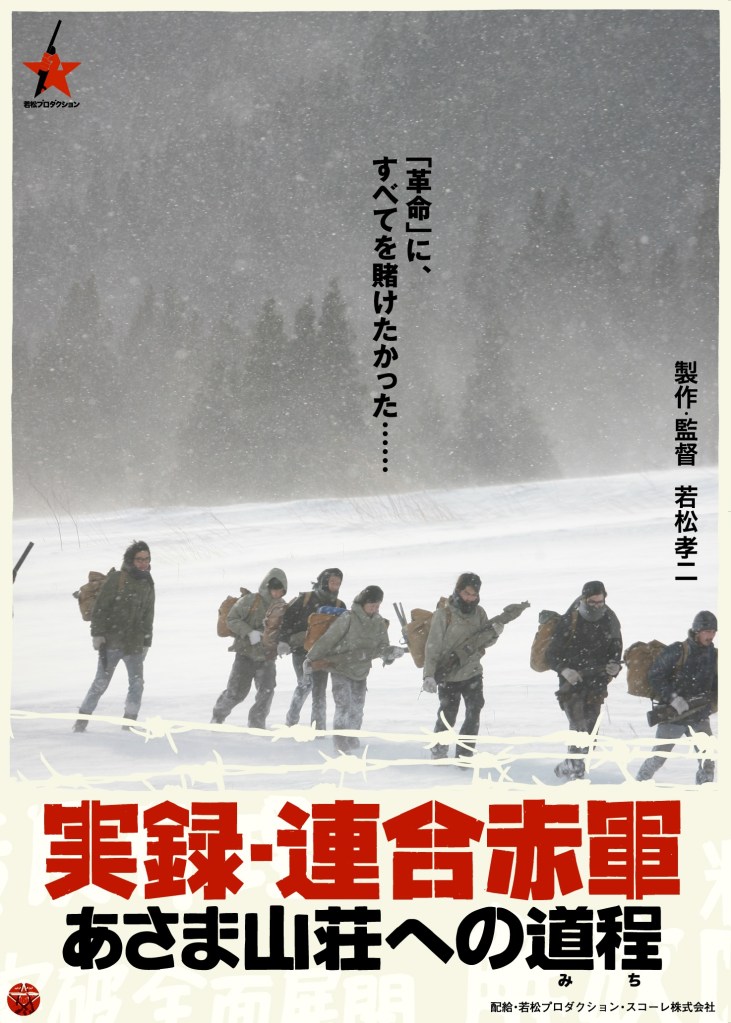
United Red Army (実録・連合赤軍 あさま山荘への道程, Koji Wakamatsu, 2007)

Koji Wakamtasu had a long and somewhat strange career, untimely ended by his death in a road traffic accident at the age of 76 with projects still in the pipeline destined never to be finished. 2008’s United Red Army (実録・連合赤軍 あさま山荘への道程, Jitsuroku Rengosekigun Asama-Sanso e no Michi) was far from his final film either in conception or actuality, but it does serve as a fitting epitaph for his oeuvre in its unflinching determination to tell the sad story of Japan’s leftist protest movement. Having been a member of the movement himself (though the extent to which he participated directly is unclear), Wakamatsu was perfectly placed to offer a subjective view of the scene, why and how it developed as it did and took the route it went on to take. This is not a story of revolution frustrated by the inevitability of defeat, there is no romance here – only the tragedy of young lives cut short by a war every bit as pointless as the one which they claimed to be in protest of. Young men and women who only wanted to create a better, fairer world found themselves indoctrinated into a fundamentalist political cult, misused by power hungry ideologues whose sole aims amounted to a war on their own souls, and finally martyred in an ongoing campaign of senseless death and violence.

Dividing the narrative into three distinct acts, Wakamatsu begins with a lengthy history lesson starting right back in 1960 with the birth of the student movement and the first casualty of the unborn revolution as a young woman loses her life protesting the rise of tuition fees. Despite the lack of success, the student movement intensifies during the turbulent 1960s with the renewal of the ANPO treaties and the perceived complicity of the Japanese government with America’s anti-communist warfare in Asia. Mixing archive footage with reconstructions and on screen text detailing timelines, names and affiliations these early segments are hard to follow but bear out the complexity and chaos which contributed to the inefficacy of the student movement. Soon, each of the leaders we have been introduced to has been removed from the scene leaving the older but inexperienced Tsuneo Mori (Go Jibiki) in charge of what was then the Red Army Faction.

Mori had only recently rejoined the movement after leaving in disgrace at fleeing a protest and thereby evading arrest. The Red Army Faction then merges with another sect, the Revolutionary Left Wing (RLF), to form the United Red Army. Led by Mori and a female commander, Nagata (Akie Namiki), the United Red Army holes up in a cabin in the woods in order to undergo military training for the upcoming armed insurrection. Prior to this, there had been a series of purges and executions in the city producing an atmosphere of terror and paranoia which only intensifies in the incestuous and claustrophobic environment of the ascetic mountain retreat.

Out of his depth and eager to prove himself, Mori’s revolutionary consciousness developes into a dangerous cult of personality in which his iron rule is more akin to fundamentalist religion than a serious political movement intended to change the world for the better. Wakamatsu’s depiction of these events is as terrifying as it is absurd. Maoist doctrine becomes a holy scripture as each of these would be revolutionaries is forced to undergo self criticism in order to devote themselves fully to the revolution and become a “true communist”. Brainwashed and naive, the cadre comply seeming not to realise that no self criticism they can offer will ever be good enough for Mori’s constant need for identity erasure and that each fault they offer will only be used to form the basis of the next charge levelled against them. What begins as questioning develops into screaming before descending into bloody violence and eventually murder.

If Mori’s fault is a kind of madness born of fear and insecurity, it is Nagata whose mania takes on an almost gleeful quality. A plain woman with unremarkable features and a sharp personality, Nagata, as she’s portrayed in the film, displays extreme issues relating to femininity. When an idealistic young woman arrives dressed in typical city fashions necessary to blend in with the capitalist bourgeoisie, Nagata wastes no time in berating her for her stylish clothes and makeup. Threatened both by the woman’s conventional beauty and high ranking position in another faction, Nagata takes especial care to make sure she herself remains on top. Despite being in a relationship with one cadre member and later leaving him for Mori (because it’s “right from the communist perspective”), Nagata cannot bear any hint of sexual activity and it is an ill judged kiss which ends up leading to the first set of mercilessly violent self criticism sessions eventually resulting in death as both parties are beaten and then tied up in the freezing mountain air where death by exposure is all but inevitable.

Mori declares that “leadership means beating” but when this is no longer enough the death sentences come thick and fast. Eventually, some members manage to escape and the mountain hideout is discovered. Splitting up and heading on the run, Mori and Nagata are captured while a group of five break into a mountain lodge where they take the caretaker’s wife hostage and remain under siege for nine days until the police eventually break in, arrest the terrorists and rescue the woman all of which became the first such event to be live broadcast on Japanese TV. The Asama-Sanso incident, as it came to be known, sealed the fate of the left wing protest movement in Japan as the terrorist violence of the renegade protestors forever coloured public perception.

Wakamatsu does not end his story here – returning to the captions which opened the film, he reveals to us the legacy of the failed student protest movement in the overseas activities of the Japanese Red Army, most notably in North Korea and the Middle East. The protest movement in Japan resulted in abject failure – the ANPO treaty survives, the Sanrizuka villages were destroyed and an airport built, the capitalist future arrived at speed heading into the bubble economy where the only revolution was consumerism. The glorious future of which these young people dreamed, free of class, gender, and social inequality, would not materialise as their idealism devolved into introspective dogmatic rhetoric, violence and murder. Trapped inside a fundamentalist cult, the true tragedy is that this was a children’s revolution – the vast majority of its victims under 25 years old, one just 16 and forced to participate in the death of his own brother. How much good could each of these socially conscious young people have gone on to do if only they’d found a less destructive cause? Would anyone want to live in the world born of this revolution? Contrasting the joyous camaraderie of the peaceful protests with the escalating, internecine violence of the URA, Wakamatsu’s vision of the movement he was once a part of is a necessarily bleak one but resolute in its gaze. Ugly, cold and unforgiving United Red Army is a warning from history which has only sympathy for those caught up in its terrible machinations.


Original trailer (English subtitles)