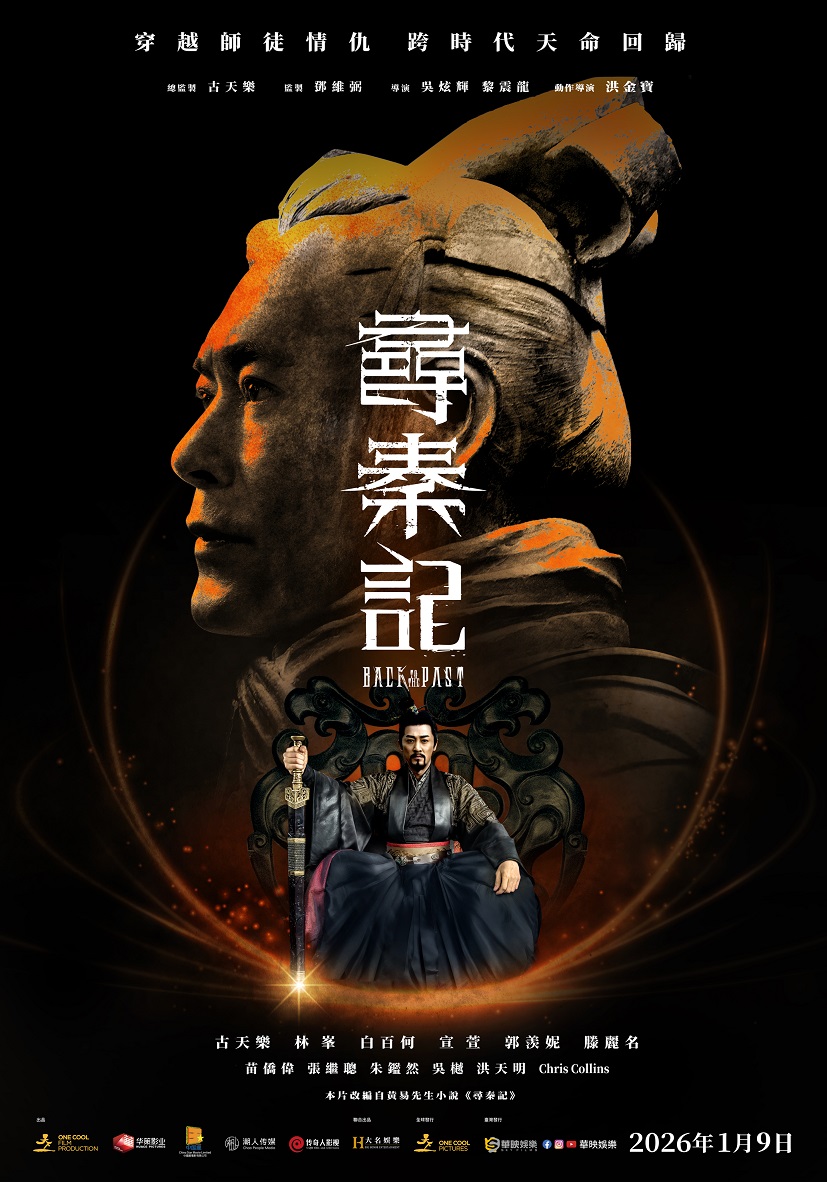
Back to the Past (尋秦記, Jack Lai & Ng Yuen-Fai, 2025)

Can history be changed, and if it can, should it be? In a way, Jack Lai & Ng Yuen-Fai’s Back to the Past (尋秦記) is an attempt to change history in itself in that it’s a long-awaited sequel to a television series that concluded more than 20 years ago. A passion project from star Louis Koo, the film opens in contemporary Hong Kong where the inventor of the time machine that sent Hong Siu-lung back in time to witness the ascension of the Qin emperor is released from being “wrongfully imprisoned” for attempting to change history.

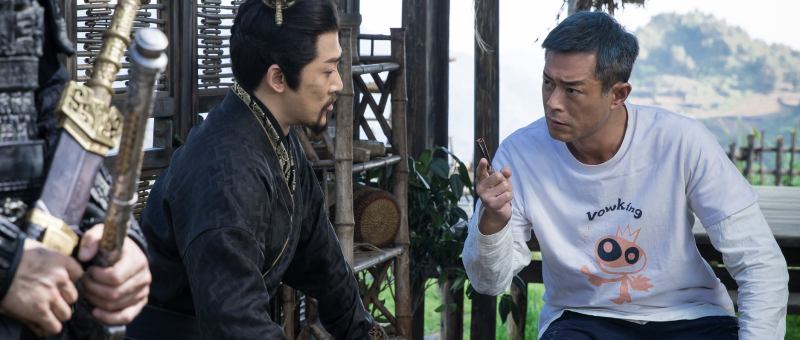
Lung (Louis Koo) seems to have told those back in the Qin Dynasty that he came from a mysterious “hometown” . He’s now estranged from his former pupil, Qin Emperor Poon (Raymond Lam), after becoming disillusioned with his despotic rule. It seems that Lung’s inability to return to the present due to a broken amulet somehow contributed to Ken (Michael Miu) getting sent to prison. Now he’s out, he’s sending himself back to the past because, for otherwise unexplained reasons, he wants to become the Qin emperor himself to prove that it is possible to change history after all. Though it is apparently still 2025 in contemporary Hong Kong, Ken and his team have access to a lot of futuristic gadgets like metal discs that can suddenly transform into motorcycles, transparent holographic communication devices, and a headset that can give you the appearance of another person.

Thus Lung is a man doubly trapped in the past in that he has no way of knowing how the society developed in the years since he left. He’s essentially fighting a war on two fronts as he’s ambushed by Ken’s team, some of whom are only there to loot “ancient antiques”, while in fear of his life from Poon who blows hot and cold over wanting to kill him as a potential traitor. The TV series had ended on a cliff hanger in which Lung’s son Bowie changed his name to “Yu”, meaning eagle, but also giving him the name of the warlord who overthrew the Qin emperor but ended up becoming a dictator himself.

The incongruity of Qin Dynasty warriors facing off against Ken’s ultramodern kit with bows and arrows is indeed fascinating, though the puzzling lack of confusion among Lung’s friends and family is possibly explained away by having seen various other odd things from Lung’s “hometown” in the past. No one is very surprised when he puts on his future clothes either, while the bun clip hair extension one of his wives made him wear gets dropped pretty quickly. Aside from the clash of eras, there’s also a commentary on the nature of family as is perhaps expected for a (Western) New Year movie. Ken is given the opportunity to trade his captured daughter for Lung’s captured wife, but refuses, insisting that he only wants the Qin emperor. When one of his men is killed, Lung tells Poon that he won’t help him any more so he’ll have to make his own way to back to the palace. His wives, however, tell him that Poon is still family even if he did turn a bit evil, and after all he risked his life to save Bowie, so it would be mean to leave him behind.

Poon is the spiritual son who has disappointed his father, Lung by turning to the dark side but Lung can never quite give up on him while as much as he bangs on about having Lung killed, Poon can’t bring himself to do it either and seems to still want Lung’s approval just not as much as absolute power. Trapped in the past, Lung has come to realise that it’s family that’s important so it doesn’t really matter where you are as long as you’re all together. A tacked on “alternate ending” sells the New Year theme with the entirety of the Qin Dynasty cast being beamed to 2025 to enjoy some nice food and a fireworks display all together as a family after which Lung returns to the past and says he’ll never come back to the future. It’s tempting to read his declaration as an expression of the nostalgia inherent in the premise, that Lung wants to go back to an earlier time when things weren’t as complicated as they are now even if he’s still living under an oppressive regime. But at the same time, history can’t necessarily be reclaimed in that way and even for him things have moved on, though of course for those in the present it is still possible to change “history” and perhaps more difficult to do so if you can’t let go of an idealised past.


Trailer (English subtitles)
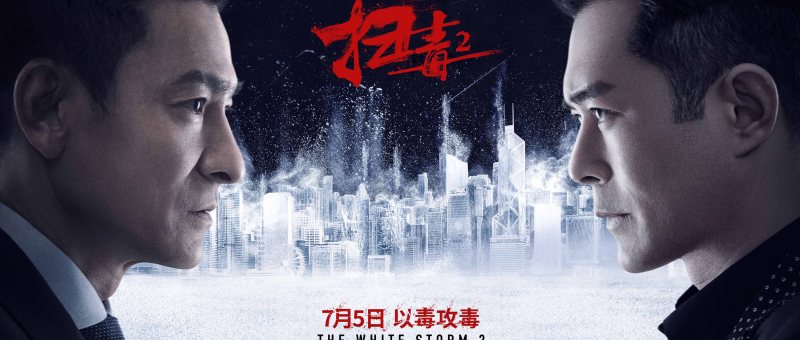
The White Storm 2: Drug Lords (掃毒2天地對決, Herman Yau, 2019)

132134ti38vkkj3p299ni8The war on drugs comes to Hong Kong care of Herman Yau’s latest foray into heroic action, White Storm 2: Drug Lords (掃毒2天地對決). In the grand tradition of Hong Kong movies adding a random prefix to the title, Drug Lords is a “thematic” sequel to Benny Chan’s 2013 hit White Storm, which is to say that it shares nothing at all with Chan’s film save the narcotics theme and the participation of Louis Koo who returns in an entirely different role. What Yau adds to the drama is a possibly irresponsible meditation on vigilante justice and extrajudicial killing which, nevertheless, broadly comes down on the side of the law as its dualist heroes eventually destroy each other in a nihilistic quest for meaningless vengeance.

A brief prologue in 2004 sees depressed Triad Yu Shun-tin (Andy Lau) abandoned by his girlfriend who can no longer put up with his gangster lifestyle and inability to break with his domineering mob boss uncle. Meanwhile, across town, flamboyant foot-soldier Dizang (Louis Koo) scolds one of his guys for supposedly selling drugs in the club, only to be picked up by Shun-tin’s uncle Nam (Kent Cheng) and severely punished for getting involved with the trafficking of narcotics. Nam orders Shun-tin to cut off Dizang’s fingers as punishment, which he does despite Dizang’s reminder that they’ve been friends for over 20 years. Conflicted, Shun-tin makes amends by driving Dizang to the hospital with his fingers in a freezer bag, but by this point Dizang has had enough. To teach him a lesson, the Triads also tip the police off to raid the club, during which the wife of squad leader Lam (Michael Miu) is killed by a drug addled patron.

15 years later, Shun-tin has left the Triads and become a successful businessman married to a beautiful lawyer/financial consultant (Karena Lam) with whom he has started an anti-drugs charity, while Dizang has become Hong Kong’s no. 1 drug dealer, operating out of a slaughterhouse as a cover. The trouble occurs when Shun-tin learns that his former girlfriend was pregnant when she left him and that he has a 15-year-old son in the Philippines who has become addicted to drugs. Drugs have indeed ruined Shun-tin’s life, if indirectly. His grandfather was an opium addict, and his father died of a heroine overdose (which is why his Triad gang swore off the drugs trade). All of which means he has good reason for hating drug dealers like Dizang, but his sudden admiration for Duterte’s famously uncompromising stance on drugs is an extraordinarily irresponsible one, especially when it leads to him embarrassing the HK police force by offering a vast bounty to anyone who can kill Hong Kong’s top drug dealer – a deadly competition that, like extrajudicial killings, seems primed to put ordinary people in the firing line.

As Lam tells him, the situation is absurd. Shun-tin’s bounty means Lam will have to spend more time offering protection to suspected drug dealers than actively trying to catch them while it also leaves Shun-tin in an awkward position as a man inciting murder and attempting to bypass the rule of law through leveraging his wealth. Indeed, as a man from the slums who’s been able to escape his humble origins and criminal family to become an international billionaire philanthropist he shows remarkably little consideration for the situation on the ground or the role the kind of ultra-capitalism he now represents has on perpetuating crime and drug use, preferring to think it’s all as simple as murdering drug lords rather than needing to actively invest in a creating a more equal society.

Meanwhile, Dizang continues to lord it about all over town and Lam finds himself an ineffectual third party caught between summary justice meted out by a man who thinks his wealth places him above the law and a gangster on a self-destructive bid for vengeance against the Triads he feels betrayed him, including his old friend Shun-tin. Truth be told, the “friendship” between Dizang and Shun-tin never rings true enough to provoke the kind of pathos the violent payoff seems to be asking for while the film is at times worryingly uncritical of Shun-tin’s vendetta, suggesting that the police are ill-equipped to deal with the destructive effects of the drug trade. Nevertheless, even if it’s to placate the Mainland censors, Yau ends on a more positive message that reinforces the nihilistic, internecine nature of the conflict while hinting, somewhat tritely, at a better solution in the sunny grasslands of the child drug rehabilitation centre Shun-tin has founded in Manila. That aside, Drug Lords is never less than thrilling in its audacious action set pieces culminating in a jaw dropping car chase through a perfect replica of the Central MTR subway station.


The White Storm 2: Drug Lords is currently on limited release in UK cinemas courtesy of Cine Asia. It will also screen as the closing movie of the 2019 New York Asian Film Festival.

Original trailer (English / Traditional Chinese subtitles)