XX: Beautiful Hunter (XX ダブルエックス 美しき狩人, Masaru Konuma, 1994)

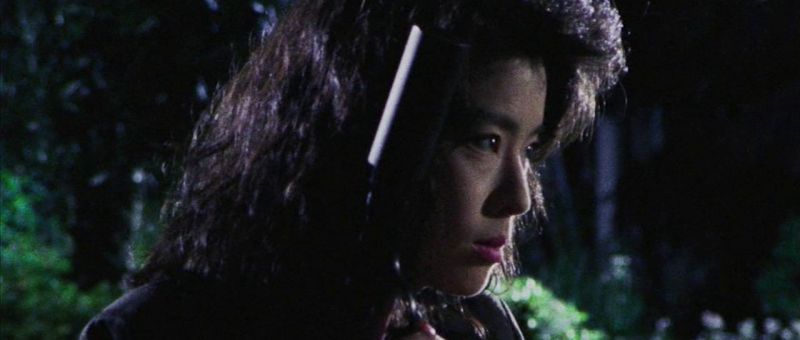
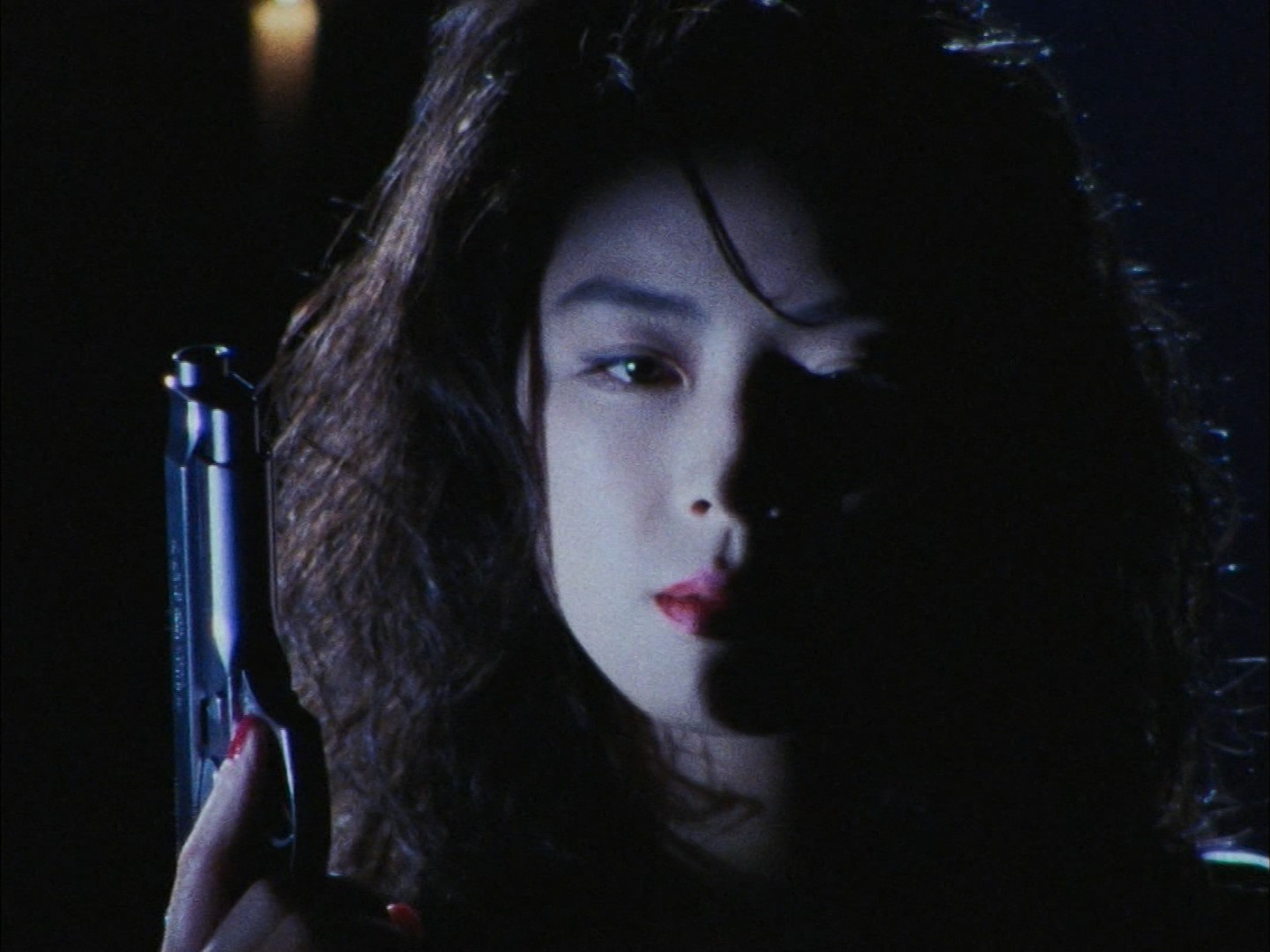
An assassin raised inside a weird Catholic hitman cult begins to reassess her life after falling for a reporter trying to expose the cult’s wrongdoings in Masaru Konuma’s adaptation of the novel by Mangetsu Hanamura, XX Beautiful Hunter (XX ダブルエックス 美しき狩人, XX: Utsukushiki Karyudo). In the classic V-Cinema mode, the film is a guns and girls crime thriller, though in other ways perhaps unusual in exploring the heroine’s gradual liberation in the wake of her sexual awakening. 

Shion (Makiko Kuno) comes of age twice, in the sense that in the opening sequence in which she undergoes a kind of baptism to become a “warrior of God,” she appears to get her period shortly after shooting her first target. Raised by the priest whom she calls “Father”, Shion is an emotionless killing machine with seemingly no thoughts at all beyond completing her mission. She does not even really seem to subscribe to the religion and is killing because Father told her to rather than for the glory of God while most of her targets are political figures that have become inconvenient. We can see both how little women are valued in this world and what a bad guy Ishizaki is when he uses his wife as a human shield before being dispassionately assassinated by Shion who does not particularly care about the collateral damage as long her primary target is killed. When the reporter she falls in love with, Ito (Johnny Okura), asks her what she’d do if he tried to run in a crowded public place, she says that she’d shoot him and that a lot of people would die, as if didn’t matter to her on either moral or practical grounds. Strangely, no one seems to react very much to the sound of a gun being fired even when Shion uses hers to bust open a coin locker, so perhaps she simply doesn’t worry about the laws of man.

But she is rattled by Ito’s photo of her executing his friend Sakuma because it reflects something of herself she didn’t want to see and has perhaps been repressing. Ito suggests that maybe she just likes killing people, which seems to bother Shion on some level, but an attempt to masturbate with her gun does indeed suggest a link between killing and sexual pleasure. It is though sexual contact with Ito that seems to awaken her when he rather strangely begins giving her oral sex after tearing at her clothes pleading for his life. As though imprinting on him, Shion becomes fascinated by Ito and the “normality” he represents. He gives her a crash course in dating while seemingly deprogramming her by getting her to eat meat and do “normal” things like going on drives in her sports car. Shion also starts dressing in more noticeably feminine fashions echoing the link between her baptism and coming of age with the suppression of her womanhood. 

It’s through this sexual liberation that Shion begins to break away from her programming and ask questions of the cult such as who her real parents were. Father seems to have a stoical attitude, exclaiming that “women are all the same” as if he knew this day would come and that Shion has evolved on falling in love. He seems to welcome this development on one level, but at the same time reduces Shion from the beautiful weapon he’s created to maternal vessel in suggesting that her true destiny lies in childbirth and that his dream is to hold her child whom he will presumably also train as an assassin. 

Meanwhile, the cult also paradoxically tries to use sex to control by subjecting her to a torture session at the hands of a lesbian dominatrix who insists she’ll show her a heaven men can never know and make her forget all about men. She does this by inserting a giant electrified dildo, which paints a very confusing picture of the cult’s views on sex, whether hetero or homosexual, penetrative or not. Ito turns up to “save” her, but thankfully it isn’t a case of a random man walking in and taking over, so much as providing a distraction for Shion to save herself while further empowering her with the motivation of love. In this world, however, love is futile and elusive. Even after freeing herself from the oppressive control of Father, Shion loses everything and intends to end her life only to turn around with another gesture of defiance though whether one of the killing machine reasserting itself or the desire for life overriding her nascent pain is difficult to say.

Scent of a Spell (魔性の香り, Toshiharu Ikeda, 1985)

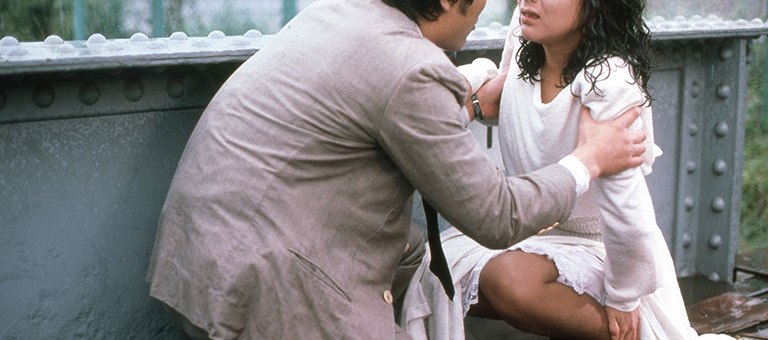
Esaka (Johnny Okura) feels like someone’s watching him. He has this sense of being observed by some otherworldly force along with a generalised feeling of uneasiness. But his paranoia seems to melt away after rescuing a young woman, Akiko (Mari Amachi), whose attempted suicide he witnesses during a rainstorm on his way home. He takes her in and one thing leads to another. For a time, they’re blissfully happy but then something starts to nag at him. Is Akiko really who she claims to be, or a demonic force of monstrous femininity?

It’s this malevolent quality to which the title of Toshiharu Ikeda’s noirish romance Scent of a Spell (魔性の香り, Masho no Kaori) alludes. Esaka is captivated by a hint of mystery and his own white knight syndrome, bewitched by Akiko but also perhaps growing tired of her and fearful of romantic commitment. He has after all been married before and his friend’s comments seems to suggest the cause of marital breakdown may either have been his womanising or his wife’s baseless jealousy. Akiko tells him that she’s on the run from an abusive husband prone to jealous rages and that though she has escaped from Osaka to Tokyo he always manages to track her down. Her sense of being pursued and Esaka’s of being watched seem to perfectly align while he seems to appreciate the fact that she needs him and he is quite literally sheltering her from danger.

Nevertheless, there are cracks in Akiko’s story beginning with the fact the bridge she threw herself off wasn’t the kind to pose a serious risk to life. The drop is only a few feet and though she resolutely refuses to be taken to a hospital because her husband might find her, she may be exaggerating the extent of her injuries. Meanwhile, she seems to have something of a jealous streak becoming irritated when Esaka talks to the proprietress of a local bar, thereafter apparently submitting herself to the attentions of his over-friendly colleague. Perhaps she had a reason to be annoyed given that she didn’t previously know any of these people and he inadvertently excluded her from the conversation, but it’s difficult for Esaka to know if she’s actually being unreasonable or he’s overreacting to a threat to his male pride and autonomy.

It’s this threat to his freedom that’s inflamed when he overhears another man talking to the lady behind the counter at a cafe he regularly goes to about his own girlfriend who is also named “Akiko” written with the character for “autumn”. Though there must be dozens of women with this not all that uncommon name combination in the city, it plants the seed of doubt in him that perhaps his Akiko and the other are the same and she’s two-timing him with this other guy while he’s at work. It also adds to his feeling that she has some kind of malevolent supernatural quality as if she were deliberately targeting lonely men for nefarious reasons. When the man from the cafe is found dead at home having been bludgeoned to death, he can’t help but feel that Akiko must have been involved and possibly intends to harm him too.

Of course, this may just be his fear that she will hurt him emotionally and his growing paranoia is a defence mechanism designed to protect himself against her abandonment or an infringement on his freedom. Or, alternatively, Akiko really is a dangerously crazed and jealous woman and letting her into his life will mean not a moment’s peace until it’s over. Even so, the pair of them discover intimacy in connection in their raw, desperate love making. Every time Esaka’s doubts rise to the surface, Akiko seduces him or he her and he momentarily forgets. In this, the film may have a latent misogyny as a final twist suggests that in the end all women are prone to fits of jealous rage not to mention cunning and trickery directed against each other as much as men who are also, to be fair, faithless liars and cheats. Akiko’s tragic backstory suggests something similar, that she is the inheritor of a legacy of compromised maternity and paternal betrayal. In any case, Esaka is not quite the hero he imagined himself to be either and in the end cannot save Akiko who may also in a way be choosing to sacrifice herself for love of him. Echoing the ending of In a Lonely Place, Ikeda casts their romance as fatalistic tragedy and bathes the noirish closing scenes in a heavenly golden light that suggests true love ends only in futility.


Scent of a Spell is released in the UK on blu-ray 17th February courtesy of Third Window Films.