Ringu (リング, Hideo Nakata, 1998)

As the investigative duo at the centre of Hideo Nakata’s eerie supernatural horror Ringu (リング) begin to unlock the mystery of Sadako, we’re told that a strange woman who may have had some kind of psychic powers was loathed by those around her in part because of her habit of sitting and staring at the sea. Nakata opens the film with waves and often returns to them as if suggesting in this millennial horror that what we fear is a transmission we cannot see. In the end there may not be so much difference between the magic of an analogue TV broadcast and a message from another plane. 

In any case, perhaps the central message is that one should pay more attention to the words of those whose warnings are often dismissed on the grounds of their age and gender. Journalist Reiko (Nanako Matsushima), for example, doesn’t seem too invested in a video she’s making about a cursed video related by a trio of high school girls in a cafe who explain that they don’t personally know anyone who’s died after watching it but have been reliably informed by friends of friends who apparently do. As will later be discovered, the girls actually give Reiko crucial information but for whatever reason she does not remember it until coming to the same conclusion herself. In any case, it’s not until her own niece, Tomoko (Yuko Takeuchi), dies in mysterious circumstances that Reiko starts to wonder if this is more than a spooky story elevating the chain letter to new technological heights.

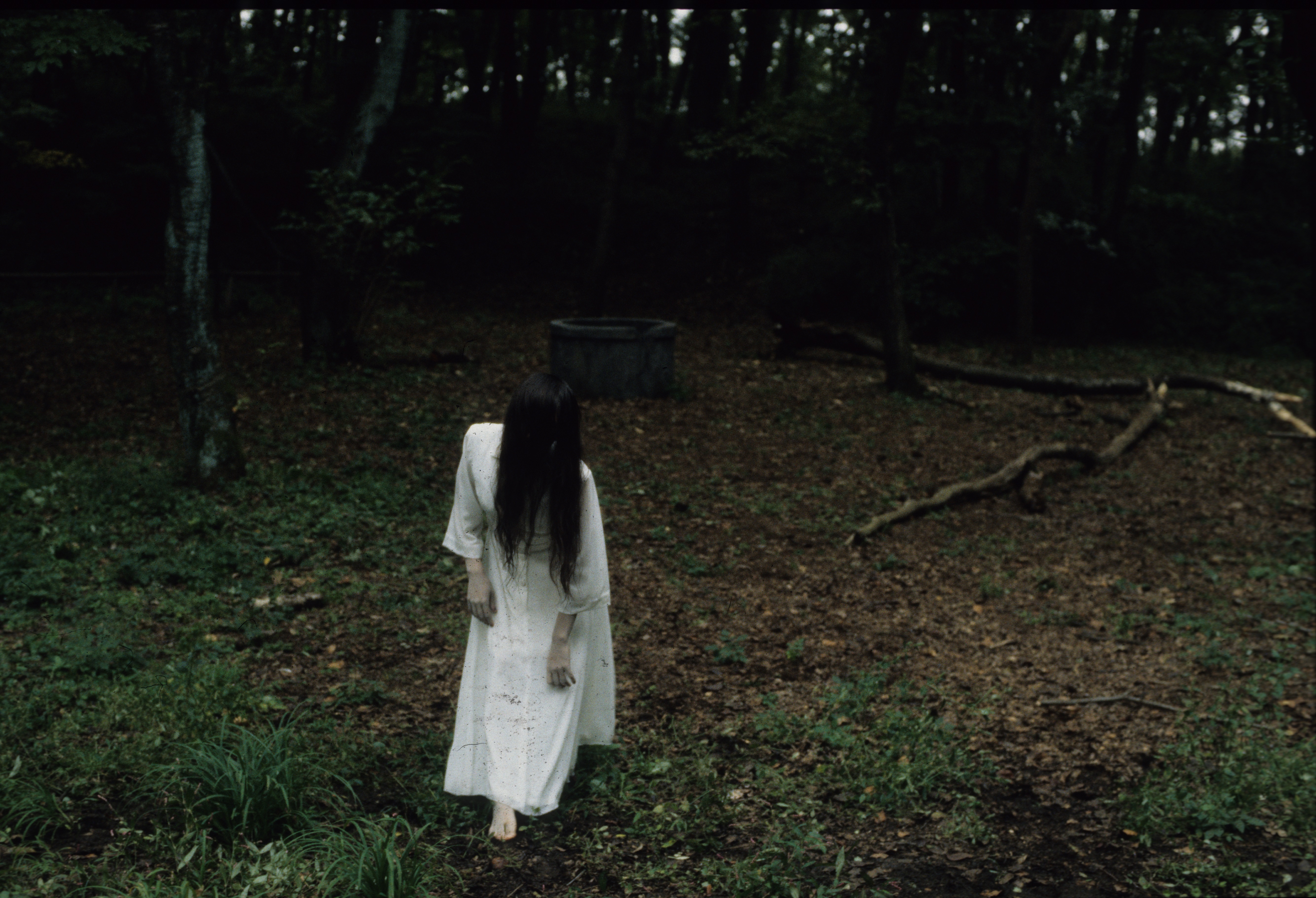
According to the urban legend, if you watch the cursed tape you’ll immediately get a phone call telling you you’ll die in seven days. The supernatural entity now synonymous with the film, Sadako, is manipulating these still analogue waves for herself. Sending her messages via television and telephone she is a literal ghost of the airwaves and as Reiko’s ex-husband Ryuji later puts it radiating her sense of rage in her own mistreatment, insisting that her story be known and that those who refuse to acknowledge it should not be allowed to survive. Just as Reiko should have listened to the high school girls, someone should have listened to Sadako and because they didn’t others now have no choice. 

In a sense Sadako represents this nascent fear of technological advancement. When Reiko answers her flip phone, it’s a reminder that there’s no escape from unwanted communication even if you can in theory try to switch it off. The girl with Tomoko when she died was driven out of her mind and now won’t venture anywhere near a television, as if you could escape Sadako’s wrath by merely keeping your distance from the portal. The two teenagers who died around the same time as Tomoko were in a car in the middle of nowhere, but cars have radios which receive radio waves. Sadako travels through the air, invisible until she chooses not to be. She may only have a direct line, but it is in one sense a call for help she’s issuing only in the very inefficient manner of a vengeful ghost whose rage has become indiscriminate or at least directed towards the society that wronged her and everyone in it rather than a single guilty party. 

In a certain sense, you can cure the curse only by spreading it. If everyone everywhere suddenly understood, learned Sadako’s painful history, then the curse would wither and die with no new hosts to go to which is perhaps what Sadako wants. Yet it leaves Reiko with a dilemma, knowing that to save the lives of those closest to her she may have to ask someone else to risk their life or even expose them without their consent. Throughout the film she’s been depicted as an imperfect mother, divorced and often leaving her small son Yoichi to fend for himself at home while the boy at one point walks past his own father in the street and does not seem to recognise him so absent had he been in his life. Through their shared quest to undo the curse, the pair in a sense reclaim their parental roles and repair their familial ties in working together to save their son’s life in contrast to the parental figures surrounding Sadako who may have done the reverse. Sadako frightens us because of her transgressive qualities, quite literally transgressing the barriers between ourselves and the stories we tell by crawling out of them and finding us here, on the other side of the screen, where we thought we were safe to remind us not to look away and to listen to those whose voices are all too often ignored. 


Ringu screens at Japan Society New York on Oct. 7 as part of the Monthly Classics series.

20th anniversary trailer (English subtitles)

Wuthering Heights (嵐が丘, Kiju Yoshida, 1988)

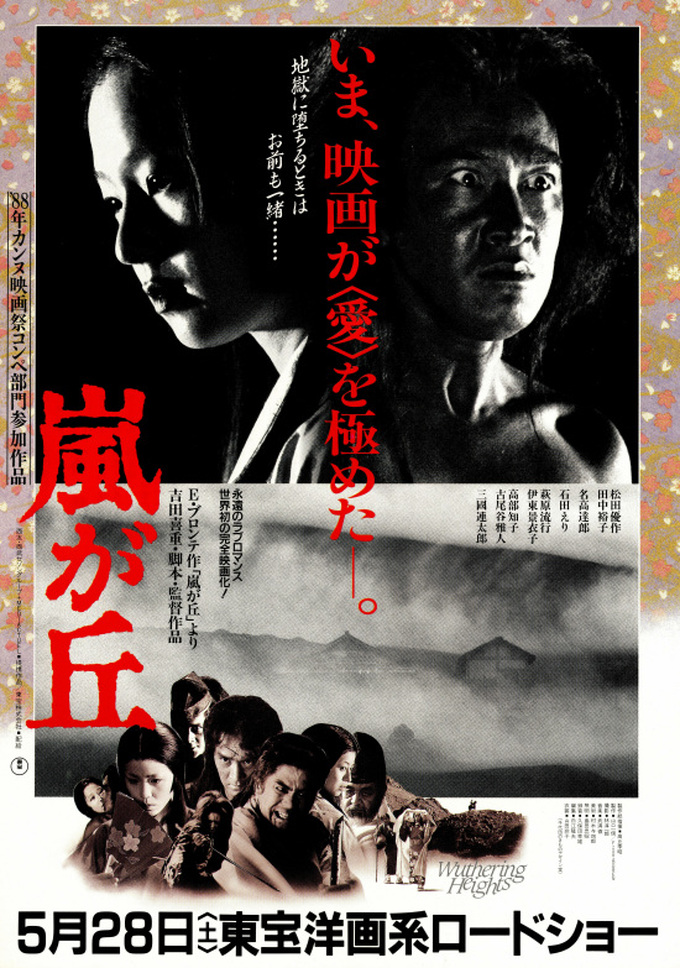
Wuthering Heights poster“In this decadent age, who believes in the gods’ anger?” asks a cynical priest, willingly inviting evil into his home in the hope of brokering a change in his constraining circumstances. A key figure of the avant garde, Kiju (Yoshishige) Yoshida, like many of his contemporaries, struggled in the heavily commercialised cinema industry of the 1970s and beyond, finding the international arena more receptive to his arthouse concerns. 1988’s Wuthering Heights (嵐が丘, Arashi ga Oka), a distinctly Japanese take on Emily Brontë’s classic novel, found funding in France where it perhaps neatly sits alongside superficially similar efforts from his similarly constrained contemporaries, but as always Yoshida’s vision is darker, more disturbing than that of the big budget epics which aimed to recapture golden age glories.

Yoshida swaps the desolate Yorkshire moors for a smokey hellscape settled in ash on the side of an unpredictable volcano. The Yamabes are a priestly family in charge of conducting various rituals to keep the serpent god happy, preventing an eruption and ensuring good rains. The house is spilt in two with a feud underway between the East mansion and the West. The East mansion is where we lay our scene as old Yamabe returns from an extended sojourn in the city, bringing back with him a feral child he found starving under a bridge and later names “Onimaru” (Yûsaku Matsuda) in honour of his “demonic” appearance.

“Demonic” maybe an unkind word to use about any child and primed to become a self-fulling prophecy, but as someone later puts it Onimaru “does not belong to this world”. He is “an evil man” whose “cruelty knows no limits”, yet two women are drawn into his orbit and find themselves unable to break free of his passionate intensity. His step-sister, Kinu (Yuko Tanaka), our Cathy stand-in, bonds with him in childhood feeling a kind of elemental connection perhaps forbidden to her as a woman of feudal Japan subject to the whims of male society. Yet she alone sees through him to humanity buried below, “your curse is the proof you will never stop loving me” she offers darkly while seducing him the night before her marriage to another man (Tatsuo Nadaka). Later that man’s sister (Eri Ishida), positioning herself as potential bride, cites the fact that he is “consumed by jealousy” as further proof that he is more man than demon, but Onimaru himself seems uncertain so deep is he in rage and resentment.

That resentment is perhaps as much about class as about anything else. A feral child, living like an animal on the streets of an unforgiving city, he’s an ill fit for the rarefied mansion of a local lord with a spiritual mission, albeit one which imprisons him in his home and forbids him from associating with the world below. Yamabe took him in for his “boldness”, actively seeking his demonic dynamism while his own son, Hidemaru (Nagare Hagiwara), remains disappointingly conservative and wedded to his old-fashioned elite entitlement. Hidemaru’s resentment of Onimaru is not so much born of parental rejection in his father’s abrupt decision to go out and find a more satisfactory son than the one dutifully waiting at home, but irritation in Onimaru’s irregular status. He resents that a mere “peasant”, a man who should be among the servants, is permitted to share his space, and it seems, has usurped his position in his father’s eyes to be groomed as an heir to the illustrious Yamabe name.

Hidemaru eventually leaves in disgust, setting off to make a conventionally successful life for himself in the city, latterly returning with a wife and son to claim his birthright only after his father’s death. Yet Hidemaru suffers too. His wife is raped and murdered by bandits, agents of chaos and yet a product of the system he was so keen to uphold, leaving him a drunken, dissolute figure unable to fulfil his obligations to the god of fire while Onimaru prospers in a violent world and is eventually gifted that which he most wanted – stewardship of the Yamabe clan.

Even so, he cannot fully possess Kinu who remains lost to him, ruined by her own internal conflict between individualism and obedience. After coming of age, her father tells her women of the Yamabe clan must leave the mountain to serve as priestesses in the shrine, but Kinu wants to “live as a true woman”. She cannot have Onimaru, but does not want to leave him so she engineers a marriage with the rival West mansion and the kindly Mitsuhiko who brands his house as one of light as opposed to the gloomy shadows of the East. Kinu has attempted to seize her own future, at least in part, but finds herself conflicted, torn between her affection for Mitsuhiko who is gentleness personified and her need for Onimaru’s brooding intensity.

Yet Yoshida’s Wuthering Heights is less a story of forbidden, transgressive loves than it is of elemental destruction, the anger of the gods manifested as imploded repression and its fiery aftermath. Yamabe, the father figure, brings “evil” into his home, infecting it with dark desire and deep resentments seemingly in the knowledge it will burn it to the ground. The third generation, orphaned and finally independent, are left to make what restitution they can and so the tale begins to reset and repeat with cousins, Hidemaru’s grown and now subjugated son Yoshimaru (Masato Furuoya), and Kinu’s fiesty daughter (Tomoko Takabe), returning their ire to the force of their oppression – Onimaru, still fearsome and implacable though ageing and maddened by his unanswerable love for a dead woman whose corpse he has begun to covet.

Kinu, on her deathbed, promised to drag Onimaru to hell (assuming they weren’t already there) if only to protect her new family and finally does just that as he finds himself expelled by the next generation, dragging a coffin off into the fiery distance. “In every way, our world is accursed” insists an exasperated retainer. Everything here is corrupt, rotten, suppurating under the weight of oppressive traditions which restrict freedom and insist on order at the price of humanity. Yoshida’s noh-inspired aesthetics add to the atmosphere of fable as his embattled protagonists attempt to reconcile their natures with their civility but find there is no answer for repressed desire other than destruction and eventual rebirth.