A New Love in Tokyo (愛の新世界, Banmei Takahashi, 1994)

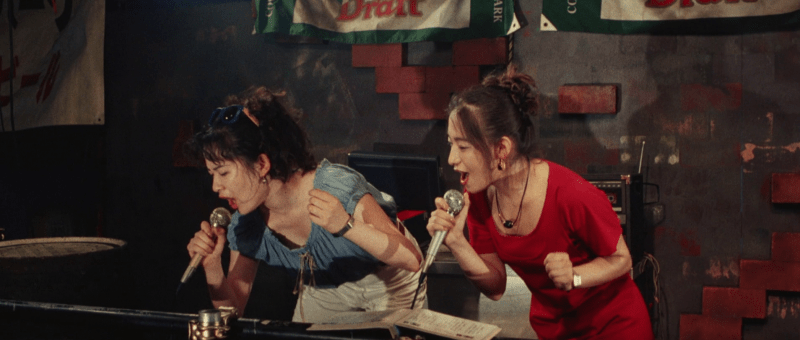
Life is theatre in Banmei Takahashi’s A New Love in Tokyo (愛の新世界, Ai no Shinsekai). Strangely marketed in some quarters as a kind of sequel to Ryu Murakami’s Tokyo Decadence though it is entirely unconnected to it, Banmei Takahashi’s after hours drama is a breezy riot that runs in direct contrast to other post-Bubble era movies which saw only despair and disillusionment in economic stagnation. For Rei (Sawa Suzuki) and Ayumi (Reiko Kataoka), however, life is one long party that they live on their own terms hoping to ride the wave all the way to the sea.

That said, it’s true that Rei, at least, is doing her dominatrix job because it’s impossible to support oneself as an artist in this economy. She is, in fact, basically subsidising her whole theatre troupe through sex work as a means of keeping it going. Her relationship to the men in the group is almost like Snow White and the Seven Dwarves while, for unexplained reasons, she sleeps with each of her dopey castmates on a rota system. It’s not until crunch time that they realise they should probably get jobs too, while the only other woman in the group (Yoko Nakajima) takes a job as a receptionist answering the phone at the call girl agency where Ayumi works.

Rei often runs into Ayumi leaving hotels and the pair soon become fast friends, though unlike Rei, Ayumi is a regular sex worker who sleeps with her clients. Nevertheless, Rei seems to like her precisely because, as she puts it, she’s a good liar, which is perhaps what you need to be to be successful at this business. She manipulates her clients by pretending to be a shy virgin so they pay her more for basic services, while lying to her boyfriend that she’s an office lady. The fact he takes it at face value suggests he might not be all that bright, which is why he’s struggling to finish his exams to become a doctor. Later, she’s thrown him over for a lad training to be a lawyer but just with as much success. Both the men she ends up with seem to be feckless and dim, though she fluffs their egos by pretending to be stupid. She says that her end goal is to become the wife of a professional lawyer or doctor, which is to say she’s looking for class status and respectability, though she’s probably earning more than they are by herself already. Ayumi has a host of savings pots and sometimes transfers large sums of money into one telling her boyfriend it’s from her father to help pay for a wedding.

Which is to say, everyone here is playing a kind of role. Both Rei and Ayumi seem to be using their real names for their work, but as Rei says the dominatrix gig is good for her acting career in allowing her to take on multiple personas. She too writes frequent letters home to her mother which bear little relation to reality in which she claims to be a therapist’s receptionist. But the clients are acting too, because this is, after all, all about role play. One of Rei’s most devoted customers is a yakuza who bosses his men around all day then comes to her to be punished. He is scrupulously polite and really rather sweet, buying up all the tickets to Rei’s play to make sure she’s not embarrassed on the opening night. Generally speaking, the streams shouldn’t cross between Rei the actress and Rei the dominatrix, so the yakuza is crossing a line by intruding on her personal life at the play, though he does so in an otherwise respectful way, apologising for his presence and making it clear that he doesn’t mean to expose her to those who might not know nor does he intend to encroach any further on her personal life.

Another of the women’s clients seems to be a fed up salaryman ranting about his boss and company lay-offs, hinting at the stressfulness of the economic situation for those working outside of the sex industry as well as the emasculating nature of corporate life in which the salaryman can only vent his frustrations through BDSM role-play rather than by actually taking it up with his boss. Rei and Ayumi are, by contrast, free from any such concerns. That is not to say, however, that their lives are easy or without danger. When a sex worker is found dead in a love hotel bathroom, a gloom falls over the industry. Rei asks Ayumi if she’s feeling alright, but as it turns out her agency has spotted a business opportunity seeing as most of the others will have decided to close for the sake for safety and as a gesture of respect. Ayumi too is threatened by a customer with a knife and is only saved by the arrival of a yakuza, in an unexpected cameo from ice cool V-Cinema star Show Aikawa, who intimidates the customer into backing off by eating his own sunglasses. Nevertheless, Ayumi goes straight back to work to meet the next customer, unwilling to let herself be cowed by male violence.

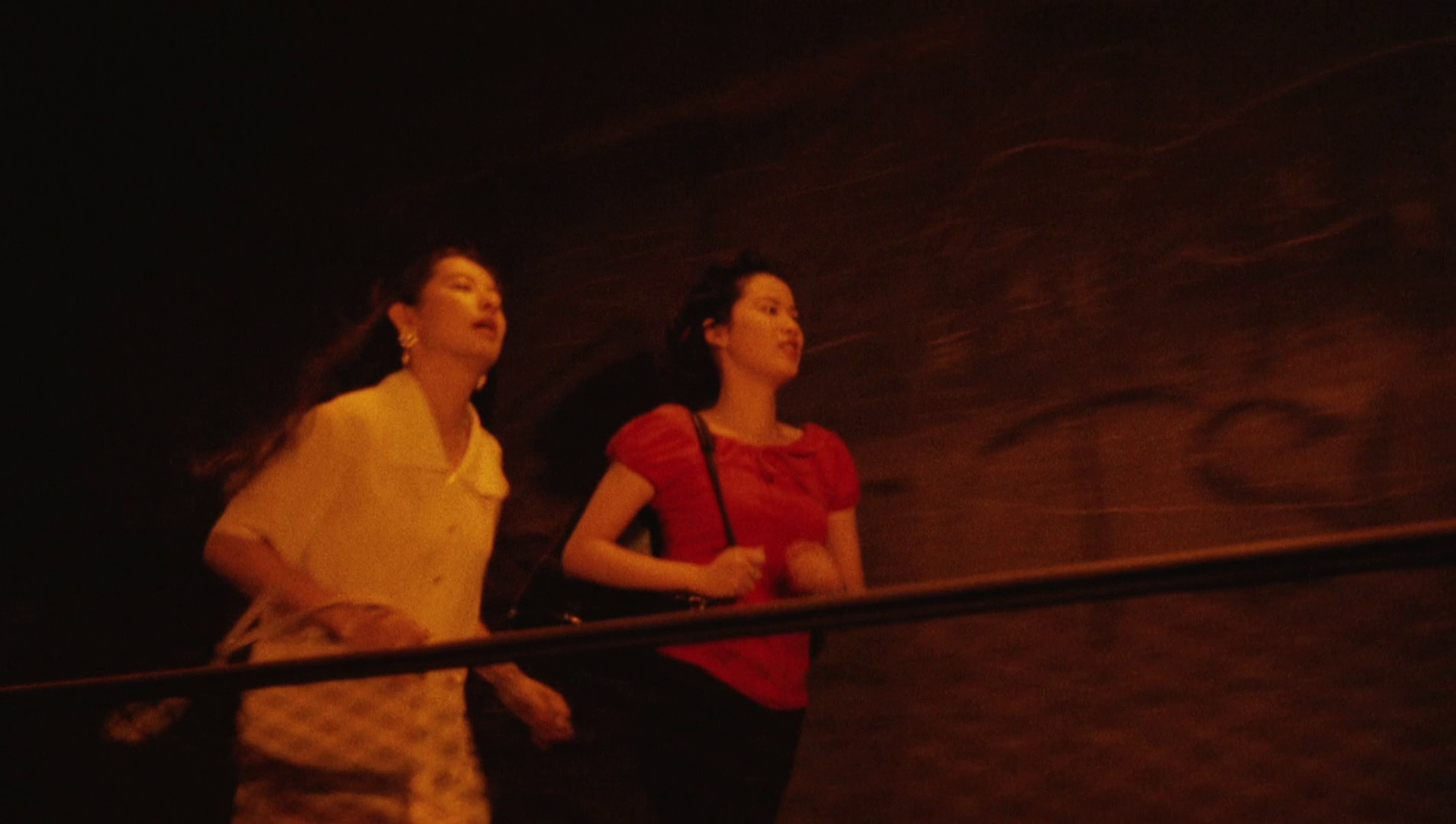
That’s something she has in common with Rei who similarly treats the attempts of men to ruin her night with similar disdain. When one customer proves rebellious, she keeps him waiting for hours while tied up and bound in the dark. She and Ayumi try turning the tables by visiting a host club, but are instantly put off by their poor quality patter. They go on a kind of date with two guys who tried to pick them up, but dump them when they’ve had enough. Rei, in particular, has several boyfriends who think they have some sort of claim on her body and her time, but she only ever does as she pleases. There’s something unexpectedly joyful about the two women running hand in hand through the midnight city, as if this were only ever their playground. The juxtaposition of the erotic photographs taken of actress Sawa Suzuki by Nobuyoshi Araki and those of her childhood hint at this quality of playfulness, as if her life were one of fun games in which she’s never quite grown up. They also remind us, however, of her ordinariness. She had a childhood too, and is, in fact, just like everyone else. Her job is just a job, no different from those of the guys at her theatre troupe who work in restaurants and video stores. She and Ayumi even exchange business cards. This festival might be over now, but that only means it’s time to start preparing for the next in the company of her friends as she and Ayumi enjoy their lives in the permanent dawn of a city that seems to exist only for them.


Trailer (English subtitles)

Wuthering Heights (嵐が丘, Kiju Yoshida, 1988)

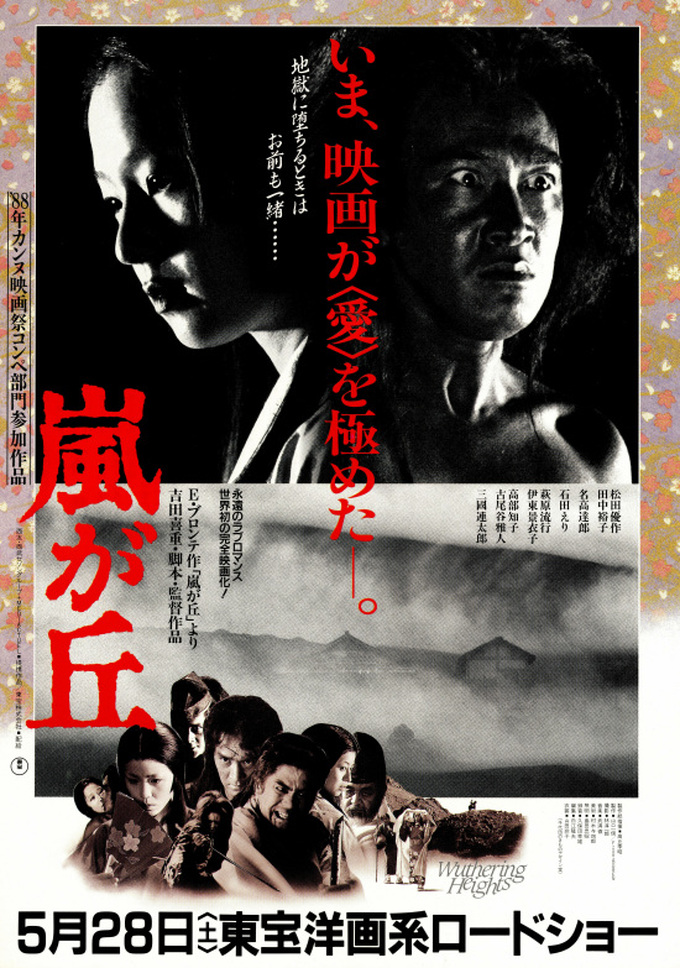
Wuthering Heights poster“In this decadent age, who believes in the gods’ anger?” asks a cynical priest, willingly inviting evil into his home in the hope of brokering a change in his constraining circumstances. A key figure of the avant garde, Kiju (Yoshishige) Yoshida, like many of his contemporaries, struggled in the heavily commercialised cinema industry of the 1970s and beyond, finding the international arena more receptive to his arthouse concerns. 1988’s Wuthering Heights (嵐が丘, Arashi ga Oka), a distinctly Japanese take on Emily Brontë’s classic novel, found funding in France where it perhaps neatly sits alongside superficially similar efforts from his similarly constrained contemporaries, but as always Yoshida’s vision is darker, more disturbing than that of the big budget epics which aimed to recapture golden age glories.

Yoshida swaps the desolate Yorkshire moors for a smokey hellscape settled in ash on the side of an unpredictable volcano. The Yamabes are a priestly family in charge of conducting various rituals to keep the serpent god happy, preventing an eruption and ensuring good rains. The house is spilt in two with a feud underway between the East mansion and the West. The East mansion is where we lay our scene as old Yamabe returns from an extended sojourn in the city, bringing back with him a feral child he found starving under a bridge and later names “Onimaru” (Yûsaku Matsuda) in honour of his “demonic” appearance.

“Demonic” maybe an unkind word to use about any child and primed to become a self-fulling prophecy, but as someone later puts it Onimaru “does not belong to this world”. He is “an evil man” whose “cruelty knows no limits”, yet two women are drawn into his orbit and find themselves unable to break free of his passionate intensity. His step-sister, Kinu (Yuko Tanaka), our Cathy stand-in, bonds with him in childhood feeling a kind of elemental connection perhaps forbidden to her as a woman of feudal Japan subject to the whims of male society. Yet she alone sees through him to humanity buried below, “your curse is the proof you will never stop loving me” she offers darkly while seducing him the night before her marriage to another man (Tatsuo Nadaka). Later that man’s sister (Eri Ishida), positioning herself as potential bride, cites the fact that he is “consumed by jealousy” as further proof that he is more man than demon, but Onimaru himself seems uncertain so deep is he in rage and resentment.

That resentment is perhaps as much about class as about anything else. A feral child, living like an animal on the streets of an unforgiving city, he’s an ill fit for the rarefied mansion of a local lord with a spiritual mission, albeit one which imprisons him in his home and forbids him from associating with the world below. Yamabe took him in for his “boldness”, actively seeking his demonic dynamism while his own son, Hidemaru (Nagare Hagiwara), remains disappointingly conservative and wedded to his old-fashioned elite entitlement. Hidemaru’s resentment of Onimaru is not so much born of parental rejection in his father’s abrupt decision to go out and find a more satisfactory son than the one dutifully waiting at home, but irritation in Onimaru’s irregular status. He resents that a mere “peasant”, a man who should be among the servants, is permitted to share his space, and it seems, has usurped his position in his father’s eyes to be groomed as an heir to the illustrious Yamabe name.

Hidemaru eventually leaves in disgust, setting off to make a conventionally successful life for himself in the city, latterly returning with a wife and son to claim his birthright only after his father’s death. Yet Hidemaru suffers too. His wife is raped and murdered by bandits, agents of chaos and yet a product of the system he was so keen to uphold, leaving him a drunken, dissolute figure unable to fulfil his obligations to the god of fire while Onimaru prospers in a violent world and is eventually gifted that which he most wanted – stewardship of the Yamabe clan.

Even so, he cannot fully possess Kinu who remains lost to him, ruined by her own internal conflict between individualism and obedience. After coming of age, her father tells her women of the Yamabe clan must leave the mountain to serve as priestesses in the shrine, but Kinu wants to “live as a true woman”. She cannot have Onimaru, but does not want to leave him so she engineers a marriage with the rival West mansion and the kindly Mitsuhiko who brands his house as one of light as opposed to the gloomy shadows of the East. Kinu has attempted to seize her own future, at least in part, but finds herself conflicted, torn between her affection for Mitsuhiko who is gentleness personified and her need for Onimaru’s brooding intensity.

Yet Yoshida’s Wuthering Heights is less a story of forbidden, transgressive loves than it is of elemental destruction, the anger of the gods manifested as imploded repression and its fiery aftermath. Yamabe, the father figure, brings “evil” into his home, infecting it with dark desire and deep resentments seemingly in the knowledge it will burn it to the ground. The third generation, orphaned and finally independent, are left to make what restitution they can and so the tale begins to reset and repeat with cousins, Hidemaru’s grown and now subjugated son Yoshimaru (Masato Furuoya), and Kinu’s fiesty daughter (Tomoko Takabe), returning their ire to the force of their oppression – Onimaru, still fearsome and implacable though ageing and maddened by his unanswerable love for a dead woman whose corpse he has begun to covet.

Kinu, on her deathbed, promised to drag Onimaru to hell (assuming they weren’t already there) if only to protect her new family and finally does just that as he finds himself expelled by the next generation, dragging a coffin off into the fiery distance. “In every way, our world is accursed” insists an exasperated retainer. Everything here is corrupt, rotten, suppurating under the weight of oppressive traditions which restrict freedom and insist on order at the price of humanity. Yoshida’s noh-inspired aesthetics add to the atmosphere of fable as his embattled protagonists attempt to reconcile their natures with their civility but find there is no answer for repressed desire other than destruction and eventual rebirth.