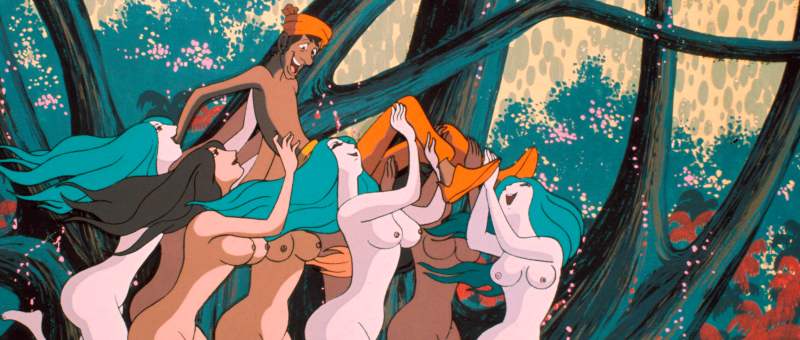
 The “Godfather of Manga” Osamu Tezuka had been a pioneer of what later became the mainstream of a burgeoning industry, kickstarting TV anime in the process with the long running Astro Boy. His ambitions, however, increasingly ran towards the avant-garde and he feared that the heavy association between his production company, Mushi Pro, and genial kids’ cartoons would only lead to diminishing artistic returns even if the increasing merchandising opportunities would perhaps allow the studio to engage in other less profitable areas such the adult-orientated anime he longed to produce. By the late ‘60s, Tezuka’s polite, inoffensive brand of child-friendly adventure stories were becoming distinctly old hat while the “gekiga” movement, acting more or less in direct opposition, continued to gain ground with older readers keen to move on to more adult fare. The Animerama series was intended to prove that Tezuka still had something new and dynamic to bring to the table and that there was a market for “racy” animation which embraced mature themes and experimental artwork.
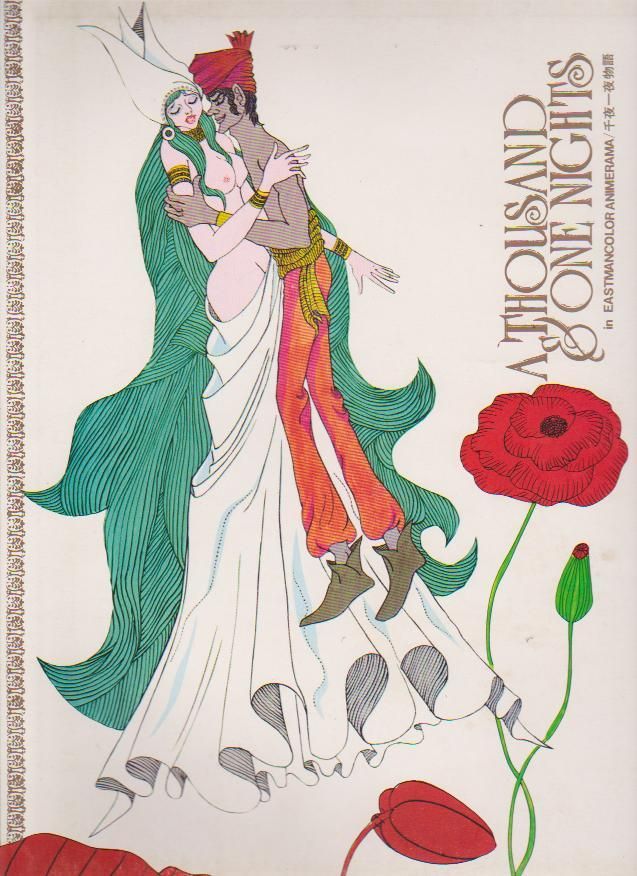
The first of the Animerama films, A Thousand & One Nights (千夜一夜物語, Senya Ichiya Monogatari), is, as the title implies, loosely inspired by classic Arabian folktales as its hero “Aldin” (Yukio Aoshima) finds and then loses true love, overcomes the urge for vengeance, is himself corrupted by wealth and power, and then is returned to the very same state in which we first encountered him walking off into the sunset in preparation for the next adventure.
The tale begins with a slave auction at which the lowly water seller Aldin first catches sight of the beautiful Milliam (Kyoko Kishida). He tries to buy her but is too poor while the son of the local police chief (Asao Koike) outbids all to win the prize. However, in the first of many strokes of luck that will befall Aldin, a sandstorm allows him steal away with Milliam who falls in love with him too and gives herself willingly to a man she sees as an equal rather than a master. Sadly, their true love story is short lived and they are soon separated sending Aldin off on a quest to return to his beloved that will only end in tragedy.
Despite the later protestations that the love of Aldin and Milliam is one of equals in which there are no masters or slaves, only a man and a woman, it remains true that Aldin watched the slave auction with a degree of titillation and would have bought Milliam had he only been able to afford her. Surviving on his wits, Aldin is a cheeky chancer waiting for that big lucky break he is sure is waiting somewhere round the corner but he is not, perhaps, above becoming that which oppresses him. Later, having become a wealthy and powerful man, he uses his wealth and his power in the same way that others use theirs against him in pressuring a vulnerable young girl to become his mistress against her will, ripping her away from her own true love in the same way he was once ripped away from Milliam by another man wearing a crown. As a “king” he wonders what “power” is, pushing his as far as it will go in order to find out and risking “losing himself” in a way he’d once thought he’d overcome in rejecting a pointless act of vengeance that would forever have changed him.
Milliam, and later Jallis – the daughter of Aldin and Milliam raised by their worst enemy, Badli (Hiroshi Akutagawa), fight for the right to decide their own romantic destiny. Like Madlia (Sachiko Ito), the feisty bandit’s daughter, they resist the social codes of their era in which women are merely prizes divided among men and actively attempt to free themselves through love only to find defeat and despair. Yet love, or more precisely lust, can also be a force of constraint and or ruin as Aldin discovers on a paradise island when he unwisely decides to abandon Madlia, who has also fallen in love with him, for the empty pleasures of orgiastic sex with the voracious islanders whose unrestrained desire soon threatens to consume him whole.
A picaresque adventure, A Thousand & One Nights is a bawdy, flippant retelling of the Aladdin myth in which the hero begins as a poor yet free and cheerful young man before experiencing what it is to be wealthy and all powerful and discovering that it only makes him mean and miserable. Shifting from model shots to live photography and abstract to cartoonish animation, Yamamoto’s direction may appear restrained in comparison to the more outlandish and surreal Belladonna of Sadness but is a masterclass in finding artistry through budgetary limitations. A psychedelic odyssey through freedom and constraint, desire and obsession, A Thousand & One Nights is a forgotten landmark of experimental animation as relentlessly strange as it is endearing.
Available on blu-ray from Third Window Films as a part of double release with Eiichi Yamamoto & Osamu Tezuka’s Cleopatra.
Original trailer (English subtitles, NSFW)
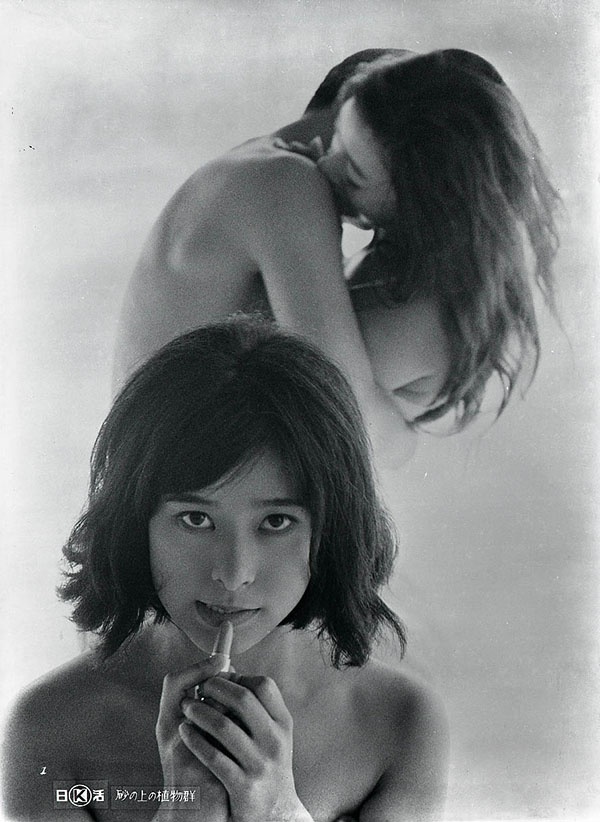 Despite being among the directors who helped to usher in what would later be called the Japanese New Wave, Ko Nakahira remains in relative obscurity with only his landmark movie of the Sun Tribe era, Crazed Fruit, widely seen abroad. Like the other directors of his generation Nakahira served his time in the studio system working on impersonal commercial projects but by 1964 which saw the release of another of his most well regarded films Only on Mondays, Nakahira had begun to give free reign to experimentation much to the studio boss’ chagrin. Flora on the Sand (砂の上の植物群, Suna no Ue no Shokubutsu-gun), adapted from the novel by Junnosuke Yoshiyuki, puts an absurd, surreal twist on the oft revisited salaryman midlife crisis as its conflicted hero muses on the legacy of his womanising father while indulging in a strange ménage à trois with two sisters, one of whom to he comes to believe he may also be related to.
 Windows on Worlds