
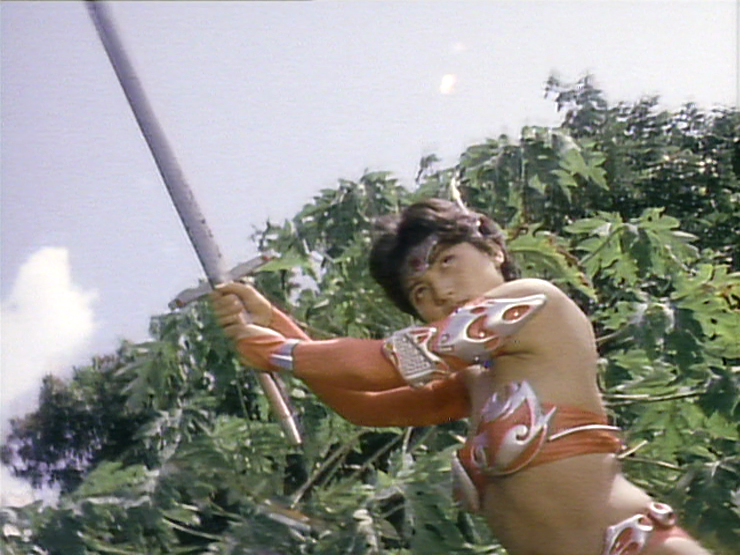
Star Virgin (スターヴァージン, Ichiro Omomo, 1988)

A young woman sets off to travel the universe and discovers that a lot of it’s full of inappropriate men, which is why is her father thoughtfully gave her a chastity bracelet that can detect “evil intent” and allow her to transform into the superhero Star Virgin to protect her virginity. We first see her do this in a weird reptile planet where, for some reason she’s being crucified as a giant Jabba the Hut-like frog extends his gruesome tongue towards her. 

Produced with the involvement of props team Ogawa Modelling who wad worked on Bye-Bye Jupiter, director Ichiro Omomo intended Star Virgin (スターヴァージン) to be a tokusatsu take on the Supergirl movie from 1984. A pilot version made in 1986 was apparently more serious in tone, though the completed film released two years later is deliberately silly and includes a series of references to contemporary Hollywood cinema such as Eiko and her Earth friend Ko running away from a ball of dung spun by a giant dung beetle like in Indiana Jones, while the robots have a heads up interface that’s clearly inspired by The Terminator, and the inside of the villain’s lair resembles the inside of the ships in Star Wars.

But while Eiko seems to be an intergalactic princess, she only speaks Japanese and the design of her fish-like spacecraft, which doesn’t look that big but has room for a giant bubble bath, is inspired more by Japanese sci-fi manga. She’s apparently come to Earth after the bad experience on the reptile planet because she thought there was a chance of it becoming civilised in the future, but is immediately drawn into a bizarre conspiracy run by a man who’s been perfecting various gadgets for the last 84 years in order to reverse Japan’s defeat in the Second World War. Eiko’s new bug-obsessive friend Ko (Fujio Takumi) annoys him by first guessing the First World War and then suggesting perhaps his siphoning off of the imperial navy’s resources is one reason they lost.

Nevertheless, Ko’s indifference lays bare a generational divide in which wartime defeat has become a kind of joke and something that only old people go on about rather than a serious wound on the national psyche. Colonel Arashiyama (Isao Sasaki), however, is intent on turning the cold war hot so Russia will nuke America, while Japan will be safe because of the protective barrier he’s placed around it. He’s also enabled his secret island to float in the sky for protection and has kidnapped Ko because he thinks he’s stolen a precious gem that stems back to the gods of Japan’s creation myth which he needs to win the war as if he’s essentially weaponising Japaneseness. Predictably, he wants Eiko to be his new princess and dresses her in white gown while taking some kind of elixir to make himself young and virile. Of course, she only needs to string him along until he finally goes too far and activates the chastity belt.

Not being able to activate it at will seems like a serious design fault, while it’s not altogether clear if it would still activate if Eiko herself were to pursue a romance. Not that that’s all that likely given the frankly inappropriate treatment she receives from men other than Ko. In fact, she’s a bit confused why he doesn’t try anything, but it’s mainly because he’s too busy thinking about bugs. In any case, they have to team up together to escape Colonel Arashiyama’s lair and stop all of his dastardly plans. Though it was clearly made on a shoestring, the special effects and production design are incredibly impressive and have a real sense of charm and invention. Never taking itself too seriously, the film nevertheless completely commits itself to its bizarre world of alien princesses and conspiracy, before finally returning to what it presented itself as in the beginning, a teenage girl’s travel diary. Even the evil robot’s programming is broken as he’s taken in by some local children and becomes their friend, just as Eiko and Ko enjoy a fun time at beach in a classic idol movie-style ending.
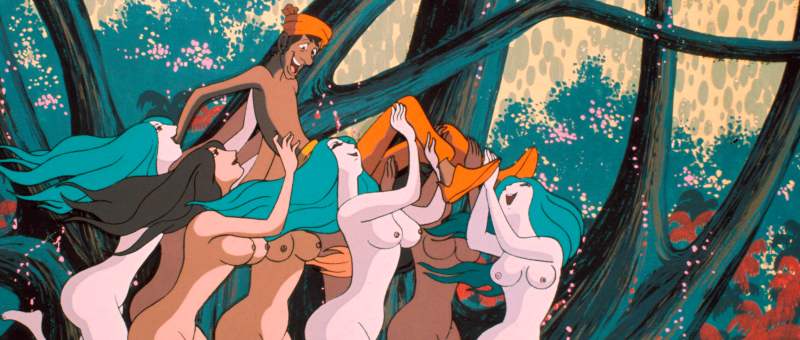

A Thousand & One Nights (千夜一夜物語, Eiichi Yamamoto, 1969)

one thousand and one nights poster 2The “Godfather of Manga” Osamu Tezuka had been a pioneer of what later became the mainstream of a burgeoning industry, kickstarting TV anime in the process with the long running Astro Boy. His ambitions, however, increasingly ran towards the avant-garde and he feared that the heavy association between his production company, Mushi Pro, and genial kids’ cartoons would only lead to diminishing artistic returns even if the increasing merchandising opportunities would perhaps allow the studio to engage in other less profitable areas such the adult-orientated anime he longed to produce. By the late ‘60s, Tezuka’s polite, inoffensive brand of child-friendly adventure stories were becoming distinctly old hat while the “gekiga” movement, acting more or less in direct opposition, continued to gain ground with older readers keen to move on to more adult fare. The Animerama series was intended to prove that Tezuka still had something new and dynamic to bring to the table and that there was a market for “racy” animation which embraced mature themes and experimental artwork.

The first of the Animerama films, A Thousand & One Nights (千夜一夜物語, Senya Ichiya Monogatari), is, as the title implies, loosely inspired by classic Arabian folktales as its hero “Aldin” (Yukio Aoshima) finds and then loses true love, overcomes the urge for vengeance, is himself corrupted by wealth and power, and then is returned to the very same state in which we first encountered him walking off into the sunset in preparation for the next adventure.

The tale begins with a slave auction at which the lowly water seller Aldin first catches sight of the beautiful Milliam (Kyoko Kishida). He tries to buy her but is too poor while the son of the local police chief (Asao Koike) outbids all to win the prize. However, in the first of many strokes of luck that will befall Aldin, a sandstorm allows him steal away with Milliam who falls in love with him too and gives herself willingly to a man she sees as an equal rather than a master. Sadly, their true love story is short lived and they are soon separated sending Aldin off on a quest to return to his beloved that will only end in tragedy.

Despite the later protestations that the love of Aldin and Milliam is one of equals in which there are no masters or slaves, only a man and a woman, it remains true that Aldin watched the slave auction with a degree of titillation and would have bought Milliam had he only been able to afford her. Surviving on his wits, Aldin is a cheeky chancer waiting for that big lucky break he is sure is waiting somewhere round the corner but he is not, perhaps, above becoming that which oppresses him. Later, having become a wealthy and powerful man, he uses his wealth and his power in the same way that others use theirs against him in pressuring a vulnerable young girl to become his mistress against her will, ripping her away from her own true love in the same way he was once ripped away from Milliam by another man wearing a crown. As a “king” he wonders what “power” is, pushing his as far as it will go in order to find out and risking “losing himself” in a way he’d once thought he’d overcome in rejecting a pointless act of vengeance that would forever have changed him.

Milliam, and later Jallis – the daughter of Aldin and Milliam raised by their worst enemy, Badli (Hiroshi Akutagawa), fight for the right to decide their own romantic destiny. Like Madlia (Sachiko Ito), the feisty bandit’s daughter, they resist the social codes of their era in which women are merely prizes divided among men and actively attempt to free themselves through love only to find defeat and despair. Yet love, or more precisely lust, can also be a force of constraint and or ruin as Aldin discovers on a paradise island when he unwisely decides to abandon Madlia, who has also fallen in love with him, for the empty pleasures of orgiastic sex with the voracious islanders whose unrestrained desire soon threatens to consume him whole.

A picaresque adventure, A Thousand & One Nights is a bawdy, flippant retelling of the Aladdin myth in which the hero begins as a poor yet free and cheerful young man before experiencing what it is to be wealthy and all powerful and discovering that it only makes him mean and miserable. Shifting from model shots to live photography and abstract to cartoonish animation, Yamamoto’s direction may appear restrained in comparison to the more outlandish and surreal Belladonna of Sadness but is a masterclass in finding artistry through budgetary limitations. A psychedelic odyssey through freedom and constraint, desire and obsession, A Thousand & One Nights is a forgotten landmark of experimental animation as relentlessly strange as it is endearing.


Available on blu-ray from Third Window Films as a part of double release with Eiichi Yamamoto & Osamu Tezuka’s Cleopatra.

Original trailer (English subtitles, NSFW)