Phantom of the Toilet (トイレの花子さん, Joji Matsuoka, 1995)

A transfer student quickly becomes the magnet for the anxieties of her classmates amid an ongoing spate of serial murders of primary school children in Joji Matsuoka’s kids adventure movie Phantom in the Toilet (トイレの花子さん, Toiret no Hanako-san). Loosely inspired by the classic urban legend about the ghost of a little girl who haunts school toilets, the film is less a horror movie than a tale of bullying, mass hysteria, and the ways in which childish emotions can spiral out of control.

Natsumi’s (Ai Maeda) no stranger to that herself. A tomboy, she’s largely excluded from the group of popular girls at her school and exists in a rather liminal space. Her older brother Takuya (Takayuki Inoue) is in the year above, but predictably doesn’t like being bothered by his little sister at school and is for some reason embarrassed by the fact his widowed father is a milkman. Nevertheless, he’s incredibly earnest and righteous and volunteers for various things at the school like the student council. Natsumi’s problems begin when the popular girls insist on doing a Ouija board to find out the identity of a serial killer who’s already killed two children their age from different schools. Natsumi doesn’t realise that it’s a trick the other girls are playing on her, but the Ouija board says the killer is Hanako, the toilet ghost, and Natsumi is the next victim.

Meanwhile, a new girl joins their school in Takuya’s class and is immediately resented by the popular girls because she’s pretty and clever, so obviously they turn against her. Chief among the complaints against Saeko (Yuka Kono) is that she used the cubicle at the end of the girls’ toilets which supposedly belongs to Hanako, because obviously she doesn’t yet know this bit of school lore. After a series of odd things happen, including the murder of the school’s pet goat, everyone comes to the conclusion that Saeko must be possessed by Hanako and is planning to murder them all. Even Natsumi has her doubts, but eventually decides to defend Saeko while Takuya, who seems to have a crush on her, eventually gives in to peer pressure despite his promises to protect her and vision of himself as someone who does the right thing.

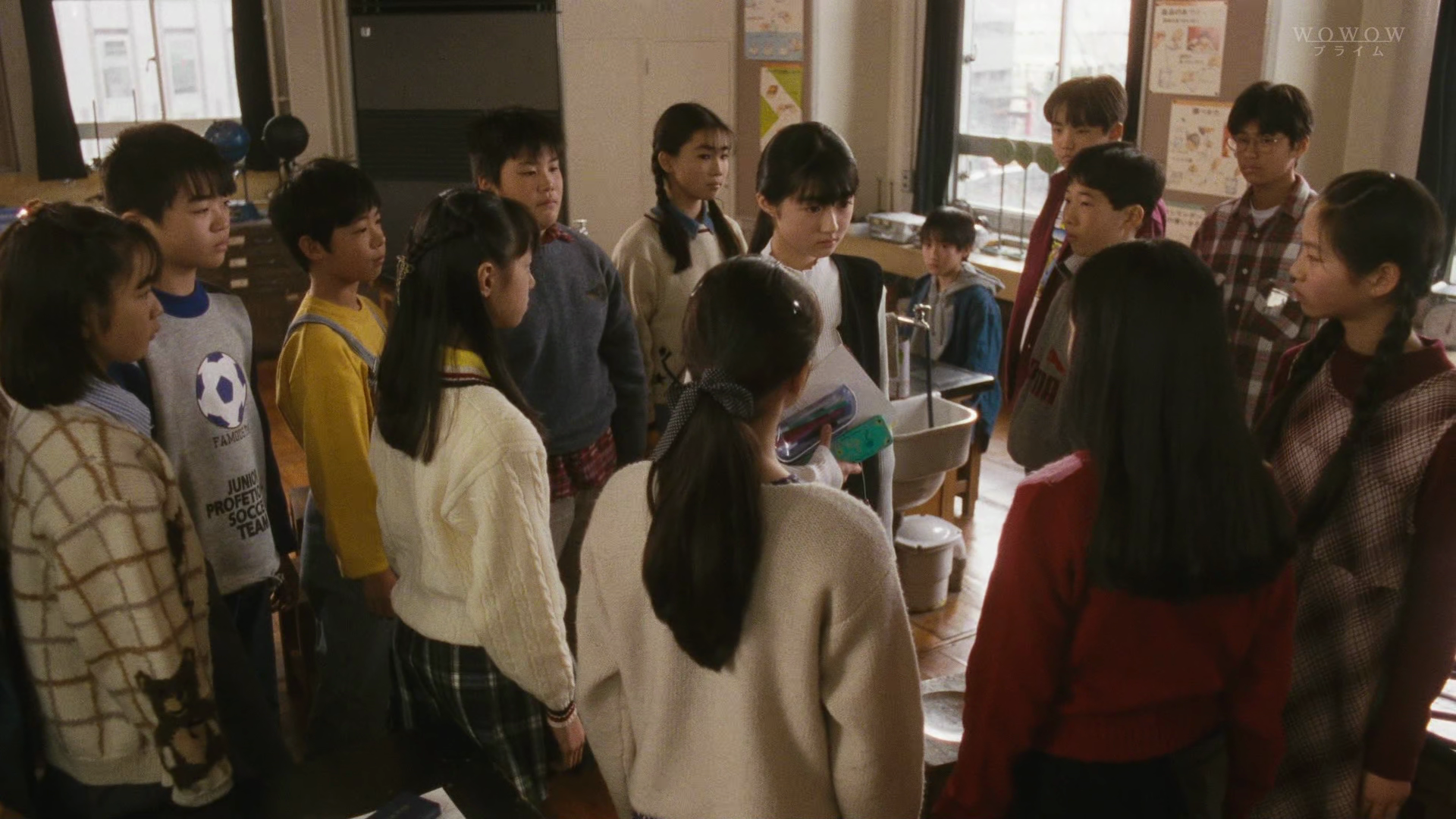
To that extent, it isn’t really Hanako that haunts the children so much as the idea of her is misused as a means of social control. A silly rumour soon gives way to mass hysteria as the popular girls bring more of the children over to their side to gang up on Saeko while the teachers are largely absent or oblivious. While in another film the kids might band together to look for the killer of the other children and thereby protect themselves and each other, instead they become ever more paranoid and the outsider figure of Saeko becomes the focus of all their negative emotions from the jealousy of the other girls to the uncertainness of Takuya who doesn’t know what to do with his confusing feelings for Saeko. In a touching moment, he replies via writing on the blackboard rather than speaking when Saeko uses it to communicate with him after losing her voice, but later ends up shouting at her to go away and leave him alone. “Silence means you agree,” one his classmates points out when Takuya attempts to abstain from an otherwise unanimous vote to subject Saeko to a kind of test akin to a ducking stool to prove whether or not she really is Hanako. Only Natsumi remains on her side.

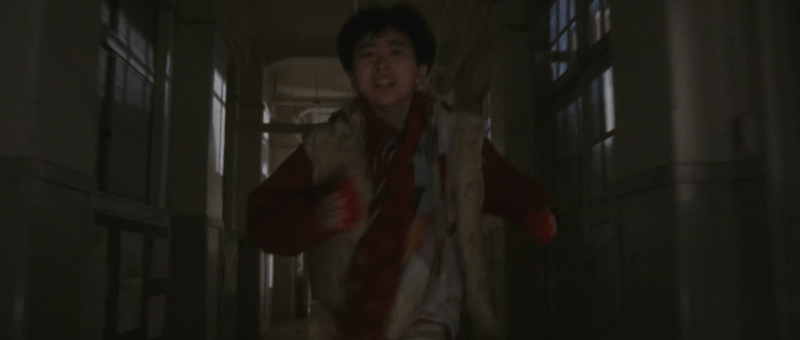
Meanwhile, the real child killer hovers in the background like an abstract threat before finally invading the school like a refugee from a slasher movie. Swinging his scythe around, his crazed moaning may prove too prove frightening for younger audiences while not even Natsumi’s father and their teacher can stop him from murderous wandering. In the end, the “real” Hanako surfaces but as a more benevolent figure who calls the kids back to the school and creates a more positive sense of mob mentality as they all shine their torches on the killer as if confronting him with what he is and what he’s done. The curse itself is lifted as the other kids rally round to save Saeko and finally accept her as one of them. A charming exploration of a 90s childhood from Grandpa playing Nintendo shogi to the looming anxieties of stranger danger, the ultimate message is one of solidarity and friendship as Hanako helps the kids let go of their petty disagreements to confront the real monster and save each other.


Trailer (no subtitles)
Transparent: Tribute to a Sad Genius (サトラレ, Katsuyuki Motohiro, 2001)

What would life be like if your every thought were audible for miles? Adapted from the manga by Makoto Sato, Katsuyuki Motohiro’s Transparent: Tribute to a Sad Genius (サトラレ, Satorare) considers how ironically isolating such a talent may turn out to be as the sufferer finds themselves withdrawing from others in embarrassment while wider society begins to resent being unable to tune out of their every inane thought or avoid being hurt by hearing something no one would ever say out loud even if they thought it privately. 

The “Committee for the Preservation of the Specially Gifted” is dedicated to protecting the so-called “Transparents” whose thoughts are audible for a 10m radius though they have no control or even idea that it is happening. They’ve started an extensive public information campaign to reduce the stigma held against them because as they claim Transparents are a valuable natural resource mainly as they all have super high IQ and are at the forefront of technological advancement. Then again this extensive campaign seems like overkill as there are only currently seven confirmed Transparents on record, but in a minor twist the campaign is necessary because it’s essential that the Transparents never find out that their thoughts are public, the first apparently having taken their own life because of the intense embarrassment of trying to live without any kind of privacy. 

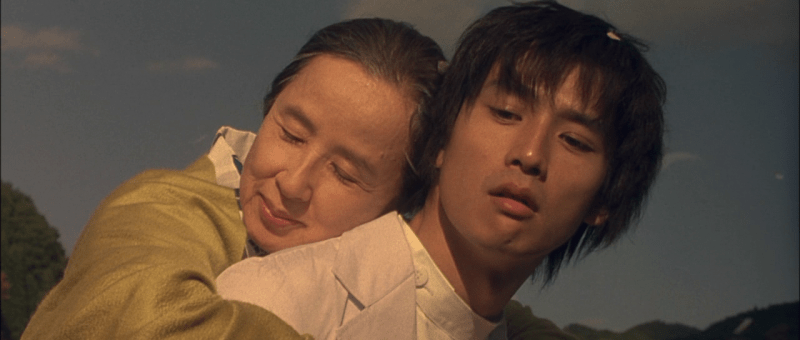
This is the first ethical problem with the Transparent program which is curiously contradictory in its approach. The government could easily have said that Kenichi (Masanobu Ando), the sole survivor of a plane crash at three years old plucked from the wreckage when rescuers heard his internal monologue begging for help, had died and raised him in a lab, but instead they choose to return him to his grandmother in a designated Transparent town where they provide him with the illusion of a “normal” life while simultaneously micromanaging his existence. Their problem now is that he’s qualified as a doctor and wants to practice, but clinical medicine is obviously an occupation which requires discretion. Patients overhearing his “real” thoughts might not be helpful to their recovery, while he can hardly claim patient doctor confidentially when he’s likely to leak private medical details simply in the course of his work. Meanwhile, it tuns out that he’s already invented a revolutionary cure for athlete’s foot which is another reason why the council want to manipulate him into shifting towards research rather than clinical practice. 

That’s why they’ve dispatched military psychologist Yoko (Kyoka Suzuki) who specialises in Transparents hoping that she can find a way to bend him to their will, but gradually she begins to come to a new understanding of what his life is like even while he has no idea everyone knows what he’s thinking. For example, no one wants to date a Transparent because they don’t want the intimate details of their love lives broadcast all over town, while the perfectly ordinary thoughts which should definitely stay in his head on catching sight of crush Megumi (Rina Uchiyama) can’t help but make her feel uncomfortable. The entire town is forced to pretend that they can’t hear him think, which seems somewhat unfair, leaving him at a disadvantage and more often at not at a loss as to why someone might seem hurt or upset by him when didn’t even say anything. Meanwhile, much of Yoko’s role lies in gently manipulating him, the entire committee decamping to a summer festival in a nearby town so they can let him down gently by leading him to believe Megumi already has a steady boyfriend who is kind to children and the elderly so he’s forced to be happy for her that’s she’s found such a great guy and can give up on his romantic aspirations. 

The tone is in general admirably progressive in that it ultimately argues for a greater sense of acceptance for all minorities, but it’s difficult to square the positive message with the ways the Transparents are also being uncritically manipulated, forced to live a simulacrum of a life in an engineered small-town Japan which grateful to have them only for the massive subsidies they receive for local development in return for making sure the Transparents are kept in the dark about their condition so that the committee can exploit their genius as they plan to do with Kenichi after getting him to the research institution. Even so what they discover is that Kenichi knew what his genius was and only through letting him follow his dreams can they truly unlock it, while the committee is forced to reckon with the various ways they’ve dehumanised him, the chairman eventually referring to him as a person as opposed #7 as he’d always called him before. Somewhat contradictory and more than a little uncomfortable in its implications, Transparent: Tribute to a Sad Genius is presented as heartwarming drama and it does indeed warm the heart with this its messages of equality and acceptance not to mention the right to follow one’s dreams whatever they may be but never really reckons with its central thesis in which the authorities pat themselves on the back for being kind and doing the right thing while simultaneously exploiting those they claim to care for without their knowledge or consent. 


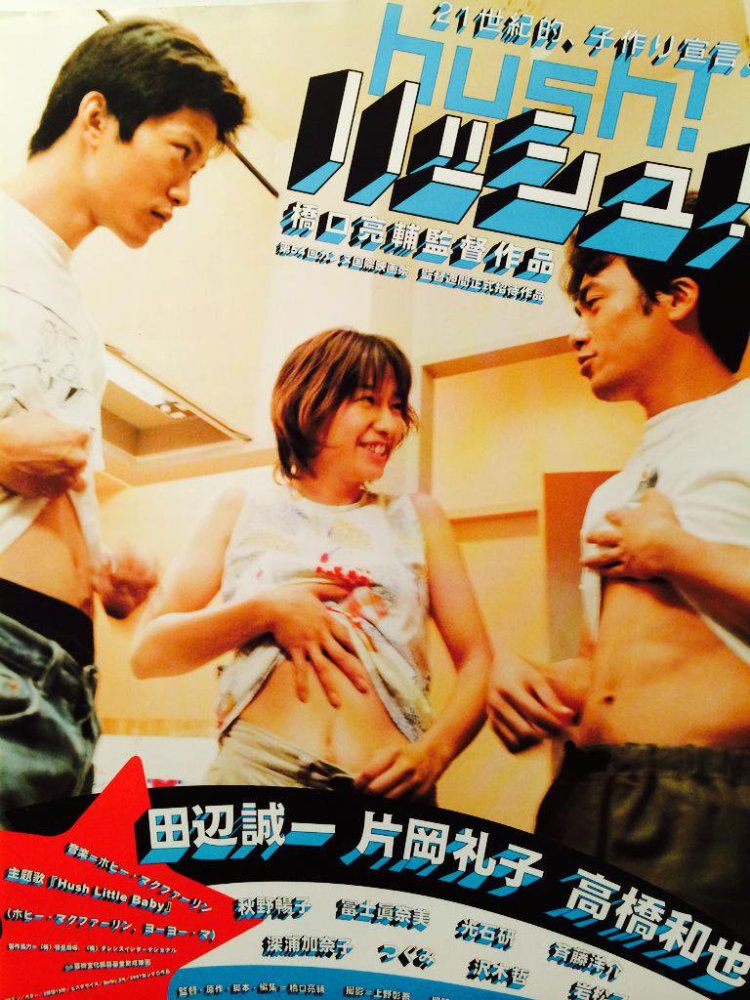
Hush! (ハッシュ!, Ryosuke Hashiguchi, 2001)

hushThe family drama is a mainstay of Japanese cinema, true, but, it’s a far wider genre than might be assumed. The rays fracture out from Ozu through to The Family Game and Crazy Family which sought to ask a few questions about where the idea of “family” was headed in a society of rapidly increasing materialism. Ryosuke Hashiguchi comes at the idea from a different angle in 2001’s Hush! (ハッシュ!) as he once again takes the perspective of the gay community and asks if the “traditional family” is about to change – what could, or should, survive if the old, rigid ideas can be remade into something lasting created out of love and acceptance rather than obligation?
As the film begins, Naoya (Kazuya Takahashi) wakes up to find his one night stand already fully dressed and heading out the door, awkwardly, without even stopping to say goodbye. Eventually he hooks up with the kindly Katsuhiro (Seiichi Tanabe) and the two quickly become fairly serious but then a damaged woman, Asako (Reiko Kataoka), enters their lives hoping to use Katsuhiro as a sperm donor, forcing the men to reassess a number of important desires and beliefs, putting strain on their still fledgling relationship. If that weren’t enough drama, a girl at Katsuhiro’s place of work has also developed a crush on him and is prepared to take her unreturned love to some extremely dark places.

The first level of mini stresses Naoya and Katsuhiro have to contend with is their conflicting (if complementary) personalities and attitudes to their sexuality. Naoya is an easy going type with a job at a pet grooming salon. He’s a fully out gay man and a frequenter of city’s gay scene. Katsuhiro, by contrast, is much more mild mannered and innately kind. He works at a scientific research station and is more or less closeted – that is, he doesn’t particularly go out of his way to hide his sexuality from his work mates and family but he doesn’t volunteer the information either. This attitude seems to bother Naoya at various points but being the easy going type he’s apt to let it go most of the time.

However, when Katsuhiro reveals Asako’s offer, Naoya is actively against it. His idea of gay life suggests that relationships are generally short, he prefers the relative freedom of his life as an essentially “single” man rather a husband shackled to a family. Katsuhiro on the other hand perhaps would have liked children, or to be a father figure to someone else’s. Though Naoya has previously expressed boredom and disillusionment with his life spent in clubs and gay bars, he’s still resistant to the idea of settling down, or at least to the belief that a single relationship really can stay the course.

All three of the central characters have, in a sense, been let down by the “traditional” family. Naoya’s father left when he was small, leaving him with a single mother which is something that wasn’t so common when he was a child resulting in a fair amount of social stigma from other people in the community. These days his brassy mother knows about his sexuality and seems OK with it (aside from getting the random idea that Naoya will be wanting a pair of breasts at some point). Katsuhiro’s father was an alcoholic who died when he was just a small boy, his relationship with his brother and his family seems good but he’s afraid to reveal his sexuality to them for fear of disapproval. His brother had an arranged marriage, which doesn’t seem to have worked out so well at least from the sister-in-law’s perspective. Asako has also had a troubled life looking for affection in all the wrong places, feeling that if she had not been neglected as a child perhaps she’d have been a steadier adult. Naoya was running away from the idea of family ties, but Katsuhiro and Asako are actively seeking to repair the ones which never grew into the kind of roots one needs to anchor onself in a society entirely built around familial bonds.

After receiving some surprising medical news, Asako perversely decides that her own salvation lies in becoming a mother. She’s had enough of casual relationships and decided to go a different route so when she spots the kind look Katshiro gives a small child at a restaurant, she decides he must be the one to father her baby. Asako knew that Naoya and Katsuhiro were a couple, but that works out pretty well for her plan so she approaches him and makes her left field offer right off the bat. It will take some figuring out but this literal third way is a neat solution to a series of problems and, being completely new, is safe from the pettiness and misery often found within the traditional family unit. Contrasted with the bitterness displayed by Katsuhiro’s sister-in-law, the unusual arrangement of these three would be parents and their unborn child(ren) is one filled with love, forgiveness and mutual support rather than cold obligation or a simple fulfilment of societal expectations.

Once again Hashiguchi proves himself adept at creating a series of complex, flawed human beings who are nevertheless relatable and often endearing. Hashiguchi’s films tend to run long but he also ensures that even his supporting characters are well enough drawn to maintain interest in the many subplots from Naoya’s abrasive gay bar buddy to Katsuhiro’s unhinged stalker. An interesting sideways look at the state of the modern family, Hush! seems to advocate that just shutting up and going with the flow is not the answer but there are quieter solutions to be found if everyone is willing to listen to the silence.


Original trailer (no subtitles)

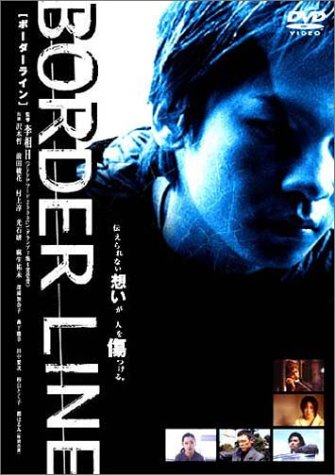
Border Line (Lee Sang-il, 2002)

border lineThroughout his career Lee Sang-il has shown himself adept at creating ensemble character dramas but nowhere is this as much in evidence as in his well crafted debut, Border Line. Focussing on the unlikely overlapping stories of a number of people who each find themselves crossing a threshold of a more spiritual nature, Border Line traces back each of the fractures in contemporary society to the broken cord of the parental bond.

We begin with teenage technical school student Matsuda (Sawaki Tetsu) who’s been in trouble for refusing to wear the required overalls. Later he runs away after his father is murdered only to be knocked down by drunken taxi driver Kurosawa (Murakami Jun) who ends up driving him half way to Hokkaido which is where he said he was from. Meanwhile, housewife Aikawa (Aso Yumi) has just started a new job at the combini but her son keeps skipping school and she soon realises it’s down to aggressive bullying. If that wasn’t enough, her husband has gone incommunicado after abruptly revealing via telephone that he lost his job a month ago and hasn’t found another one. Taking a step down to the underworld, we also meet low life gangster Miyaji (Mitsuishi Ken) who’s having a very bad as his partner ran off with the takings from a pachinko parlour to pay for expensive medical treatment for his daughter.

These are the lives of ordinary modern day people each facing extreme stress from all angles be they financial, societal, or existential. Matsuda is a young man and it’s only natural that he rebels a little to try and figure out who he is but it seems there may have been more going on in his life than just not wanting to wear a uniform. His mother left when he was a child and we don’t find out much about his relationship with his father but he spends the rest of the film looking for parental figures to essentially give him the permission to become an adult. The first of these is the taxi driver, Kurosawa, who, for various reasons isn’t able to help him (and only really decides he wanted to when it was too late). Finally, after a series of coincidences, he runs into Miyaji who is still grieving over having lost contact with his daughter after running out on his suicidal wife. Miyaji is not a great role model in many ways but still has some wisdom to impart to the younger man which may save his life in ways both literal and figural.

Miyaji and Aikawa are both coming from the other direction but struggling with their parental responsibilities. Aikawa has taken the job at the combini to help pay their mortgage – the house is very important to her as she was always ashamed of the modest home she grew up in with her parents. Like Miyaji, her husband seems to have more or less abandoned his family in his shame over losing his job, leaving Aikawa to bear all the responsibility for herself and her son. Eventually the pressure becomes so intense that Aikawa’s typical Japanese housewife persona starts to crumble resulting firstly in fantasies of violence before a crime filled rampage and kidnapping plot threaten to destroy what’s left of her life.

Back with the kids, another coincidence turns up Miyaji’s estranged high school aged daughter now also orphaned following the death of her mother leaving her with no other option than visiting hotel rooms with dodgy businessmen. Shunned at school and alone at home, hers is a lonely life marred by the failure of her parents. Both she and Matsuda, whom she eventually meets through another set of random coincidences, have had their futures ruined by poor parenting but, ironically, it maybe Miyaji who is able to help them even in his continued absence.

For a debut film, Border Line is a remarkably assured affair. Elegantly shot with decent production values, it handles its complicated set up with ease affording each of its distressed protagonists a degree of sympathy and understanding without the necessity of moral judgement. However, Lee does seem to want to lay the ills of modern society at the feet of the crumbling family unit only to present his younger protagonists with the idea of salvation as self actualisation. Decidedly low key, Lee’s debut film has a less commercial, deeper sensitivity than his subsequent efforts but still offers the compassionate sense of humanity which continues to inform his filmmaking.