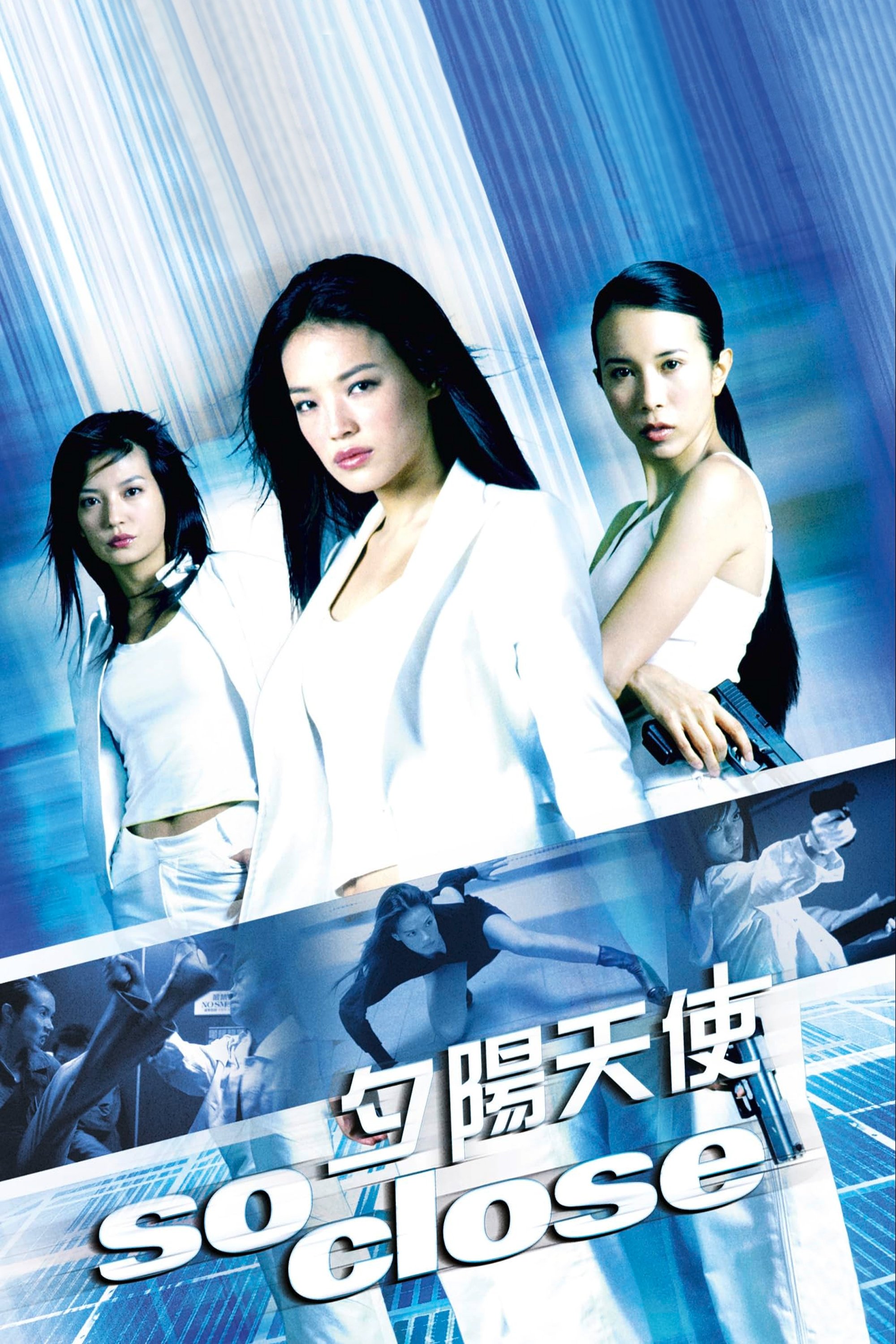
So Close (夕陽天使, Corey Yuen Kwai, 2002)

A latish entry in post-millennial cyber thrillers, Corey Yuen’s So Close (夕陽天使) finds two hit women sisters safeguarding next generation technology in keeping it out of the hands of corrupt businessmen who in fact murdered their father to get it. They claim he always intended to gift his all-powerful mass surveillance tool to the police, which either seems politically uncomfortable or incredibly naive, but have been using it themselves to earn their keep as killers for hire albeit justifying themselves in insisting on the moral bankruptcy of their targets.

In this case, that would be Chow Lui (Shek Sau) who according to “Computer Angel” made his “evil fortune” through drug smuggling. Infinitely smug, Chow thinks he has better technology but is soon proved wrong as Computer Angel admits she also sent the virus, or more accurately manifested it, to teach Chow a lesson. Yuen fills the film with 90s cyberpunk motifs, even having Computer Angel, later identified as Lynn (Shu Qi), jump off a building in a shot that is a clear homage to Ghost in the Shell while otherwise employing electronic imagery of cables and wires though the “World Panorama” system largely works through satellite.

In the opening sequence, Chow’s company is also revealed to be a global enterprise connected around a large table via the internet while futuristic systems allow him to have video calls with associates speaking Japanese and English. He suggests they simply pay the hackers to save their reputation which is apparently built on their world-class security systems though he himself perhaps remains sceptical abruptly shutting down his younger brother’s attempt to broker a deal investing in a company called Dragon. His office meanwhile has a bonsai tree in the background and his brother Nunn seems to have very close ties with a Japanese gangster hinting at a possible economic anxiety.

This fraternal conflict is eventually reflected in the fracturing relationship between the two sisters as field agent Lynn informs her sister Sue (Zhao Wei) that she wants to give up the killing trade after reuniting with an old boyfriend and deciding to get married. Techno wiz Sue has no other means of supporting herself and is resentful that Lynn always takes charge and won’t let her participate in missions, though Lynn is later vindicated when Sue’s hasty decision to take on a solo job goes just about as wrong as it can go. Meanwhile, their relationship is also strained by the presence of Hung (Karen Mok), a policewoman investigating Chow’s death who, as she later says, is strangely drawn to Sue who rollerblades around her at a record store with thinly concealed desire. 

There might be something in the fact that the actresses playing Sue and Lynn are from the Mainland and Taiwan respectively each performing their scenes in Mandarin but dubbed into Cantonese for the local release. They are indeed outsiders, firstly because of their unusual profession and secondly because of their all-powerful surveillance tool that allows them to carry out their missions yet also acting as a moral authority even if as Lynn later says they kill for money not conviction. World Panorama allows them to edit surveillance footage, placing fake avatars of themselves in the digital space and allowing them to otherwise recreate reality in a way that seems in keeping with the film’s otherwise low-key special effects which have an almost tongue-in-cheek quality parodying other more serious cyber thrillers from the mid-90s. 

The film’s English title comes from Yuen’s use of the Carpenters’ track (They Long to Be) Close to You, yet the Chinese is the more melancholy Sunset Angel which is most obviously refers to the film’s final scene if also perhaps calling time on the sisters’ roles of guardians of next-gen tech and avenging ghosts of the machine working out the bugs of corrupt gangster businessmen. In any case, they move through the “real” world like digital avatars performing incredible feats of human agility and not least in the high impact action scenes culminating in a lengthy katana fight in a tatami mat room which both echoes the cyberpunk aesthetics and reinforces an idea of corporatising colonialism finally blown away by the forces of female solidarity and an unlikely loves story between a soldier and a bandit. 


Trailer (English subtitles)

Fallen Angels (墮落天使, Wong Kar Wai, 1995)

4K

Wong Kar Wai may be associated with a melancholy existentialism but Chunking Express, filmed on the fly in an effort to shake off frustration during the famously difficult shoot on Ashes of Time, had been a breath of fresh air which characterised pre-Handover Hong Kong as a place of anxiety mired in nostalgia but also with tremendous energy and a fervent hope for the future. Its quasi-sequel, however, is the other side of the coin. If Chungking Express’ Hong Kong were heaven Fallen Angels (墮落天使) is its hell. 

As if to signal the connection between the two visions of Hong Kong, the twin protagonists of Fallen Angels each repeat the words of He Qiwu, cop 223, that daily one rubs elbows with a thousand strangers some of whom may later become friends or confidants, but this time around the words spell less of possibility than of a fatalistic inevitability. Indeed, the central drama occurs because melancholy hitman Ming (Leon Lai-ming), tired of his life, yearns for control after years of “lazily” allowing all of his decisions to be made for him. “The best thing about my job is there’s no need to make decisions” he explains, “who’s to die, when, where..it’s all decided by others.” “I don’t know whether it’s a good decision or not” he adds after vowing to make a change, “but at least it’s mine”. 

Good or bad it hardly matters, it is all decided. The protagonists of Fallen Angels live in a kind of purgatory of perpetual longing, looking for a connection which seems to elude them. Ming has been in a non-relationship with his “partner” (Michelle Reis), more of a handler, for 155 weeks, a “dating” method which seems to spell out his preoccupation with time. Despite their long association, however, the pair rarely meet in person, believing that “partners should never get emotionally involved with one another”. That’s something the unnamed partner later comes to accept, explaining that after moving on from Ming she’ll be careful to avoid becoming attached. Mirroring Chungking’s Faye, we find her in Ming’s apartment, sharing his space, tidying up for him, changing his sheets, and repairing his ansaphone but slipping past him at the train station careful that the streams do not cross. Yet she also tells us that sometimes she sits in his favourite seat at their favourite bar because it makes her feel close to him, avowing that sometimes it’s better not to get too close, find out too much about someone and you lose interest. “I know how to make myself happy” she adds, ironically resorting to just that, alone on Ming’s bed while he drifts into another non-relationship with a woman who dyed her hair blonde (Karen Mok) in the hope that it would make her memorable. 

The obsession with blondes recalls Brigitte Lin’s wigged assassin from Chungking Express, another “Blondie” bringing together mute ex-con Ho Chi Moo (Takeshi Kaneshiro), prisoner no. 223 neatly mirroring He Qiwu’s badge number in addition to sharing his nickname and having apparently lost his voice as a child after eating expired tinned pineapple, with his “first love” Charlie Young (Charlie Yeung Choi-Nei) who enlists his help to track down the treacherous young woman about to marry her ex. He later rubs elbows with a changed Charlie, dressed in a stewardess’ uniform ironically mirroring the romantic ending of Chungking Express seconds after Chi Moo’s clumsy mimicking of Faye’s iconic dancing, though she does not remember him. Like Ming, Chi Moo wants control over his life, deciding to be his own boss, but does even this partly out of resignation that his muteness makes it much more difficult to make the kinds of connections he longs to make. He lives parasitically making an illicit living “borrowing” other people’s businesses after hours and intimidating customers into buying his services, eventually losing two father figures in quick succession, thrusting him into an unsought adulthood in which he returns to his former life but tries to pick stronger businesses that won’t “get hurt easily”.

Despite its sense of defeat and melancholy, perhaps even a touch of nihilism, Fallen Angels does however end with a sense of peace and positivity even in that which may or may not be a transitory connection for the gentle warmth it imparts. Collaborating once again with Christopher Doyle, Wong’s underground Hong Kong is a purgatorial dreamland of infinite longing filled with the fatalism of a gangster noir in which there is no future and no freedom only loneliness and death punctuated with brief moments of warmth, but in those brief moments is perhaps a reason for living at least until one’s “expiration date” arrives. 


Transfer: The most radical of the 4K restorations, Fallen Angels is presented in a 2.35:1 aspect ratio, cropped from the 1.79:1 of the original release with the effect that the images appear further constrained while additional distortion occurs at the edges of the frame. In his introduction to the series, Wong offered the following comment on the aspect ratio change:

With Fallen Angels, I have changed the format to CinemaScope, because it was originally what I had intended to release the film in. When we were cutting the film, we accidentally turned the Steenbeck on anamorphic instead of standard. I felt that the film looked much more interesting because the setting[ck] enhanced the distance of the characters on top of the extreme wide angle that we shot with. Back then, it was impossible to shoot a film in standard and release it in anamorphic. With this restoration, we have successfully fulfilled this wish.

Additionally, while the film maintains the distinctive green tint in keeping with the house style of the new restorations, several scenes originally in colour have been regraded to monochrome while others originally in monochrome have been retouched with elements of colour.


Fallen Angels is currently available to stream in the UK via BFI Player in its newly restored edition as part of the World Of Wong Kar Wai season.

Restoration trailer (English subtitles)

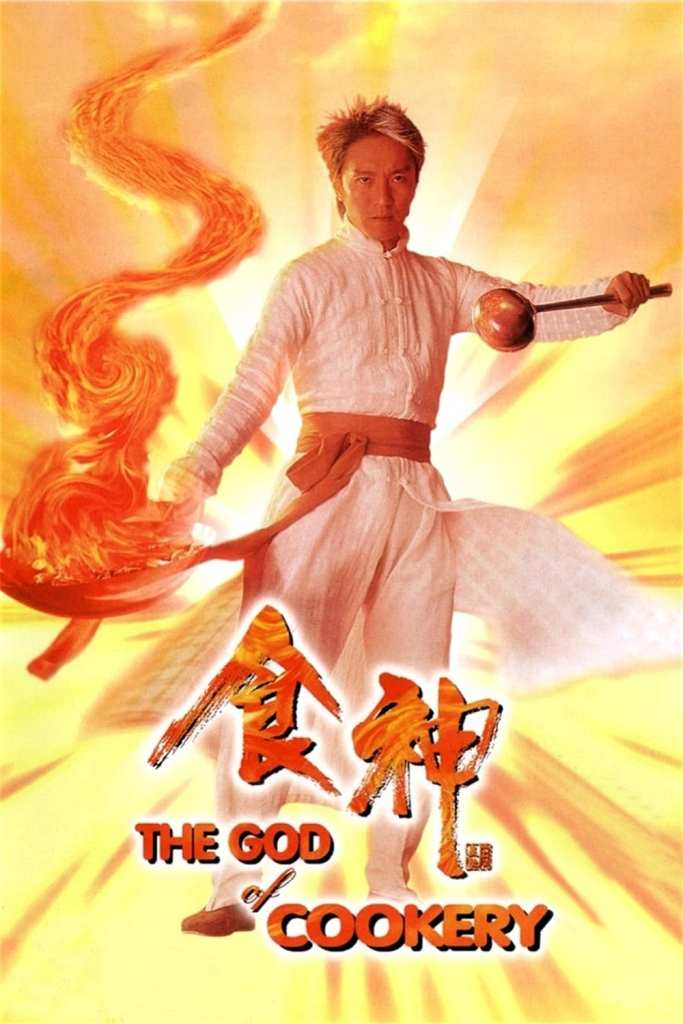
The God of Cookery (食神, Stephen Chow, 1996)

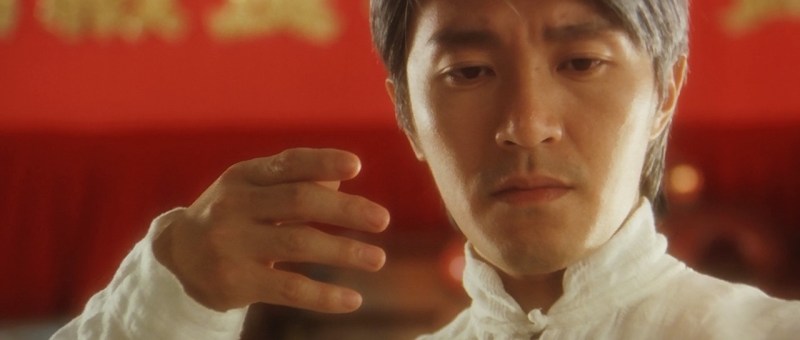
Thing about cooking is, you gotta have heart. At least, that’s the main takeaway from Stephen Chow’s 1996 culinary comedy God of Cookery (食神) in which he once again stars as a man who’s become rich and successful exploiting the talents of others but gets a major humbling when his duplicity is exposed by an even more duplicitous, though apparently talented, rival. Only by living among the people and rediscovering the simple joy of ordinary food cooked with love can he regain his true identity as the “God of Cooking”. 

Stephen Chow (Stephen Chow playing a character of the same name but written with different characters) has built up a successful food empire built around himself as a celebrity chef known as the “God of Cooking”. As a popular TV judge on a cooking competition, he makes a point of giving each of the contestants zero points, starting off with words of praise but eventually finding fault with “basic” techniques and even at one point complaining that it doesn’t matter how tasty the dish is because the chef is so ugly it’s made him lose his appetite. Chow treats his employees with total disdain, going so far as making a prospective hire defecate in public in front of a lift in return for a job, while schmoozing with Triads to expand his empire. The Triads, however, are getting fed up with him and have installed a mole in his organisation. Bull Tong (Vincent Kok Tak-chiu) is a talented chef who claims to have trained at the Chinese Culinary School on the mainland. He makes a point of causing public embarrassment to Chow by tearing apart one of his signature dishes at the press launch for the 50th branch of his branded restaurant chain. Chow is exposed as a talentless fraud and thanks to his haughty attitude, his friends abandon him. 

Penniless and destitute, he rocks up at a noodle stall run by Sister “Twin Daggers” Turkey (Karen Mok), critiquing her noodles in the same way Bull had torn apart his. Turkey takes pity on him after he’s beaten up by thugs and accepts him into her mini street gang. It’s Chow who finds an innovate solution to to her turf war with a rival stall holder in inventing the not entirely appetising “Pissing Beef Balls” which prove an instant hit with all who try them, even helping to cure those suffering with anorexia (apparently a widespread problem of the time, at least according to onscreen newspapers). Chow has not, however, lost his cynical streak and wants to get back to the top by opening a nationwide chain of Pissing Beef Ball restaurants, while Bull and the Triads begin to panic about his seemingly unstoppable success. 

Parodying both Tsui Hark’s Chinese Feast from the previous year, and Wong Jing hit God of Gamblers, Chow brings even more of his now familiar slapstick style, turning cookery into a kind of martial art, and even including a brief sequence in which he gets trapped inside the Shaolin Temple and ends up learning some of their patented culinary techniques. As the cynical top chef, Chow stands in for the evils of the age, puffed up on empty capitalism, openly telling his staff to pull dirty restaurant tricks like making the seats small and uncomfortable to increase turnover and filling the drinks with giant ice cubes to keep costs down and encourage guests to order more. Bull Tong, however, goes even further, beating the staff and suggesting they serve greasy, salt-laden dishes like French fries so kids order more soda, ignoring complaints from the chefs that it’s unethical to serve such obviously unhealthy food to children. 

Sister Turkey’s cuisine, by contrast, might not exactly be top table stuff but it makes no pretence of being anything other than it is. Her rival prides himself on using high quality ingredients, even making sure his oil is changed daily, making it plain that your average market hawker (whether he’s telling the truth or not) at least appears to have more concern for his customers than giant restaurant chains do. Turkey’s ordinary barbecue pork and rice dish with a side of egg is the best Chow’s ever tasted because it was made with kindness. He may have been fond of saying that you have to have heart to cook, but it was just one of his soulless catchphrases until he realised it was true. Good food, companionship, love, and a Christmas miracle slowly work their magic until the “God of Cookery” is finally restored thanks to a little celestial intervention, showing the Bull Tongs of the world exactly what they’re missing.


The God of Cookery screens in New York on Feb. 15 as part of this year’s New York Asian Film Festival Winter Showcase.