Sunshine of My Life (一路瞳行, Judy Chu, 2022)

A young woman comes to a better understanding of her family and her relationship with it after a series of crises some more serious than others in Judy Chu’s semi-autobiographical drama, Sunshine of My Life (一路瞳行). More a coming-of-age tale than an exploration of the difficulties faced by those with disabilities in the recent past, Chu’s heartfelt film nevertheless stresses familial solidarity as the heroine comes to realise that her misplaced resentment is mostly teenage angst and that at the end of the day her parents just want her to be happy.

Yan (Karena Ng) was born to two parents who are each blind. A perfectly ordinary though dangerous accident that could easily happen to a sighted mother leaves a toddler Yan scalded and unkind relatives questioning the couple’s decision to have a child at all implying it is somehow irresponsible and that they are incapable of caring for her. Nevertheless, Yan’s mother Hung (Kara Wai) resolves to do everything she can to keep her daughter safe beginning with attaching bells to her so she has a better idea of where she is and what she’s doing at all times. This early incident does in one sense colour Hung’s parenting style, constantly questioning herself as to whether she’s a good mother and preoccupied with the judgement of others all of which later feeds into her teenage daughter’s resentment as the older Yan grows tired of feeling responsible for her parents’ care. 

As a child, Yan had helped her parents by reading out menus and describing the world she sees around her but as a high school student she resents having to rush home after school rather than hanging out with her friends and also seems to be ashamed of her parents’ disability never telling anyone about her family and instead claiming that her mother is ill in hospital. She tells her art teacher that she just wants to get out of Hong Kong and doesn’t care where she goes so long as it’s far away while later telling her no good rich kid boyfriend that she’s searching for “freedom”. On one level she feels intense guilt for leaving her parents behind as if she were abandoning them, worried that they really can’t manage without her, but also fears for her own future and feels trapped as if she’s being asked to sacrifice her own hopes and dreams to stay by her parents’ side forever.  

Yan is indeed a teenage girl and has a slightly self-centred way of looking at things, never quite stopping to appreciate how difficult her parents lives can be in a conservative society that is often unwilling to accommodate difference. When her classmates all mock and jeer at a poster advertising a star gazing event for the blind all she can do is smile politely, and at one point she even walks straight past Hung waiting for her outside the school gates perhaps on one level simply embarrassed to have her mother meet her as any teenage girl might be but also anxious to hide her existence from her boyfriend. After being arrested by the police for illegal street selling, Yan’s father Keung (Hugo Ng) gets a job as a masseuse but is later exploited by his employer who tries to force him to sign a new contract accepting a 20% pay cut while increasing the manager’s commission. Keung refuses and is fired but vows to fight for the other workers to end discrimination against the blind and ensure they enjoy the same labour rights as sighted workers. 

Faced with a series of crises from a brush with criminality to her boyfriend’s sudden absence and her father’s failing health, Yan is forced to reconsider her relationship with her parents. On witnessing Hung stand up for herself and take her father’s corner Yan realises that she might have underestimated her mother’s capability and what she took for dependency was more a general sense of warmth in receiving care that made her life easier. Tinged with ’90s nostalgia from the ubiquitous cassette tapes Hung uses to record precious moments to pagers and pinups, Chu’s warmhearted drama finds a mother and daughter coming to a better understanding of each other as they both learn to embrace independence and freedom if in a slightly different way than originally anticipated.


Sunshine of My Life screened as part of this year’s Five Flavours Film Festival and is available to stream in Poland until 4th December.

Original trailer (Traditional Chinese / English subtitles)
An Inspector Calls (浮華宴, Raymond Wong & Herman Yau, 2015)

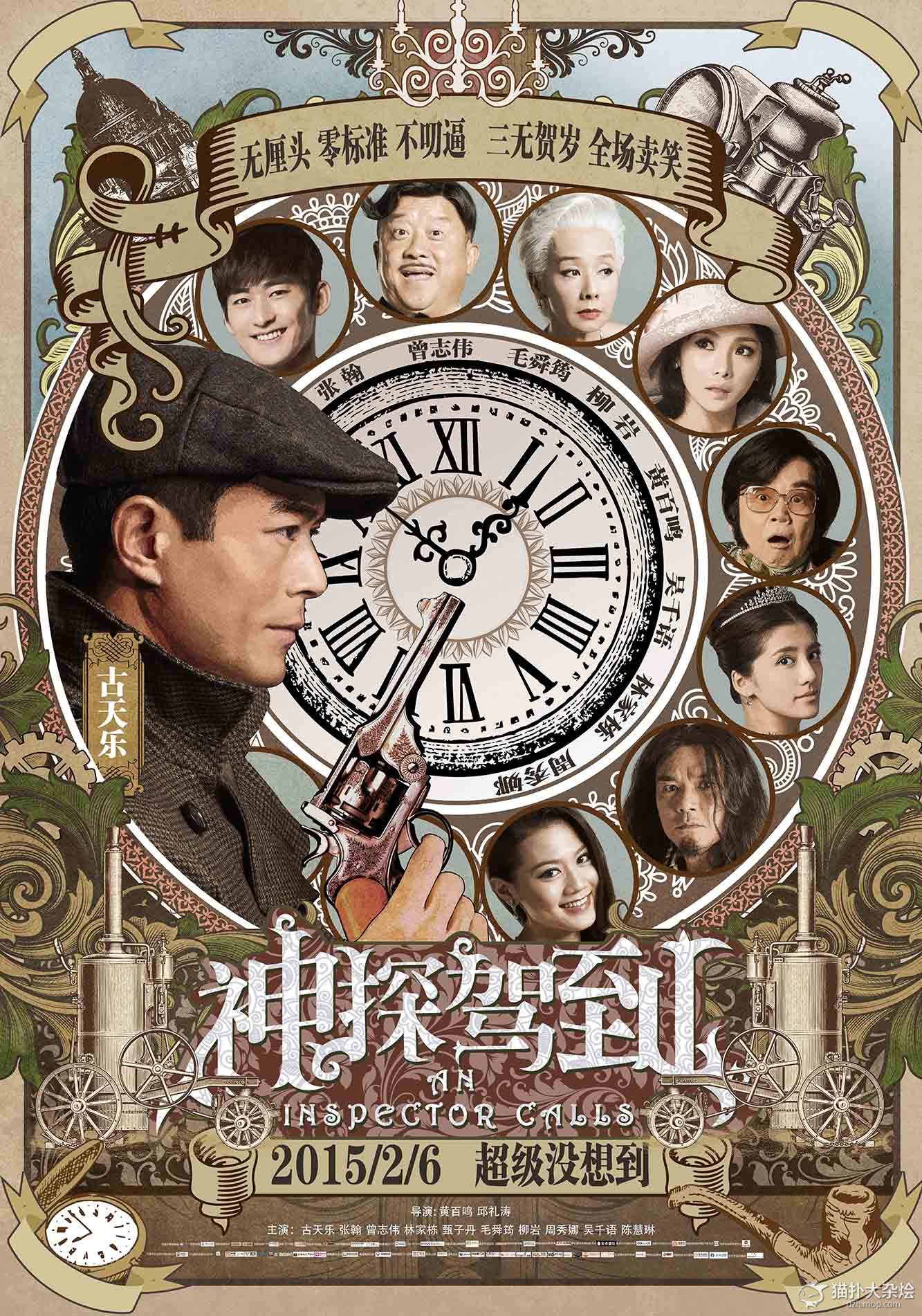
Inspector Calls poster 1J.B. Priestley’s An Inspector Calls found itself out of favour until a phenomenally successful stage production brought it back into the national consciousness in the early ‘90s, but even if some decry its inherent melodrama as a relic of another era the play’s comments on the entrenched classism of British society sadly still ring true. An Inspector Calls is many things, but one thing it defiantly is not is funny – a series of concentric tales of betrayals and oppressions, Priestley’s drama lays bare the callousness with which the privileged bolster their position through the story of one faceless factory girl standing in for an entire social class whose lives are often at the mercy of those “above” them.

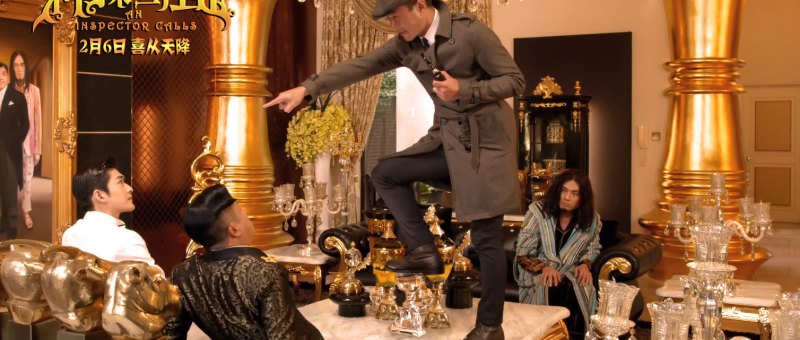
In adapting Priestley’s play as a Chinese New Year movie (a strange concept in itself), Herman Yau and Raymond Wong relocate to contemporary Hong Kong, re-conceiving it as a broad comedy of the kind one might expect for the festive period. The setup is however still the same. The Kau family will be receiving a visitation – this time from Inspector Karl (Louis Koo Tin-lok) who has some difficult news for each of them. Three hours previously, a young woman committed suicide in her apartment by drinking bleach, taking the child she was carrying with her. Inspector Karl views this as a double murder and, based on the diary they found at the crime scene, has brought the reckoning over to the Kaus’.

The Kaus, at the present time, are preparing an engagement party for daughter Sherry (Karena Ng) who will be marrying the handsome younger brother of a factory owner, Johnnie (Hans Zhang Han). What no one can know is that the family business is going under, the Kaus are broke, mum and dad don’t get on, and all of this finery is merely rented affectation. The only member of the family who still seems to have something like a social conscience – Tim (Gordon Lam Ka-tung), the 27-year-old younger son, is viewed by all as a feckless and naive hippy, hiding out in his childhood bedroom, still all fluffy cushions and toy soldiers.

As the Inspector explains, he holds Mr Kau (Eric Tsang Chi-wai) responsible because the woman once worked in his factory and he fired her for participating in a strike for better pay and conditions. Sherry got her fired too when she worked in an upscale fashion store. Johnnie knew her during an unfortunate period as a bar hostess, and Tim as a masseuse. Mrs Kau (Teresa Mo Shun-kwan), who heads up a woman’s charity and publicly espouses tolerance while privately judgmental, once turned her down for familial support seeing as the father of her child was still living. She advises holding him to account and if he won’t pay, forcing his family to take responsibility on his behalf. The irony being that the father is likely her own son and that if this poor woman had rocked up at the Kaus’ with a sad story and an infant in her arms, she would have been met with nothing more than contempt save perhaps some hush money to send her on her way.

The Kaus are merely a series of examples of the various ways the wealthy mistreat the poor, wielding their sense of entitlement like a weapon. Yau and Wong adopt an oddly Brechtian approach in their expressionist production design with the faceless masses identified only through titles – the word “labour” on the workers’ caps, “manager” in the fashion store, “secretary” at the foundation. None of these people are really worthy of names because they will always be “less” while the Kaus are “more” in more ways than one. Actions, however, have consequences. The family console themselves that this is all far too coincidental, that they couldn’t all have known the “same” woman in different guises, but that in many ways is the point – she isn’t one woman but all women, used, abused, and discarded not only by heartless men but by jealous and judgemental members of her own sex too. Better than her than me, they might say, but that’s no way to run a healthy society as the sensitive, slightly damaged Tim seems to see.

Like the Birlings, the Kaus attempt to brush the Inspector’s warning off, thinking it’s all been some elaborate prank that can they laugh about and then forget, but there will be a reckoning even if they attempt to gloss over the various revelations regarding their moral failings. Wong and Yau’s vague gesturing towards the outlandish greed of the hypocritical super wealthy is undercut by the ridiculous New Year slapstick of it all despite the Metropolis-like production design and expressionist trappings, giving in to an excess of its own in an extremely unexpected musical cameo from a martial arts star and the decision to end on a social realist photo of an innocent, pigtailed proletarian woman dressed in red. Nevertheless, strange as it all is the bizarre adaptation of Priestley’s play has its own peculiar charm even if it’s outrageousness rather than moral outrage which takes centre stage.


Currently available to stream online via Netflix in the UK and possibly other territories.

Original trailer (English / Traditional Chinese subtitles)