Shinobi No Mono 6: The Last Iga Spy (忍びの者 伊賀屋敷, Kazuo Mori, 1965)

Though there’s a clear divide between the first three films in the Shinobi no Mono series and those that followed, one thing that remained constant is that time passed. By the sixth instalment, we’re already in 1637 which is more than 50 years after the setting of the first film which began in 1575 at the tail end of the Warring States era. Hero of films four and five, Saizo had been desperate to return to the chaos of the pre-Seikgahara society in which the ninja could indeed hold sway though as he discovered the pax Tokugawa was definitely here to stay. 

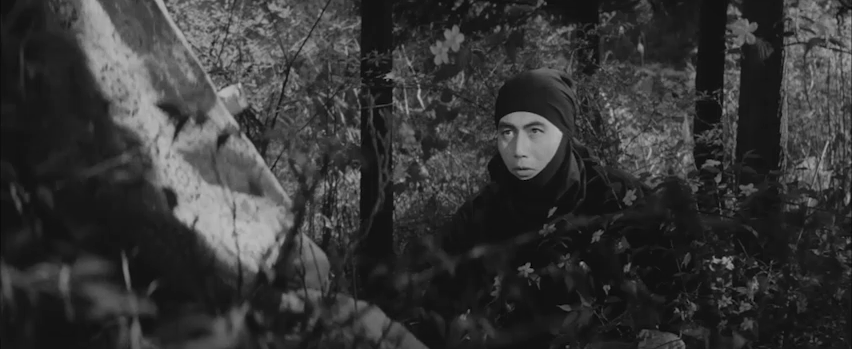
Given that Saizo would now be an old man, the torch is passed to his son, Saisuke (Raizo Ichikawa), who like his father opposes the Tokugawa but also has a desire for revenge against the corrupt petty official who killed him during the battle of Shimabara which definitely sealed the Tokugawa victory. Ieyasu may be dead, but the regime has only become more oppressive while it seems there is still enough intrigue to provide work for the jobbing ninja only now it’s taking place largely within the palace in the de facto one party state of the feudal society. 

On the other hand, there is a degree of destabilisation and societal flux as the old class system struggles to adjust to a world of peace. The nation is filled with disenfranchised samurai and ronin who largely have no real options to support themselves other than becoming mercenaries or taking odd jobs from various lords in the hope of eventually being taken in as a permanent retainer. It’s these ronin that Saisuke, and the rebellion’s leader Yui Shosetsu (Mizuho Suzuki), hope to marshal in convincing them to rise up against Tokugawa oppression and regain at least a little of the freedom their immediate forebears enjoyed.

The evils of this system can be seen in an otherwise sympathetic lord’s insistence that his underling will have to take the blame and commit seppuku if his decision to help the rebels is discovered. As Saisuke later remarks, the era of human knowledge rather than weaponry is already here and battles are largely being fought over parlour games played in court. At this point, the shogun’s sudden demise leaving only an 11-year-old son has opened a power vacuum that allows unscrupulous lords, like Saisuke’s enemy Izu (Isao Yamagata), to exercise power vicariously. Izu has used it to enrich himself by exploiting desperate ronin and spending vast sums on personal projects, yet he proves himself a true politician in effortlessly covering up for the lord who tried to help the rebels doubtless knowing that he now has him in his pocket for life.

Seemingly returning to the low-key social principles of the first few films, Saisuke’s rebellion is also towards the inherently unfair system complaining that the battle for power is a monster that feeds on courage and will crush conscience like an insect. But as Izu says, times have changed and the struggle cannot be ended even if Saisuke argues that anything manmade can be dismantled. Saisuke has to admit that he’s been outplayed, the leader of the revolution also turns out to be corrupt, taking advantage of other people’s desperation and dissatisfaction to enrich himself while Izu’s plotting has left him largely blindfolded as a ninja clearly out of his depth in the new and confusing world of the Tokugawa hegemony. A powerful man is always looking for a victim, he reflects, perhaps echoing the plight of Goemon unwittingly manipulated by the duplicitous Sandayu while admittedly somewhat drunk on his own misplaced sense of self-confidence. 

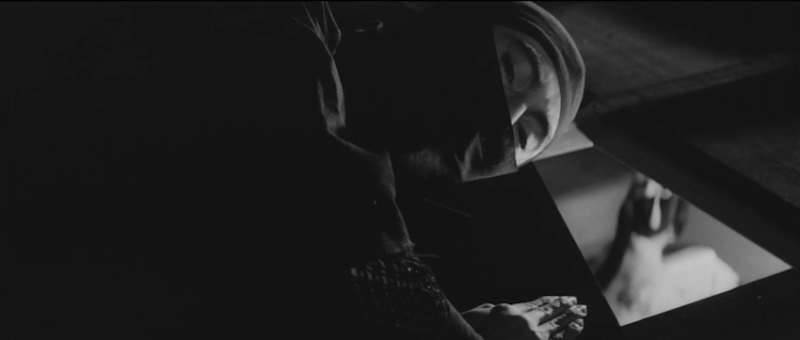
Deviating a little from the realism of the series as a whole, the film shifts into more recognisably jidaigeki territory revolving around corrupt lords and an exploited populace even if in this case it’s the disenfranchised warrior class experiencing a moment of mass redundancy though apparently unwilling to resist. Peep holes behind noh masks add a note of quirky innovation to the backroom machinations of the Tokugawa regime while silent ninja battles and flaming shuriken add to the sense of noirish danger even as it becomes clear that the ninja is approaching a moment of eclipse, no longer quite necessary in a world of constant duplicity.  

Hush! (ハッシュ!, Ryosuke Hashiguchi, 2001)

hushThe family drama is a mainstay of Japanese cinema, true, but, it’s a far wider genre than might be assumed. The rays fracture out from Ozu through to The Family Game and Crazy Family which sought to ask a few questions about where the idea of “family” was headed in a society of rapidly increasing materialism. Ryosuke Hashiguchi comes at the idea from a different angle in 2001’s Hush! (ハッシュ!) as he once again takes the perspective of the gay community and asks if the “traditional family” is about to change – what could, or should, survive if the old, rigid ideas can be remade into something lasting created out of love and acceptance rather than obligation?

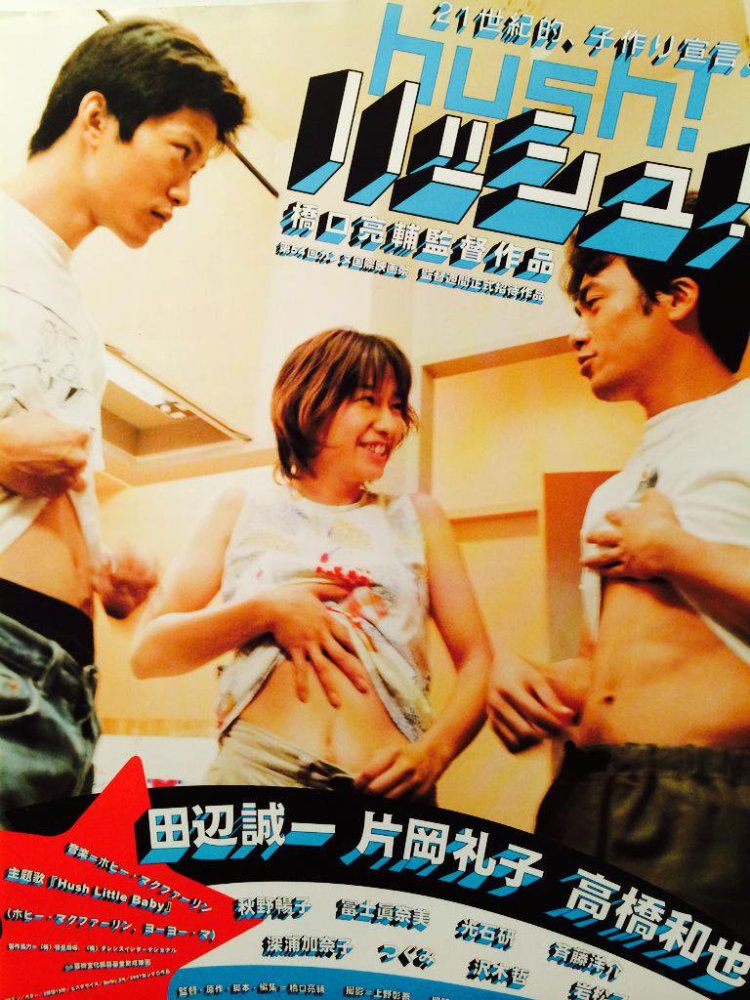
As the film begins, Naoya (Kazuya Takahashi) wakes up to find his one night stand already fully dressed and heading out the door, awkwardly, without even stopping to say goodbye. Eventually he hooks up with the kindly Katsuhiro (Seiichi Tanabe) and the two quickly become fairly serious but then a damaged woman, Asako (Reiko Kataoka), enters their lives hoping to use Katsuhiro as a sperm donor, forcing the men to reassess a number of important desires and beliefs, putting strain on their still fledgling relationship. If that weren’t enough drama, a girl at Katsuhiro’s place of work has also developed a crush on him and is prepared to take her unreturned love to some extremely dark places.

The first level of mini stresses Naoya and Katsuhiro have to contend with is their conflicting (if complementary) personalities and attitudes to their sexuality. Naoya is an easy going type with a job at a pet grooming salon. He’s a fully out gay man and a frequenter of city’s gay scene. Katsuhiro, by contrast, is much more mild mannered and innately kind. He works at a scientific research station and is more or less closeted – that is, he doesn’t particularly go out of his way to hide his sexuality from his work mates and family but he doesn’t volunteer the information either. This attitude seems to bother Naoya at various points but being the easy going type he’s apt to let it go most of the time.

However, when Katsuhiro reveals Asako’s offer, Naoya is actively against it. His idea of gay life suggests that relationships are generally short, he prefers the relative freedom of his life as an essentially “single” man rather a husband shackled to a family. Katsuhiro on the other hand perhaps would have liked children, or to be a father figure to someone else’s. Though Naoya has previously expressed boredom and disillusionment with his life spent in clubs and gay bars, he’s still resistant to the idea of settling down, or at least to the belief that a single relationship really can stay the course.

All three of the central characters have, in a sense, been let down by the “traditional” family. Naoya’s father left when he was small, leaving him with a single mother which is something that wasn’t so common when he was a child resulting in a fair amount of social stigma from other people in the community. These days his brassy mother knows about his sexuality and seems OK with it (aside from getting the random idea that Naoya will be wanting a pair of breasts at some point). Katsuhiro’s father was an alcoholic who died when he was just a small boy, his relationship with his brother and his family seems good but he’s afraid to reveal his sexuality to them for fear of disapproval. His brother had an arranged marriage, which doesn’t seem to have worked out so well at least from the sister-in-law’s perspective. Asako has also had a troubled life looking for affection in all the wrong places, feeling that if she had not been neglected as a child perhaps she’d have been a steadier adult. Naoya was running away from the idea of family ties, but Katsuhiro and Asako are actively seeking to repair the ones which never grew into the kind of roots one needs to anchor onself in a society entirely built around familial bonds.

After receiving some surprising medical news, Asako perversely decides that her own salvation lies in becoming a mother. She’s had enough of casual relationships and decided to go a different route so when she spots the kind look Katshiro gives a small child at a restaurant, she decides he must be the one to father her baby. Asako knew that Naoya and Katsuhiro were a couple, but that works out pretty well for her plan so she approaches him and makes her left field offer right off the bat. It will take some figuring out but this literal third way is a neat solution to a series of problems and, being completely new, is safe from the pettiness and misery often found within the traditional family unit. Contrasted with the bitterness displayed by Katsuhiro’s sister-in-law, the unusual arrangement of these three would be parents and their unborn child(ren) is one filled with love, forgiveness and mutual support rather than cold obligation or a simple fulfilment of societal expectations.

Once again Hashiguchi proves himself adept at creating a series of complex, flawed human beings who are nevertheless relatable and often endearing. Hashiguchi’s films tend to run long but he also ensures that even his supporting characters are well enough drawn to maintain interest in the many subplots from Naoya’s abrasive gay bar buddy to Katsuhiro’s unhinged stalker. An interesting sideways look at the state of the modern family, Hush! seems to advocate that just shutting up and going with the flow is not the answer but there are quieter solutions to be found if everyone is willing to listen to the silence.


Original trailer (no subtitles)