Festival Champ (お祭り野郎 魚河岸の兄弟分, Norifumi Suzuki, 1976)

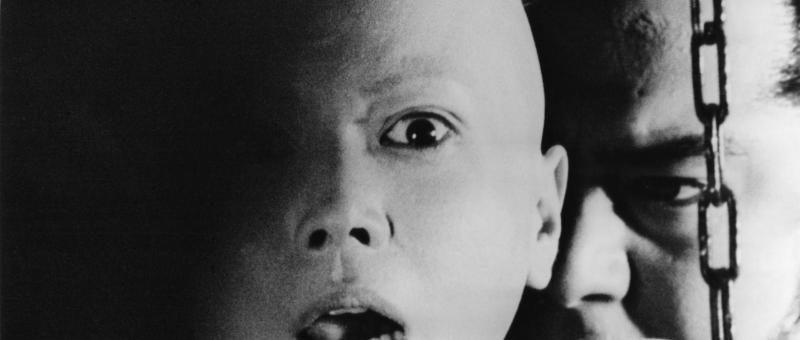
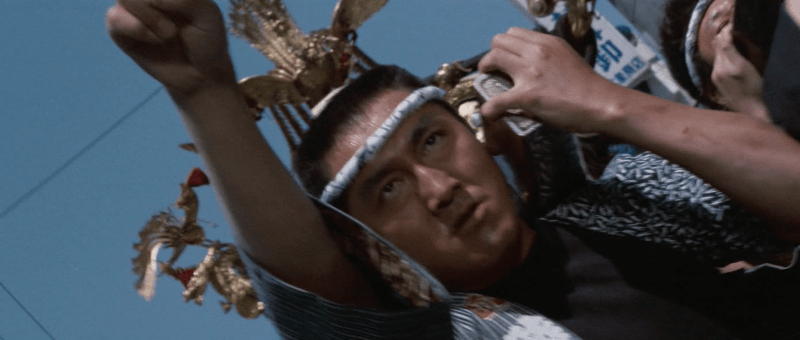
Who doesn’t love a festival? The hero of Norifumi Suzuki’s Festival Champ (お祭り野郎 魚河岸の兄弟分, Omatsuri yaro: Uogashi no Kyodai-bun) loves them so much that he travels all over Japan to help out in places where young men have become thin on the ground thanks to increasing urbanisation and rural depopulation. Following the success of Suzuki’s entries in the Truck Yaro series in 1975 and 1976, the film was part of a new line of comedies and sports movies launched by Toei as well as a vehicle for Hiroki Matsukata who was trying to move on from yakuza movies.

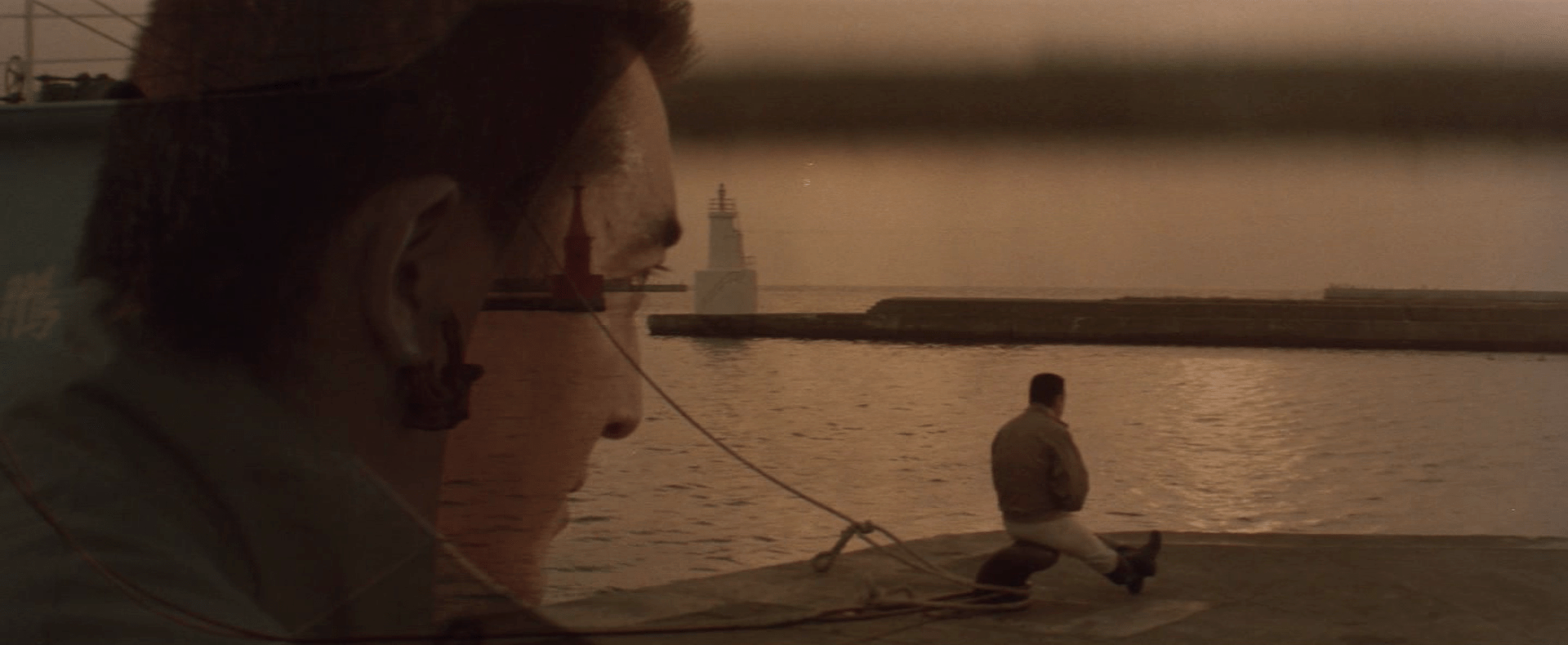
Katsuo (Hiroki Matsukata) is however something of a goodhearted bruiser who is always getting into manly scraps and especially at the festivals he travels to which is a pretty good hook for an ongoing series. But it’s not all that great for his employer who runs a family fishmonger’s at the Uogashi fish market and complains that Katsuo’s always running off and causing trouble. The fish market itself takes on an exoticised quality in the opening sequence which features a voice over from karate queen Etsuko Shihomi, here in a purely dramatic role, who is the daughter of a well-to-do traditional Japanese restaurant and travels there daily by speedboat to pick up the best fresh fish available. Suzuki throws in some documentary-style stock footage and statistics about the market that lend a strangely corporate feel, but then homes in on its capacity as a community hub. Kiyoko says it’s her favourite place precisely because there’s nothing formal about it. Deals are done through body language and you don’t need any kind of resume to work there, everyone’s welcome. 

That may be the implied contrast between Kiyoko’s father, who owns an upscale place and cultivates genuine relationships with local fishermen and brokers, and local boy made good Kurosaki who has supposedly become the CEO of a restaurant chain, itself a symbol of the soulless corporation of ‘70s Japan. Kurosaki rocks up dressed like a yakuza, but everyone treats him as a successful businessman and in part thanks to Katsuo’s boss Zenjiro’s recommendation is eager to make deals with him but predictably he’s running a huge scam that could destroy the local economy. Zenjiro is later faced with the difficult decision of selling his family business to repay all the other fishermen and brokers that have fallen foul of him. 

It’s this societal sense of unfairness that stripper Kumi (Terumi Azuma) hints at when she says she feels “frustrated” and that her long-lost brother Eiji (Toru Emori) probably feels even more frustrated than she does after he slaps her having found out that she’s become a burlesque dancer. As she points out to him, he ran away from home and left her behind with the aunt that was cruel to them so what exactly he expected her to do is a mystery. In the end, it’s his own fault for abandoning her, so he has no leg to stand on in criticising her for the way she’s lived her life. Kumi is well accepted in the local community and walks around in very elegant attire which gives her the air of an “ojosan” or upperclass lady to much greater extent that Kiyoko has in her love of the earthy world of the fish market. The fact that she turns out to be suffering from a tragic terminal illness perhaps only reinforces this sense of unfairness, that the modern world has essentially poisoned her and she can no longer survive in it.

The only things that give her solace are Katsuo and the idea of joining in carrying a shrine festival which would seem to be ways of reconnecting with a more essential Japaneseness. Despite his rowdiness, Katsuo is as she describes him the kindest person she’s ever met and a more positive vision of a still traditional masculinity that looks to protect the community and those around him. He gets into a fight with Eiji, but after exchanging a few blows the men become firm friends, while it’s trying to hook his wimpy friend Kinichi up with a date that brings him to Kumi in the first place. Meanwhile, it seems like Ayuko (Junko Natsu) has a crush on him and despite Zenjiro’s exasperation with Katsuo, everyone expects that he will eventually marry her and take over the family business. 

And so, it’s only a violent, but also quite funny, intervention from Katsuo that can eventually overcome the disruption Kurosaki threatens. Suzuki throws in a lot of his trademark weirdness including all of Zenjiro’s other daughters having fishy names, and a local sex worker who is insatiably aroused by octopuses followed by a gag in which Katsuo is trolled with a suggestive-looking shellfish, but mostly rests on a sense of qualified wholesomeness and community all carried on Katsuo’s broad shoulders as the lone guardian of a more essential Japaneseness otherwise uncorrupted by venal post-war capitalism.


*Norifumi Suzuki’s name is actually “Noribumi” but he has become known as “Norifumi” to English-speaking audiences.
Female Yakuza Tale (やさぐれ姐御伝 総括リンチ, Teruo Ishii, 1973)

Having completed her quest for revenge, Ocho (Reiko Ike) returns in Female Yakuza Tale (やさぐれ姐御伝 総括リンチ, Yasagure anego den: Sokatsu Lynch) once again swept up in intrigue after being framed for a bizarre series of murders. With Teruo Ishii taking up the reins from Norifumi Suzuki, the film has a slightly more realistic aesthetic making frequent use of handheld particularly in the narrow backstreets of the late Meiji Society while eventually taking a bizarre detour into the cruel world of an early 20th century mental health institution. 

In any case, Ocho’s troubles start when she’s met at Kobe harbour by a woman who says she’s come to fetch her. On arrival at her destination, Ocho is chloroformed and sexually assaulted by three men who evidently think she’s think she’s someone else and decide to get rid of her after realising their mistake. She wakes up next to the dead body of another woman and is in danger of becoming the prime suspect in a series of murders the subtitles don the “crotch-gauge” killings. After managing to escape, she sets about trying to find out who set her up and what’s going on while getting involved in a succession crisis in the Ogi in which the old boss who was once good to her has been killed. 

Though with much less political subtext, the film nevertheless indulges in the Sinophobia common in many similarly themed dramas in revealing a Mr Lee of Yokohama to be a major player in a drug trafficking scam in which women are forced to smuggle drugs in their vaginas after the gang gets them hooked to manipulate them. Besides Ocho, another woman dressed eerily like Sasori in a black wide brimmed hat and loose dress known as “Yoshimi of Christ” is also on their tail and seeking revenge while echoing some of the religious themes of the first film. She later teams up with recently released yakuza Jyoji who is looking for the daughter of the old boss who has gone mysteriously missing while he is also convinced that present boss Gondo had something to do with it along with the old man’s death. 

This is however mainly a tale of female revenge, Ocho’s being on the yakuza who cut off the Old Boss’ finger after he stood up for her as a teeanger whens she was caught cheating at a gambling den. Nevertheless, what eventually emerges is a sense of female socildairy as Ocho, Yoshimi, and the other women abused by the gang come together to free themselves from its grasp in a strange orgy of violence utilising eerie green lighting to lend it an almost supernatural dimension even if in the end the final blow is struck by a man and not without a little irony. 

This sense of unreality otherwise out of keeping with the immediacy of Ishii’s handheld camera is also seen in the mental institution to which the film eventually travels, a foggy gothic building echoing the Western mansion in the first film but similarly filed with oppressed and abused women sent mad by a patriarchal society or perhaps merely sent there to become so by men who wanted them out of the way. Gondo himself seems to be a regular visitor bringing along his own electroshock machine but finally resorting to using his bare hands in order to tie up a loose end and preserve his own position as head of the clan. 

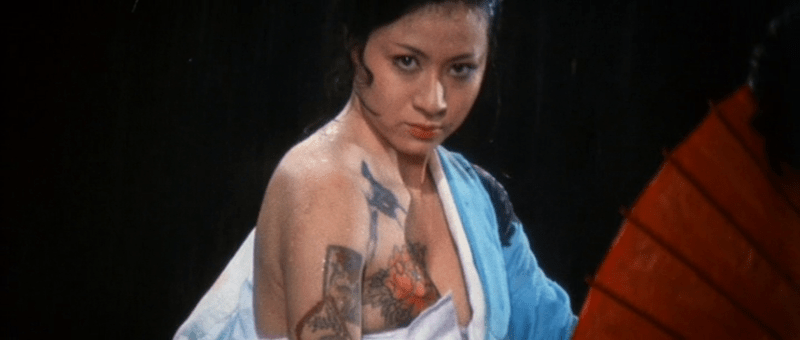
Ocho is not above using her sexuality to manipulate him, while Ishii maintains the naked sword fights from the first film both from the balletic opening of Ocho and her parasol to the chaos of the final sequence as the women come together to take their revenge as one. Perhaps strangely there isn’t an awful lot of gambling in the film, but Ocho nevertheless makes good use of her trademark hanafuda cards while in a moment of symmetry it’s the wife of her target who eventually settles the matter in a more diplomatic fashion by subjecting herself to the same humiliation to which Ocho had been subjected to bring the circle to a close. Having once again stood up against corrupt crooks and greedy men, Ocho later takes her sisters with her as she walks off this time into the sunset rather than the dark. 


Original trailer (no subtitles)

Bohachi Bushido: Code of the Forgotten Eight (ポルノ時代劇 忘八武士道, Teruo Ishii, 1973)

A nihilistic ronin falls into the hellish trap of the Yoshiwara in Teruo Ishii’s dazzlingly psychedelic period drama, Bohachi Bushido (ポルノ時代劇 忘八武士道, Porno Jidaigeki: Bohachi Bushido). Adapted from a manga short by Kazuo Koike, the film once again tackles Edo era corruption as a brothel owner with a special connection to the shogun attempts to wipe out the competition presented by an enterprising merchant class only to find himself hoist by his own petard.

Ishii signals his intentions early on with the artfully staged opening scequence in which wandering ronin Shino (Tetsuro Tanba) is attacked on a bridge at dusk. As he turns to slash at an opponent, the blood splatter morphs into the film’s title while the clang of swords gives off little blue sparks that turn into the listings for the cast and crew. By the time the title sequence has concluded, night has descended on the bridge and Shino finds himself engulfed in darkness. “To die is hell, but to live is also hell” he exclaims as he jumps into the water below, hoping to be free of his empty life of killing. 

Unfortunately, he is rescued and brought to the Yoshiwara where they try to persuade him to join the Bohachi clan so called because to do so you must abandon all eight human virtues. The Bohachi’s main line of work is the sexual torture of women until they become docile dolls for their brothel. Shino describes them as “revolting” but then adds “just like me” and agrees to join anyway only to earn their mistrust when he refuses to play along with their games, buying but not sleeping with a woman brought in over a debt. Though Shirakubi, the guy who recruited him, tries to kick Shino out and calls the police on him for good measure, the big boss, Shirobe (Tatsuo Endo), decides he’ll take him in for use as an attack dog taking down anyone who interferes with business be they lords or officials. 

The irony is that the nihilistic Shiro enthusiastically takes to his work because he dislikes the debauchery of the Edo-era society even while working for the “legitimate” brothel owner who is at least “licensed” to exploit women for financial gain. What Shirobe resents is the rise of quasi-brothels in the various teahouses that are obviously selling more than just tea but continue to undercut his business by selling women even cheaper than he does. He also feels betrayed by the various samurai lords who choose to visit the teahouses over his own establishment and therefore seeks to have them frightened into submission by ordering Shino to kill any man found with one of the tea house sex workers. Later he even declares a kind of sex worker amnesty promising to pay five ryo for any of the teahouse women brought to him, no matter by who, and then joking that he’s actually killing two birds with one stone by getting his hands on a high quantity of new stock for a very low price. 

Shino refuses to sleep with the women and is most offended when his male assistant is killed in an attack by the rival brothel owners yet the team of warrior women sent to protect him did nothing to help because their orders were only to protect Shino and Shirobe’s orders must be followed to the letter on the pain of death. He seems to know he’s living on borrowed time and Shirobe probably intends to finish him off once he’s finished his mission of removing all opposition and restoring Shirobe’s power to manipulate the shogun but barely does anything to resist until faced with the rather ironic punishment of being given opium and then forced to participate in a never-ending orgy intended to result in his death in an extraordinary psychedelic sequence from Ishii . 

Of course, what they didn’t reckon on was Shino’s ironic desire to live or at least not to be beaten in which he actively begins stabbing himself to overcome withdrawal symptoms and carry on fighting even when they try to ram him with a giant spear cart. Ears are cut off, flying across the screen followed by arms and then heads. Ishii lends a poetic sheen to the closing moments as Shino is caught in a hero pose alone in the snow but still standing, if barely, and freed at least from one kind of hell if not from many others. 


Hanzo the Razor: The Snare (御用牙 かみそり半蔵地獄責め, Yasuzo Masumura, 1973)

Hanzo the Razor the Snare posterYasuzo Masumura had spent the majority of his career at Daiei, but following the studio’s bankruptcy, he found himself out on his own as a freelance director for hire. That is perhaps how he came to direct this improbable entry in his filmography on the second of a trilogy of exploitation leading jidaigeki films for Toho. Essentially a vanity project for former Zatoichi star Shintaro Katsu who both produces and stars in the series, Hanzo the Razor: The Snare (御用牙 かみそり半蔵地獄責め , Goyokiba: Kamisori Hanzo Jigoku Zeme) is another tale of the well endowed hero of the Edo era protecting ordinary people from elite corruption, but Masumura, providing the script himself, bends it to his own will whilst maintaining the essential house style.

Hanzo (Shintaro Katsu) chases a pair of crooks right into the path of treasury officer Okubo. As expected, the lord and his retainers kick off but Hanzo won’t back down, shouting loudly about honour and justice much to his lord’s displeasure. Eventually Hanzo takes the two crooks into custody and they tell him exactly what’s happened to them this evening – they snuck over from the next village to steal some rice from the watermill but they found a dead girl in there and so they were running away in terror. Hanzo investigates and finds the partially clothed body still lying in the mill untouched but when he takes a closer look it seems the girl wasn’t exactly murdered but has died all alone after a botched abortion. Realising she smells of the incense from a local temple, Hanzo gets on the case but once again ends up uncovering a large scale government conspiracy.

Though it might not immediately seem so, Masumura’s key themes are a perfect fit for the world of Hanzo. In his early contemporary films such as Giants & Toys and Black Test Car, Masumura had painted a grim view of post-war society in which systemic corruption, personal greed, and selfishness had destroyed any possibility of well functioning human relationships. It was Masumura’s belief that true freedom and individuality was not possible within a conformist society such as Japan’s but this need for personal expression was possible through sexuality. Sex is both a need and a trap as Masumura’s (often) heroines chase their freedom through what essentially amounts to an illicit secret, using and manipulating the men around them in order to improve their otherwise dire lack of agency.

Hanzo’s investigation takes him into an oddly female world of intrigue in which a buddhist nun has been duped into becoming a middle-woman in a government backed scheme pimping innocent local girls to the highest bidder among a gang of wealthy local merchants. Hanzo berates the parents of the murdered girl for not having kept a better eye on her, but these misused women are left with no other recourse than the shady protection of others inhabiting the same world of corrupt transactions such as the local shamaness who has developed a “new method of abortion” just as Hanzo has developed a “new method of torture” which involves a bizarrely sexualised ritual in which both parties must be fully naked before she enacts penetration with her various instruments. Hanzo first tries more usual torture methods on the nun before indulging in his trademark tactic of trapping her in a net to be raised and lowered onto his oversize penis which he keeps in top notch by beating it with a stick and ramming it into a bag of rough uncooked rice.

Unlike the first film, the women are less ready to fall for Hanzo’s giant member. The nun complains loudly that her Buddhist vows of chastity are being violated while Hanzo’s later rape of the woman who runs the local mint is a much more violent affair. Hanzo grapples with her legs as she struggles, gasping as he opens his loincloth and reveals his surprisingly large appendage, once again playing into the fallacy that all women harbour some kind of rape fantasy. Hanzo has done this, he claims, to “calm her down”, because he could sense her sexual frustration and desperate need for male contact. To be fair to Hanzo, he does appear to be correct in his reading of the woman’s behaviour as she sheds her anxiety and becomes a firm devotee of the cult of Hanzo.

Meanwhile, political concerns bubble in the background as the main conspiracy revolves around consistent currency devaluations which are placing a stranglehold on the fortunes of the poor while their overlords, who are supposed to be protecting them, spend vast sums on claiming the virginity of innocent young girls. Hanzo may be a rapist himself (though he makes it clear that he derives no pleasure from his actions and only gives pleasure to the women involved), but he draws the line at the misuse of innocents, saving a little girl about to be violated by the master criminal Hamajima (Kei Sato) in a daring confrontation in which he boldly brings his own coffin, just in case.

Masumura broadly sticks to the Toho house style, but gone is the camp comedy of the first instalment with its giggly gossipers and humorous shots of Hanzo’s permanently erect penis. Instead he opts for an increase in sleazy voyeurism, filling the screen with female nudity whilst neatly implicating the male audience who enjoy such objectification by shooting from secretive angles as his collection of dirty old men crowd round a two way mirror to watch the lucky winner torture and abuse the soft young flesh they’ve just been bidding on. Like Sword of Justice, The Snare also ends with a slightly extraneous coda in which Hanzo settles a dispute with another official by means of a duel he would rather not have fought. Walking off bravely into the darkness, Hanzo utters only the word “idiot” for a man who wasted his life on petty samurai pride. Hanzo has better things to do, protecting the common man from just such men who place hypocritical ideas of pride and honour above general human decency in their need for domination through fear and violence over his own tenet of unrestrained pleasure.


Original trailer (no subtitles)

https://www.youtube.com/watch?v=2qwRTC0p3mM

The Bullet Train (新幹線大爆破, Junya Sato, 1975)

bullet train posterFor one reason or another, the 1970s gave rise to a wave of disaster movies as Earthquakes devastated cities, high rise buildings caught fire, and ocean liners capsized. Japan wanted in on the action and so set about constructing its own culturally specific crisis movie. The central idea behind The Bullet Train (新幹線大爆破, Shinkansen Daibakuha) may well sound familiar as it was reappropriated for the 1994 smash hit and ongoing pop culture phenomenon Speed, but even if de Bont’s finely tuned rollercoaster was not exactly devoid of subversive political commentary The Bullet Train takes things one step further.

A bomb threat has been issued for bullet train Hikari 109. This is not a unique occurrence – it happens often enough for there to be a procedure to be followed, but this time is different. So that the authorities don’t simply stop the train to find the device as normal, it’s been attached to a speedometer which will trigger the bomb if the train slows below 80mph. A second bomb has been placed on a freight train to encourage the authorities to believe the bullet train device is real and when it does indeed go off, no one quite knows what to do.

The immediate response to this kind of crisis is placation – the train company does not have the money to pay a ransom, but assures the bomber that they will try and get the money from the government. Somewhat unusually, the bomber is played by the film’s biggest star, Ken Takakura, and is a broadly sympathetic figure despite the heinous crime which he is in the middle of perpetrating.

The bullet train is not just a super fast method of mass transportation but a concise symbol of post-war Japan’s path to economic prosperity. fetching up in the 1960s as the nation began to cast off the lingering traces of its wartime defeat and return to the world stage as the host of the 1964 olympics, the bullet train network allowed Japan to ride its own rails into the future. All of this economic prosperity, however, was not evenly distributed. Where large corporations expanded, the small businessman was squeezed, manufacturing suffered, and the little guy felt himself left out of the paradise promised by a seeming economic miracle.

Thus our three bombers are all members of this disenfranchised class, disillusioned with a cruel society and taking aim squarely at the symbol of their oppression. Takakura’s Okita is not so much a mad bomber as a man pushed past breaking point by repeated betrayals as his factory went under leading him to drink and thereby to the breakdown of his marriage. He recruits two helpers – a young boy who came to the city from the countryside as one of the many young men promised good employment building the modern Tokyo but found only lies and exploitation, and the other an embittered former student protestor, angry and disillusioned with his fellow revolutionaries and the eventual subversion of their failed revolution.

Their aim is not to destroy the bullet train for any political reason, but force the government to compensate them for failing to redistribute the economic boon to all areas of society. Okita seems to have little regard for the train’s passengers, perhaps considering them merely collateral damage or willing accomplices in his oppression. Figuring out that something is wrong with the train due to its slower speed and failure to stop at the first station the passengers become restless giving rise to hilarious scenes of salarymen panicking about missed meetings and offering vast bribes to try and push their way to the front of the onboard phone queue, but when a heavily pregnant woman becomes distressed the consequences are far more severe.

Left alone to manage the situation by himself, the put upon controller does his best to keep everyone calm but becomes increasingly frustrated by the inhumane actions of the authorities from his bosses at the train company to the police and government. Always with one eye on the media, the train company is more preoccupied with being seen to have passenger safety at heart rather than actually safeguarding it. The irony is that the automatic breaking system poses a serious threat now that speed is of the essence but when the decision is made to simply ignore a second bomb threat it’s easy to see where the priorities lie for those at the top of the corporate ladder.

Okita and his gang are underdog everymen striking back against increasing economic inequality but given that their plan endangers the lives of 1500 people, casting them as heroes is extremely uncomfortable. Sato keeps the tension high despite switching between the three different plot strands as Okita plots his next move while the train company and police plot theirs even if he can’t sustain the mammoth 2.5hr running time. A strange mix of genres from the original disaster movie to broad satire and angry revolt against corrupt authority, The Bullet Train is an oddly rich experience even if it never quite reaches its final destination.


Original trailer (no subtitles)