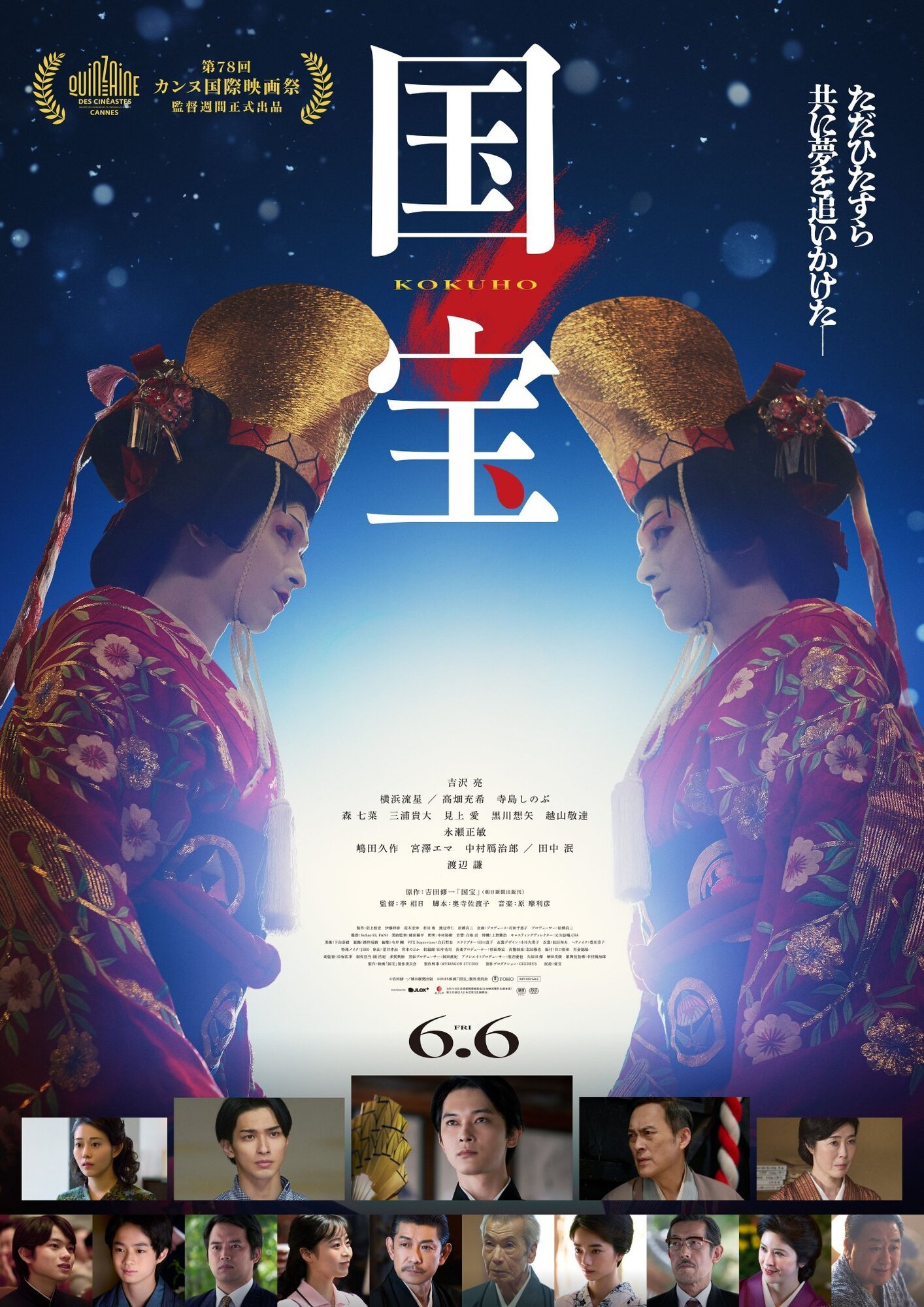
Kokuho (国宝, Lee Sang-il, 2025)

What does it mean to commit yourself so entirely to your art that you become it and effectively cease to exist? Playing the role of Ohatsu in Chikamatsu Monzaemon’s Love Suicides at Sonezaki, Kikuo (Ryo Yoshizawa) asks if Ohatsu’s lover Tokubei is really resolved to die for their love. The scene is intercut with his brother and rival Shunsuke leaving the theatre, led away by Kikuo’s girlfriend Harue (Mitsuki Takahata), just as Ohatsu leads Tokubei towards their mutual fate, as if Shunsuke were agreeing that he is not resolved to give his all to art in the way Kikuo evidently feels himself to be, at least in this moment.

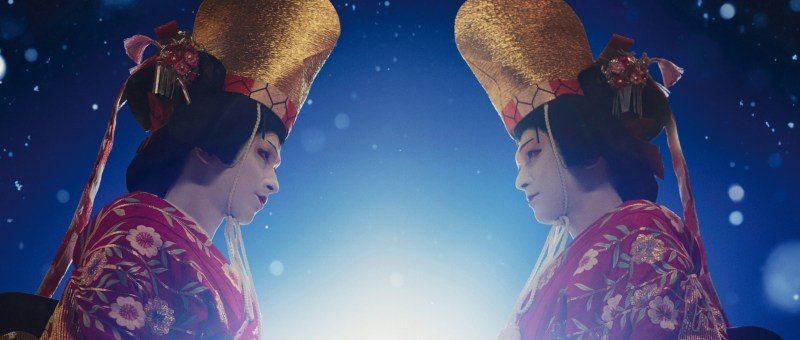
The roles between them are reversed several times before they eventually perform the play again, but each of them are, in effect, in a love suicide with the art of kabuki, though kabuki itself is destined to live on. In any case, the “kokuho” of the title is a living national treasure and one who has indeed embodied their art. We’re introduced to one early on, Mangiku (Min Tanaka), an ageless onnagata, or player of female roles, who has a quasi-spiritual quality and warns the young Kikuo that though his face maybe beautiful, it could also be a barrier to his art and, in the end, consume him. It is said of Mangiku that all he will leave behind him is his art. The words are spoken with pity, but this is really what it means to be a kokuho and the highest compliment that might be paid to an artist. Mangiku himself would likely approve, casting an eye around his spartan room and declaring himself unburdened. 

But Kikuo is only half-joking when he says he cut a deal with the devil to make him the best kabuki actor in Japan. As a woman he abandoned later scolds him, all his sacrifices were made by others. Actors are greedy, another laments, and it’s true enough that Kikuo feared little in his need for success. The irony is that he too was an heir, only to a yakuza dynasty to which he could not succeed. His was father was gunned down in front of him while preparing to draw his sword, while Kikuo’s rebound tattoo does him no favours in the end and his attempt to avenge his father’s death apparently fails. Nevertheless, he vies for the approval of his surrogate father and kabuki master Hanjiro (Ken Watanabe) who values his skills above those of his biological son Shunsuke (Ryusei Yokohama) who alternately resents having his birthright stolen from under from him and acknowledges that Kiku has an innate talent with which his bloodline can’t compete.

Nevertheless, there’s a genuine and enduring brotherhood between the two men that never quite slips into hate or acrimony even as circumstances conspire against them. They both want what the other has. In the kabuki world, bloodline is everything and Kikuo is viewed as a interloper usurping Shunsuke’s rightful position, while Shunsuke wants the raw talent he knows he lacks and no amount of training and commitment can buy. Yet it is in a way about resolve, or at least the willingness to give your life to the stage and die in the pursuit of art. Kikuo’s signature piece is the Heron Maiden, in which a heron falls in love with a young man and becomes a young woman. But her love is unrequited. She goes mad, and can only show her love for him by dancing until she dies. This is, in effect, Kikuo’s dance with kabuki, a waltz to the death as he yearns for the “scenery” he as been searching for and eventually finds the apotheosis of his art in the moment of the heron’s demise.

Like Lee Sang-il’s previous films Villain and Rage based on a novel by Shuichi Yoshida, the film is a poetic meditation on the price of the pursuit of art that revels in its sumptuous production design and the intricacies of the kabuki world. With shades of Farewell, My Concubine, it frames its central dynamic not quite one of straightforward rivalry but a brotherhood between two halves of one whole who each know that neither of them can really win, while becoming a kokuho is an endless pursuit of artistic perfection in which one must be resolved to kill the self and die on stage in a lover’s suicide with a forever elusive kabuki.


Kokuho screened as part of this year’s LEAFF.

Trailer (English subtitles)

My Sunshine (ぼくのお日さま, Hiroshi Okuyama, 2024)

A golden light seems to pour into the life of Takuya (Keitatsu Koshiyama), a nervous young man with a stammer, as he stands transfixed by the elegant movements of a figure skater. As the world around him literally brightens, he begins to discover another side of himself, though it’s never quite clear if it’s Sakura (Kiara Takanashi), a moody teenage girl whose attitude to figure skating seems ambivalent at best, with whom he’s fallen in love or the simple act of figure skating itself. 

Drawing on autobiographical experience, Okuyama studied figure skating himself while his older sister trained to be a champion, My Sunshine (ぼくのお日さま, Boku no Ohisama) otherwise roots itself in the small-town Japan of the late ‘90s and 2000s in which being different was not exactly welcomed. But in fact, most people seem accepting of Takuya, if in a sometimes patronising way, viewing him as a boy with his head in the clouds and cutting him off when he attempts to speak rather than give him the time to finish. When the teacher is going around the class asking the children to read out a stanza of a poem each, he picks on Takuya and tells him to take his time, though the boy’s anxiety is palpable. The teacher may be caught between two options and struggling to decide which is better, not asking him to read at all to spare him from his classmates’ mocking which would also be to exclude him and reinforce a sense of inferiority in his otherness, or to ask him deliberately and try to encourage patience to teach him and the other children that there’s nothing wrong with the way he speaks. 

But in any case, Takuya is already something of an outsider in that he has no aptitude for sports and it’s never clear if he actually enjoys them or just participates because it’s what you do in this town to be man. When a recent arrival to the town and former international pro-figure skater Hiroshi (Sosuke Ikematsu) catches sight of him clumsily trying to teach himself how to dance like Sakura, it enlivens something in him that reminds him of the passion he once felt for skating. He finds himself wanting to help the boy, gifting him his old figure skating skates and teaching him for free before hitting on the idea of training him alongside Sakura as a pair.

Sakura isn’t all that keen to begin with, though at times, it seems as though she may not even like figure skating and is only doing it because her mother makes her. She tells Hiroshi that she isn’t aiming to become the best ice dancer and is a little resentful of being forced to go back to basics to meet Takuya’s skill level but goes along with it because the coach says so. What she thinks of Takuya isn’t exactly clear, though she seems to look down on him a little like the other kids who also mock him giving up ice hockey to do a “girl’s” sport. For her part she seems to have a crush on the handsome and mysterious Hiroshi that, like Takuya, she is unable to articulate. For this reason, along with an insecurity in her talent, she resents the special attention Takuya seems to be getting when it’s her mother who’s paying for the lessons and comes to the conclusion that he’s just more interested in him than her.

She may not altogether be incorrect. In his early coaching sessions with Sakura, Hiroshi doesn’t seem all that invested and is distracted by Takuya in the same way Takuya is distracted by the sunlight or the snow. In trying to help Takuya, he’s trying to help himself and for a time succeeds as the three of them generate a joyful familial relationship, culminating in a day skating on a frozen lake. But he too is unable to be honest about the fact that he came to this rural town to be with his partner who decided to take over the family business when his father passed away. Kai (Ryuya Wakaba) laughs off questions about whether he’s married yet, and the two men seem to live together quietly otherwise isolated from the community around them. When Sakura catches sight of them together, she realises something she may not really be equipped to fully understand, only further deepening her sense of resentment in an unreasonable feeling of betrayal. It isn’t really homophobia that motivates her as much jealousy when she suddenly brands Hiroshi as “‘disgusting” and accuses him of getting a kick out of making a boy do a girl’s sport, excusing her conviction that he prefers Takuya over her and potentially giving herself an out to quit skating (though it seems her mother’s not taking the hint).

But like Sakura, Hiroshi is also uncertain if this is the right place for him or if he and his partner can really live together in this small town permanently. Though he answers “of course” when Kai asks if he’s glad he came, Hiroshi pointedly gives no answer when he’s asked if he really wants to be here. Kai says that he hasn’t talked about skating like this for ages nor seemed so happy, suggesting that there may have been something missing in his life that the relationship didn’t compensate for and may not survive without. How his professional career ended is never explained, though his telling Sakura that he only got to compete internationally because of the lack of male dancers speaks to a degree of insecurity that contributes to a lack of ambition in his personal and professional lives. All three of them are, for varying reasons, unable to say what they really want or how they really feel. Though they find temporary solace in their fragile bond, it is only, as Takuya’s brother cruelly puts it, meant to last until the snow melts. Nevertheless, now dressed in a new school uniform clearly far too big for him that suggests he has some more growing to do, Takuya may have found a means of self-expression in dance that might give him the courage to speak his mind.


My Sunshine screened as part of this year’s Queer East.

Trailer (English subtitles)