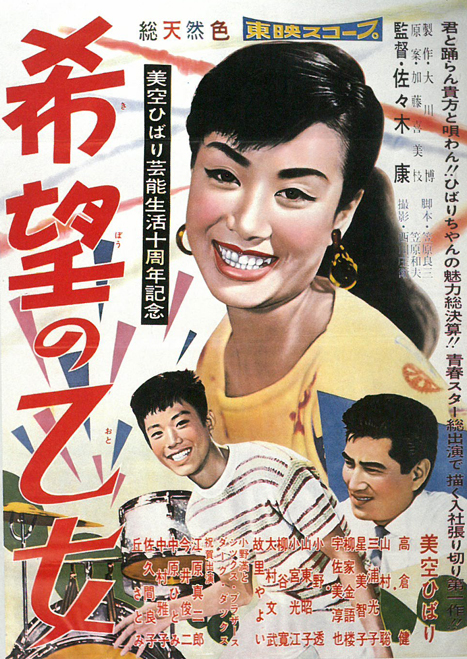
With Song in Her Heart (希望の乙女, Yasushi Sasaki, 1958)

song in her heartAnother vehicle for post-war singing star Hibari Misora, With a Song in her Heart (希望の乙女, Kibo no Otome) was created in celebration of the tenth anniversary of her showbiz debut. As such, it has a much higher song to drama ratio than some of her other efforts and mixes fantasy production numbers with band scenes as Hibari takes centre stage playing a young woman from the country who comes to the city in the hopes of becoming a singing star.

After beginning with a rural, almost cowboy-style number in which Hibari appears as the well dressed lady of the manor, Sayuri, riding her horse across the wide pastureland, the action quickly moves to the city when Sayuri’s mentor finally convinces her uncle that her future lies in showbiz and not an early marriage as he had envisioned. However, once she gets there she finds her potential tutor extremely unwilling to fulfil his promise to take her on. After winning him over, she quickly makes friends with the locals who also want the singing teacher to become the leader of a band they’ve formed in the hopes of raising some money to build a proper children’s playground to stop them playing in dirty ditch land nearby which is a well known health hazard. Soon enough the band takes off but there’s more trouble ahead for Hibari and co. as they are betrayed by those closest to them.

Working as a celebration of Hibari’s career so far With a Song on Her Heart is filled with excuses for Hibari to sing both as a music student and band vocalist as well as fantasy production numbers some of which are even bigger on dance than on song. The plot is quite simple but there is a lot of it, in contrast to other films of this kind, as Hibari sets about healing the grief stricken heart of her bandleader and fulfilling the hopes of the ordinary people turned musicians through the power of song. The romance element is a light one and not the focus of the film but bears mentioning as Hibari’s love interest is played by Ken Takakura – the archetypical star of the yakuza movie who was to marry fellow singing sensation (and frequent Hibari Misora co-star) Chiemi Eri the following year.

Despite its nature as a celebratory project, With a Song in Her Heart doesn’t quite meet the high production standards of other Misora starring films. Shot in colour and in 2.35:1, the majority of the film is studio bound (often very obviously so) with simple sets and a straightforward directing style. Nevertheless, even if it fails to impress on a technical level, With a Song in Her Heart knows what it’s about and so it makes sure to fill its relatively short duration with as many songs as possible, light romance and a cheerful atmosphere of people coming together to try and solve a social problem through spreading love and joy in the form of music. The musical styles are unusually varied embracing Hibari Misora’s regular ballads as well as mixing in world influences from mariachi to african drums with a strong big band jazz undercurrent.The overall feeling is one of goodnatured wholesomeness and even if low on impact With a Song on Her Heart is a decent showcase for Hibari Misora’s talents as she celebrates her tenth year in the business at the age of only 21.
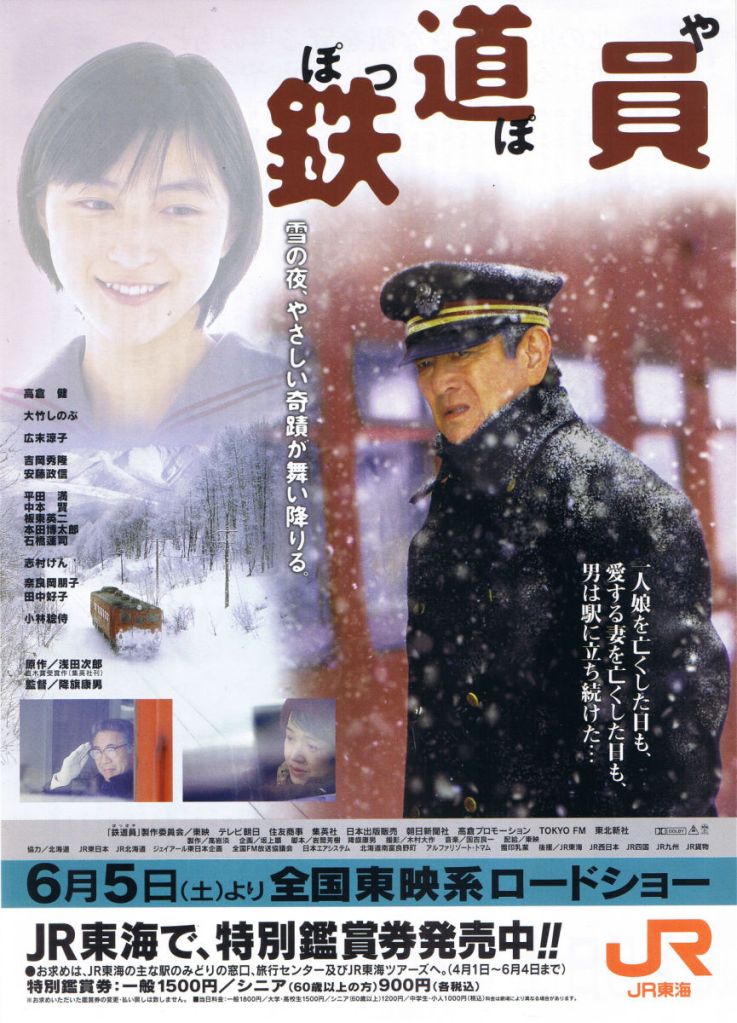


Poppoya (鉄道員, Yasuo Furuhata, 1999)

img_0The late Ken Takakura is best remembered as cinema’s original hard man but when the occasion arose he could provoke the odd tear or two just the same. 1999’s Poppoya (鉄道員) directed by frequent collaborator Yasuo Furuhata sees him once again playing the tough guy with a battered heart only this time he’s an ageing station master of a small town in deepest snow country which was once a prosperous mining village but is now a rural backwater.
Otomatsu Sato has spent his life in service to the railway. Like his father before him who believed the key to the modernisation of Japan after its defeat in the second world war was in its transportation network, Sato started as an engineer before being promoted to station master. Morning and evening in the freezing cold he bid in and sent out each passenger and freight train travelling through his one track station. However, though he clearly loves his job Sato has experienced a great deal of personal tragedy in pursuit of his career. He wasn’t there when his baby daughter died, nor was he there when his wife lay dying in hospital. He was where he always is, on the platform until the last train goes out. Now, however, the mine has closed, the town is full of old people and there are no passengers on the train so the line will be closing. Having given his life to something which will be so unceremoniously erased, what is a man like Sato to do now?

In true Takakura fashion, Sato appears tough and fairly unapproachable on the outside but actually he’s quite well respected in the town and even if some of the other residents bemoan his rigid ways, they grudgingly respect him for being the way he is. He takes his duties seriously and would never countenance breaching them for something as trivial as personal concerns, even when those concerns are something as understandable as the death of a family member. The way he sees things, this is his duty and must be fulfilled, properly each day no matter what. This may seem a little obsequious in Western eyes, though many of the other (particularly female) characters also agree Sato takes things much further than he needs to, but dedication to one’s duty is, after all, an admirable trait.

However, now it’s all been for nowt. The railway line is to be closed, the land will engulf it once again erasing the years of Sato’s work just as if he were never there. He’s sacrificed final moments with his wife and child – not even that, just sacrificed moments. He’s given all to the railway and now there’s no place left there for him. His best friend, the father of a son also in the railway business, is to take another job at a hotel complex but Sato is a railwayman through and through – he’ll work on the tracks or not at all.

Around this time Sato also starts seeing some strange new children around. He assumes they’ve come to stay with grandparents in the village, this being the time of the New Year holiday. The little one has a strangely old fashioned looking doll that reminds Sato of one he bought for his infant daughter only she never really had the chance to enjoy it. Then he meets an older sister who’s kind of a live wire before meeting the oldest – a high school student dressed in an old fashioned looking uniform who really reminds him of someone he used to know. All these strange encounters force Sato to further re-examine his past, reliving old regrets and assessing a life lived in service to an ideal at the expense of the joy he might have felt as a happy family man.

Beautifully photographed with picturesque shots of trains against the deep snows of Northern Japan, Poppoya was Japan’s submission for the 1999 Oscars and does have all the trappings of a prestige melodrama. It unabashedly pulls at the hearts strings and even if the rather sentimental score takes things too far, Poppoya does nevertheless manage to draw the odd tear for Sato’s lonely, regretful old age. Sentimental yet genuinely affecting, Poppoya is an effectively crafted weepy which serves as a timely reminder to embrace the things which are most important to you while there’s still time.


The Hong Kong blu-ray release of Poppoya includes English subtitles (though they are a little “imperfect”).

Only trailer I can find has Korean subs:


The Yellow Handkerchief (幸福の黄色いハンカチ Yoji Yamada, 1977)

siawasenoWhen you hear the name Yoji Yamada, you pretty much know what you’re getting. A little laughter, a few tears and a reassuring if sometimes sad ending. You’ll get all that and more with the Yellow Handkerchief although, to allow a minor spoiler, the ending is anything other than sad even if it provokes a few tears. Yes it’s sort of syrupy and it’s not as if it breaks any new cinematic ground but once again Yamada has been able to work his magic to turn this romantic melodrama into a warm, funny and ultimately affecting tale.

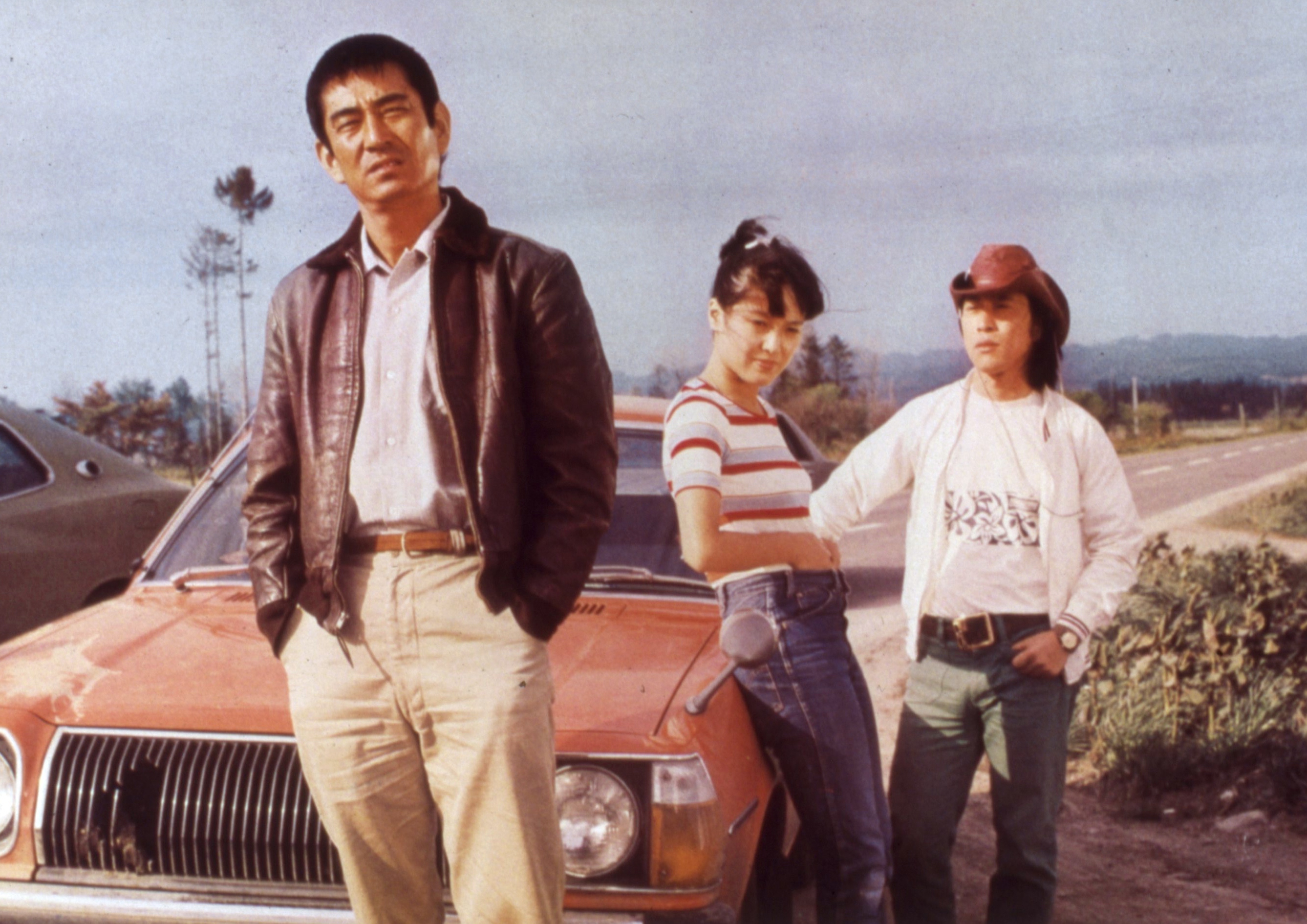
Kin-chan, nursing the pain of unrequited love buys a garish red car and goes north where he attempts to pick up girls in fairly cack handed ways. Finally he hooks one outside of a station as she’s too shy and polite to tell him to buzz off. Things get decidedly awkward until the pair bond over a shared hatred of miso noodles at which point Akemi becomes a little more lively. A short way into their road trip, they meet the forlorn figure of Yusaku (Ken Takakura) who ends up joining them on their random road trip around Hokkaido. However, Yusaku’s brooding nature raises a few questions – where has he been, where is he going and why does he both very much want to go and not want to go at all?

Given that it’s Ken Takakura playing Yusaku, you might have a few ideas and you wouldn’t be *entirely* wrong but Takakura amply proves there’s more to his talents than playing a yakuza badass in series of extremely popular but by then out of fashion gangster movies. Suffering from an excess of nobility, Yusaku is a man who’s made a series of poor life choices and is slowing building up the courage to find out if a particular bridge he tried to burn is still salvageable.

Kin-chan and Akemi by contrast turn out to be a pair of live wire odd balls with Kin-chan desperately chasing Akemi and Akemi blithely ignoring him. Despite various attempts to shake Kin-chan off he generally ends up coming back (one time with a giant crab dinner) and getting himself into all kinds of hilarious trouble. They may be the film’s comic relief but in their story proves strangely moving too.

The Yellow Handkerchief won the very first Best Picture award at the Japanese Academy Prize ceremony back in 1978 as well as a host of other awards from Kinema Junpo and other critical bodies and it’s not hard to see why. It’s a prestige picture, and a pretty saccharine one at that, but Yamada makes it all work and comes out with a genuinely affecting piece of cinema. Filmed against the gorgeous backdrop of the island of Hokkaido, The Yellow Handkerchief is the ideal rainy day movie and though it may all end in tears they are far from tears of sadness.