The Phoenix (火の鳥, Kon Ichikawa, 1978)

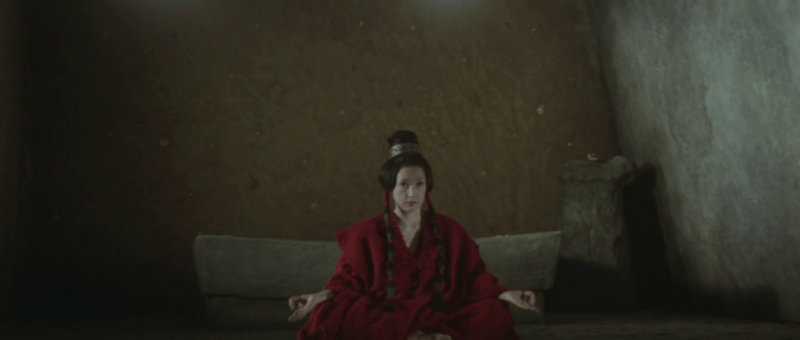
The people of early Japan contemplate different visions of immortality in Kon Ichikawa’s sprawling adaptation of the first chapter in Osamu Tezuka’s manga series, The Phoenix (火の鳥, Hi no Tori). Featuring a mix of animation and live action, the film takes place in an ancient, pre-modern Japan in which just about everyone chases the mysterious fire bird in belief that drinking its blood will confer eternal life. They each want it for different reasons, some more to stop someone else getting it than for themselves but all discover that there are other ways of living on than the strictly literal. 

Broadly speaking the film takes place during the era of possibly mythical sorceress queen Himiko (Mieko Takamine) who rules over the nation known as Yamatai which is the name given to a kingdom in Japan in ancient Chinese sources. Himiko wants the phoenix because she fears that her power is founded on a youth and beauty which has begun to fade while the people are beginning to lose faith in her magic, not least because her rule is oppressive and authoritarian. She also fears that should the Chinese emperor drink the phoenix blood first, they will forever be under his yoke yet the seal that confers her rule was in fact given by him so perhaps they are already. Her brother, Susano (Toru Emori) whom she also fears may usurp her, enlists famed hunter Yumihiko (Masao Kusakari) from the state of Matsuro to help them capture the phoenix seeing as the two nations have some kind of treaty. Yumihiko says he doesn’t really care about that, but ends up helping anyway.

In any case, Matsuro is soon overrun in a surprise attack by warlord Jingi (Tatsuya Nakadai) from Takamagahara who is set on colonisation, which is in its way another bid for “immortality” if culturally rather than literally. After all, he claims “I will implant our civilisation in these lands” before explaining that “not even the greatest kings live forever” but history will. Meanwhile, Yamatai doctor Guzuri (Ryuzo Hayashi) is washed up on the shores of remote kingdom Kumaso where Uraji (Masaya Oki) is hunting the phoenix in the hope of saving his seriously ill wife Hinaku (Reiko Ohara). Uraji is soon burnt to a crisp by the Phoenix’s light, but Guzuri is able to save Hinaku using “modern” medicine, that is by applying “blue mould” which as the onscreen text explains contains penicillin. Perhaps feeding someone mould doesn’t sound much more scientific than the bizarre folk medicine proposed by the witchdoctor which involves rubbing the severed heads of cats and ravens together and putting fish bones on the patient’s head while burning their buttocks, but it works which is not exactly a means of “immortality” but does promise the ability of temporarily overcoming death without the Pheonix’s help. 

But medicine can’t help you with an invasion, and when the Yamatai suddenly turn up and raze the village to get better access to the phoenix after realising it lives in a nearby volcano only Hinaku and her brother Nagi (Toshinori Omi) survive. Hinaku reluctantly remains with Guzuri and vows to rebuild her kingdom through childbirth vowing that she will enable the survival of Kumaso by passing her culture on through successive generations. Uzume (Kaoru Yumi), a dancer from Matsuro, later says something similar to Jingi in reminding him that “women have their own weapons” and he will “never be able to destroy life” as an abstract concept. There might be something a little uncomfortable in the implication that the phoenix is an allegory for childbirth in suggesting that one body is born in the ashes of another, but it is in the end the continuity of a lifecycle which wins out as the natural order of things. In the film’s concluding moments, the son of Hinaku and Guzuri in a sense experiences a kind of rebirth as, guided by the phoenix, he climbs out of the cave in which he has lived all his life and gazes at the vast expanses of a new world all around him. 

Ichikawa originally trained as an animator and includes several animated sequences throughout the film from cartoonish special effects when an elderly courtier bangs his head to a trio of foxes dancing to pink lady. His visual design is also heavily influenced by Tezuka’s manga with the young boy Nagi in particular striking Tezuka-esque poses and otherwise resembling Astroboy who does in fact make a surprise appearance in a brief animated sequence in which Nagi is kicked by a horse. Similarly, the conflicted general Saruta (Tomisaburo Wakayama) later gains a ridiculous Tezuka-style nose after being locked in a room filled with wasps, and Ichikawa’s vistas sometime echo the centrefold of a manga with the heroes reduced to tiny figures dwarfed by the majesty of the landscape. Even so, a rain-soaked battle pays ironic homage to Seven Samurai, while Ichikawa otherwise keeps violence to a minimum. The heads are chopped off horses and fall like cushions, entirely bloodlessly, but there is also a scene of implied attempted rape which may be out of keeping with the otherwise family-friendly approach. Despite the sense of defeat which may colour some of the closing scenes, the film ends on a note of optimistic wonder in a new journey for humanity emerging from scenes of desolation towards a bright new world. 


Sandakan No. 8 (サンダカン八番娼館 望郷, Kei Kumai, 1974)

Sandakan 8 posterSome might argue that Japanese cinema has often been reluctant to examine the nation’s traumatic 20th century history with the proper rigour, but even if subtle and coming from unexpected angles there have been many and varied attempts to ask questions about the lingering consequences of feudalism. Sandakan No. 8 (サンダカン八番娼館 望郷, Sandakan Hachiban Shokan: Bokyo), inspired by a true life account of a woman unwittingly sold into sexual slavery as a child at the turn of the century, is not only a condemnation of socially approved people trafficking and its role in building the short-lived Japanese empire but a mild provocation of the contemporary society which refuses to engage with its traumatic past.

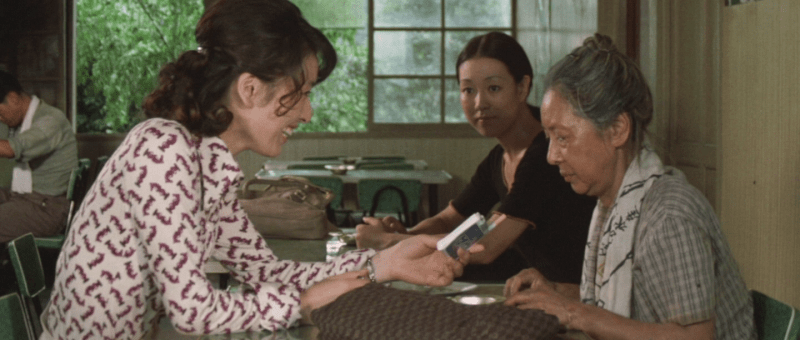
In the contemporary era, graduate student Keiko Mitani (Komaki Kurihara) is engaged in researching the “karayuki-san” – Japanese women who were sold into sexual slavery throughout Asia in the early 20th century. Almost forgotten, the karayuki-san are a taboo subject and even those still living in the areas from which women and girls were sent away are unwilling to speak of them. By chance, however, Keiko runs into an old woman in a cafe who speaks with a standard Tokyo accent and tells them that she spent most of her life “abroad”. Quickly realising she doesn’t mean she was a diplomat’s wife, Keiko wonders if the woman might be have been a karayuki-san and delays her return to Tokyo in order to find out.

There is something, it has to be said, ironically exploitative in Keiko’s determination to get the old woman, Osaki (Kinuyo Tanaka), to open up about a subject on which she so obviously does not want to be drawn. A visit to Osaki’s home reveals her to be living in a run-down hovel on the edge of town which is filled with stray cats whom Osaki feeds because “they’re all abandoned, but still they have to live”. Keiko gets herself brownie points by reacting politely to Osaki’s reduced living situation, eventually staying three weeks during which time she gradually teases out Osaki’s sad life story. Finally asking if there wasn’t anything Osaki might have liked to know about her, Keiko’s hypocrisy is fully brought home to her when Osaki admits that no one was more curious about Keiko than she was but that “people have reasons for not confiding in others” and if it’s something you need to ask about then it’s probably something that the other person may not want to share. In any case, Osaki seems to have known Keiko had an ulterior motive but does not regret sharing her story and has no worries about what Keiko might do with it as long as she makes sure to tell the truth.

The truth, in a sense, seems to be something the villagers feel themselves well acquainted with which is why Osaki lives in a shack on the edge of town. Tricked into sexual slavery as a child by an amoral people trafficker who lured her with promises of money to be made overseas, Osaki found herself in Borneo and a prisoner of “Sandakan No. 8” which was one of 10 numbered brothels on the island largely catering to Japanese travellers overseas, facilitating the expansion of the Japanese empire as accidental emissaries and ports of call. When Osaki was a child, Japan was a poor country and it was considered normal to sell one’s daughter in order to feed a family. Working overseas carried with it a kind of cache though no one, except perhaps her brother, seems to be fully aware of what Osaki is going to and she herself has not in any way chosen or consented to become a sex worker. When she eventually returns to Japan, she finds herself unwelcome in her brother’s house, which her money paid for, because of the shame associated with those who have “worked away”. Even 50 years later, she finds herself living alone, all but disowned by her only son, on the outskirts of her childhood village ostracised by the “respectable” townspeople who don’t for a second believe Osaki’s quick introduction of Keiko as her daughter-in-law.

The daughter-in-law deception is only one heartbreaking aspect of the complex relationship between the two women who are each, in a sense, hiding something from the other but end up forming a genuine connection anyway. Intensely lonely and having lived a life filled with suffering, Osaki is willing to pay for company with her story while Keiko is, not quite deliberately, using her loneliness against her in an attempt to earn her trust and get her to reveal her secrets. Nevertheless, Keiko is able to mine a rich and deep seem of 20th century trauma through the tragic story of just one woman which reaches out to hundreds like her some of whom rest in a graveyard in the forests of Borneo with their backs forever to Japan. The enemy is, once again, poverty more than it is patriarchy or even feudalism, a problem less of the essence in the rapidly improving post-war economy, but as Kumai is keen to point out, this system of state sanctioned people trafficking (finally outlawed only once Japan’s status on the world stage began to rise) had far wider implications than it might be thought which still echo into the present day and perhaps beyond if not for the efforts of women like Keiko who do not wish to forget.


Original trailer (no subtitles)

Women of the Night (夜の女たち, Kenji Mizoguchi, 1948)

Women of the Night still 1Cinema of the immediate post-war period generally leaned towards upbeat positivity, insisting that, yes, the situation is painful and difficult but it wouldn’t always be this way, at least as long as ordinary people kept their chins up and worked hard to build a better future. Mizoguchi’s Women of the Night (夜の女たち, Yoru no Onnatachi) is very much not interested in this rosy vision of future success being sold by a new morale boosting propaganda machine, but in laying bare the harsh and unforgiving nature of a society that was fast preparing to leave a significant part of its population far behind. Women suffer in war, but they suffer after war too – particularly in a society as stratified as Japan’s had been in which those left without familial support found themselves entirely excluded from the mainstream world.

Fusako (Kinuyo Tanaka), a noble, naive woman still hasn’t heard from her presumably demobbed husband and is living with her in-laws. Her young son has tuberculosis and she is desperately short of money. Selling one of her kimonos, Fusako is excited to to hear of an “interesting proposition” but is repulsed when she realises the saleswoman is inciting her to an act of prostitution. After all, she says, everybody is doing it.

After undergoing a series of tragedies, Fusako thinks things are beginning to go right for her when she manages to get a secretarial job through the kindness of a connection, but it turns out that Mr. Kuriyama (Mitsuo Nagata) is not all he seems and his business may not be as legitimate as Fusako believed it to be. Another small miracle occurs on a street corner as Fusako runs into her long lost sister, Natsuko (Sanae Takasugi), formerly living in Korea and now repatriated to Japan, but a return to normal family life seems impossible in the still smouldering ruins of Osaka filled with black marketeering, desperation, and hopelessness.

Inspired by the Italian Neo Realist movement, Mizoguchi makes brief use of location shooting to emphasise the current state of the city, still strewn with rubble and the aftermath of destruction. Osaka, like Natsuko and Fusako, finds itself at a cross roads of modernity, paralysed by indecision in looking for a way forward. Fusako, the kinder, more innocent sister dresses in kimono, does not smoke, and is committed to working hard to build a new life for herself. Natsuko, by contrast, dresses exclusively in Western clothing, smokes, drinks, and works as a hostess at a dancehall with the implication that she is already involved in casual forms of prostitution.

Natsuko’s way of life, and later that of Fusako’s much younger sister-in-law Kumiko (Tomie Tsunoda), is painted as a direct consequence of an act of sexual violence. Having been raped during the evacuation from Korea, Natsuko feels herself to have been somehow defiled and rendered unfit for a “normal” life, relegated to the underground world of the sex trade as an already damaged woman. Fusako disapproves of her sister’s choices and is alarmed by the unfamiliar world of bars and dance halls but eventually ends up in the world of prostitution herself as a result of emotional violence in the form of cruel yet incidental betrayal. Fusako’s “descent” into prostitution is less survival than an act both of revenge and of intense self-harm as she vows to avenge herself on the world of men through spreading venereal disease.

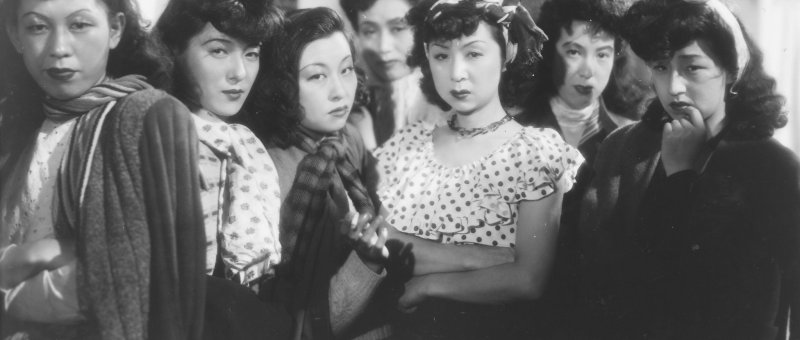
Mizoguchi’s attitudes towards sex work were always complex – despite displaying sympathy for women who found themselves trapped within red light district as his own sister had been, he was also a man who spent much of his life in the company of geishas. Nevertheless Women of the Night veers between empathy and disdain for the hosts of post-war “pan pans” existing in codependent female gangs in which violence and hierarchy were as much an essential part as mutual support. The film opens with a sign which instructs women that they should not be seen out after dark lest they will be taken for prostitutes, respectable women should make a point of being home at the proper hour. Later, when Fusako is picked up by a police raid, she comes across a woman from the “purity board” who wants to hand out some pamphlets to help women “reform” from their “impure” ways and temper their presumably insatiable sexual desire. Fusako quite rightly tells the woman where to go while the others echo her in confirming no one has volunteered to live this way because they like it. Starving to death with a pure heart is one thing, but what are any of these women supposed to do in a world that refuses them regular work when they have already lost friends and family and are entirely alone with no hope of survival?

A third option exists in the form of a home for women which has been set up for the express purpose of “reforming” former prostitutes so that they can lead “normal” lives. The home provides ample meals, medical treatment and work though its attitude can be slightly patronising even in its well meaning attempt to re-educate. Again the home is working towards an ideal which is not evident in reality – there are no jobs for these women to go to, and no husbands waiting to support them. Incurring yet another tragedy, Fusako receives a well meaning lecture from a male employee at the home to the effect that it’s time for women to work together to build a better world for all womankind but Fusako has seen enough of the sisterhood realise that won’t save her either and leaves the man to his platitudes trailing a dense cloud of contempt behind her.

Yet Fusako does change her mind, finally reunited with the missing Kumiko who has also fallen into prostitution after running away from home and being tricked by a boy who pretended to be nice but only ever planned to rob and rape her. In a furious scene of maternal rage, Fusako rails against her plight, enraged by Kumiko’s degradation which ultimately forces her to see her own. Brutally beaten by the other women for the mere suggestion of leaving the gang, Fusako is held, Christ-like, while she pleads for an end to this existence, that there should be no more women like these. The storm breaks and the other women gradually come over to Fusako’s side, depressed and demoralised, left with no clear direction to turn for salvation. Mizoguchi ends on a bleak note of eternal suffering and continuing impossibility but he pauses briefly to pan up to an unbroken stained glass window featuring the Madonna and child. Fusako emerges unbroken, taking Kumiko under her maternal wing, but the future they walk out into is anything but certain and their journey far from over.   


Screened at BFI as part of the Women in Japanese Melodrama season. Screening again on 21st October, 17.10.

Oh Seagull, Have You Seen the Sparkling Ocean? : An Encounter (鴎よ、きらめく海を見たか めぐり逢い, Kenji Yoshida, 1975)

seagullSparkling seas sound like hopeful things, especially if you’re a majestic seagull flying far above, bathed in perpetual sunshine. But then, perhaps the water below is shining with the shards of broken hopes which float on its surface, is its beauty treacherous or in earnest? So asks the singer of the title song which recurs throughout the film as if to undercut even its brief moments of happiness. There is precious little joy to be found in the lives of the two protagonists of Oh Seagull, Have You Seen the Sparkling Ocean? : An Encounter (鴎よ、きらめく海を見たか めぐり逢い, Kamome yo, Kirameku Umi wo Mitaka: Meguriai), only pain and confusion as they try to rebuild their ruined lives in an uncaring city.

Katsuo is a drifting young man, one of the many to have escaped the mining industry after the pits began to close down but now finds only temporary manual work available to him. In Tokyo, he works as part of a window washing team, gazing into high rise office buildings which are a world away from his precarious hand to mouth existence. In one particular window he spots an office lady attempting to straighten her stockings in an otherwise empty room. Smitten he decides to pursue the woman though she is far from interested in a peeping tom of a window guy who’s coming on far too strong.

Kumi has her own problems. Like Katsuo she’s found herself in the city after escaping a life of poverty and the unwanted attentions of a relative in a fishing village. Her sights are set a little higher in the increasingly consumerist environment of ‘70s Tokyo, hence her high rise career and desire to find the right kind of husband. However, even here, she doesn’t seem able to get away from possessive men and is stalked by an ex-boyfriend who just won’t take no for an answer.

Eventually Kumi and Katsuo grow closer but on a visit to the beach come across an injured seagull which Kumi immediately tries to bury despite the fact it isn’t actually dead yet – better to die than live on in shame, says Kumi. Katsuo disagrees and decides to take it home and nurse it back to health though Kumi breaks up with him because of it. After a chance encounter the pair get back together but their fragile love story is under attack from every possible direction.

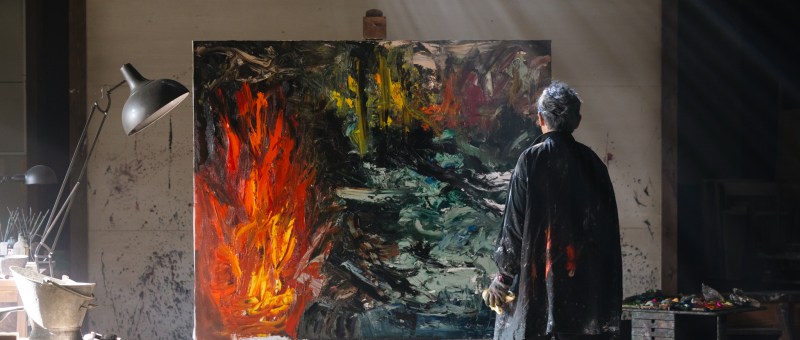
Katsuo and Kumi have each led difficult lives though they have very different ways of coping with trauma. Katuso has retreated into a fantasy world inspired by Gaugin’s famous painting Where do we come from? What are we? Where are we going?. When he first meets Kumi, all Katsuo can talk about is Resipuruko and how wonderful everything will be when he gets there. The speech exasperates Kumi who at first feels stupid for not having heard of Resipuruko, but then cheated to discover its just a made up place of the kind that children create out of fun. Nevertheless, Resipuruko continues to become a symbol in their lives, a place of hope and peace in which they would be able to live together freely and in comfort, away from the difficulties of everyday city life.

Katsuo is cheerful and optimistic. Not exactly forward looking but proceeding in the name of hope. Kumi is driven more by fear and resentment, constantly looking behind her rather than ahead. Though Katsuo’s life has not been easy, Kumi has experienced more suffering with less agency which has left her with far less capacity for making the best of things. Like Nina in Chekov’s play, she is the seagull – something beautiful, destroyed, just because it could be. Katsuo’s efforts to heal the wounded bird run in parallel to his desire to save Kumi but then, the seagull wants to be free and Kumi is forced to feel as if she never will be.

At one point Kumi says she and Katsuo are on different sides of an invisible window and it’s true that they’re opposites in many ways – he thrives on fantasy, she is destroyed by reality, but they could be perfectly happy together if it weren’t for the vagaries of fate.  Oh Seagull, Have You Seen the Sparkling Ocean? : An Encounter, is a tale of tragedy as young lives are ruined by time and circumstance, leaving them with only broken hearts to face the unfair world before them. Resipuruko exists only in a spiritual sense, but it can be called forth if you believe in it enough. Dreams are fragile things, whether realistic or fantastical, but they, like the seagull, deserve their time to fly unfettered.


Original trailer (no subtitles)