In the Name of the Son (아들의 이름으로, Lee Jung-gook, 2021)

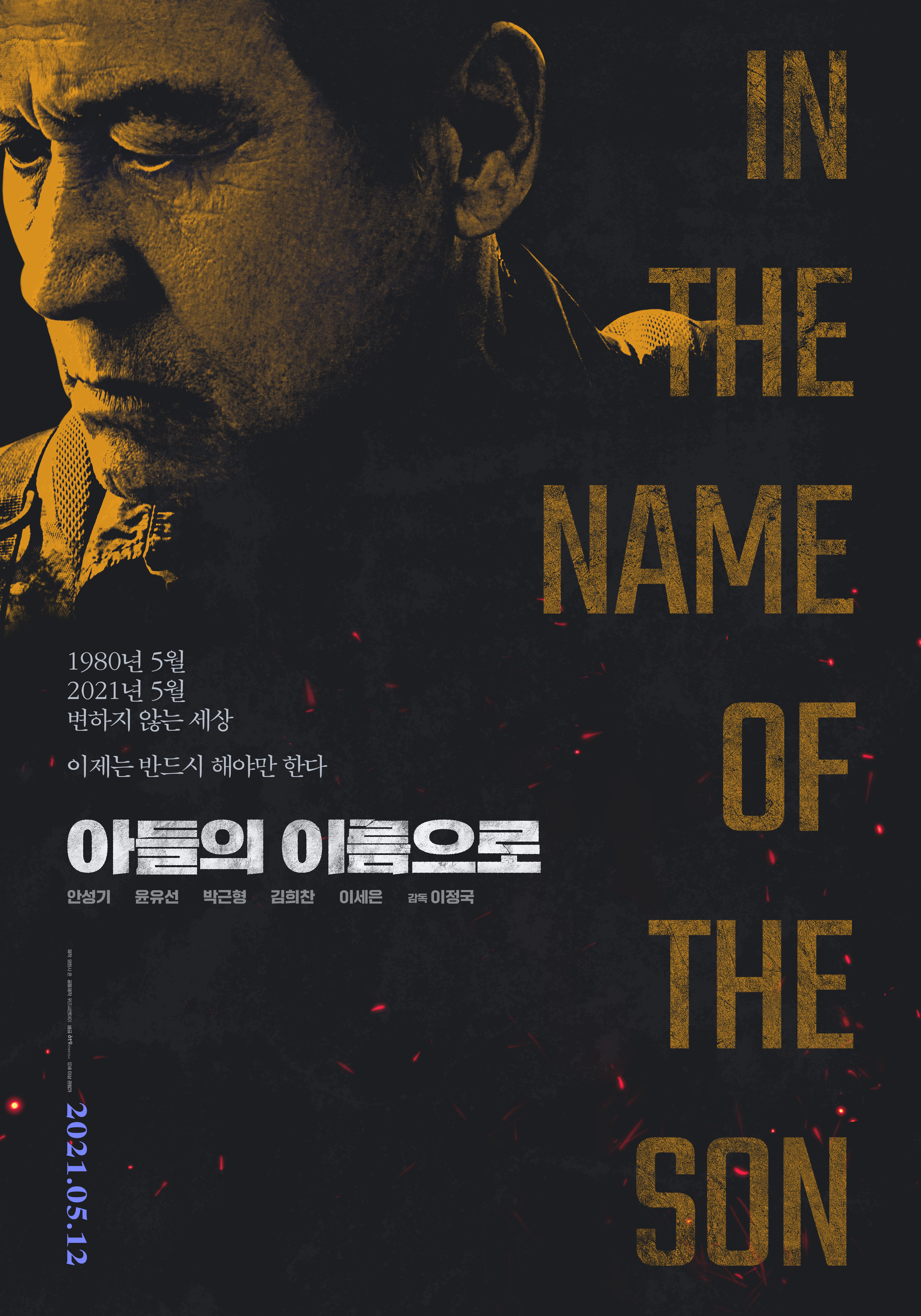
Partway through Lee Jung-gook’s raw exploration of the radiating effects of historical trauma In the Name of the Son (아들의 이름으로, Adeurui ireumeuro), the conflicted hero quotes a line from In Search of Lost Time which his son had recommended to him, “pain is only healed by thoroughly experiencing it”. The quote in itself reflects the hero’s wounded state in having failed to reckon with the sins of the past, a failing which has cost him dearly on a personal level, while simultaneously hinting at a national trauma which has never been fully addressed by the contemporary society. 

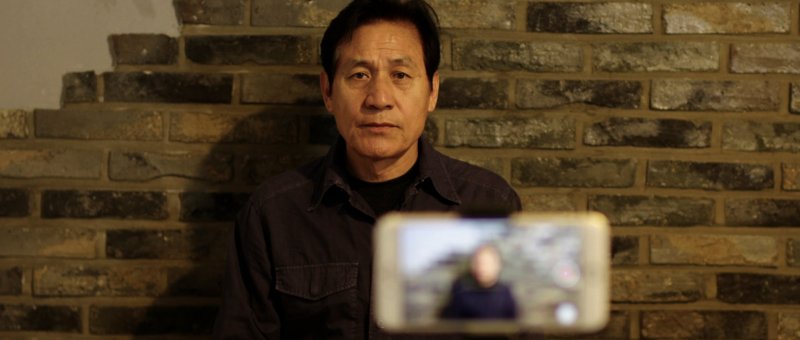
When we first meet ageing designated driver Chae-gun (Ahn Sung-ki) he’s preparing to hang himself in a forest before noticing a stray parakeet, presumably an escaped family pet, chirping nearby in desperation. Taking pity on the bird knowing it cannot survive on its own he gives up on his plans and takes it home. We can see that Chae-gun is a compassionate man, softly spoken, perhaps a little shy and distant yet caring deeply for those around him such as the ladies from Gwangju who run a cafe where he is a regular, while he’s frequently seen making phone calls to his son in America. Yet as we later discover he is also a man of violence with an old-fashioned, authoritarian mindset, ominously sliding off his belt to beat up a gang of kids who tried to dine and dash before making them come back to apologise and pay their bill and later doing the same to bullying classmates of the cafe owner’s son, Min-woo (Kim Hee-chan). 

He does these things less out of an old man’s disapproval of the younger generation’s lack of moral fibre than a genuine desire to help and most particularly the ladies at the cafe, but simultaneously takes Min-woo to task for a lack of manliness berating him in front of his bullies for not standing up for himself. These flashes of violence hark back to the hyper-masculine patriarchal attitudes that defined the years of dictatorship while also hinting at the buried self Chae-gun struggles to accept which so contrasts with his innate kindness and sense of justice. He too is angry and confused that those who ordered acts of atrocity such as the 1980 Gwangju Massacre have never been brought to justice and are living comfortable lives often still ensconced in country’s ruling elite such as former general Chairman Park whom he often drives home from a local Japanese restaurant to his mansion in a traditional village in the middle of Seoul. 

As we discover, Chae-gun has his own reasons for being preoccupied with Gwangju in particular, yet it’s the failure to reckon with the buried past that he fears erodes future possibility. In a metaphor that in truth is a little overworked, one of the new assistants at the cafe, also from Gwangju, is mute, literally without a voice until the buried truths of the massacre are symbolically unearthed allowing her to speak. Meanwhile, many of Chae-gun’s generation are succumbing to dementia, an elderly man constantly escaping from his nursing home to wander a local park looking for his teenage son who went missing during the uprising and was never seen again. Chairman Park remains unrepentant, blaming everything then and now on “commies” while explaining to Chae-gun that they were “patriots” not “murderers” bravely defending the Korean state and in any case God forgives all so they’ve no need to blame themselves. 

Park may feel no remorse but the unresolved trauma of Gwangju continues to echo not only through Chae-gun’s wounded soul but through society, a heated debate breaking out between a group young people of critical of the authoritarian past and a collection of older conservative nationalists who object to their criticism of President Park Chung-hee arguing that he rebuilt the economy and gave them the comfortable lives they live today. Yet what Chae-gun feels he owes to his son and implicitly to the younger generation is an honest reckoning with the past and his part in it while those who live with no remorse should not be allowed to prosper, guilt-free, as victims continue to suffer. What he’d say to those who thought that they bore no responsibility is that the greatest sin of all may have been in blindly following orders. Only by fully experiencing the pain of the national trauma can society hope to heal itself from the weeping wounds of the unresolved past.


In the Name of the Son streamed as part of the 14th season of Asian Pop-Up Cinema.

Original trailer (English subtitles)
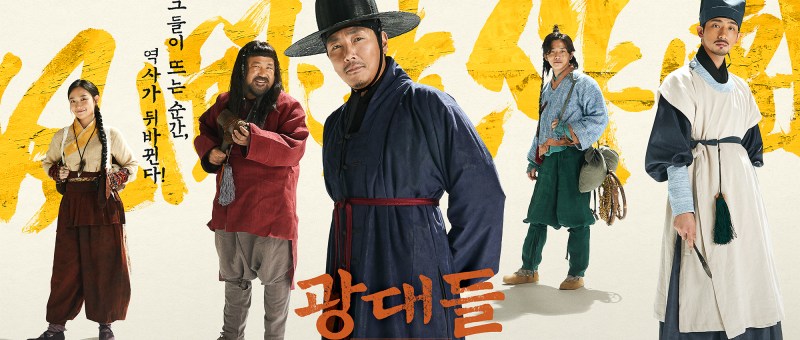
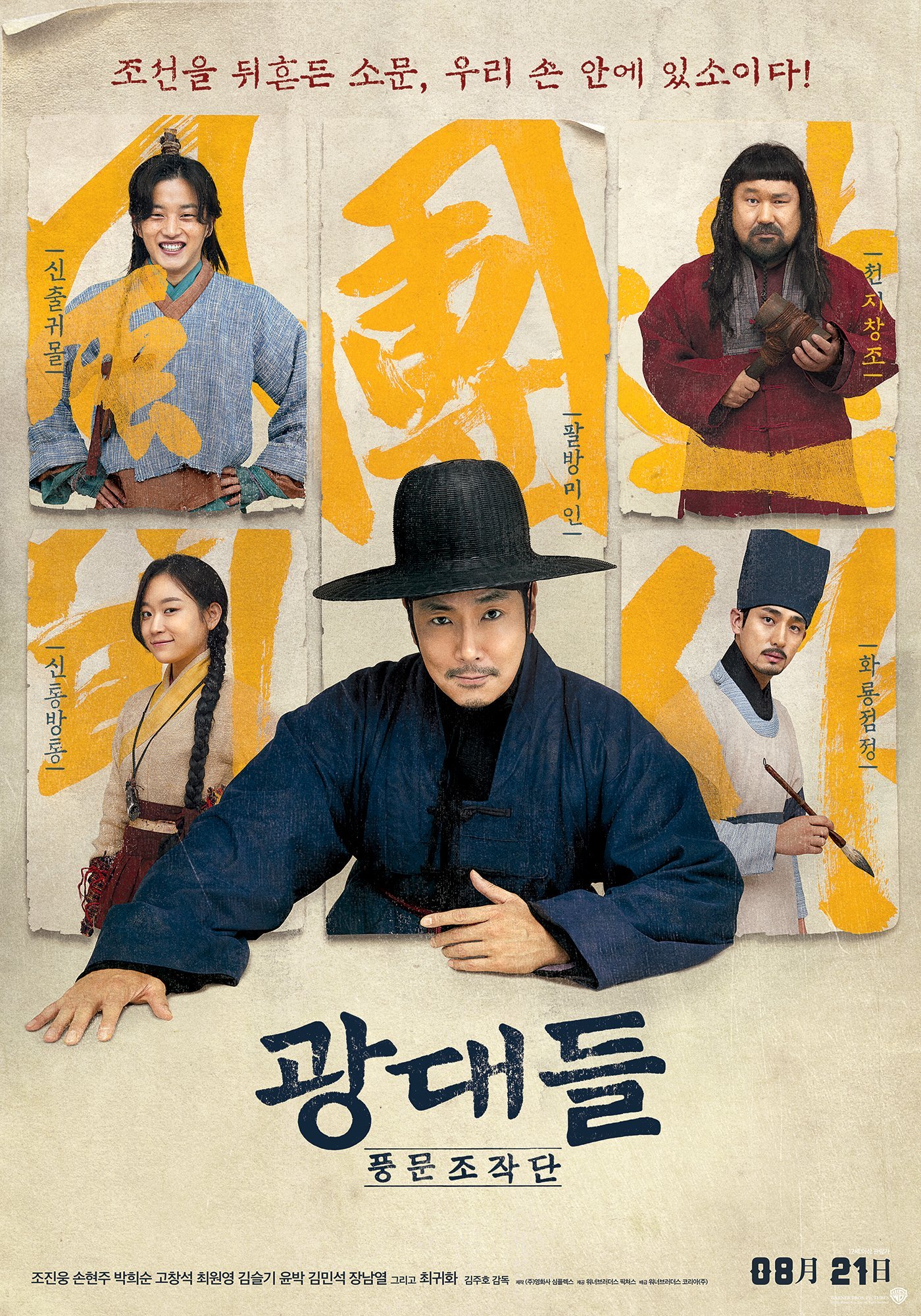
Jesters: The Game Changers (광대들: 풍문조작단, Kim Joo-ho, 2019)

“Even with swords to our necks we say what we must!” a stage actor insists, though somewhat duplicitously as he wilfully says what he must to survive while simultaneously defending his artistic integrity. Oddly timely, Jesters: The Game Changers (광대들: 풍문조작단, Gwangdaedeul: Pungmunjojakdan) is an ironic exploration of the importance of art in engendering narrative proving once and for all that it really can remake the world. Our hero finds himself less torn than you’d expect him to be, only too keen to parrot the words of a regime he does not respect in return not only for his life but for material gain. 

Our heroes are a band of “jesters”, itinerant street entertainers who belong to a kind of underclass and earn their living through their ability to change “reputations”. Petitioned by an ageing wife discarded in favour of a young and beautiful concubine, the gang blacken the other woman’s reputation by literally putting on a show with storyteller Ma Deok-ho (Cho Jin-woong) as the romantic hero sweeping her off her feet. The illusion is broken by a sudden spell of rain, but in any case the gang soon find themselves falling foul of prime minister Han Myeong-hoe (Son Hyun-joo) who makes them an offer they can’t refuse – counter the disadvantageous narrative that the king is a cruel tyrant who usurped the throne through murdering his brothers and nephew with tales of his magnificence, or die. Deok-ho points out that a good way of raising his reputation would be cutting taxes and getting rid of corrupt nobles but unsurprisingly as is rapidly becoming evident, he isn’t being hired to speak the truth. 

On the one hand, Jesters is the tale of Deok-ho’s slow path towards realising his responsibility as an artist to tell the “truth” even when it is inconvenient. His mentor Mal-bo (Choi Gwi-hwa) had come by a banned book, The Six Loyal Subjects, which recounted the real story of how the king came to the throne and was determined to promulgate it, merely changing the name of the king to that of Ming to protect himself against a censorious crack down on street entertainers spreading “fake news”. Deok-ho claims to believe only what he sees, rejecting the evidence of the book, cynically determined to do whatever it takes to escape his poverty. He’d rather not be threatened, but he has no particular objection to Han’s request, only using it to increase his social status by ensuring the gang are re-registered as “middle class” rather than lowly entertainers, later even angling for a position at court. For Han, he engineers miracles from a tree which bends to clear the way for the passing monarch to visitations from the Buddha and floral rain falling from golden skies, tales of which spread quickly through the gossip-hungry nation embellished as they go. 

As Han puts it “history is made by those with power” and to that extent he who controls the past controls the future. Han executes three street performers for spreading “fake news”, men who were literally prepared to die for their artistic integrity in the way Deok-ho was not, while employing Deok-ho to spread “propaganda” that glorifies a weakened king. Enjoying his new status Deok-ho does not really consider the implications of what he’s doing until he realises that Han is playing his own angle, improving his stunts for additional leverage, razing a village so that the nearby temple where one of Deok-ho’s “miracles” occurred might be expanded. Han claimed to be mounting an egalitarian revolution, deposing a “mad” king to hand power back to the people but of course only meant to manipulate regal power for himself. 

Power, as we see, belongs more or less to the storytellers who literally write the narrative. In old Joseon that’s those like Deok-ho, or in other times newspapers, TV shows, or social media feeds. Deok is only just realising he had power all along, if only he had listed to Mal-bo and used it more wisely rather than “rolling his tongue for fame and cheers”. A somewhat flippant satire on fake news/propaganda synchronicity, Jesters makes a passionate plea not only for the power of art to remake the world but for the responsibility of the artist to tell the truth even when it is not popular.


Jesters: The Game Changers screens at the Rio on 31st October as part of this year’s London Korean Film Festival.

International teaser trailer (English subtitles)

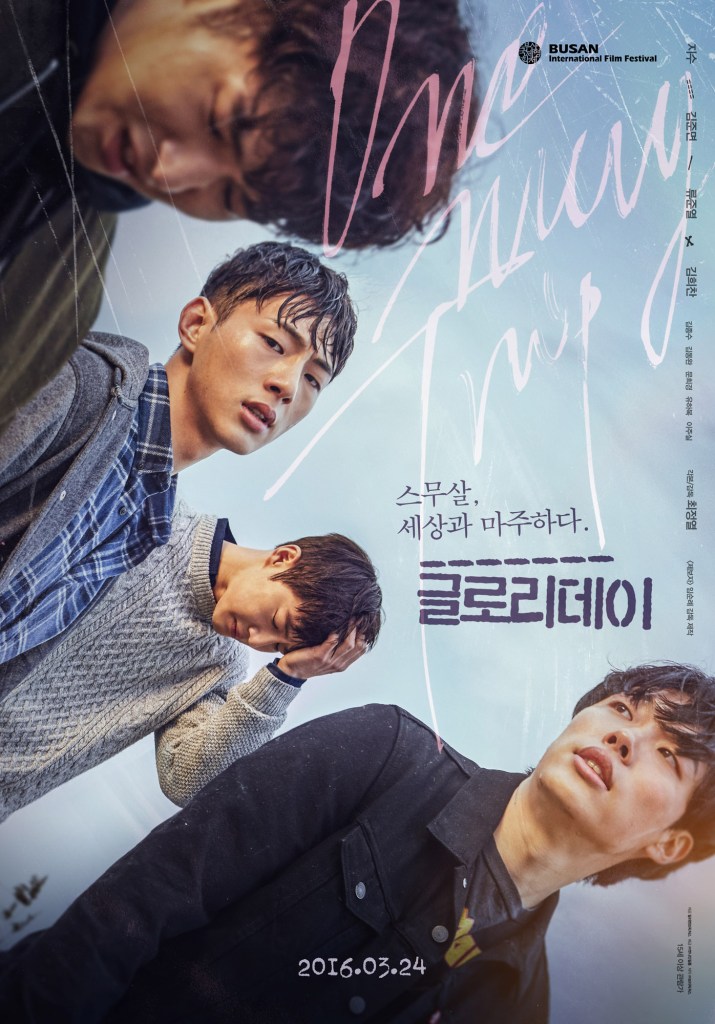
One Way Trip (글로리데이, Choi Jeong-yeol, 2016)

one-way-trip-poster

Young men just trying to do the right thing often end up losing out in the long run – so it is for the four best friends at the centre of Choi Jeong-yeol’s One Way Trip (글로리데이, AKA Glory Day). Caught right on the liminal divide between adolescence and adulthood, each of the four has a different path set before him, not entirely of their own choosing. De facto leader Young-bi (Ji Soo) seems the most directionless of the four but as the only one with a driving license he’s found an old banger of a van and got the guys together for one last road trip before Sang-woo (Suho) enlists in the military. Joined by city councilman’s son Ji-gong (Ryoo Joon-Yeol) and Doo-man (Kim Hee-Chan), a reluctant baseball player, the boys take off for the last real trip of their adolescent lives.

Things do not go to plan as the opening sequence features the guys furiously running away from the police, more worried about their parents finding out than any more serious consequences, but tragedy strikes when Sang-woo is knocked over in a hit and run accident. With Sang-woo unconscious in the hospital, the remaining three guys find themselves locked up on assault charges which later graduate to murder. How did their peaceful trip turn out like this?

Told largely through flashbacks explaining both the events of that night and the guys’ lives, One Way Trip examines the effect of a traumatic incident on each of the boys as they find their friendship coming under increasing pressure. Hanging around near the harbour, the guys spot a couple having a domestic dispute in a nearby car before the man drags the woman outside and proceeds to accuse her of having an affair whilst becoming increasingly violent. Headstrong Young-bi decides to intervene but goes too far in picking a fight with the guy while the woman gets herself to safety. When the violent husband falls into a nearby boat, the guys get scared and run off but the battered wife has already called the police who wind up chasing them through the town.

Panicking in the police station, distraught Young-bi gets himself into even more trouble sending their case straight up to the detectives. Though originally sympathetic, the police change their tune when it turns out that the woman involved is a high profile TV news reader. In an attempt to protect her reputation, she refuses to back the boys’ story and implicates them in the murder of her husband. The police, not overly interested in the finer details of the case, want a speedy resolution – a desire which is only echoed from further up where head office is getting pressure from the media.

These are all nice, ordinary kids who’ve never been in any kind of trouble before but suddenly they’re being encouraged to turn on each other and engineer the best possible outcome for themselves as individuals. Ji-gong’s mother (Moon Hee-kyung) is a prim woman most worried about what the neighbours will think, not to mention the impact on her husband’s political career. Doo-man’s father (Yoo Ha-bok) is even more panicked than his son and immediately starts making every conceivable kind of fuss at the police station, including attempted bribery. Young-bi, by contrast, has no one to speak for him as the only responsible adult is his older brother (Kim Dong-wan) – his father is already in jail. To the other parents, the answer is obvious, blame it on the no good delinquent their “nice” kid has been lead astray by and forget about the whole thing.

Though these boys are almost men, they have very little control over their own lives which continue to be dictated by parental expectation. Ji-gong’s overbearing mother locks him in the house to try and force him to study while Doo-man’s father ignores his pleas that he can’t stand playing baseball and is sick of the other players’ resentment because they know he’s only on the team because his father put him there. Young-bi has no firm parental input but his feelings about his family circumstances are what lead him to try and help a woman in peril, as well as the reason he loses his temper so quickly. Sang-woo, the most blameless among the boys, has only his grandmother whom he wanted to spare a life of hardship by serving in the military followed by a solid government guaranteed job afterwards.

Fear and external pressures start to work their magic on the three previously innocent guys who thought they were doing something good but have ended up paying the price. Heartbreak and betrayal are the order of the day as money, power, and influence will always win out over justice, goodness and friendship. Injustice is the force that governs the world, Young-bi thought he was doing the right thing by coming to the aid of a woman under attack only for everyone else to tell him he should have just minded his own business and not gotten involved. Bookended scenes of the four guys together having fun on the beach only reinforce the stark contrast between their youthful innocence, naively believing in friendship and the essential goodness of helping others, and their post-trip awakening to the self-centred indifference of the adult world.


Reviewed at the 2016 London Korean Film Festival.

International trailer: