
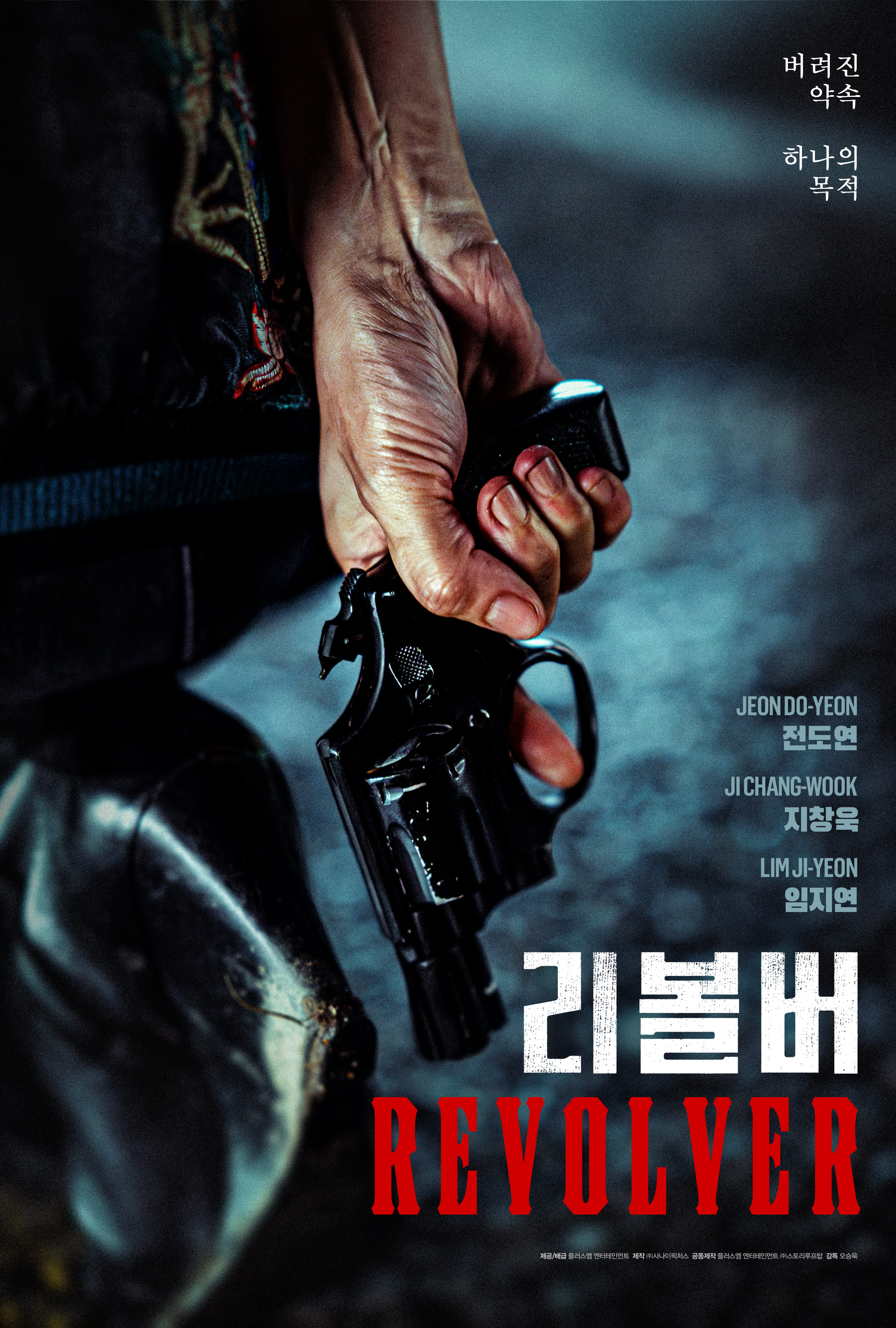
Everyone is always making promises to Su-yeong, but promises don’t count for very much in this world of infinite duplicity. Reuniting director Oh Seung-uk with The Shameless star Jeon Do-yeon, Revolver (리볼버) takes place in a world of corrupt cops and criminal gangs where no one can be trusted and every relationship is transactional. Like the barrel of a revolver, allegiances shift and rotate as Su-yeong attempts to navigate these turbulent waters while well aware that she is completely alone and has only her quest for vengeance and justice to sustain.
It’s by a broken promise that’s she’s been betrayed. After having become lowkey involved in police corruption to help her lover Captain Lim (Lee Jung-jae), former policewoman Su-yeong agreed to take the fall for the squad. They promised her that she’d only lose her job rather than go to prison and that she’d be allowed to keep the apartment she’d just bought, get a 700,000-dollar payout, and a new job working for Eastern Promises security division. Only in the police station does she realise she’s been tricked as they slap a drug trafficking charge on her and hand down a two-year sentence. Predictably, once she gets out, no one’s there to meet her except a gloating prosecutor and a random woman she’s never met before, Yoon-sun (Lim Ji-yeon), who says she was a friend of Lim’s. He’s since been found dead in a suspected suicide, though that matters less to Su-yeong than the fact he gifted her apartment to someone else and has since died in mysterious circumstances.
The funny thing is that Yoon-sun, who is working both with corrupt cop Dong-ho (Kim Jun-han) and the gang led by Grace (Jeon Hye-jin), actually has some sympathy with Su-yeong and disproves of the way she’s been treated. After all, they could have just paid her her money like they said they would. Well used to navigating these waters, Yoon-sun appears to be playing her own game and keeping her options open yet it seems genuine when she tries to help Su-yeong which isn’t to say she wouldn’t betray her if she absolutely had to but right now she doesn’t. There is something quite poignant about the sense of female solidarity that arises between them, even though they are romantic rivals, as women who’ve both been let down by this patriarchal society. Su-yeong is rightly fed up with it and she’s going to get her money and her apartment no matter what if only to make sure they don’t win. Yoon-sun has chosen complicity as her chosen means of survival, but may be silently rooting for Su-yeon to break the both of them out of this repressive system.
To that extent it’s ironic that the former detective’s main weapon is a retractable baton, as if she were trying to enact justice though she herself is a compromised figure having at least been on the fringes of the corruption if perhaps not at the heart of it. Then again, all of the police appear to be corrupt so perhaps it’s more that she’s no better than the world that surrounds her and well aware that promises mean nothing and no one can be trusted. Lim seemingly broke a number of promises to her but may have tried to make it right in the end, while she’s also the victim of a vendetta by grudge-bearing cop Dong-ho (Kim Jun-han) whose romantic overtures she once turned down leaving him with a desire to destroy her completely. Top bad guy Andy (Andy) also appears to be a figure of compromised masculinity, playing the rabid dog but having no other backing than his ambiguous relationship with Grace who may have offed a female rival to solidify her grasp over the criminal enterprise. Violently beaten by Su-yeong, he too vows revenge to reclaim his masculinity but is ill equipped to achieve it.
Despite being disregarded as not a proper detective, Su-yeong patiently follows all the clues and plays a long game to track down the source of all her misery while really her dreams had been small, owning a nice apartment and sharing it with Lim. On her release from prison, she tells the guard that her parents are dead and she has no friends or relatives signalling her aloneness in a vast world of betrayal but also her resilience and refusal to back down in her ironic fight for “justice” which is simply making sure those who’ve wronged her honour their promises and she gets what she’s owed. The occasional bouts of dark humour such as the absurdity of the final confrontation scene lend a touch of surreality to Oh’s purgatorial world of constant mistrust. “Live as if you were already dead,” a defeated Andy ineffectually screams as he vows vengeance and insists Su-yeong hasn’t heard the last of this. But Su-yeong has been living like she’s dead all along and now, finally, might be alive once again.
Revolver is available digitally in the US courtesy of Well Go USA.
International trailer (English subtitles)
 In a time of crisis, the populace looks to the government to take action and save the innocent from danger. A government, however, is often forced to consider the problem from a different angle – not simply saving lives but how their success or failure, decision-making process, and ability to handle the situation will be viewed by the electorate the next time they are asked who best deserves their faith and respect. Pandora (판도라) arrives at a time of particularly strained relations between the state and its people during which faith in the ruling elite is at an all time low following a tragic disaster badly mishandled and seemingly aided by the government’s failure to ensure public safety. Faced with an encroaching nuclear disaster to which their own failure to heed the warnings has played no small part, Pandora’s officials are left in a difficult position tasked with the dilemma of sacrificing a small town to save a nation or accepting their responsibility to their citizens as named individuals. Unsurprisingly, they are far from united in their final decision.
 Windows on Worlds