Cobweb (거미집, Kim Jee-woon, 2023)

An insecure filmmaker becomes entangled within the movie in his mind in Kim Jee-woon’s homage to golden age Korean cinema, Cobweb (거미집, Geomijip). The film has caused some controversy with the family of director Kim Ki-Young attempting to file an injunction to prevent its release complaining that it shows him in a bad light, which is one reason earlier prints of the film listed the protagonist’s name as “Kim Ki-yeol” while it has now been changed to simply “Kim Yeol”. Kim Jee-woon argues that the character is not intended to represent Kim Ki-Young but is an amalgam of various directors of that time, yet it is true that his filmmaking has more than a little in common with that of the late director of The Housemaid.

Another reason they may have been upset is that the film turns on a tragic studio fire that cost the life of a director while Kim Ki-Young himself really did die in a house fire though 20 years later at the age of 78. Meanwhile, the director who dies in the studio is clearly modelled on Shin Sang-ok. The actor who plays him (Jung Woo-sung) is styled to look exactly like Shin who often appeared wearing sunglasses. The film’s Shin Sang-ho (Song Kang-ho) is an example of an artist who gave all of himself for his art and then was quite literally consumed by it, stepping into the flames to get the perfect shot while burning with artistic passion. 

Kim Yeol (Song Kang-ho) by contrast can only watch. He’s hassled by some film critics in a diner who call him a “trash” director while suggesting that only his debut was any good and that was probably because it was Shin Sang-ho’s script though Kim Yeol is forever telling everyone that he really did write it himself. They ask him if he is still a servant in Shin’s house, a question that deeply wounds him not least because he has become the inheritor of Shin’s production company but struggles to emerge from his shadow. 

These themes of servitude and oppressive hierarchies are expressed through the film that Kim Yeol is making, itself titled Cobweb, which he has a sudden urge to reshoot in order to make it a “masterpiece” and prove that he is more than just a hack director of “trashy” genre films. The problem is that in the authoritarian 70s in which the film takes place, Korean cinema was constrained by an ever tightening censorship regime which prohibited any criticism of the government and required that films push conservative moral messages. Kim Yeol wants to take his conventional melodrama in which a young woman takes her own life in sacrifice for her family, and turn it into a story about a “modern woman” who refuses to do so. The wife, Mi-ja (Im Soo-jung), will now be a woman plotting a slow-burn revenge against the wealthy family who callously cast out her pregnant mother who had been their maid eventually teaming up with a Housemaid-esque factory girl who had given birth to her husband’s child, along with a former servant turned forest-dwelling hunter. 

Getting that past the censors might be difficult, even if they weren’t already on high alert after finding out about Kim Yeol’s unauthorised changes to the script which had already been passed. Kim Yeol is confident he can get it all shot within two days, but his cast aren’t very happy about being brought back or about the new direction of the film. “Why is it all so corny and overblown?” an exasperated veteran actress sighs unconvinced by Kim Yeol’s “vision”. Fiction and reality are increasingly blurred. The leading man really is having an affair with the woman who plays the factory girl who is secretly pregnant, a huge scandal in the waiting in the stringent 70s society where adultery is a criminal offence. A method acting policeman claims he has a prison cell in his home and spies on the illicit couple in noir fashion making little notes in his notebook. Kim Yeol meanwhile is so wrapped up in the film that he answers the phone on set rather than the one on the lot which is actually ringing. At a climatic real life moment, it’s the music cue from the melodrama which finally breaks in.

There’s a striking contrast between the full colour set design as we see it and the way it appears in the high contrast black and white of the film within the film which is full of gothic touches such as driving rain and thunderstorms not to mention film noir lighting and eerie composition. Kim Jee-woon includes a series of homages to golden age directors from the obvious nods to The Housemaid to echoes of The Devils Stairway while director Lee Man-Hee gets a name check as, perhaps ironically, a more established figure whom Kim Yeol fears his AD will leave him for.

Lee Man-Hee also had a fair amount of trouble with the censors and was actually arrested for breaking the National Security Law due to his overly sympathetic depiction of North Korean soldiers. In an attempt to get the censors off his back, Kim Yeol lies that the film is “anti-communist” while the head of the censor’s board relents because he’s just so excited about seeing North Korean spies get burned to death in Kim Yeol’s incendiary long shot. In a running gag, no one but Kim Yeol really understands the ending of the film though calling it anti-communist might be a stretch even if it might satisfy the censor’s moral concerns. In any case it remains uncertain if Kim Yeol, who has a hallucination of Shin Sang-ho giving him a fiery pep talk while hopped up on anxiety mediicine that might be destabilising his sense of reality, is really happy with his work and has finally managed to overcome his insecurity or is still entangled in Shin’s web and in the end slowly consumed by it.


Cobweb screens 13/14th October as part of this year’s BFI London Film Festival.

International trailer (English subtitles)
The Foul King (반칙왕, Kim Jee-woon, 2000)

A dejected office worker seeks release from a mundane life of constant degradation as a masked wrestler but finds himself ultimately unable to escape the headlock of the corporate society in Kim Jee-woon’s pro wrestling farce The Foul King (반칙왕, Banchikwang). As the title may suggest, you might have to play a little dirty in order to claw back some dignity but then perhaps everyone’s struggling to free themselves from something be it old debts, middle-aged disappointment, or complicity with the dubious business practices of turn of the century capitalism. 

Even before he enters the ring, Dae-ho (Song Kang-ho) is wrestling, fighting his way onto and out of a packed rush hour train only to arrive at work a few minutes late to be given a passive aggressive dressing down from his boss (Song Young-chang) during the morning pep talk. His boss then in absurd fashion corners him in the gents and places him in a headlock while telling him off some more just to ram the message home. Poor Dae-ho finds this so humiliating that all he really thinks of is a short term solution of learning how to evade his boss’ control while mooning over his attractive desk mate Miss Jo and further berating himself for being too shy to ask her out. His other problem is that he’s not very good at his job as a low-level bank cashier. He and his work friend Doo-sik (Jung Woong-in) are bottom in the office rankings for failing to secure any new accounts.

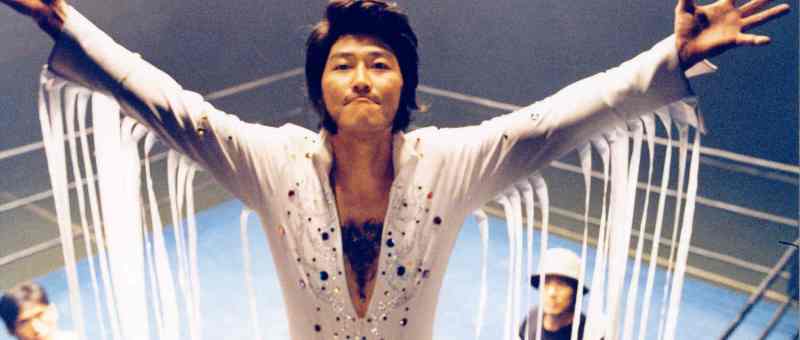
Trapped between his abusive boss and dismissive father (Shin Goo) with whom he still lives, Dae-ho finds himself both emasculated and infantilised while continuing to indulge childhood fantasies drifting off into a dream sequence in which he is Elvis in the wrestling ring trying to impress Miss Jo but still defeated by his giant bug of a boss. He first turns to a friend who teaches Taekwondo to children but he tells him Taekwondo is a “mental discipline” while a real martial artist would never end up in a headlock anyway. But then as if by magic he wanders past a moribund wrestling gym and ventures inside only for the coach, Jang (Jang Jin-young), to throw him out for being a bit odd. Threatened by a gangster into training up a comic relief character specialising in cheating to bolster the profile of another wrestler, Yubiho (Kim Su-ro), hoping to drum up publicity for a Japan tour, Jang relents remembering Dae-ho’s manic rank about his love for classic heel Ultra Tiger Mask as seen on TV decades earlier. 

Being a heel is not quite what Dae-ho had in mind, after all what he wants is to figure out how to escape a headlock yet he finds himself bizarrely in his element if a little clumsily rejoicing in moustache twirling villainy, cartoonish pranks, and comic pratfalls. He begins to grow in confidence but also overreaches, managing to teach a gang of youths (amusingly standing under a huge mural ironically reading “Korea! Fighting!”) a lesson and redeeming his sense of masculine pride after a defeat while making a total drunken fool of himself in his unrequited love for Miss Jo at the office karaoke party once again getting pummelled by his boss. While Dae-ho turns to wrestling in search of freedom and personal fulfilment, Doo-sik tries to regain his self-respect by doing the right thing refusing to be a part of his boss’ obviously dodgy business practices while threatening to blow the whistle if like Dae-ho perhaps realising that there is no way to beat this system while remaining inside it. 

Dae-ho discovers that he gains confidence by putting on a mask, specially the Ultra Tiger Mask worn by his childhood hero, while “winning” in the ring through “cheating” getting audience laughs with zany cartoon stunts. Only when the mask is torn by an unnecessarily aggressive Yubiho does he enter full on rage mode attempting to take revenge for his constant belittlement by ignoring the script to teach Yubiho a lesson as the pair of them brawl all over the stadium making weapons of random chairs and even at one point the session bell itself. Yet in a real sense Dae-ho never really achieves much of anything, scoring a symbolic victory in provoking a tie but never figuring out how to escape the corporate headlock while continuing to be bullied by his boss, rendered entirely powerless within the hierarchal corporatised society of early 2000s Korea. A darkly comic take on existential futility, Foul King meditates on the compromises inherent in playing the game Dae-ho ironically finding confidence in wilful humiliation as a dishonourable heel while unable to escape his constant degradation wrestling for agency within the confines of his regular office worker life. 


The Foul King streams in Poland until Nov. 29 as part of the 15th Five Flavours Film Festival.

Trailer (English subtitles)

A Bittersweet Life (달콤한 인생, Kim Jee-woon, 2005)

bitterweet life posterAs Boss Kang (Kim Young-chul) tells the hero of Kim Jee-woon’s A Bittersweet Life (달콤한 인생, Dalkomhan Insaeng), no matter how well things are going, it only takes one mistake to make it all float away. Like any good film noir, the forces which conspire to ruin the quiet, orderly life of cooler than thou gangster Sun-woo (Lee Byung-hun) are those of desire as they come in conflict with codes of loyalty and decency. Sun-woo, like many a lonely hitman before him, finally wakes up to the emptiness of his life only to find no point of escape except the one he has often provided for others in precisely the same situation.

Smartly suited, Sun-woo is the trusted manager of the casino bar, Dolce Vita. Taken away from his elegant dessert in the upstairs restaurant, Sun-woo deals with a group of rowdy customers in true gangster fashion by launching in with a series of jump kicks and quickly thrown punches that reveal just why it is Sun-woo rules the roost. Sun-woo’s boss, Kang, has a special mission for his most trusted minion – keep an eye on his much younger girlfriend, Hee-soo (Shin Min-a), while he travels to Shanghai for three days. Kang thinks Hee-soo is having an affair. If she is, Sun-woo’s options are either to call Kang right away or take affirmative action on his own initiative.

Sun-woo investigates, but much to his surprise finds himself taken with Hee-soo. She is indeed having an affair, something which Sun-woo tries to ignore but finally has to be dealt with. A sudden pang of sympathy stops him from contacting Kang or pulling the trigger. Instead he decides to let the pair go on the condition they never see each other again. Thinking it’s all behind him, Sun-woo tries to go back to his regular job but he’s still dealing with the fallout from playing whistleblower on a high ranking gangster’s son.

Kim opens with an arty black and white sequence of tree branches swaying. In the story offered in voice over a disciple asks whether it is the trees or the wind which are moving, but the master replies that is is neither – it is the heart and mind which move. Like the branches, Sun-woo’s heart has begun to stir. Not love exactly, or lust, but movement. Sun-woo gazes at the way Hee-soo’s hair brushes her shoulder, at the way she walks and smiles at him. Listening to her cello rehearsal, his own emotional symphony begins, dangerously unbalancing his previously one-note existence with its identical suits and minimalist apartments.

Yet if Sun-woo’s downfall is Hee-soo and her alluring vitality, it was Kang’s first. An ageing gangster, Kang feels foolish taking up with a young girl but just can’t help himself. He loves the way Hee-soo couldn’t care less about what other people think, but that also worries him because she’ll never care what he thinks. Kang’s childishly romantic gift of a kitschy lamp with two owls huddling together on the base is the perfect symbol of his misplaced hopes – oddly innocent yet ultimately redundant. Notably, the lamp is one of many things shattered when Sun-woo takes Hee-soo’s lover to task.

Realising he has been betrayed, though not quite for the reasons he thinks, Sun-woo vows revenge. Everything has gone wrong, and he no longer believes in any kind of future which has him in it. Pausing only to send a more mature romantic gift to Hee-soo, an elegant lamp she’d admired on one of their shopping trips, he marches off towards certain death no longer caring for own life in his quest for vengeance and retribution. Repeating Kang’s questions back to him, asking for the real reason any of this happened, doesn’t get him very far but even if these two men have shared the same folly, they fail to understand each other even in death.

Returning to the master and his pupil, the closing coda recounts another story in which the pupil wakes up from a dream, weeping. The master asks him if he’s had a nightmare but the pupil says no, he’s had the sweetest of dreams. He’s crying because he’s awake and knows his dream can never come true. Sun-woo too has woken up, he knows there’s nothing for him now except to accept his fate. He has but been asleep, dreaming a sweet dream, and now he must wake and taste life’s bitterness just as he prepares to leave it.


Screened at London Korean Film Festival 2017.

Original trailer (English subtitles)

The Age of Shadows (밀정, Kim Jee-woon, 2016)

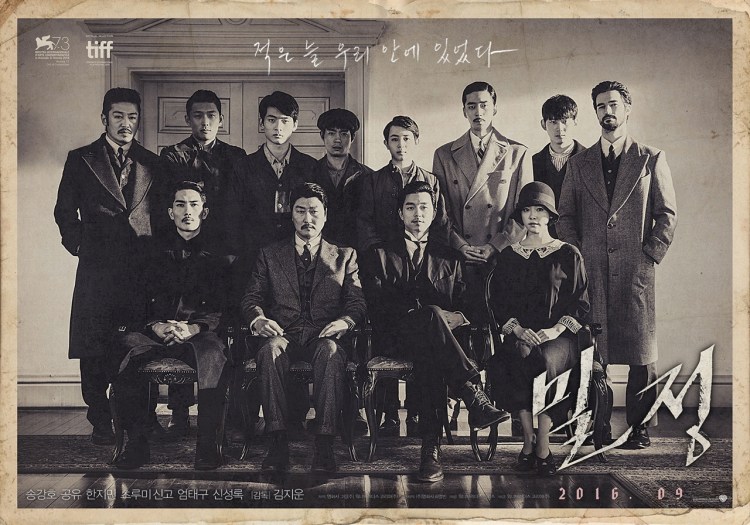
age-of-shadowsWhen the country of your birth has been occupied by another nation, what do you do? Do you fight back, insist on your independence and expel the tyrants, or quickly bow to your new overlords and resign yourself to no longer being what you once were? Kim Jee-woon becomes the latest director to take a look at Korea’s colonial past with the Resistance based thriller Age of Shadows (밀정, Miljung) which owes more than a little to Melville’s similarly titled Army of Shadows, as well as classic cold war spy dramas The Third Man and The Spy Who Came in From the Cold.

The film opens with an impressive set piece in which two Resistance members, Jang-ok (Park Hee-soon), and Joo (Seo Young-joo) are betrayed whilst trying to sell a Buddhist statue. Joo is captured but Jang-ok makes a run for it as what looks like the entire Japanese garrison of Seoul chases him, running gallantly over the picturesque Korean rooftops. Cornered, Jang-ok is confronted by Korean born Japanese policeman Jung-chool (Song Kang-ho), once a Resistance member himself and a former comrade in arms of Jang-ok. This is the point Jung-chool’s carefully crafted collaboration beings to fracture – his friend, rather than allow himelf to be captured, shouts “Long Live Korea” and blows his own brains out.

His mission a failure, Jung-chool is then moved onto the next investigation which aims to dig out the Resistance top brass in the city. Jung-chool’s Japanese boss Higashi (Shingo Tsurumi) wants him to infiltrate the cell headed by antique dealer and photographer Woo-jin (Gong Yoo) in the hope that it will lead them to head honcho, Jung (Lee Byung-hun). However, Higashi also saddles him with a very young but high ranking Japanese official, Hashimoto (Um Tae-goo), to “help” him bring in Woo-jin.

In Jung-chool’s final conversation with Jang-ok, his friend berates him for the decision to turn traitor and work for the Japanese rather than against them. Jung-chool asks him if he thinks independence is a credible aim, implying he’s long since given up believing in the idea of the Japanese ever being overthrown. Jang-ok evidently believed in it enough to sacrifice his own life, but other comrades have also abanoned the cause and actively betrayed the movement in much more serious ways than Jung-chool’s pragmatic side swapping.

Even if Jung-chool has decided that if you can’t beat the Japanese you may as well join them, he’s coming to the realisation that his superiors, even if they’ve previously treated him warmly, will never regard him as equal to the Japanese personnel. Hashimoto’s sudden arrival undercuts Jung-Chool’s career progress and reminds him that he serves a very distinct purpose which may soon run out of currency. Higashi, having seduced Jung-chool with promises of a comfortable life and praise for his skills, does not trust his Korean underling enough to send him out on his own. This personal wound may do more to send him reeling back to the other side than anything else, especially as his “replacement” Hashimoto is a crazy eyed psychopath who has half a mind to burn the entire city just to be sure of getting his man.

A man who’s been turned once can be turned again and so mastermind Jung decides to prod Jung-chool in the hope that he’ll become an asset rather than a threat. As he puts it, what’s more frightening than feeling your heart move and Jung-chool’s certainty has already been shaken. Song Kang-ho perfectly inhabits Jung-chool’s conflicted soul as his old patriotic feelings start to surface just as he begins to truly see his masters for what they are. Always keeping his intentions unclear, Jung-chool is the ideal double agent, playing both sides or maybe neither with no clear affiliation.

Like Army of Shadows, the final nail in the coffin is delivered by a sentimental photograph. In this chaotic world of betrayals and counter betrayals, there can be no room for love or compassion other than loyalty to one’s comrades and to the movement. Yet against the odds Woo-jin comes to trust Jung-chool implicitly, certain that he will finally choose the side of freedom rather than that of the oppressor. The relationship between the two men provides the only real moments of comic relief, though others members of the group are less well defined including an underwritten part for Woo-jin’s Chinese love interest (Han Ji-min) who isn’t permitted to do very much other than model some elegant twenties outfits.

Maintaining tension throughout, Kim intersperses psychological drama as betrayal piles on betrayal, with intense action sequences including a particularly claustrophobic train based game of hide and seek. Inspired by real historical events, Kim does not claim any level of authenticity but sets out to tell the story of the double dealing inside a man’s heart as he weighs up duty and self interest and asks himself how far he’s willing to go for the sake of either. The age of “shadows” indeed, these are hollow men whose identities have been eroded, living only for today but in certainty of the bright tomorrow. Kim’s examination of this turbulent period is both a big budget prestige picture with striking production values, and a tense, noir-inflected thriller in the mould of Melville, but also a nuanced human drama unafraid to ask the difficult questions which lie at the heart of every spy story.


Reviewed at the 2016 London East Asia Film Festival.

Original trailer (English subtitles)