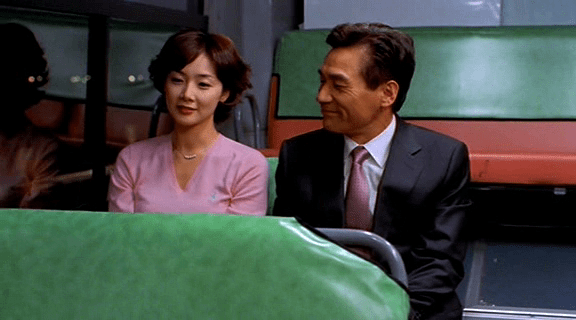
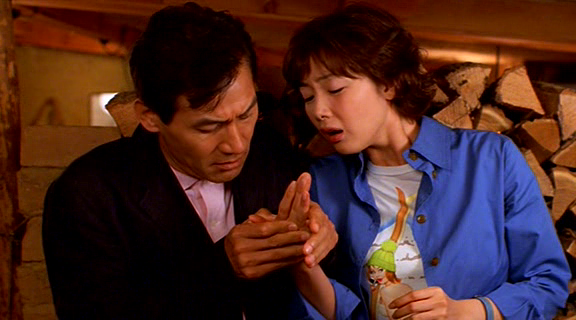
The Romantic President (피아노 치는 대통령, Jeon Man-bae, 2002)

A pure-hearted politician finds himself falling for an uncompromising teacher in Jeon Man-bae’s nonsense comedy Romantic President (피아노 치는 대통령, Piano chineun daetongnyeong). This president is indeed “romantic” in the sense that he is an idealised vision of a political leader. The film doesn’t go into his politics at all and it’s ambiguous where he belongs on the political divide. Instead, he is depicted as a man of integrity who is good and kind. In short, the kind of political leader that might not really exist in real life.

Min-wook (Ahn Sung-ki) first appears in disguise having gone undercover to talk to a group of homeless people living at the station. While talking to them, he himself is harassed by a policeman overstepping the bounds of his authority. The policeman calls the men “trash” and says that they disgust ordinary people. Little knowing who he is, the policeman bullies Min-wook who then identifies himself by striking the same pose as on as his campaign photo.

Something similar happens later when Min-wook decides to take a day driving a taxi in order to get closer to the people he is supposed to be serving. All of which marks him out as someone who is genuinely interested in the lives of the electorate and how to make them better. Though references are made to other political scandals, Min-wook seems to be held to a different standard and is a figure of integrity and incorruptibility. This is, however, why his romance is so dangerous in that It complicates his image and the secrecy involved because of his position makes it seem like he’s done something wrong or that there is an illicit quality to his relationship with schoolteacher Eun-soo (Choi Ji-woo). However, at the film’s conclusion, Min-wook admits that the “piano-playing president” was a persona he constructed for the purpose of winning the election, which is to say inauthentic. He has been lying all along, but his romance with Eun-soo has made it impossible for him to continue with the subterfuge. Only by being his true self can he gain romantic fulfilment even if it comes at the cost of his political career.

For her part, Eun-soo may also be harbouring a secret that paints her as something of a political rebel and possible extremist. She has failed to keep a job for more than six months because of her eccentric behaviour and intense interest in teaching in which, like Min-wook, she is invested in her pupils lives and wants to do what she can to make them better. On arrival at her new school she poses as a pupil to find out the class gossip and then becomes determined to save Young-hee (Im Soo-jung) who has become a delinquent little knowing she is the president’s daughter. No one else is willing to go against the Blue House with the consequence that Young-hee has become drunk on power, rebelling in the hope that someone will push back. Eun-soo is that person and soon earns Young-hee’s trust precisely because of the genuine interest she takes in her that is undaunted by her father’s position.

Young-hee too responds to authenticity and gradually becomes more authentic herself through her interactions with Eun-soo. Nevertheless, at the same time, the film suggests that society remains judgemental and is not always prepared to recognise an individual’s authentic identity. Eun-soo’s roommate is a transwoman who is repeatedly deadnamed and then eventually outed by the invasive press when Eun-soo’s relationship with Min-wook is exposed. Nevertheless, Eun-soo strives to protect her friend while accepting that she may have to deny her feelings to protect Min-wook’s position.

Despite all the silliness and zany antics, the film has a degree of earnestness at its heart in which it believes that it shouldn’t be wrong to express one’s true feelings. Authority figures can fall in love too, and it’s better for everyone if they do, otherwise you end up with the toxic combination of power and unhappiness that causes the policeman to abuse his authority to bully the homeless. Even so, the irony is that on becoming Min-wook’s official partner, Eun-soo must again play another role, radically altering her appearance to conform to the image of the president’s wife. Nevertheless, once authentically embraced, their love is accepted by the wider society which is then itself improved as a result.


Trailer (English subtitles)

Cobweb (거미집, Kim Jee-woon, 2023)

An insecure filmmaker becomes entangled within the movie in his mind in Kim Jee-woon’s homage to golden age Korean cinema, Cobweb (거미집, Geomijip). The film has caused some controversy with the family of director Kim Ki-Young attempting to file an injunction to prevent its release complaining that it shows him in a bad light, which is one reason earlier prints of the film listed the protagonist’s name as “Kim Ki-yeol” while it has now been changed to simply “Kim Yeol”. Kim Jee-woon argues that the character is not intended to represent Kim Ki-Young but is an amalgam of various directors of that time, yet it is true that his filmmaking has more than a little in common with that of the late director of The Housemaid.

Another reason they may have been upset is that the film turns on a tragic studio fire that cost the life of a director while Kim Ki-Young himself really did die in a house fire though 20 years later at the age of 78. Meanwhile, the director who dies in the studio is clearly modelled on Shin Sang-ok. The actor who plays him (Jung Woo-sung) is styled to look exactly like Shin who often appeared wearing sunglasses. The film’s Shin Sang-ho (Song Kang-ho) is an example of an artist who gave all of himself for his art and then was quite literally consumed by it, stepping into the flames to get the perfect shot while burning with artistic passion. 

Kim Yeol (Song Kang-ho) by contrast can only watch. He’s hassled by some film critics in a diner who call him a “trash” director while suggesting that only his debut was any good and that was probably because it was Shin Sang-ho’s script though Kim Yeol is forever telling everyone that he really did write it himself. They ask him if he is still a servant in Shin’s house, a question that deeply wounds him not least because he has become the inheritor of Shin’s production company but struggles to emerge from his shadow. 

These themes of servitude and oppressive hierarchies are expressed through the film that Kim Yeol is making, itself titled Cobweb, which he has a sudden urge to reshoot in order to make it a “masterpiece” and prove that he is more than just a hack director of “trashy” genre films. The problem is that in the authoritarian 70s in which the film takes place, Korean cinema was constrained by an ever tightening censorship regime which prohibited any criticism of the government and required that films push conservative moral messages. Kim Yeol wants to take his conventional melodrama in which a young woman takes her own life in sacrifice for her family, and turn it into a story about a “modern woman” who refuses to do so. The wife, Mi-ja (Im Soo-jung), will now be a woman plotting a slow-burn revenge against the wealthy family who callously cast out her pregnant mother who had been their maid eventually teaming up with a Housemaid-esque factory girl who had given birth to her husband’s child, along with a former servant turned forest-dwelling hunter. 

Getting that past the censors might be difficult, even if they weren’t already on high alert after finding out about Kim Yeol’s unauthorised changes to the script which had already been passed. Kim Yeol is confident he can get it all shot within two days, but his cast aren’t very happy about being brought back or about the new direction of the film. “Why is it all so corny and overblown?” an exasperated veteran actress sighs unconvinced by Kim Yeol’s “vision”. Fiction and reality are increasingly blurred. The leading man really is having an affair with the woman who plays the factory girl who is secretly pregnant, a huge scandal in the waiting in the stringent 70s society where adultery is a criminal offence. A method acting policeman claims he has a prison cell in his home and spies on the illicit couple in noir fashion making little notes in his notebook. Kim Yeol meanwhile is so wrapped up in the film that he answers the phone on set rather than the one on the lot which is actually ringing. At a climatic real life moment, it’s the music cue from the melodrama which finally breaks in.

There’s a striking contrast between the full colour set design as we see it and the way it appears in the high contrast black and white of the film within the film which is full of gothic touches such as driving rain and thunderstorms not to mention film noir lighting and eerie composition. Kim Jee-woon includes a series of homages to golden age directors from the obvious nods to The Housemaid to echoes of The Devils Stairway while director Lee Man-Hee gets a name check as, perhaps ironically, a more established figure whom Kim Yeol fears his AD will leave him for.

Lee Man-Hee also had a fair amount of trouble with the censors and was actually arrested for breaking the National Security Law due to his overly sympathetic depiction of North Korean soldiers. In an attempt to get the censors off his back, Kim Yeol lies that the film is “anti-communist” while the head of the censor’s board relents because he’s just so excited about seeing North Korean spies get burned to death in Kim Yeol’s incendiary long shot. In a running gag, no one but Kim Yeol really understands the ending of the film though calling it anti-communist might be a stretch even if it might satisfy the censor’s moral concerns. In any case it remains uncertain if Kim Yeol, who has a hallucination of Shin Sang-ho giving him a fiery pep talk while hopped up on anxiety mediicine that might be destabilising his sense of reality, is really happy with his work and has finally managed to overcome his insecurity or is still entangled in Shin’s web and in the end slowly consumed by it.


Cobweb screens 13/14th October as part of this year’s BFI London Film Festival.

International trailer (English subtitles)